What is the main function of overload switch ?
I removed the switch and i have no different in the gear ( every thing normal
) ?
I removed the switch and i have no different in the gear ( every thing normal
Follow along with the video below to see how to install our site as a web app on your home screen.
Note: This feature may not be available in some browsers.
What is the main function of overload switch ?
I removed the switch and i have no different in the gear ( every thing normal) ?

If I told you I had harsh downshifting into 2nd, but 2-3 seems fine.
M

If the switch is disconnected or not working properly, the full-throttle shifts are affected (delay / hang). There is no change at part throttle, but the WOT shifts will not be correct until you fix it. The switch is cheap and easy to replace, if it's defective, just change it.
Anyone who doesn't believe me - go unplug the switch and then do a bunch of WOT runs, pay attention to how the upshift occurs. Now reconnect the switch and repeat. Trust me, the switch MUST be functioning for optimal performance.
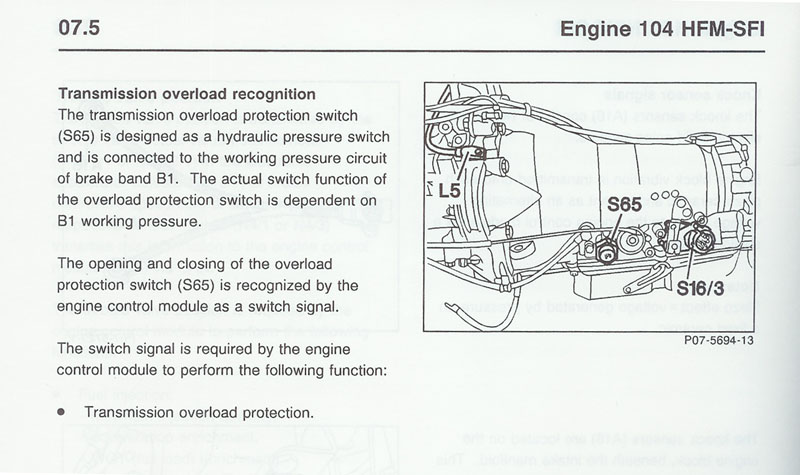
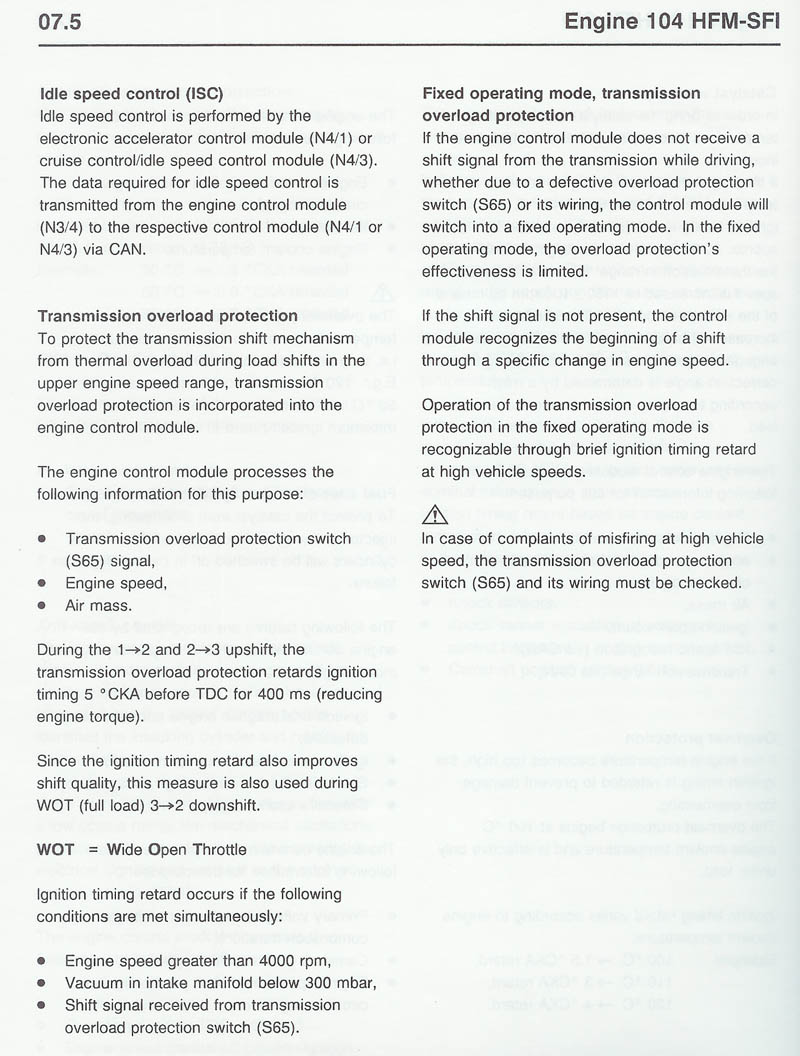
M104 FSM shown below, M119 is essentially the same:
![]()
![]()


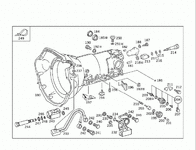
Can somebody explain to me what is the part that is located underneath the overload protection switch? In the picture the number is 232. Is connected to the wire. In my 500E noticed that part but not in others 500E
![]()
Your 500E transmission should look like the photo below. There should not be anything on your transmission that isn't on everyone else's 500E transmission.Can somebody explain to me what is the part that is located underneath the overload protection switch? In the picture the number is 232. Is connected to the wire. In my 500E noticed that part but not in others 500E

Interesting. The 129.066 has a different transmission, so it could have different external components. I've never heard of any 124.036 (or .034) having the item specified in post #7...I've seen that set up on early R129 500SL though

Can somebody explain to me what is the part that is located underneath the overload protection switch? In the picture the number is 232. Is connected to the wire. In my 500E noticed that part but not in others 500E
![]()
Transmission overload protection switch S65 - Removal, replacement info | Transmission and Driveline <--- part number is here.Im experiencing hanging/stumbling at WOT upshifts. This thread seems to indicate my overload protection switch may be bad (95 E420).
Does anyone know the part number for that switch?
VIN?Im experiencing hanging/stumbling at WOT upshifts. This thread seems to indicate my overload protection switch may be bad (95 E420).
Does anyone know the part number for that switch?
WDBEA34E9SC158976VIN?
Dan
@Klink Do you know how the EZL knows if the the shift is 1-2 or 3-2 as opposed to 3-4 or 4-3? The EZL sees the RPM change, and pulls timing until it sees second gear fully engage. Presumably it should not be doing the same when shifting into 3rd since there is no overload switch for 3rd gear, so I'm wondering how the EZL knows the shift is into 2nd, and whether it will also pull timing in 3rd. My 400E is misbehaving on 4-3 shifts and throwing an overload switch code. I've replaced the switch and verified it is indeed working in 2nd as it should. Just trying to understand the function of the overload switch a little better so I can try to solve this.Re: overload switch ?
That's not surprising, as that switch actually has no function the vast majority of the time. The switch function becomes significant during full throttle up shifts and down shifts into second gear.
To limit the load applied to the number one transmission band and provide smoothness, the ignition control unit applies a deep but brief timing retard during extremely high load 1-2 up shifts and 3-2 downshifts. This results in an engine torque reduction that results in a faster and smoother shift into second gear, along with less thermal and mechanical load on the number one brake band. This timing retard is applied just as the ignition control unit "senses" the RPM change as the shift commences. The timing retard is removed the instant that pressure is built up inside that switch.
Note that during these two shifts, the number one brake band is restraining the movement of the number one clutch drum. The switch responds to pressure build up in the spring-loaded retaining member of the transmission band. That build up of pressure occurs just as the rotation of the number one clutch drum ceases. In that manner, the switch signals to the ignition control unit that the shift into second gear has fully completed, and in response to that signal, the ignition control unit releases the timing retard.
Contrary to some peoples imaginings, eliminating the switch from the circuit does not result in a performance gain during those shifts. Note that the switch does not produce the timing retard, it only limits the period of the timing retard. The ignition controller ALWAYS provides the timing retard during those shift points if they occur at an extremely high load (essentially, full throttle). Without the change in state of the switch being available as a signal, the ignition control unit simply applies an extremely long period of timing retard lasting well past any possible time required for the mechanical shift event to take place. Note also that jumping the switch to "lie" to the control unit produces the same effect. The logic of the control unit recognizes implausible states and reacts accordingly, again with a long duration timing retard...
![]()