• Hi Guest !

    Welcome to the 500Eboard forum.

    Since its founding in late 2008, 500Eboard has become the leading resource on the Internet for all things related to the Mercedes-Benz 500E and E500. In recent years, we have also expanded to include the 400E and E420 models, which are directly related to the 500E/E500.

    We invite you to browse and take advantage of the information and resources here on the site. If you find helpful information, please register for full membership, and you'll find even more resources available. Feel free to ask questions, and make liberal use of the "Search" function to find answers.

    We hope you will become an active contributor to the community!

    Sincerely,
    500Eboard Management

Front Wheel Bearing Part Numbers

emerydc8

E500E **Meister**
Member
I'm trying to figure out which part to order for my 1995 E420 front wheel bearing kit.

The epc says the kit is 129 330 0351, but when I insert that number into autohausaz, it comes back as 129 330 0151. This is an SKF kit for $28.62.

The epc shows the kit for the 500E is 124 330 05 51, but when I insert this into autohausaz, it still comes back with the SKF kit (129 330 0151). Also, the epc shows the individual inner and outer bearings are identical for the E420 and 500E (002 980 1902 inner and 002 980 2002 outer).

What is strange is that when I insert 129 330 0151 (the autohausaz number) into parts.com, it shows a "tapered roller" for $70.80.

Parts.com has the kit (129 330 0351/124 330 05 51) for $70.80 each, but if I can save some with autohausaz and the quality is acceptable, $28.62 sounds a lot better. Anyone?
 
Jon,

Your making this way to hard... I would buy Timken bearings for the 420/500e's. Timken is the best brand in tapered roller bearings and are available at autozone. I think it takes a 12 and a 17. But they can look it up and database is good. You can get them from rockautoparts or other sources. I think the OE for MB right now is NTN, but I'm sure that changes every few years.
You will need the grease seals and if you are a factory type of guy- a tube of the mb wheel bearing grease.
I think it's just a MIL spec grease from Shell.

Michael
 
You can get Timken bearings of the correct size from any AutoZone, Napa, etc. it's a standard industry size for the inner and outer bearings, shared with many Chevy & GM products.

Just be sure to get a name-brand bearing. Like I said, Timken is easy to get.
 
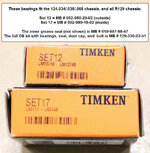
Yeah, but what are the Timken part numbers...? :hornets:

EDIT: Timken part numbers in photo attached below. Additional photos at this link.

wheel_bearings_V8_timken1.jpg
 
Dave.. 12 and 17.

I like timken.... Usually USA or France made. High quality steel. Latrobe 52100
Off brands use 1055 and carberize... Sp
Oe for diff bearings...

Mike
 
Last edited:
The FAG set should be fine. I used the Timkens shown in post #4 above (available from Rock Auto, search for "SET12" etc), but you need to buy everything separately if you go that route.

Make sure to only use the OE MB neon-green grease, and be careful with measuring it out, and also setting the end play with dial gauge. Can't remember if there's a HOW-TO on front wheel bearing replacement. One 150g tube of the MB grease is enough for 1 front axle (2 wheels / 4 bearings). Setting the end play is tricky and generally takes a dozen attempts to get it right at the 0.01-0.02mm spec. Don't forget to bolt the rotors tight to the hub when doing this!

:banana2:

wheel_bearing_grease1.jpg wheel_bearing_grease2.jpg
 
FAG is fine, but I think that the Timken bearings used are even better, and cheaper, and easily available.
 
When changing front bearings, do races absolutely positively need to be replaced? Mine are perfectly smooth with zero scuffing.

Can you recommend a dial (+ stand/mount?) that's needed to adjust bearing play to 0.01-0.02 mm?

Lastly, 0.01 mm is so tiny, I think human hair's thicker... I understand that the bearing's life will be shortened if this little play is not allowed, but are there any other negative effects?

This is a first "major" job that I'm doing myself

Thanks!
 
Last edited:
Relied on FCPeuro's part catalog. At the most responsible moment, found out they don't fit 🤦‍♂️:pissed:🤦‍♂️
Autozone around me doesn't offer Timken. There is Duralast and National. Is National on an approved list?
 
I see the FAG bearings on FCPEuro's site have a p/n starting with a 201 and MBOem has a p/n starting with 129. Am I reading that right?
 
I noticed the llink you have above to ECSTuning has a p/n for the bearings that matches MBOemparts
 
I noticed the llink you have above to ECSTuning has a p/n for the bearings that matches MBOemparts

Your observations are correct. If I'd ordered from ECST, I'd be good. But, I mostly order from mboemparts.com or fcp and FCP's catalog is wrong for this part
 
You can get the Timken bearings at a NAPA parts store, or other local McFlaps type store. Or heck, order the correct TIMKEN size via Amazon.
 
...FCP's catalog is wrong for this part.
Ugh. This is why you never, EVER, trust online part catalogs. From ANY vendor. Get the p/n from the EPC, look up by part number only.

Online catalogs (including MBOEMparts, and any other RevolutionParts dealers) are simply not accurate enough to trust. Some RevParts vendors will double-check your order if you provide the VIN, but this only helps if you are buying parts for 1 vehicle at a time, and the parts ordered are not upgrades - like buying late LCA's for an early car, in which case the vendor may "fix" your "error" and send you the early LCA's you don't want.

:duck:
 
Last edited:
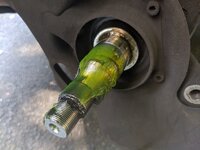
The old bearing on my car that I just removed was Timken which means someone changed it before I acquired the car 5 years ago. Not sure why, but the green grease was all over the spindle, which is not supposed to be the case? Aren't some people just animals?

IMG_20190921_101555.jpg
 
Would this work for play adjustment?
Not really. The magnetic base is perfect, but the dial gauge is only accurate to 0.01", and spec is 0.0004 - 0.0008" (0.01-0.02 mm). Be careful, I saw one listing that showed 0.01mm resolution/graduation, but accuracy was ±0.03 mm!!! You may need to buy the dial gauge separately from the magnetic base.

How much, in your estimation, would bearing's life shorten with zero play?
I don't know. But a couple cars I purchased had zero play when I checked them. Even if it doesn't shorten bearing life substantially, it does cause excess drag, and can reduce MPG and slow a car at the dragstrip up to a tenth / 1 mph. (Don't ask how I know.)


The old bearing on my car that I just removed was Timken which means someone changed it before I acquired the car 5 years ago. Not sure why, but the green grease was all over the spindle, which is not supposed to be the case? Aren't some people just animals?
That's normal. Most of the 45g of grease goes into the center of the hub after packing into the bearings, but you can apply a thin coat to the spindle.
 
Grease spec is 60g total per side (45g for bearings + center of hub, 15g in dust cap):

FSM procedure for adjustment, note the brake disc MUST be bolted to the hub to get an accurate reading from the dial gauge. Also note that while initial spec is 0.01-0.02mm, limit when checking is 0.05mm.


Additional writeup from Easley/Ritter pasted below:


WHEEL BEARING REPLACEMENT TIPS
by George Murphy
Date: Wed, 17 Jan 2001
Richard Easley has LOTS of experience with front wheel bearings . . . Here's a few things to consider:
First, get the MB Chassis manual for your car so you can do the job right. In my experience, the grease should be changed at the 90,000-mile service - I found my OEM grease was getting a little stiff by this mileage. Use MB wheel bearing grease part no 001 989 23 51 10 or a good grade of lithium high temperature bearing grease - Kendall Blue comes to mind. Of course, buy new inner hub seals.
Pull a bearing cap and look at the grease - if it is stiff and wax-like, it is long past time for bearing re-pack. Anyway, I do bearing grease at 90,000 miles interval (third 30,000 mile service) since MB now uses that new green high temp grease in all cars since 1986.
If your bearings are OK, but if the hubs are coming off anyway for rotor change, change bearing grease and install new seals. Thoroughly clean the hub and bearings of ALL old grease. DO NOT SPIN BEARINGS at high speed with air gun to dry them - be gentle with the air. Some mechanics like to have fun by making that high-pitched whine,Ķ. using compressed air to spin and dry out cleaned bearings - it is really hard on the bearings to do that.
Next, pack bearings by hand with MB grease - save all excess - weigh out correct # of grams and pack it into hub IAW the MB chassis manual. There's a reason for the specified grams of grease for the bearings and inside the hub. Too much leads to overheating and too little starves the bearings of grease. The grams specified for inside the hub and the bearings just fills the hub cavity such that centrifugal force during rotation forces the grease outward in both directions to continually pressurize the bearings and keep them lubricated. It has been shown that the grease actually "circulates" inside the hub and through the bearings to keep them lubricated - that's why properly lubricated MB front wheel bearings can last so long, and that is the reason for that 45 grams of grease.
Use the rest of the grease to fill the hubcap. In this manner the inside seal stops the grease from leaving the bearing due to centrifugal force, and the cap, being full of grease, keeps the grease inside the hub/bearing area.
The 150 gram tube of MB grease will do both front wheels - simply follow the MB factory chassis manual procedure. For a 150 gram tube of MB wheel bearing grease, here's how it breaks down: (From Tech Data Manual Section 33) - (All weights are approximate)
124.034 / 124.036 models: total 60 grams - 45 in the hub with bearing; 15 in the hub cap
Be sure to maintain the specified charge. Suitably weigh entire charge prior to starting assembly of front wheel hub. Weigh quantity filled into hub. Fill roller cage of tapered roller bearing well with grease. Also provide roller faces with grease. Fill hub cap approx to beaded rim.
Starting 12/88 all models use 150 gram tube - green grease part no. 001 989 23 51/10 DO NOT MIX GREASE TYPES - unexpected results may occur.
As to setting the free play, certainly the dial gauge method is preferred. Here's how I did it ON A 107 before I bought a dial gauge: (N/A for 126 and those w/o washer)
Re-assemble the washer and adjust nut and tighten it about 25 to 30 Nm while spinning the wheel. Back off the adjust nut just enough so that you can barely rotate the washer behind it by hand - that should be as close as you can do it by feel. Tighten the lock bolt and check that the washer can still be rotated by hand - it should be a little stiff, but movable.
If you replace the bearings and races, you should repeat the above after a few hundred miles to assure that adjustment is correct. I've always had to re-adjust after bearing race change, so plan on doing it anytime you replace bearings and races . . .
Hint: If changing bearings, put the new bearing races in the freezer. Put the hub in the oven at about 250F. Drive out the old races while the hub is hot. After a few hours in the freezer, the races will almost drop into the hub without a driver - but use a wood or plastic driver to assure proper seating of the bearing races.
 
A bearing grease packer is also a useful addition for this task. It is important to properly pack wheel bearings with grease you tube will have videos of proper packing procedure by hand but the tool makes it faster & easier.
I put the neon green grease into a plastic baggie, then insert the bearing, and squish it all around to pack the grease into the bearing. This allows you to still keep the measured amounts in spec, which may be harder if using a packing tool.

:rugby:
 
@gsxr , thank you! I read everything

Just to clarify, green MB grease is used to pack the bearings themselves, then what ever is left of the 45 grams should be used to coat inside of the wheel hub, correct?

I used peachparts "how-to" as well as watched a video on youtube, and there the bearings were packed but no grease was used on the inside of the wheel hub...
 
I put the neon green grease into a plastic baggie, then insert the bearing, and squish it all around to pack the grease into the bearing. This allows you to still keep the measured amounts in spec, which may be harder if using a packing tool.

:rugby:

Unfortunately Dave the baggie method is questionable practice IMO. Bar using a bearing packet tool which are available inexpensively there is a hand packing method that works to ensure the grease fully filled between each needle roller. By pressing grease in through the larger end and seeing it squeeze out at the other end. Like this video:


I dont get too hung up weighing the grease on the bearing itself. The race must be fully packed first, then worry about the QTY of grease in the whole assembly. It is more common for people to fill inside the hub where the grease really does nothing
 
Just to clarify, green MB grease is used to pack the bearings themselves, then what ever is left of the 45 grams should be used to coat inside of the wheel hub, correct?
Correct. The reason is explained in the post above.

I used peachparts "how-to" as well as watched a video on youtube, and there the bearings were packed but no grease was used on the inside of the wheel hub...
Whaa...? That sounds wrong! Grease MUST be present in the hub center. And, there's no other place for the balance of the 45g to be used...

:blink:
 
... there is a hand packing method that works to ensure the grease fully filled between each needle roller. By pressing grease in through the larger end and seeing it squeeze out at the other end.
I basically use the hand-pack method described, but inside the plastic bag. :rugby:


I dont get too hung up weighing the grease on the bearing itself. The race must be fully packed first, then worry about the QTY of grease in the whole assembly.
I weigh the grease using a digital refrigerant scale, and as you said it's important to make sure the race is fully packed. But the amounts are important too, for the reasons described in the Ritter/Easley writeup.

IIRC, Klink has said the 15g in the cap isn't really necessary, but it doesn't hurt either...

:klink:
 
fill inside the hub where the grease really does nothing

I did not see anyone on the web do this, but sounds very reasonable:

The grams specified for inside the hub and the bearings just fills the hub cavity such that centrifugal force during rotation forces the grease outward in both directions to continually pressurize the bearings and keep them lubricated. It has been shown that the grease actually "circulates" inside the hub and through the bearings to keep them lubricated - that's why properly lubricated MB front wheel bearings can last so long, and that is the reason for that 45 grams of grease.
 
I meant to say to say that people more often than not, overfill the centre section where the extra QTY does nothing or puts pressure on the rear seal by having too much grease.

So that's why weighing is important overall and yes Dave I agree that some grease in the cap itself is a good idea.
 
Why use peach parts when we have a perfectly good HOW-TO here?
We did... past-tense.

Lowdude deleted his vid.


:pc1:
 
There’s one in the 126 section that’s also at least partially applicable.

 
I need some help. Trying to adjust bearing with brake rotor mounted and using dial gauge I realized that the two pins (see photo) are not holding the rotor to the wheel hub, only the locking bolt. On the side of the locking bolt rotor sits tight, but there's some lateral play in the rotor on the opposite side. Those two pins fall through freely through the mounting holes on the rotor itself, but do require hammering to go into the wheel hub...

Question: are these pins supposed to fasten the rotor to the wheel hub exactly like the locking bolt (tight, zero play)?
 

Attachments

  • IMG_20190926_170130.jpg
    IMG_20190926_170130.jpg
    3 MB · Views: 4
Last edited:
Question: are these pins supposed to fasten the rotor to the wheel hub exactly like the locking bolt (tight, zero play)?

My understanding is that those pins are just locating pins and do not hold the rotor to the hub. I can see what you're saying about there being play on one side of the rotor (opposite the hold down screw). Could you use some lug bolts and spacers (sockets) to tighten the rotor down to the hub with the wheel off?
 
Yup, the pins are just locating pins. The single small locking bolt is only there to hold the rotor in place while installing the caliper.

The rotor is clamped in place by the 5 wheel lug bolts.

Per the FSM, use at least one bolt to clamp the rotor to the hub while measuring with the dial gauge. I like to use 3 bolts for grins. If you don't have any shorty wheel bolts with threads up to the ball seat, visit your local hardware store and pick up a few M12x1.5 bolts around 20-25mm long.

:pc1:
 
Oh damn it. I put native wheel bolt on, opposing of the locking bolt, but it doesn't clump the rotor - runs out of thread.

At any rate, with wheel bolt opposite of locking bolt and dial gauge in place, thuging on the rotor right above the single locking bolt to avoid rotor flexing, I get 0.01-0.02 mm on the gauge, but if I would not look at it, tactile feel is if it's more than that....

When you set your play at 0.01-0.02mm, what did it feel like tactile wise?

Thanks, gentlemen
 
Last edited:
You really need to get the rotor clamped tightly to the hub, otherwise you'll measure 0.01-0.02mm of movement between the rotor and hub, and the bearings may be too tight.

By feel, with the bearing set correctly and wheel bolted in place, if you grab the tire at top+bottom and wiggle back and forth, it should just barely move... but it should move. If there's no play at all (no movement), the bearing is too tight.

:duck:
 
HomeDepo near me did not have any m12 x1.5 bolts of any lengths. Only m12 x1.75 🙄. I bought m12 washers, will see if that works. Preliminary butt dyno over 5 mi round trip, as if my car had a missing sway bar reinstalled
 
Last edited:
Using washers on the factory wheel bolt worked very well (picture is of set up, not final adjustment). What a pain in the butt to get that play at 0.01-0.02 mm

IMG_20190928_134148.jpg
 
Using washers on the factory wheel bolt worked very well (picture is of set up, not final adjustment). What a pain in the butt to get that play at 0.01-0.02 mm

View attachment 88808

Good job! Doing the job right. As you can see unless your Klink etc you cannot feel the correct play. A gauge is essential.

Another tip I'll add is that a conventional dial gauge works very well. An analog gauge with needle. This way its wasy to see the swing of the needle for play. And to always check tightening the clamp nut as this will impact the play a little. You have to "feel" for where it needs to be by nipping the clamp nut up loosen adjust - tighten nut and check play again etc.
 
@JC220, thank you. I'm learning from all of you gentlemen. A month or so ago I've never even changed oil 🤓 Nobody, no matter how much they charge per hour will ever give a proper car to these cars like the owner will
 
@JC220, thank you. I'm learning from all of you gentlemen. A month or so ago I've never even changed oil 🤓 Nobody, no matter how much they charge per hour will ever give a proper car to these cars like the owner will

Yes keep after the DIY! Buying tools etc is a wise investment and no better hands than your own to fettle at the car. My motley fleet would not exist at all if I had to pay shop rates and trust that they could repair it without "swapagnostics" in the first instance. The only time I had a car of mine in a shop was my 44k miles S280 which went to a MBZ main dealer for an oil change (to
Keep the book fully stamped) and they overfilled it with oil
 
Actually, your story with oil overfilled at the dealership, so to speak, contributed to my tipping point to stop using indies for as much work as possible. I've tried to domesticate several of them over the years, and no matter how nicely I've treated them and my consisted business were to no avail. Jesus Christ's approach of turning the other cheek was also futile. When proletariat is in boss's chair, it's a toxic combination, even if he appears to be mild mannered
 
Yup, the pins are just locating pins. The single small locking bolt is only there to hold the rotor in place while installing the caliper.

The rotor is clamped in place by the 5 wheel lug bolts.

Per the FSM, use at least one bolt to clamp the rotor to the hub while measuring with the dial gauge. I like to use 3 bolts for grins. If you don't have any shorty wheel bolts with threads up to the ball seat, visit your local hardware store and pick up a few M12x1.5 bolts around 20-25mm long.

:pc1:
Now I need some help here. I've never mounted or used a dial guage before. I am at the stage where I need to adjust the play. Take a look at the attachments. I have no clue what to do.
Any and all help is appreciated
 

Attachments

  • IMG_20191218_145156.jpg
    IMG_20191218_145156.jpg
    2.5 MB · Views: 13
  • IMG_20191218_145527.jpg
    IMG_20191218_145527.jpg
    1 MB · Views: 13
You are almost there. The rotor is bolted to the hub and you have the gauge. Now pry back the brake pads a bit so the rotor can move freely, a few mm air gap between each pad and rotor is plenty. Follow the FSM procedure.

Note that your dial gauge is a bit short on resolution for the tight tolerance required here, spec is 0.01-0.02mm, and your gauge has 0.02mm as slightly less than ONE graduation (between red arrows in attached photo).

The adjustment is correct when you can push/pull the brake disc in/out and the needle moves back & forth between the lines on the gauge (red arrows in photo). After each adjustment with the spindle nut, spin the rotor a few times, and tap on it with a rubber mallet to free up the bearings. Repeat until the measurements turn out correct. It can take a dozen tries.

FSM: http://www.w124-zone.com/downloads/MB CD/W124/w124CD2/Program/Chassis/33-0300.pdf
 

Attachments

  • gauge.jpg
    gauge.jpg
    35.3 KB · Views: 4
For the front wheel bearings, Timken from Amazon is really inexpensive --- even less today in 2021 than what post #6 shows Autozone selling them at in 2013. :jono: I will get a set from Amazon and see what the country of origin is.

For the rest of the front wheel bearing stuff:
Is Elring or Rein or DPH an acceptable quality part for the seal ring #32? 019-997-88-47 @ about $3-$5? The official MB part is over $20. Thanks.


1632809534289.png
 

Who has viewed this thread (Total: 2) View details

Who has watched this thread (Total: 2) View details

Back
Top