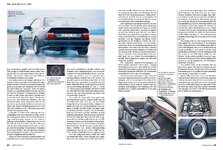

Recently found this post on FB - with an English translation (by google, as admitted by poster) of the original article for this AMG-Hammer test.
"Dampfhammer" relates to"steam hammer" - seems to want to emphasise on the power the engine delivers and its way of doing so...
Text is found below => enjoy it!
Alberto
Auto Moto und Sport testting C124 Hammer with (very) rough translation to English. My German readers will forgive my translation hopefully, as It was Google, not me. I hope you can understand enough, even though the grammar is not the best.
Hans Peter Seufert
The Americans have coined the term "Hammer" for the high-performance Mercedes versions from AMG. The most powerful tool currently available is a CE Coupé with a six-liter, four-valve, eight-cylinder engine.
There are certainly some attractive alternatives to this car. For example, a Ferrari Testarossa (94,267 DM), a Porsche Turbo (199,167 DM), a Bentley Turbo R (52,539 DM), or a BMW package for the whole family, consisting of a 750i, a 325i Convertible for the wife, and a 316i for the kids (149,517 DM). The figures in parentheses, as any car enthusiast will quickly notice, are not the list prices, but rather the savings compared to an AMG Mercedes with the 6.0 32V designation.
The coupé, dubbed the "star of all AMG vehicles" by the manufacturer, costs a whopping 335,550 marks – certainly enough to warrant a reinterpretation of the company's acronym. How about "Arab Millionaires Wanted"? (AMG In German - Arabische Millionäre Gesucht“)
A lavishly equipped 300 CE Coupé, priced at 85,859 marks, forms the base car and the rest is swallowed up by the AMG conversion. It would be going too far to list all the details here, but a few examples will do. Two not particularly comfortable Recaro seats with leather upholstery cost a total of 11,706 marks, the widebody conversion, including the super-wide wheels, devours 41,096 marks, and the burl wood trim for the automatic gear selector is a comparatively modest 477 marks. And now, hood up, all that's missing is the right engine. A bore of 100 millimeters, instead of the standard 96.5 millimeters, increases the displacement of the 560 SE eight-cylinder engine to almost six liters, and the light-alloy block is fitted with two massive, custom-designed four-valve cylinder heads. The resulting output is 385 hp (283 kW) at 5500 rpm, with a maximum torque of 566 Newton meters – a record-breaking figure for a naturally aspirated engine. Price: 98,240 DM. The result is a car whose exorbitant price tag is hard to believe. Because it remains, after all, a mid-range Mercedes coupé, and despite the generous use of wood and leather, it lacks the air of exclusivity that automatically surrounds a Ferrari or Aston Martin. Even the chunky bodywork hardly elevates the AMG product, since even the best-looking Manta has that these days.
Noble understatement, then? The question remains open for individual answering.
The technical specifications certainly sound impressive enough; the driver should be prepared for quite a lot. Even at idle, the large eight-cylinder engine announces its message of absolute authority with a deep burble, and when accelerating, it sounds as awe-inspiringly angry as only a naturally aspirated V8 can. Memories of a long-gone eight-cylinder era are awakened, the most ferocious representative of which was the Cobra. The roaring staccato that the AMG engine unleashes at full throttle is undoubtedly an acoustic experience, even if its droning frequencies can get on your nerves after two or three hours on the motorway.
And there's always more power than you can reasonably use. Sure, there are cars being built that accelerate even better, and a few even with a higher top speed. What's remarkable about the AMG, however, is how effortlessly the sheer power from the large engine displacement is unleashed, how full throttle even at low revs presses the passengers into their seats—all by simply pressing the accelerator pedal, without any virtuoso handling of the clutch and gearshift.
Because only an automatic transmission seemed capable of handling the mighty torque of the six-liter engine, and it performs its task flawlessly. The torque converter engages relentlessly, but the shifts weren't programmed for short, sharp shifts to maximize power, but rather occur as smoothly and seamlessly as in a completely standard Mercedes, even during kickdown or manual downshifting at high revs. As in the series, there are also
the two driving modes "E" and "S", whereby
"E" (for Economy) is generally the better choice
because it avoids frantic back-and-forth shifting, which the high-torque engine really
doesn't need. The slightly dampened power delivery due to the automatic transmission ensures that the AMG Mercedes puts its power down effectively. Only when starting under full throttle do the tires briefly whine, before gripping the asphalt and launching the coupe with a surge of acceleration that only noticeably diminishes well above 200 km/h. Of course, there is a certain risk in the seemingly effortless attainment of high and very high speeds—only a glance at the speedometer reveals that one is already going much faster than one initially perceived. And this inevitably means heavy work for the brakes, which signal, through a distinct juddering under heavy use, that they have reached their natural limit with so much power and weight.
The rapidly declining needle of the fuel gauge also shows how much energy is being converted here. The AMG is rarely satisfied with less than 15 liters per 100 kilometers; frequent use of its power can cause consumption to skyrocket to over 20 liters per 100 kilometers. It is therefore completely incomprehensible that the standard 70-liter tank was retained, which often necessitates refueling after only 300 kilometers.
The unbridled increase in power, which makes the AMG one of the fastest cars ever, inevitably raises the question of whether a sensible limit has already been exceeded. Experience shows that, assuming driving experience, one quickly becomes accustomed to such an abundance of horsepower because handling it is relatively easy. The problems arise from today's typical traffic conditions; from a purely technical point of view, the speed potential is easily manageable. AMG deliberately opted for a pronounced understeering characteristic, playing it safe. Despite the extremely wide tires, this ensures acceptable straight-line stability even at very high speeds; even longitudinal grooves barely unsettle the car.
The possible lateral accelerations in corners are very high, but—as long as the road isn't wet—unpredictable reactions are not to be expected. In extreme cases, the AMG will understeer and stabilize itself when the throttle is released.
However, the pronounced understeer also results in a certain degree of sluggishness. On winding country roads, the front-heavy coupé isn't quite in its element. While easy to drive thanks to the precise and sufficiently light power steering, its handling is noticeably hampered by its high weight. It's not a purebred sports car, then, even though the modifications to the chassis exceed the level of effort typically seen in tuner circles. The AMG coupé features an electronic suspension control system developed in collaboration with Bilstein, which includes both the ride height and bump detection. The ground clearance can be adjusted in three stages in the cockpit, and the suspension offers soft, medium, and hard settings. An automatic system is also included: above 140 km/h, the body lowers to its lowest position, and above 170 km/h, the suspension automatically lowers to hard, regardless of the manual setting.
Aside from the largely trouble-free handling, the result of this complex suspension technology is unsatisfactory, as the basic setting is clearly too stiff. Even during leisurely cruising, the suspension is barely noticeable; the AMG bumps stiffly over the smallest bumps and transmits them almost unfiltered to the occupants. This is compounded by loud suspension and road noise, which further reduces comfort.
Things improve somewhat at higher speeds on the motorway, because good road surfaces are usually prevalent there, and long undulations are absorbed quite well even with a firm damper setting.
So, one has to live with these imperfections and ideally not think about the price or the aforementioned alternatives. Moreover, another one is to be added next year: a Mercedes coupé of the W 124 series, from the factory with a five-liter 51015611 four-valve eight-cylinder engine and 300 hp - for considerably less than half the AMG price.
The cool thing is that in South Africa,, folks thinks out of the box, in the BMW league few ZA cars are some of the most individual and most special BMWs ever made,,
Back to the main topic,, have a look here,, NO it is not as powerful,, but it is a Mercedes CE124 as close to factory with V8 5.6
"Dampfhammer" relates to"steam hammer" - seems to want to emphasise on the power the engine delivers and its way of doing so...
Text is found below => enjoy it!
Alberto
Auto Moto und Sport testting C124 Hammer with (very) rough translation to English. My German readers will forgive my translation hopefully, as It was Google, not me.
I hope you can understand enough, even though the grammar is not the best. Hans Peter Seufert
The Americans have coined the term "Hammer" for the high-performance Mercedes versions from AMG. The most powerful tool currently available is a CE Coupé with a six-liter, four-valve, eight-cylinder engine.
There are certainly some attractive alternatives to this car. For example, a Ferrari Testarossa (94,267 DM), a Porsche Turbo (199,167 DM), a Bentley Turbo R (52,539 DM), or a BMW package for the whole family, consisting of a 750i, a 325i Convertible for the wife, and a 316i for the kids (149,517 DM). The figures in parentheses, as any car enthusiast will quickly notice, are not the list prices, but rather the savings compared to an AMG Mercedes with the 6.0 32V designation.
The coupé, dubbed the "star of all AMG vehicles" by the manufacturer, costs a whopping 335,550 marks – certainly enough to warrant a reinterpretation of the company's acronym. How about "Arab Millionaires Wanted"? (AMG In German - Arabische Millionäre Gesucht“)
A lavishly equipped 300 CE Coupé, priced at 85,859 marks, forms the base car and the rest is swallowed up by the AMG conversion. It would be going too far to list all the details here, but a few examples will do. Two not particularly comfortable Recaro seats with leather upholstery cost a total of 11,706 marks, the widebody conversion, including the super-wide wheels, devours 41,096 marks, and the burl wood trim for the automatic gear selector is a comparatively modest 477 marks. And now, hood up, all that's missing is the right engine. A bore of 100 millimeters, instead of the standard 96.5 millimeters, increases the displacement of the 560 SE eight-cylinder engine to almost six liters, and the light-alloy block is fitted with two massive, custom-designed four-valve cylinder heads. The resulting output is 385 hp (283 kW) at 5500 rpm, with a maximum torque of 566 Newton meters – a record-breaking figure for a naturally aspirated engine. Price: 98,240 DM. The result is a car whose exorbitant price tag is hard to believe. Because it remains, after all, a mid-range Mercedes coupé, and despite the generous use of wood and leather, it lacks the air of exclusivity that automatically surrounds a Ferrari or Aston Martin. Even the chunky bodywork hardly elevates the AMG product, since even the best-looking Manta has that these days.
Noble understatement, then? The question remains open for individual answering.
The technical specifications certainly sound impressive enough; the driver should be prepared for quite a lot. Even at idle, the large eight-cylinder engine announces its message of absolute authority with a deep burble, and when accelerating, it sounds as awe-inspiringly angry as only a naturally aspirated V8 can. Memories of a long-gone eight-cylinder era are awakened, the most ferocious representative of which was the Cobra. The roaring staccato that the AMG engine unleashes at full throttle is undoubtedly an acoustic experience, even if its droning frequencies can get on your nerves after two or three hours on the motorway.
And there's always more power than you can reasonably use. Sure, there are cars being built that accelerate even better, and a few even with a higher top speed. What's remarkable about the AMG, however, is how effortlessly the sheer power from the large engine displacement is unleashed, how full throttle even at low revs presses the passengers into their seats—all by simply pressing the accelerator pedal, without any virtuoso handling of the clutch and gearshift.
Because only an automatic transmission seemed capable of handling the mighty torque of the six-liter engine, and it performs its task flawlessly. The torque converter engages relentlessly, but the shifts weren't programmed for short, sharp shifts to maximize power, but rather occur as smoothly and seamlessly as in a completely standard Mercedes, even during kickdown or manual downshifting at high revs. As in the series, there are also
the two driving modes "E" and "S", whereby
"E" (for Economy) is generally the better choice
because it avoids frantic back-and-forth shifting, which the high-torque engine really
doesn't need. The slightly dampened power delivery due to the automatic transmission ensures that the AMG Mercedes puts its power down effectively. Only when starting under full throttle do the tires briefly whine, before gripping the asphalt and launching the coupe with a surge of acceleration that only noticeably diminishes well above 200 km/h. Of course, there is a certain risk in the seemingly effortless attainment of high and very high speeds—only a glance at the speedometer reveals that one is already going much faster than one initially perceived. And this inevitably means heavy work for the brakes, which signal, through a distinct juddering under heavy use, that they have reached their natural limit with so much power and weight.
The rapidly declining needle of the fuel gauge also shows how much energy is being converted here. The AMG is rarely satisfied with less than 15 liters per 100 kilometers; frequent use of its power can cause consumption to skyrocket to over 20 liters per 100 kilometers. It is therefore completely incomprehensible that the standard 70-liter tank was retained, which often necessitates refueling after only 300 kilometers.
The unbridled increase in power, which makes the AMG one of the fastest cars ever, inevitably raises the question of whether a sensible limit has already been exceeded. Experience shows that, assuming driving experience, one quickly becomes accustomed to such an abundance of horsepower because handling it is relatively easy. The problems arise from today's typical traffic conditions; from a purely technical point of view, the speed potential is easily manageable. AMG deliberately opted for a pronounced understeering characteristic, playing it safe. Despite the extremely wide tires, this ensures acceptable straight-line stability even at very high speeds; even longitudinal grooves barely unsettle the car.
The possible lateral accelerations in corners are very high, but—as long as the road isn't wet—unpredictable reactions are not to be expected. In extreme cases, the AMG will understeer and stabilize itself when the throttle is released.
However, the pronounced understeer also results in a certain degree of sluggishness. On winding country roads, the front-heavy coupé isn't quite in its element. While easy to drive thanks to the precise and sufficiently light power steering, its handling is noticeably hampered by its high weight. It's not a purebred sports car, then, even though the modifications to the chassis exceed the level of effort typically seen in tuner circles. The AMG coupé features an electronic suspension control system developed in collaboration with Bilstein, which includes both the ride height and bump detection. The ground clearance can be adjusted in three stages in the cockpit, and the suspension offers soft, medium, and hard settings. An automatic system is also included: above 140 km/h, the body lowers to its lowest position, and above 170 km/h, the suspension automatically lowers to hard, regardless of the manual setting.
Aside from the largely trouble-free handling, the result of this complex suspension technology is unsatisfactory, as the basic setting is clearly too stiff. Even during leisurely cruising, the suspension is barely noticeable; the AMG bumps stiffly over the smallest bumps and transmits them almost unfiltered to the occupants. This is compounded by loud suspension and road noise, which further reduces comfort.
Things improve somewhat at higher speeds on the motorway, because good road surfaces are usually prevalent there, and long undulations are absorbed quite well even with a firm damper setting.
So, one has to live with these imperfections and ideally not think about the price or the aforementioned alternatives. Moreover, another one is to be added next year: a Mercedes coupé of the W 124 series, from the factory with a five-liter 51015611 four-valve eight-cylinder engine and 300 hp - for considerably less than half the AMG price.
The cool thing is that in South Africa,, folks thinks out of the box, in the BMW league few ZA cars are some of the most individual and most special BMWs ever made,,
Back to the main topic,, have a look here,, NO it is not as powerful,, but it is a Mercedes CE124 as close to factory with V8 5.6