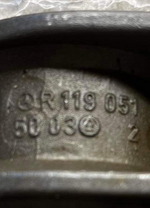
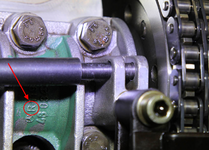
See below from EPC documentation:
The Mercedes-Benz Parts Numbering System
Each Mercedes-Benz spare part is assigned an identification number,
used for ordering the part. These part numbers follow an ordered system,
as the following:
1-Basic Numbering
2-Sorting order
3-Letter prefixes
4-Suffix Numbers
Lets swim to little details about each.
1-Basic Numbering
The most common part number has 10 digits and a letter prefix “A”. Such a part number is written as follows:
A 117 030 10 17
Note the spacing and grouping of the digits. When spoken, you say it as it’s written, like “A- one-seventeen, oh-thirty, ten, seventeen”. Most people used to MB part numbers will say it that way, and saying it differently tends to confuse.
Each section has a distinct meaning:
A Prefix for Passenger Car parts. Other prefixes (such as B, C, N and W) are explained below.
117 Type Number – This is the internal type designation indicating which vehicle type for which this part was first designed. Parts may be (and often are) used in other types. Some parts use other numbers unrelated to model types.
030 The parts group number. Major group 03 corresponds to the EPC group to which the part generally belongs. The third digit indicates (broadly) the type of part from that group.
10 Modification Number. This identifies the modification status or variant of the part. The first version or variant is generally numbered 00, and numbers increase with new variants. A higher number does not necessarily mean the part is newer or better, it is assigned somewhat randomly and not all numbers are assigned or used in strict sequence.
17 Part Type. Most similar parts of a certain type have the same type number. In this case, part type 17 (in group 030) is a Piston.
2-Sorting order
When sorting a list of 10 digit part numbers, use the order shown:
A 117 030 10 17 will be sorted in the following order
117 will be Third
030 will be First
10 will be Fourth (last)
17 will be Second
For example, first put all part numbers in order of the second group of digits (030), then sort within the group by type (17), then by Type number within Type (117), and last by Modification Number.
That makes Sense!
All other part prefixes (such as N or B) are sorted in direct numerical order.
Examples of the spacing and grouping of part numbers with other prefxies are:
B6 782 0415
BQ682 0116
HWA202 545 27 19
N004019 013802
W210 589 03 29 00
3-Letter prefixes
Use of the correct letter prefix is essential. While most parts are numbered uniquely, some may be duplicated with different letter prefixes.
The map to the treasure:
A Passenger car parts
B Accessory parts
BQ MBUSA Domestically-assigned part numbers
C Commercial vehicle parts
HWA Special passenger car parts (generally AMG)
N DIN (German Industry Standard) parts
Q Not a valid part, used as a placeholder in some EPC catalogs. Usually 12 digits, often all zeros. Do not confuse with BQ part numbers.
W Special tools
X Some commercial vehicle & light truck parts
4-Suffix Numbers
There are two kinds of suffix number, known as ES1 and ES2. A part generally uses only one or the other, but both may be used for a single number. ES is an abbreviation for the German words Erganzungs Schluessel, which translate as “Supplemental Key”.(See learning Dutch is easy )
)
ES1 codes are always two digits, and always immediately follow the base part number. The ES1 is sometimes called an “Index” number in the literature. Some ES1 numbers can be used to designate a specific version of a base number, such as for Pistons or Springs, which can be supplied with slightly different sizes or values. The meaning of some common ES1 codes is as follows:
05 Special demand part. Often used to denote parts supplied for a service action
10-15 Package sizes for a base number. Often used for service fluids
26-28 Component that is pre-programmed or specially prepared
64-69 A part identical to the base number, but from a different supplier or location
70 A core with value which should be returned for credit
80 A remanufactured component, which also has a core value.
81 A remanufactured component, which does not have any core value.
87, 88 Same as 80
90 A remanufactured part with no core value, often used for Warranty repairs
ES2 codes are always four characters, with digits and letters often mixed. These are always placed at the end of the entire part number, after the ES1 number if necessary. These are most commonly used to denote the color and texture of specific parts which are supplied in different colors and/or extures. The correct ES2 code must be specified to receive the correct part. These are sometimes called “Color Codes”, not to be confused with paint and trim color codes. Some parts have an ES2 code of 9999, which generally means that the part is provided in primer and must be painted.

The following link covers quite a bit of the above but also has some additional information:
Learn how to read and decode Mercedes-Benz part numbers, including letter prefixes, type numbers, group codes, and suffix numbers for accurate parts ordering.

www.adsitco.com
Understanding Mercedes-Benz Part Numbers: How to Read & Decode Every Digit
If you have ever tried to order a replacement part for your Mercedes-Benz, you have probably come across a string of numbers and letters that looks more like a classified code than a product listing. Something like A 117 030 10 17 might seem overwhelming at first glance, but every character in that sequence carries specific meaning. Once you understand the system, finding the right part for your vehicle becomes far more straightforward.
Mercedes-Benz developed its part numbering system decades ago, and it has remained remarkably consistent ever since. Whether you drive a classic W123 sedan or a brand new GLC, the same logic applies to every component in the catalog. Knowing how to read these numbers helps you confirm you are ordering the correct part, cross-reference components between models, and communicate more effectively with dealers and parts suppliers.
Why Understanding Mercedes-Benz Part Numbers Matters
Mercedes-Benz operates around 30 production sites across four continents, and in 2024 alone, the company produced over 2 million vehicles, according to
Mercedes-Benz Group. With that kind of volume spanning decades of production history, the parts catalog for these vehicles is enormous. The Electronic Parts Catalog, commonly known as the EPC, contains listings for every vehicle manufactured after 1946. That includes everything from engine gaskets and brake calipers to interior trim clips and electrical connectors.
Without a standardized numbering system, tracking all of those components would be nearly impossible. The Mercedes-Benz part number format gives mechanics, parts specialists, and DIY owners a reliable way to identify exactly which component they need, what vehicle it was originally designed for, and whether it has been updated or superseded. Getting the wrong part because of a single transposed digit is a common frustration, and understanding the numbering structure helps you avoid that entirely.
The Basic Structure of a Mercedes-Benz Part Number
The most common Mercedes-Benz part number consists of a single letter prefix followed by 10 digits. These digits are grouped in a very specific way, and the spacing matters. A typical part number looks like this: A 117 030 10 17. When speaking to a dealer or parts specialist, you would say it exactly as it is grouped, such as “A, one seventeen, oh thirty, ten, seventeen.” People who work with Mercedes parts regularly use this cadence, and saying it differently tends to cause confusion.
Each section of that number tells you something different about the part. The letter prefix identifies the type of product. The first three digits indicate the vehicle type or model for which the part was originally designed. The next three digits correspond to the parts group. The following two digits represent the modification or variant number. The final two digits identify the specific part type within its group.
Mercedes-Benz Part Number Letter Prefixes Explained
The letter that appears before the digits is not decorative. It tells you what category the part falls into, and using the correct prefix is essential when ordering. Some parts may share the same numeric sequence but carry different prefixes, which means they are entirely different components.
The prefix “A” is by far the most common and designates standard passenger car parts. If you own a Mercedes-Benz sedan, coupe, SUV, or wagon, the vast majority of parts you order will start with this letter. The prefix “B” identifies accessory parts, which are components sold as optional add-ons or enhancements rather than standard equipment. “BQ” is a prefix assigned by Mercedes-Benz USA for domestically sourced parts that have been given their own identification numbers.
Commercial vehicle parts carry the prefix “C,” while “HWA” designates special passenger car parts, which are almost always associated with AMG performance components. If you see the letter “N” at the start of a part number, that identifies a DIN part, meaning it conforms to a German industrial standard. These are typically hardware items like bolts, washers, and fasteners. The prefix “W” indicates special tools, and “X” appears on some commercial vehicle and light truck components.
Understanding the Mercedes-Benz Type Number
The first three digits after the letter prefix are known as the type number. This is the internal designation that tells you which vehicle type the part was originally designed for. In the example A 117 030 10 17, the “117” corresponds to the internal model code for a specific Mercedes-Benz vehicle or engine. If you are familiar with Mercedes chassis codes and engine models, this number will often look recognizable. A part with a type number of 124, for example, was first introduced for the W124 platform, which includes the 300E and early E-Class sedans from the late 1980s and early 1990s.
It is important to know that just because a part carries a certain type number does not mean it only fits that vehicle. Mercedes-Benz frequently uses parts across multiple models. A component originally numbered for the W202 C-Class might also appear in the W210 E-Class parts catalog. The type number simply tells you where the part originated, not where it ends up.
Parts with a type number starting with “000” or in the “900” range are universal components not tied to a specific model. The 000 series typically indicates common trade parts available through the broader automotive aftermarket. The 900 series refers to components that were assigned a Mercedes-Benz part number by Mercedes-Benz USA specifically, and these are almost exclusively sourced domestically rather than through the global supply chain.
How Mercedes-Benz Part Group Numbers Work
The second set of three digits is the group number, and this is where the part numbering system becomes especially useful for identifying what a component actually is and where it goes on the vehicle. The group number corresponds directly to the sections in the Electronic Parts Catalog and the factory service manual, so once you learn to recognize common group numbers, navigating those resources becomes much faster.
The group numbering system was formalized in the early 1960s when Mercedes-Benz adopted computing systems and needed a standardized way to categorize components. Before that, it was difficult to tell from a part number alone whether a component belonged to the engine, the chassis, or the body. The current system solves that problem by assigning number ranges to specific areas of the vehicle. Groups 01 through 23 cover engine-related components. Groups 24 through 58 are assigned to the chassis, including the platform, suspension, brakes, and drivetrain. Groups 60 through 92 correspond to the cab and body, covering everything from doors and windows to interior trim and electrical systems.
The third digit within the group provides additional specificity about the type of component. For instance, group 180 falls within the engine range and refers to the lubrication system. Within that group, individual part numbers identify oil filters, oil pumps, gaskets, and other related components. This layered approach means that even before you look up a part in the catalog, the group number alone can give you a general idea of what it is and where it belongs on the car.
Mercedes-Benz Part Modification Numbers and Part Type Codes
The two digits that follow the group number are the modification number. In the example A 117 030 10 17, the “10” is the modification number. This identifies which version or variant of the part you are looking at. The first version of a given part typically starts at 00, and the number increases as new variants are introduced. A higher modification number does not necessarily mean the part is newer or better. These numbers are assigned somewhat randomly and not every number in the sequence is used.
The final two digits are the part type code. This number identifies the specific component within its group. In our example, “17” in group 030 designates a piston. Most parts of a similar type within a group will share the same part type number regardless of which vehicle model they were designed for. This consistency makes it easier to compare similar components across different Mercedes-Benz models.
Decoding Mercedes-Benz Part Suffix Numbers
Beyond the standard 10-digit format, some Mercedes-Benz part numbers include suffix codes known as ES1 and ES2. These supplemental keys provide additional information about the part and are important to pay attention to when ordering.
ES1 codes are always two digits and appear immediately after the base part number. They can indicate a variety of things depending on the context. A suffix of 05 often means the part is a special demand item, frequently associated with service actions or recalls. Suffixes between 10 and 15 typically denote package sizes, which is common for fluids and consumables. Numbers in the 26 to 28 range indicate the component has been pre-programmed or specially prepared. Suffixes between 64 and 69 mean the part is functionally identical to the base number but comes from a different supplier or manufacturing location.
Some of the most useful ES1 codes for Mercedes-Benz owners relate to remanufactured parts. A suffix of 70 indicates a core with trade-in value that should be returned for credit. The suffix 80 identifies a remanufactured component that also carries core value, while 81 is a remanufactured part with no core value. The suffix 90 is another remanufactured designation with no core return, often used in warranty repairs.
ES2 codes are always four characters and may include a mix of digits and letters. These are commonly associated with trim and color specifications for body-related parts. An ES2 code of 9999 generally means the part is supplied in primer and needs to be painted to match your vehicle.
Mercedes-Benz DIN and NORM Hardware Part Numbers
If you have ever ordered bolts, screws, washers, or other fasteners for your Mercedes-Benz, you may have noticed that these parts follow a slightly different numbering format. Hardware items use a 12-digit part number preceded by the letter “N” for DIN standard components or beginning with “9” for NORM components.
A DIN hardware part number like N 000960 020078 breaks down in a logical way. The “N” indicates it is standard hardware. The “000” tells you it is a universal item not tied to a specific model. The “960” refers to the DIN standard the bolt conforms to, in this case DIN 960, which specifies hex head cap screws with a partially threaded shank. The “020” indicates a diameter of 20 millimeters, and the remaining digits identify the specific length, thread pitch, hardness, and other specifications.
NORM hardware follows a similar format but uses a “9” as the first digit. The NORM classification means the fastener has been manufactured to meet industry-specific standards that may be more restrictive than basic DIN specifications. For most routine maintenance and repairs, the distinction between DIN and NORM is not something you need to worry about, but it is helpful to understand the format if you are sourcing hardware independently.
How to Use Mercedes-Benz Part Numbers with the Electronic Parts Catalog
The Electronic Parts Catalog is the most reliable tool for looking up and verifying Mercedes-Benz part numbers. The EPC contains exploded diagrams showing every component on the vehicle, organized by group number. You can search by entering your VIN, which gives you the most precise results for your specific car, including production date variations and option-specific components.
When you find a part in the EPC, the listing will show you the full part number along with any suffix codes, supersession information, and applicable chassis number ranges. If a part has been updated or replaced by a newer version, the EPC will note the superseding part number. This is especially valuable for classic Mercedes-Benz owners, as some original part numbers have been discontinued and replaced over the years.
For a deeper understanding of how chassis codes relate to the parts you need, check out our
Mercedes-Benz Chassis Codes guide. Knowing your chassis code makes navigating the EPC and identifying the correct parts significantly easier.
Tips for Ordering Mercedes-Benz Parts by Part Number
Having the correct part number in hand is the single best thing you can do to make sure your order goes smoothly. Here are a few practical tips that can save you time and prevent costly mistakes when ordering Mercedes-Benz parts.
- Always have your VIN ready. Your Vehicle Identification Number is the most accurate way to verify part fitment, especially for components that vary by production date or equipment level.
- Pay attention to the full part number including any suffix codes. Two parts with the same base number but different suffixes can be very different items, particularly with trim-related components.
- If a part has been superseded, always order the new number. Dealers and reputable parts suppliers will have supersession data available and can confirm the current part number for you.
- When searching for parts online, try removing the letter prefix and spaces from the part number. The Mercedes-Benz spacing format does not always translate well to search engines, so searching “1170301017” instead of “A 117 030 10 17” often yields better results.
- Consider remanufactured parts for expensive components. Parts with an ES1 suffix of 80 or 81 are factory remanufactured to OEM specifications and can offer significant savings on items like alternators, starters, and steering racks.
Common Mercedes-Benz Part Group Numbers to Know
Familiarizing yourself with a handful of common group numbers can speed up your parts searches considerably. While the full list of groups is extensive, these are some of the categories that Mercedes-Benz owners encounter most frequently.
- Groups 01 through 06 cover the engine block, cylinder head, pistons, and related internal engine components.
- Group 07 covers the engine mounting and related brackets.
- Groups 14 through 18 handle the fuel system, exhaust, and engine lubrication.
- Groups 27 through 29 cover the front axle, rear axle, and steering components.
- Groups 42 through 43 are assigned to the drivetrain, including the transmission and transfer case.
- Groups 65 through 68 cover the doors, windows, mirrors, and related body hardware.
- Groups 82 through 83 handle the electrical system, including the wiring harness and control modules.