• Hi Guest !

    Welcome to the 500Eboard forum.

    Since its founding in late 2008, 500Eboard has become the leading resource on the Internet for all things related to the Mercedes-Benz 500E and E500. In recent years, we have also expanded to include the 400E and E420 models, which are directly related to the 500E/E500.

    We invite you to browse and take advantage of the information and resources here on the site. If you find helpful information, please register for full membership, and you'll find even more resources available. Feel free to ask questions, and make liberal use of the "Search" function to find answers.

    We hope you will become an active contributor to the community!

    Sincerely,
    500Eboard Management

High Temperature Issue While Driving

Gullwing

E500E Enthusiast
Member
Hi fellow E500 Enthusiasts!

I have a 1995 E500 Limited with 74k KM. I had an issue with the MAF. Symptoms were very high CO readings, cutting out and hesitation. Diagnosis was faulty MAF PCB. While the MAF issue was present, engine was running mostly at normal and sometimes even at low temp. My explanation is that probably it was due to running very rich. I had the MAF replaced with a reconditioned unit and all issues of bad emissions, running poorly and cutting out are now solved. The engine now runs perfect and response is as it should be. Hot and cold start is also good now.

The issue I have now since replacing the MAF is that the engine is running too hot especially while under load/driving. The engine is continuously on 100 Deg. C and the temp. climbs to 105 Deg C. while driving 110-120 km/h. Once I reduce the speed or stop the temp. goes down again to 100 Deg. C. The electric fans are continuously on high speed. I can hear the fan clutch kicking in when accelerating but it does not change the temperature. I checked also while in idle/parking and temperature is on 100 Deg. C to accelerate to 2000-3000 RPM and hold it there. Fan clutch is engaging and electric fans are on high speed but temperature steadily climbs to 110 Deg. C. We do have high ambient temperatures here - was around 40 Deg. C with AC on.

The fan clutch has been replaced recently. Any idea what this could be? Radiator, water pump or thermostat? Would appreciate any help or inputs to troubleshoot this issue. I have heard that tase engines tend to run hot especially with high ambient temperatures but 105-110 Deg. C at a speed of 120 km/h does not seem normal.

Maybe someone has experienced something similar before. Thank you for your help.
 
Hi fellow E500 Enthusiasts!

I have a 1995 E500 Limited with 74k KM.....

The fan clutch has been replaced recently. Any idea what this could be? Radiator, water pump or thermostat? Would appreciate any help or inputs to troubleshoot this issue. I have heard that tase engines tend to run hot especially with high ambient temperatures but 105-110 Deg. C at a speed of 120 km/h does not seem normal.
Maybe someone has experienced something similar before. Thank you for your help.
Welcome! Of course as you know the cooling system on the M119 in the w124 must be in tip top shape or else the car runs hot.

First, what did you replace the viscous fan clutch with? an OE unit? Something from the aftermarket? Even the OE ones were sometimes incorrectly calibrated from the factory. You can do a search on the viscous fan clutch here and you will find a treasure trove of threads discussing it.

Secondly - you mention that engine temp increases with speed, and decreases when you come to a stop. That's surprising. Normally what happens is that the engine is hot, but needs more coolant flowing to bring the heat away, so revvving the engine a little or starting to drive at >1000 rpm will get the coolant flowing enough to bring the temperature down. When was the last time the coolant was changed? And, what coolant was used? How old is the radiator? Could it be clogged?

If the answer to those questions is that you don't know, then it doesn't hurt to put in a new radiator, coolant, water pump, etc...... not that it will surely fix the problem (not trying to fix things by throwing parts at it) but just to get things back to a baseline for a nearly 30 year old car..... and THEN start diagnosing.

Cheers.
 
I replaced with new parts EVERY SINGLE ITEM IN THE ENTIRE COOLING SYSTEM last year. Radiator, water pump, thermostat, cooling hoses, coolant temp sensors, fan clutch.

I am finding now with hotter ambient temperatures, that with 85F ambient temps, my car is still running 95-100C indicated temp with the A/C on, running at freeway speeds (65+ MPH). It is running 5 degrees cooler with the A/C not on. Ambient temps below 80F the car runs perfectly at an indicated 85-90C.

It is not running hot enough to kick on the aux fans, though the real test for this will come in the summer, when we have much higher heat (90-95F) and humidity levels. I expect it will get up to 105C indicated to kick on the aux fan.

It is possible that the factory Horton fan clutch (which is NLA) was mis-calibrated from the factory, and thus perhaps not quite as efficient as it should be. But, the fact that I have seen the temp gauge kiss 100C indicated temps, with ALL NEW factory and quality OEM parts in the cooling system, confirms my belief that these engines just run a bit hot, and DO NOT LIKE high ambient temperatures, and especially DO NOT LIKE humid temperatures.

I ran the car all of last fall, winter, and early spring and temperatures behaved perfectly at 85-90C.
 
The fan clutch has been replaced recently. Any idea what this could be? Radiator, water pump or thermostat? Would appreciate any help or inputs to troubleshoot this issue.
Based on your description, the indicated temps are accurate, and the fan clutch is engaging (roaring) when hot. So I don't think it's the fan clutch, if it's roaring away at 3000rpm. I seriously doubt the problem would be the water pump.

If the thermostat has not been replaced in the last 5-10 years, you can start there. If the radiator is original, I'd replace both the t-stat and radiator (new OE, or new Behr "Premium" line). You may also have debris blocking the condenser and/or radiator fins, which requires removing the radiator to clean out with compressed air. Again, if the radiator is 25 years old, it's due for replacement. Ditto for the radiator cap (OE/Reutter only), and if the plastic reservoir is original, might as well do everything at once.


I have heard that tase engines tend to run hot especially with high ambient temperatures but 105-110 Deg. C at a speed of 120 km/h does not seem normal.
You are correct. Engine temps of 105-110°C are not normal at a steady 80mph, even in UAE. In very hot ambient temps, it should be closer to 95-100°C.

BTW, nice car you have there, and welcome to the forum!

:welcome5:
 
@Gullwing
Welcome to the forum.

Check this thread out:


Net - when I first got my car (~47K miles) it would run hot and with @gsxr's help (you can see in that thread), I got it sorted out.
There were two problems:

1. The 15 amp fuse that is located in the relay that controls the stage 1 of electric aux fan was blown
AND
2. My A/C refrigerant was low, so there was not enough pressure in the system for Stage 1 electric fans to kick in, even after I replaced the fuse above.

My fix (as you can see from that thread):
- replace the 15 amp fuse in the relay that controls Stage 1 fans
- have evacuated & refill done of the A/C refrigerant (otherwise stage 1 will never come one)

Part of the problem in sorting my issue out was, I could hear the Stage 2 go on, after that car got quite hot - but it should never have gotten that hot in the first place if Stage 1 came on as designed - so I assume since Stage 2 was on and viscous clutch for mechanical fan was engaged and working, that something must be wrong with my cooling system (even though I had cooling system flushed).
It wasn't - all along it was that my Stage 1 fans were never coming on.
Either one of the problems I had would cause that, but I had both.
You can see the the thing described in that thread.

Your problem may be completely different, but the reason I bring it up is I remember experiencing "Aux fans running full bore, mechanical fan running right and coolant was just flushed and my car would still run hot".

Also as @gerryvz says, these engines do run a bit hot compared to what you may see with other cars, even when everything is in perfect working order, so the final thing I did was buy a "Cool Harness 95"
You can find it here:
K6JRF Auto Page ... click on the "Cool Harness Link" and it will take you to here: K6JRF Auto Page

The Cool Harness is literally a 10 min DIY.

With my A/C pressure right, the 15 amp fuse in the above mentioned Relay replaced and when I installed "Cool Harness 95", I have not had my car go over 100C once since.
 
Last edited:
Also, the bandaid approach fixes things temporarily. That to me is a get you home issue until you can diagnose. .
 
Thank you all for your replies. Really appreciate your support to help me sort out this issue :)

@Jlaa
Am not sure whether the fan clutch which was installed in December was OEM or aftermarket. I have already contacted my parts supplier to verify this. Do you guys only recommend using the OEM one or is there also an aftermarket one which is good to use? Is there any brand you can recommend?
Coolant was changed recently in December and the system was flushed. Coolant type was I think Petronas. Does the type of coolant used make a difference and are there any recommendations? Radiator was not removed for servicing. I heard that there are also good additives to reduce the temp. however not sure how effective they are or whether just a marketing gimmick.
The radiator is old and as far as I know still the original one. I have owned the car over 10 years and have not changed it.

@gerryvz
Think this is also the road I am going to have to go down to change the potential culprits in the cooling system due to age. Our weather here is very similar to Texas with high ambient temperature and humidity but also dry heat. I was driving the car in winter sometimes without ac and these issues did not show up. Yesterday I was driving in 40 Deg. C. and high humidity. I am now hesitant to use the car which is sad so this is why I want to sort this out so I can also use it safely in summer. Which sensors do you recommend to replace?
My aux fans are continuously on high speed and the temp. is still not coming down even with fan clutch engaged.

@gsxr
Thank you for the compliment and the welcome :-)
Yes thermostat has not been replaced as long as I own the car which is more than 10 years. I there a special opening temp. rating I need to consider for the thermostat? For my climate it should of course be low opening temp.
The radiator has also not been replaced and I am confident it is still the original old one. As you suggest I am thinking it is a good idea to replace both the thermostat and radiator. The workshop said that they can remove and service the radiator but not sure if this would do the job. Maybe better to get a new one.
On the EPC I found the part number A 124 5000 302 for the radiator. I found a Behr unit with part number A 124 500 1402. Can you confirm if this is correct and will fit? I am thinking maybe this part number superseded the old one?
In case I decide to replace the water pump do you recommend only OEM if still available or will an aftermarket German brand be ok too?
Do you recommend I replace any sensors along the way?
Yes it would be great if I could keep the temp. in the region 95-100 Deg. C. even in our hot summer. I don't like to watch the needle climb over the 100 Deg. C. line. Don"t want to overstrain the engine.

@msq
Thank you for the welcome message and for the link to the thread. Good to hear that you managed to sort your problem out.
I paid attention to the stage 1 & 2 Aux. fan speeds. My stage 1 speed comes on with the AC which I believe is correct. Stage 2 comes on early slightly before the temp. needle reaches the 100 Deg. C. line.
Sometime last year I noticed the temp. going up while stuck in traffic with AC on and I did not hear the aux. fans coming on even when temp. went over the 100 Deg. C. line. Especially on stage 2 you can hear the fans. So I pulled over and noticed that fans were not on at all. I let the car cool down and then made it home as I was not too far away. They also did not come on on stage 1.
The electrician at the workshop diagnosed the problem to be a wiring/connection issue and a corroded contact.
What he did find during that inspection was that there is a non original harness connected to the temp. sensor so this must be the cool harness you are talking about to make the aux. fans kick in at high speed at lower temp. I did not install this. Must be from the previous owner.
This explained to me the reason why my aux. fans start to run on stage 2 at just below the 100 Deg. C. line.
Considering my car has this harness and cooling fans already kick in on stage 2 at less than 100 Deg. C. there must definitely be a problem somewhere. They are now continuously on stage 2 even while driving and the temp. is still climbing over 100 Deg. C. and does not stay steady.
So with the cooling fans on stage 2, fan clutch engaged and air flow from driving the temp. still climbs.

@nocfn
Thank you for the input. Is there one intake temp. sensor to be replaced or are there any more sensors which could be responsible?
 
  • The OEM Sachs/Horton fan clutch is preferred, but is NLA. As @Jlaa mentioned the OE/OEM clutch can be out of calibration, new out of the box. The problem with aftermarket clutches is they are "over-engaged", meaning they are engaged at cool temps, and some brands do not dis-engage at 3500rpm per factory spec and will roar to 6000rpm redline.

  • Type of coolant does not make a difference in cooling, however only G-05 or G-48 antifreeze should be used.

  • Additives are primarily a marketing gimmick, however a bottle of Red Line Water Wetter would not hurt. Additives will not cure your problem.

  • The aux fans normally engage at 107C and shut off when the temps drop below 100C. The "CoolHarness" will reduce both cut-in and cut-out temps, meaning the fans will engage high speed at 95-100C, but then will not cut out until temps drop somewhere below 90C. Your car definitely has the "CoolHarness" already installed. However, the cooling system should be capable of keeping temps below 107C without the harness.

  • The standard thermostat is fine. It is fully opened by 94°C. Since your temps are above this, a lower-rated t-stat won't help anything. There are 2 different types, early and late, check your engine serial number vs EPC. Or visually inspect the t-stat housing, the early and late types are visibly different. They are NOT interchangeable. Only the last few hundred E500's produced have the late t-stat design.

  • Removing the radiator for "service" is a waste IMO; a new radiator is available for ~$250 USD in USA. I'm not sure what the cost is where you live. 124-500-03-02 is the number for the E500E, 124-500-14-02 is for the 400E/E420, however they are interchangeable and I've never been able to find any difference between the two. The #14 radiator will fit. Just make sure if buying aftermarket, it's Behr "Premium Line" (made in South Africa, where the OE/dealer radiators are produced), not the cheaper Behr version made in India.

  • The water pump job is fairly expensive and should not be necessary at 74kkm. I'd get the OE/dealer rebuilt pump rather than any aftermarket pump, if you decide to replace it. So much of the engine has to come apart to replace the water pump, I would seriously consider also having the front crank seal replaced at the same time, as the additional labor cost should be quite low and if not leaking yet, it will be soon at 25 years old. If it was my car, I wouldn't replace the water pump, if it isn't leaking.

  • Temps over 100C (up to 110-115C) will not cause damage, but are not normal either. If you see the temps near 120, shut off the AC and run the heater.

  • With only 74kkm, all the electrical sensors should be fine. However none of them should significantly affect engine temperatures. You could replace all of them but don't expect any change in engine temps. There are three coolant sensors and one air temp sensor.
 
Thank you all for your replies. Really appreciate your support to help me sort out this issue :)

@Jlaa
Am not sure whether the fan clutch which was installed in December was OEM or aftermarket. I have already contacted my parts supplier to verify this. Do you guys only recommend using the OEM one or is there also an aftermarket one which is good to use? Is there any brand you can recommend?
Coolant was changed recently in December and the system was flushed. Coolant type was I think Petronas. Does the type of coolant used make a difference and are there any recommendations? Radiator was not removed for servicing. I heard that there are also good additives to reduce the temp. however not sure how effective they are or whether just a marketing gimmick.
The radiator is old and as far as I know still the original one. I have owned the car over 10 years and have not changed it.

@gerryvz
Think this is also the road I am going to have to go down to change the potential culprits in the cooling system due to age. Our weather here is very similar to Texas with high ambient temperature and humidity but also dry heat. I was driving the car in winter sometimes without ac and these issues did not show up. Yesterday I was driving in 40 Deg. C. and high humidity. I am now hesitant to use the car which is sad so this is why I want to sort this out so I can also use it safely in summer. Which sensors do you recommend to replace?
My aux fans are continuously on high speed and the temp. is still not coming down even with fan clutch engaged.

@gsxr
Thank you for the compliment and the welcome :)
Yes thermostat has not been replaced as long as I own the car which is more than 10 years. I there a special opening temp. rating I need to consider for the thermostat? For my climate it should of course be low opening temp.
The radiator has also not been replaced and I am confident it is still the original old one. As you suggest I am thinking it is a good idea to replace both the thermostat and radiator. The workshop said that they can remove and service the radiator but not sure if this would do the job. Maybe better to get a new one.
On the EPC I found the part number A 124 5000 302 for the radiator. I found a Behr unit with part number A 124 500 1402. Can you confirm if this is correct and will fit? I am thinking maybe this part number superseded the old one?
In case I decide to replace the water pump do you recommend only OEM if still available or will an aftermarket German brand be ok too?
Do you recommend I replace any sensors along the way?
Yes it would be great if I could keep the temp. in the region 95-100 Deg. C. even in our hot summer. I don't like to watch the needle climb over the 100 Deg. C. line. Don"t want to overstrain the engine.

@msq
Thank you for the welcome message and for the link to the thread. Good to hear that you managed to sort your problem out.
I paid attention to the stage 1 & 2 Aux. fan speeds. My stage 1 speed comes on with the AC which I believe is correct. Stage 2 comes on early slightly before the temp. needle reaches the 100 Deg. C. line.
Sometime last year I noticed the temp. going up while stuck in traffic with AC on and I did not hear the aux. fans coming on even when temp. went over the 100 Deg. C. line. Especially on stage 2 you can hear the fans. So I pulled over and noticed that fans were not on at all. I let the car cool down and then made it home as I was not too far away. They also did not come on on stage 1.
The electrician at the workshop diagnosed the problem to be a wiring/connection issue and a corroded contact.
What he did find during that inspection was that there is a non original harness connected to the temp. sensor so this must be the cool harness you are talking about to make the aux. fans kick in at high speed at lower temp. I did not install this. Must be from the previous owner.
This explained to me the reason why my aux. fans start to run on stage 2 at just below the 100 Deg. C. line.
Considering my car has this harness and cooling fans already kick in on stage 2 at less than 100 Deg. C. there must definitely be a problem somewhere. They are now continuously on stage 2 even while driving and the temp. is still climbing over 100 Deg. C. and does not stay steady.
So with the cooling fans on stage 2, fan clutch engaged and air flow from driving the temp. still climbs.

@nocfn
Thank you for the input. Is there one intake temp. sensor to be replaced or are there any more sensors which could be responsible?
I think GSXR hit all the points for all of us.
 
The driver’s side electric fan on my ‘94‘ was intermittent and weak so I replaced it last year. There was a noticeable cooling capacity improvement with the new fan. The A/C also works much better. This year the same fan is squeaking on my ‘95‘ and I suspect it's weak and about to fail. You can grab the center of the spinning motor and see what kind of force it is making as compared to the other fan. The fan (Febi\Biltstein from AurohausAZ) is less than $100. It’s the work installing it that’s no fun.

If you have verified the big spring-like resistor that controls the low speed fans is in good shape (no corroded terminals), the fuses in the ice cube relays are good, and your refrigerant charge is correct, you might consider replacing at least the driver’s side electric fan if not both.
 
Last edited:
Sometime last year I noticed the temp. going up while stuck in traffic with AC on and I did not hear the aux. fans coming on even when temp. went over the 100 Deg. C. line. Especially on stage 2 you can hear the fans. So I pulled over and noticed that fans were not on at all. I let the car cool down and then made it home as I was not too far away. They also did not come on on stage 1.
The electrician at the workshop diagnosed the problem to be a wiring/connection issue and a corroded contact.
What he did find during that inspection was that there is a non original harness connected to the temp. sensor so this must be the cool harness you are talking about to make the aux. fans kick in at high speed at lower temp. I did not install this. Must be from the previous owner.
For what it is worth, several years ago I had a condition where my electric fans WERE coming on when they WERE NOT supposed to and were also NOT coming on when they WERE supposed to. As well, engagement of the AC compressor was flaky -- sometimes the AC compressor didn't want to engage.

At first I thought it was the cool harness that I had installed. I was never fond of the CH anyways because I always felt that it was needlessly engaging the electric fans while I was driving around the neighborhood at low speed, and the fans make a lot of noise.

When I removed the CH, I realized that the upper wiring harness was original and decayed, so I replaced it. That was several years ago and my electric fan operation as been fine ever since (and I have not re-installed the cool harness).
 
@gsxr

Think will go by your recommendation and tackle the radiator, thermostat and expansion tank cap first. As you suggested water pump should still be fine as there is also no abnormal noise or any leak. Fan clutch seems to be engaging as it should as well. Expansion tank is fine.
Agreed that servicing the radiator does not make sense as the cost for this is also around US$ 200.00 so for the price you mentioned much better to get a new one. After all the part is 26 years old. I would have to purchase it from the US or Europe as locally there is only an aftermarket version (German called Autostar) available which I would rather not experiment with.
I will not replace any sensors for now then since these should be ok.

@emerydc8

Thank you very much for the input. I will ask the workshop to pay extra attention to the aux. fans and check the cooling capacity and function.

@Jlaa

I replaced both the upper and lower wiring harness as they were both still original. The wiring was brittle which caused all sorts of stuff to happen.
 
Only thing I have not done yet is the electronic throttle actuator wiring. I am not getting any symptoms of ASR light or limp mode so am hoping that is sill ok.
 
@gsxr

Agreed that servicing the radiator does not make sense as the cost for this is also around US$ 200.00 so for the price you mentioned much better to get a new one. After all the part is 26 years old. I would have to purchase it from the US or Europe as locally there is only an aftermarket version (German called Autostar) available which I would rather not experiment with.
@Jlaa
You can never go wrong replacing an old radiator.
 
First things I would do are the easiest -- replace the thermostat and the expansion tank pressure cap. Both relatively cheap and easy to do. Inspect all of your cooling hoses (upper, lower, and elbow hose at the thermostat) to ensure they are not soft or worn. If so, replace.

See if the thermostat gets you where you need to be. I had a bad thermostat on my M104 G-wagen and it caused major hot running issues (110+C) that a new fan clutch and radiator didn't remedy. So it is a good idea to start with the small things and go from there.

Always know, too, that running the A/C is always going to elevate the temperature by ~5C. So, if your car normally runs at 90C, it's going to run at 95+C. If 95C, it's going to run at 100C.

Yesterday I had my E500 out in 75F ambient temps, with the A/C on. It was running ~90C with the A/C off (normal), and 95C with the A/C on. And kissing the 100C line when at long stoplights with the A/C on, although when moving it went back down to the 95C mark. I am fine with this. If higher ambient temps (85+F), I would expect temps to be slightly higher than I just mentioned. These engines DO NOT like high temps and this is compounded by high humidity.
 
@gerryvz

Thank you very much for the additional info regarding the thermostat. So it seems that thermostats can also have an issue of causing higher temps. They usually cause engines not to warm up to operating temp. when they are stuck open so seems can also work the other way then that
it maybe is stuck not fully open or is not regulating the temp. properly. The thermostat has not been changed on my car so will definitely do that.
I have already ordered original thermostat and expansion tank cap.

Yes you are right about the temp. difference with ac on or off. I noticed the same thing. If I can keep mine between 95 and 100 Deg. C. with ac on during our hot summer would be great. I don't like to see it climbing over the 100 Deg. C. line.
Keep me posted how it goes when you have temps. of 104 F and above in the next months.
 
Hi guys,

Wanted to have your opinion on ignition parts. Have found distributor caps and rotors by the German manufacturer Bremi. Anyone have any experience with the different brands? Will these be ok or is it better to go with Bosch?
The ignition wire set I found is also Bremi. Any recommendations are appreciated.
 
Hi guys,

Wanted to have your opinion on ignition parts. Have found distributor caps and rotors by the German manufacturer Bremi. Anyone have any experience with the different brands? Will these be ok or is it better to go with Bosch?
The ignition wire set I found is also Bremi. Any recommendations are appreciated.
Bremi was never OEM for any Mercedes electrical parts AFAIK, and definitely not OEM for any M119 ignition components. They may be acceptable, other people have used them without major issues, but in general I'd prefer other brands as noted below - note these are my personal preferences:

Caps: Beru preferred, Bosch second choice​
Rotors: OE/Genuine only (made by Doduco)​
Insulators: Bosch (no other brands available)​
Wires: Beru ZEF-635 only (NOT Bosch!)​
Plugs: Bosch F8DC4 or Genuine MB (Beru)​
Coils: Bosch only​

In USA, there are some counterfeit Bosch parts being sold, so only buy from authorised dealers. People have reported defective new caps AND rotors (and, a bad wire in a wire set) out of the box for most brands, there is no 100% guarantee for any particular brand. Beru used to sell reboxed OE/Doduco rotors but have changed to aftermarket Facet now, so if you read old posts recommending Beru rotors, it's old information. Most vendors will have the new Beru/Facet rotors which are a different Beru part number (extra digit added).

BTW, although Bremi is a German company, I'm not positive if their parts are actually made in Germany. Some may be, others may not be.
 
What are the pros and cons of altering the ratio between water and the G-05 or G-48 antifreeze? Let say going to 60% water to 40% coolant.
 
What are the pros and cons of altering the ratio between water and the G-05 or G-48 antifreeze? Let say going to 60% water to 40% coolant.
In theory, a lower percentage of antifreeze may help thermal transfer, in particular when used with Water Wetter. However, you don't want to go much below 40% antifreeze if you live in an area that gets below freezing in winter. When I lived in Sacramento where it almost never went below 40°F, I went as low as 20% antifreeze, but I can't do that in Idaho.
 
In theory, a lower percentage of antifreeze may help thermal transfer,
I aim to mix at around 60% water and the antifreeze tester reads -28 which is more than adequate for Vancouver winters. I find it does help the car run cooler than when the tester read -40.
 
Last edited:
Ordered radiator, thermostat and expansion tank cap from Mercedes and received the parts today. Radiator is Behr and thermostat is 119 200 00 15 probably because my car is a late production 95. Thanks for pointing this out @gsxr.
Will keep you posted.
Are there any specific steps to follow when filling coolant once the new radiator is installed to avoid any air pockets?
 
Ordered radiator, thermostat and expansion tank cap from Mercedes and received the parts today. Radiator is Behr and thermostat is 119 200 00 15 probably because my car is a late production 95. Thanks for pointing this out @gsxr.
Will keep you posted.
Are there any specific steps to follow when filling coolant once the new radiator is installed to avoid any air pockets?
Refilling the system with coolant is well documented here on the forum. Check here. And here.

What you want to do when refilling is the following:

1) Fill the radiator through the upper hose (removing the end of the upper hose clamped to the water pump). You shoud get about 4 liters of fluid directly into the radiator.

2) Re-attach the hose to the water pump.

3) Fill the coolant expansion tank just above the "max" line.

4) Start the engine and warm it up, and run the car's heater at full blast

5) Adjust the coolant level as the thermostat opens and the coolant circulates by pouring more coolant into the expansion tank as needed. Re-install the cap onto the expansion tank.

6) Drive the car for a few miles, and then make any final adjustments as needed. DANGER: You may want to let the car cool down and system pressure go away before removing the expansion tank cap with a hot/pressurized cooling system to avoid burns or spraying coolant.

Optionally, as step 2b, I have in the past also filled up the water pump with coolant (where the hose attaches) before re-attaching the upper hose, but this is not strictly required. It can be a bit messy, but you can get more coolant directly into the engine this way, and it reduces the amount of coolant that you have to fill up / adjust at the expansion tank after running the engine.
 
Last edited:
Modification to the post above:

I always fill the engine block first, through the upper radiator hose disconnected. With the block drained, you should get 4-5 quarts into the block. This eliminates a potential air pocket in the block. Then re-attach the hose and fill the expansion tank all the way to the top (metal neck), repeatedly, until the level no longer drops. This lets coolant flow through the aeration hose to the top of the radiator. Measure the amount drained and make sure you get within 1 quart back in, before starting the engine. I.e., if you drain 10 quarts, you should be able to pour close to 9 back in. If not, there's a sizeable air pocket. Even with all of the above, the system will still "burp" after reaching operating temp and require another ~1 quart to top off after it cools down (don't open the cap above ~60C)..

Pre-mix coolant before filling! You will drain 9-10 quarts out at most and may refill slightly more when replacing the radiator. System capacity is 12-13 quarts total, not 16+ as shown in the manual (this is an error).

Alternately, use a vacuum fill tool (like this one) which eliminates all the headaches above.
 
@gerryvz & @gsxr

Thank you for the very helpful instructions on cooling system refilling.

@gsxr
I saw you mentioned Water Wetter by Red Line. I checked and it is available here. Do you recommend that I add it and if so how much?
Summer goes up to 45 Deg. C and winter is around 20 Deg. C minimum.
Another point I would like to clarify is the mixture. Workshops here fill 100% coolant without diluting/mixing as far as I know.
Is it advisable to mix the coolant with water? If so at what ratio for our hot climate?
 
Summer goes up to 45 Deg. C and winter is around 20 Deg. C minimum.
Another point I would like to clarify is the mixture. Workshops here fill 100% coolant without diluting/mixing as far as I know.
I think coolant bottles come from factory as 100% coolant and a 50/50 mix: 50% water, 50% coolant. Shops in UAE likely 50/50 bottles. No one uses straight coolant on our planet (maybe in Arctic?).

In UAE you will benefit from GSXR's Sacramento ratio of 20% coolant/80% water mixture. More water - better cooling. You'd need to premix this ratio yourself prior to filling the system
 
@gerryvz & @gsxr

Thank you for the very helpful instructions on cooling system refilling.

@gsxr
I saw you mentioned Water Wetter by Red Line. I checked and it is available here. Do you recommend that I add it and if so how much?
Summer goes up to 45 Deg. C and winter is around 20 Deg. C minimum.
Another point I would like to clarify is the mixture. Workshops here fill 100% coolant without diluting/mixing as far as I know.
Is it advisable to mix the coolant with water? If so at what ratio for our hot climate?
Add a full bottle of Water Wetter to the system. Don't expect any significant improvement, but it doesn't hurt anything.

The reason I always recommend pre-mixing, is due to the spec error in the manuals showing 16-qt system capacity. If a shop pours in 2 gallons of antifreeze and then tops off with water, the resulting mix will be ~75% antifreeze or higher, which is bad for multiple reasons (including reduced thermal transfer). The only accurate way is to premix, and pour in pre-mixed coolant. Some aftermarket coolant (like Zerex G-05) is sold pre-mixed as 50/50, as kiev noted above. This costs a bit more but is convenient if you use a 50/50 mix.

In a hot climate that never goes below freezing, you can use much lower percentages of G-05 or G-48. I'd still use a minimum of 10%-20% as antifreeze is needed to prevent corrosion, and lubricate components. Never use only water in the system. With ~20% antifreeze and Water Wetter, there might be a few degrees reduction in temps, maybe. You can top off premixed 50/50 as needed, the small amounts won't significantly affect the overall percentage. The cooling systems tend to "lose" a small amount of coolant over several years between system flushes, even if there are no leaks.
 
@gsxr
Thank you very much for the useful advice. When you say add a bottle of Water Wetter do you mean a 12 Oz. bottle ofWater Wetter additive?
Yes - one 12oz bottle. I believe if you read the instructions on the label, you'll find that would be the recommended amount for a system size of ±12 quarts.
 
Hi guys,

I have been looking at my history with regard to the ignition system. The last time I changed the ignition caps and rotors was in December 2012. WOW. Time flies.
Wires never changed. Spark plugs recently. I have not done very much mileage since changing the caps and rotors (maybe 4000 KM). Think caps and rotors were Bosch.
No symptoms which point at any ignition issues - car runs smooth, no misfire or rough idle or any hesitation.
Would you recommend that I change any of these parts anyway as a service or not? If yes which parts should I change. On the other hand if there are no issues ignition related maybe good to leave as it is. Let me know your thoughts. Thanks.
 
If the car runs smooth, with no misfire or rough idle or any hesitation, you can skip the ignition parts for now. They will not be related to high coolant temps. With only 4000km the caps & rotors should be fine.

:tumble:
 
@gsxr
Wanted to ask your opinion on the type of engine oil to be used for our hot climate. Which viscosity do you recommend and is fully synthetic ok to use? Thanks!
 
@gsxr
Wanted to ask your opinion on the type of engine oil to be used for our hot climate. Which viscosity do you recommend and is fully synthetic ok to use? Thanks!
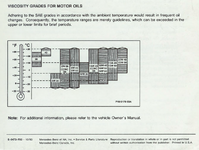
I follow the original factory recommendations for viscosity (see chart below). In a very hot climate, I'd use 10W-40 as a minimum, and would consider 15W-40, 15W-50, or 20W-50.

Fully synthetic is OK to use, and I use it in my engines (Red Line 10W-40). However, keep in mind that some synthetics may cause leaks at some seals, which had previously not been leaking... the front crank seal in particular. I've had to change the front crank seal in almost all my cars. I personally believe the benefit outweighs the risk of leaks, and use synthetic in all my engines & transmissions (Red Line D4 or High Temp ATF). This is particularly of concern in severe service applications, and I'd consider frequent ambient temps over 100°F/40°C to be severe service. YMMV, etc.


1623352595391.png
 
I would go 15W-40 or 15W-50, myself. Both are good all-around weights. When I lived in Houston, I used 20W-50 on my 560SEC (M117).

The M119s were generally designed to use a 10W-x or higher viscosity oil.
 
Add a full bottle of Water Wetter to the system. Don't expect any significant improvement, but it doesn't hurt anything.

The reason I always recommend pre-mixing, is due to the spec error in the manuals showing 16-qt system capacity. If a shop pours in 2 gallons of antifreeze and then tops off with water, the resulting mix will be ~75% antifreeze or higher, which is bad for multiple reasons (including reduced thermal transfer). The only accurate way is to premix, and pour in pre-mixed coolant. Some aftermarket coolant (like Zerex G-05) is sold pre-mixed as 50/50, as kiev noted above. This costs a bit more but is convenient if you use a 50/50 mix.

In a hot climate that never goes below freezing, you can use much lower percentages of G-05 or G-48. I'd still use a minimum of 10%-20% as antifreeze is needed to prevent corrosion, and lubricate components. Never use only water in the system. With ~20% antifreeze and Water Wetter, there might be a few degrees reduction in temps, maybe. You can top off premixed 50/50 as needed, the small amounts won't significantly affect the overall percentage. The cooling systems tend to "lose" a small amount of coolant over several years between system flushes, even if there are no leaks.
@gsxr
Am currently arguing the point with the workshop to use 20% coolant and 80% water as you recommended. They are saying better to use a higher percentage of coolant as it has a higher boiling point than water and to prevent corrosion. So they say min. 50/50. They seem to think the more coolant the better for our climate.
What are your thoughts on this?
 
@gsxr
Am currently arguing the point with the workshop to use 20% coolant and 80% water as you recommended. They are saying better to use a higher percentage of coolant as it has a higher boiling point than water and to prevent corrosion. So they say min. 50/50. They seem to think the more coolant the better for our climate.
What are your thoughts on this?
I would defer to guidance from Red Line... they recommend lower percentages of antifreeze for better heat transfer with Water Wetter. And, Water Wetter is designed to prevent corrosion even when used with plain water / zero antifreeze.

Click here to read their white paper (PDF file), note the chart at the upper right of the first page. Excerpt:

"For maximum temperature reductions use the most water and the least antifreeze possible to prevent freezing in your climate. Even in summertime the use of air-conditioning can blow freezing air through the heater and cause freezing of the heater core unless approximately 20% antifreeze is used."

The higher percentage (50%) makes little difference at the max pressure allowed by the cap (1.4 bar). Plain water at 1.4 boils at 260°F/127°C while 50/50 mix boils at 275°F/135°C. The chart below doesn't show a 20% mix but it appears it may be around 265°F/130°C. Bottom line, having your radiator cap and system properly sealed and able to maintain 1.4 bar is more critical than the percentage of antifreeze, for boil protection.

If you are running the car above 120°C... there are other problems to be concerned about!

:duck:

boil101bw.jpg
 
Hi guys,
It seems that the Behr fan clutch which I replaced recently is not functioning properly. Since the original one is no longer available, which fan clutch should I buy? Anyone have good experience with any of the brands?
 
Based on previous posts, I assume you currently have a Behr aftermarket clutch installed? What's wrong with it?

I don't know which aftermarket clutch is the least of the evils, except that so far, we haven't heard any reports of ACM-branded clutches failing (yet).

:seesaw:
 
Wanted to give you guys an update. Bottom line is the issue is still there. Have changed the radiator, thermostat and expansion tank cap.
Coolant is a 50/50 mix with distilled water and Water Wetter additive. Changed the fan clutch several months ago with a Behr unit.
Cooling harness is also installed so electric fans kick in earlier.

So we took the E500 for an extensive test drive today. Ambient temperature was high at 44 Deg. C (111°F) and it was midday. When driving at a constant speed of around 120 km/h for around 15 min. the temperature needle stayed very slightly below 100 Deg. C or was on the line. Photo attached. Then drove a bit faster for a short while and the temp. was still ok. After that it started to rise gradually. Stopped to check and electric fans were running on high speed and fan clutch seemed to be engaging. So could not spot anything abnormal. The temperature started to drop once I turned on the heater and also when I came to a halt and the car was idling. On standstill once you accelerate and keep the rpm on 3.000 the temp. climbs again.

We are really puzzled what it could be. We are ruling out the water pump. It does sound like a fan clutch issue since as you mentioned there are some known quality issues with aftermarket ones. What I did notice after replacing the fan clutch is that the new fan clutch engages when setting off and the engine is still cold under 80 Deg. C. I can clearly hear it when accelerating but then not when temperatures are higher.
Could it be that this fan clutch does not engage at the right temperatures, not long enough or is maybe not spinning at the speed that is required for the M119?

Another worry I have is that it might be the head gasket. We did find a minot trace of oil residue in the expansion tank as per the attached photo. We then did an engine compression leakdown test which was normal and did not show any abnormalities. Could this be from the oil cooler?
Appreciate any inputs which will help me solve this issue. Thanks again.


6b5dcff0-ebf9-4669-af1e-8cbddd0835b1.JPG2d3610fb-db98-417a-8e59-a8c605227c59.JPG
 
The temp of ~100C in ~110F/45C ambients is normal. The question is, how hot did the engine get when temps "started to ride gradually", before you turned on the heater?

The aftermarket clutches tend to be engaged when cold, when they don't need to be... minor nuisance with the noise and tiny loss of fuel economy. However, the clutch SHOULD be engaged and roaring when hot. If you don't hear the fan roaring like a hurricane when engine temp is 100C+, up to at least 3000rpm, something is wrong with the clutch.

Dumb question: Is the fan shroud present, and are all the rubber flaps present? If the shroud is missing, that will cause a major problem. And if any of the rubber flaps are missing, that will also reduce airflow through the radiator, even if the clutch is engaged and fan is roaring.

Head gasket failures are quite rare, but the residue in the reservoir is odd. Oil would appear as dark brown blobs floating on top of the coolant. I'm not sure what the goop is in your picture. If you have the blue G-48 antifreeze it will be harder to see oil contamination. Oil in the system won't necessarily cause low compression or leakdown; and if there is substantial oil in the system, it's a major headache to remove - and, if you don't locate the source and fix it, the oil will just come back and mess up the system after it's cleaned. Hopefully it's not oil.

The engine oil cooler is separate from the radiator so that would not be an issue. The transmission cooler is located in the passenger side of the radiator but that would appear as red ATF in the coolant, and with a new radiator the two fluids should not be mixing.

:blink:
 
The temp of ~100C in ~110F/45C ambients is normal. The question is, how hot did the engine get when temps "started to ride gradually", before you turned on the heater?

The aftermarket clutches tend to be engaged when cold, when they don't need to be... minor nuisance with the noise and tiny loss of fuel economy. However, the clutch SHOULD be engaged and roaring when hot. If you don't hear the fan roaring like a hurricane when engine temp is 100C+, up to at least 3000rpm, something is wrong with the clutch.

Dumb question: Is the fan shroud present, and are all the rubber flaps present? If the shroud is missing, that will cause a major problem. And if any of the rubber flaps are missing, that will also reduce airflow through the radiator, even if the clutch is engaged and fan is roaring.

Head gasket failures are quite rare, but the residue in the reservoir is odd. Oil would appear as dark brown blobs floating on top of the coolant. I'm not sure what the goop is in your picture. If you have the blue G-48 antifreeze it will be harder to see oil contamination. Oil in the system won't necessarily cause low compression or leakdown; and if there is substantial oil in the system, it's a major headache to remove - and, if you don't locate the source and fix it, the oil will just come back and mess up the system after it's cleaned. Hopefully it's not oil.

The engine oil cooler is separate from the radiator so that would not be an issue. The transmission cooler is located in the passenger side of the radiator but that would appear as red ATF in the coolant, and with a new radiator the two fluids should not be mixing.

:blink:
One other item worth mentioning, I’ve seen the threads from several years ago regarding Evans Coolant. I have used Evans Coolant very successfully in the M119 and M117 engines. I run zero pressure (1st click on radiator cap only) and it works beautifully. Running at zero pressure tremendously reduces the stress on the cooling components, plus with a boiling temperature of over 300°F at 0 psi, hotspots in the cylinder heads at high temperature are virtually an impossibily. I have not seen any indication of degradation in thermal transfer though I know thermodynamically there is a slight difference.
 
Why are you ruling out the water pump? Have you tested it in any way? Just curious.

Does your fan's high-speed setting, when it kicks in, force the temp down?

Please check your fuses and relays for the high speed and low-speed fan (the orange and the blue relays in the relay box behind the fuse panel). I recently found that my low-speed fan relay's fuse (the blue relay) was blown, and this didn't give me any low-speed fan capability (high speed was unaffected).

It also sounds to me like a fan clutch issue. Are you sure you have a Behr clutch? The factory clutches, in the years before they went NLA, were made by Horton (Sachs), and the only aftermarket fan clutch for this application is made by ACM.

You may want to try an ACM clutch, and see if that makes a difference. They are relatively inexpensive.

I agree with the @gsxr -- a 100C indicated coolant temp at that ambient temperature level, is normal for the M119 as found in the W124. Anything above 105-110C indicated in a very hot ambient temp, with the A/C running (this likely adds 5 degrees to your running temperatures), would be worrisome and abnormal.
 
Why are you ruling out the water pump? Have you tested it in any way? Just curious.

Does your fan's high-speed setting, when it kicks in, force the temp down?

Please check your fuses and relays for the high speed and low-speed fan (the orange and the blue relays in the relay box behind the fuse panel). I recently found that my low-speed fan relay's fuse (the blue relay) was blown, and this didn't give me any low-speed fan capability (high speed was unaffected).

It also sounds to me like a fan clutch issue. Are you sure you have a Behr clutch? The factory clutches, in the years before they went NLA, were made by Horton (Sachs), and the only aftermarket fan clutch for this application is made by ACM.

You may want to try an ACM clutch, and see if that makes a difference. They are relatively inexpensive.

I agree with the @gsxr -- a 100C indicated coolant temp at that ambient temperature level, is normal for the M119 as found in the W124. Anything above 105-110C indicated in a very hot ambient temp, with the A/C running (this likely adds 5 degrees to your running temperatures), would be worrisome and abnormal.
With the metal impeller water pumps, I would agree that unless the bearings are rough or the unit is leaking, there’s not really anything else to go wrong. Though if there is significant corrosion in the cooling system, it could cause one to suspect the possibility of erosion affecting the impeller, also. I have seen water pumps with plastic impellers (on other German makes) where the plastic impeller would slip on the shaft or disintegrate overtime.
 
Last edited:
Thank you all for your inputs and comments to help me solve the issue.

@gsxr
The temperature gradually climbed to around 110 Deg. C after driving the car a bit harder. Then turned on the heater.
I will get the workshop to once again check the fan clutch and make sure it still engages at 100 Deg. C and above. I will ask them to inspect
the fan shroud and rubber flaps as well.
Tomorrow they will check the reservoir again if there are any oil droplets floating on the coolant or if there is any oil residue after the last extensive drive.
Fingers crossed there is no oil in the coolant. So if as you say it cannot be from the oil cooler leaking then it can only be the head gasket? The car is low mileage and did not overheat but who knows. Which other symptoms would I notice? Well am still hoping it is not that but need to rule it out.

@gerryvz
Did not test the water pump but we are ruling it out as there is no leak or abnormal bearing noise. The temp. would probably also rise in idle if it was defective?
Auxiliary electric fans come on at both speeds low and high. They come on at low speed once ac is switched on and on high speed when temp. reaches around 98 Deg. C. Have the cooling harness installed so they come on earlier.
So when driving at highway speed and temp. is around 100 Deg. C the fans are on at high speed and there is air flow from driving. This should bring down the temp. however as mentioned ambient temp. was high at around 44 Deg. C.
Fan clutch still need to make sure whether it is working as it should. Yes it is a Behr fan clutch I ordered from Germany. Tried to source the original but was not successful. I have now taken your advice and ordered the ACM fan clutch in any case since as you mentioned they are not crazy expensive and worth a try if that changes anything. Maybe they are more heavy duty than the Behr unit. Could also be that the Behr unit has a quality issue.
Is there anything to consider when fitting an aftermarket clutch? I read somewhere that the original clutch is 2 1/2 inches thick and the aftermarket one 2 inches. Does anything need to be modified? Can I use the original longer center bolt or will that result in lots of axial play?
Maybe this was the mistake when the Behr unit was installed.

@Streetr
Yes I have heard about the Evans coolant. I have checked but it doesn't seem to be available locally. I would have to order it from the US.
Yes you are right. I don't think it is the water pump though.
 
110°C engine temp is about the most I'm comfortable with, although technically MB says it's safe to 120°C. Personally, I'd shut the AC off and run the heater on max when engine temps hit indicated 115°C. I think 110C is hotter than it should be assuming there is normal airflow with mechanical fan roaring and electric fans on high speed, even in 45C/110F ambients.

You can do the visual check for rubber flaps yourself, just pop the hood and shine a flashlight down there. If any flaps are missing it will be very obvious, with one or more big rectangular holes.

And yes, the engine oil cooler located behind the bumper has no connection to the cooling system. It's entirely separate. If there is engine oil in the antifreeze, pretty much the only way that can occur is either a failing head gasket, OR a cracked head (which would be extremely unlikely). I don't think an intake manifold gasket failure can allow engine oil into the cooling system. A tiny amount of oil in the coolant may not have any other symptom except possibly higher than normal operating temps.

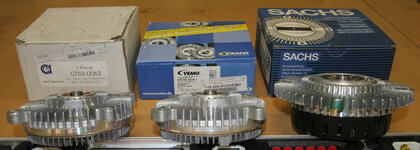
If you already have a Behr clutch installed, it should have the shorter bolt already, and the ACM clutch will be plug+play. All aftermarket clutches are thinner and require a shorter bolt. OE/OEM is either Sachs or Horton. You cannot use the original long bolt with an aftermarket clutch, the clutch and fan would be loose and wobble all over.

I've never used Evans coolant as the only advantage I can see is zero pressure. It has a bit less thermal transfer vs water and normal ethelyne glycol antifreeze. The bigger hassle is getting *all* water out of the system, which is borderline impossible without pulling the heater core. They want <3% water which will require flushing with their prep solution ($100 USD for 3 gallons needed) before filling with Evans. And, you should flush / de-oil / etc to clean everything prior to conversion, if there was any concern about oil in the system, or mineral deposits. This is extremely time consuming, especially the de-oil procedure, which requires multiple flushes, which means waiting hours in between each flush to let the engine cool... not fun. BT, DT.

:duck:

all_3_clutches4.jpg
 

Who has watched this thread (Total: 8) View details

Back
Top