

The following article is a how-to on replacing the radiator on an E500 or 500E. It should also apply equally to the 400E or E420, and generally speaking should also apply to any W124 car, with caveats.
Part numbers:
Tools needed:
Recently, the day before I left for Europe on June 16th, I was out nd about the north Houston area (I-45 corridor) in my E500, when I noticed that it was running a solid 110C on the freeway, when the speed should have had it at 100C or below. Arousing my suspicion, I downshifted the car at freeway speed into 3rd gear in an attempt to spool up the fan, to see if it would engage and cool things down a bit. It did not. At this point, being about 10-12 miles from home, I went into "emergency" mode and opened the windows and turned the heater on full blast. The temperature of the car continued to climb to the 110-115 mark -- causing me a lot of alarm. The last 5 miles home after getting off the freeway were especially nerve-wracking, because of the stoplights I had to endure. I revved the engine up to 3,000 RPM at each stoplight to keep the coolant circulating and the fan spooled up.
I got home luckily without overheating the car, but just barely avoided the dreaded 120C mark. I immediately pulled the car into my garage nose-first and popped the hood, and immediately saw the culprit -- the car was blowing steam out the front and rear of the upper driver's side of the radiator, and one could see dried coolant all over the engine compartment. The car was hissing and steam was escaping, and it continued to do this for a good 10 minutes after shutting the car off.
Finally, after letting the car cool down considerably, I decided to fill the bone-dry coolant overflow tank to see how much coolant had actually leaked/escaped from the cooling system. I only had 5 quarts of pre-mixed 50-50 MB coolant on hand, but the car took this and I was only at the very bottom of the coolant tank, so it probably would have taken at least another 1.5 quarts. So this means I had burned through at least 6.5 out of the car's 12-13 quarts of coolant. Oy!
Here are some photos of the carnage that I found inside of the engine compartment, once things had cooled down:


Now, I was leaving for GVZ Euro Tour 2013 literally the NEXT DAY, so I had no time to deal with this situation. So, I left the car parked in the garage with the hood up as a reminder to my wife not to drive it while I was gone.
By a stroke of good fortune, back in February my mechanic mentioned casually to me that he had a spare 500E radiator (a Nissens, new in box) that another customer had ordered a couple of years ago, but never picked up / paid for. So it was sitting around, and he wanted to get rid of it. I offered him $150 for it (AHAZ sells them for $200) and he was glad to oblige. I purchased the unit knowing that my car was still on its original radiator, and thus I got it as an insurance policy for the future. Little did I know that I would be using it in a matter of mere months...
Anyway, job #1 upon my return has been to get the radiator replaced. I got the spare unit down from my attic where I'd stored it, and the went about the task of replacing it. I spent a lot of time cleaning the engine bay of dried coolant and taking photographs; I'd say normally this job would require about 2-3 hours for the moderate do-it-yourselfer.
As with just about any job that is engine-related with our cars, remove the plastic belly-pan by removing the eight bolts that hold it to the car via 8mm socket and 1/4" ratchet. The first REAL step of the job, is then to remove the front cover from the engine. You can see some coolant had actually sprayed on the underside of this as well !! It's also a good time to remove the foam air tubes too.


The next step is to remove the upper radiator fan shroud and to loosen the lower half of the fan shroud. The lower half is not required to be removed from the car; it can be moved aside as needed. The upper part of the fan shroud attaches via two metal spring-clips, and then to the lower half with three 10mm bolts, which can easily be removed with a 10mm socket on a 1/4" ratchet.


Just for giggles, and while I was "down there" -- I decided to take a quick peek inside of the power steering reservoir to ensure that my recent tandem pump rebuild project was holding up, and PS fluid was not leaking from the reservoir or pump. I am happy to say that things are just fine.


Next up continues with the removal of the three bolts holding the two halves of the plastic fan shroud together.


Then, carefully separate the two halves of the shroud, and lift the top half out from the engine compartment. Look how much dried coolant is on that piece !!


A quick check of the decal at the top of the Behr radiator indicates that it is the original unit as installed on the car. I can't complain that it lasted 120,000 miles....

Next up, we start getting into the hose removal phase from the radiator. There are three coolant hoses to remove, and two transmission fluid lines on the passenger side. The coolant lines are the small top line to the overflow tank; the main top hose leading to the water pump, and the large bottom coolant hoses. All three of the coolant hoses are held on by ring clamps; the two transmission fluid lines are connected by banjo bolts and copper washers. These washers should be renewed upon installation of the new radiator.
First up, removing the small overflow hose. Notice that I leaned it up against the hood of the car so it would be out of the way, and any coolant inside would drain back down into the overflow tank.


Next up, it's time to drain the radiator using the built-in pet-cock on the bottom of the radiator, passenger side, behind the bumper. My car had a short length of rubber hose already installed onto the outlet, making draining a simple matter of pointing the end of the hose to my drain pan. Although the coolant looks like the green stuff, please rest assured that it is the proper MB coolant (old/yellow style). Remember, I had just added 5+ quarts of the MB stuff into the cooling system just before I left for Europe...


It's probably not a bad idea to loosen the overflow tank cap to ensure there is no vacuum in the system...

Next up, it's time to remove the two nuts that hold the transmission coolant line to the bottom of the radiator. These brackets basically just hold the line in place, but have to be removed. A 10mm socket, and moving the bottom part of the fan shroud out of the way, makes fairly short work of these two nuts. Be sure to set them aside in a safe place.

Next up, it's the banjo bolts that connect the transmission lines to the transmission oil cooler. Have a pan ready (a different one than your coolant pan) to catch the transmission fluid that will drain when you loosen the banjo bolts -- particularly the bottom one. Note that 1/2-1 cup of transmission fluid will leak out.

Next up is the large upper radiator hose. Good time to inspect these hoses and order new ones if need be... I bent the large upper hose up and stuck it behind the cap of the power steering pump reservoir, which held it very nicely.


Do the same with the lower hose (loosen clamp and remove hose).
Then, remove the two metal spring clamps that hold the radiator to the core support. Note that the clamps clamp down on rubber pads that are attached to the radiator. You will need to remove these rubber pads and transfer them to the new radiator.


Next you will need to CAREFULLY lift the radiator out of the car. You will need to wiggle it and jigger it to get it out, but it will come out in a couple of minutes, with patience. Take special care to have the lower radiator hose neck and the flange for the transmission cooler line holding clamps clear the fan clutch. Also, BE CAREFUL so as not to damage the A/C condenser coils that are right in front of the radiator.
Here you see a couple of views of the old and new radiator, immediately after removal. Note that some transmission fluid and coolant will continue to run out of the old radiator, so take caution with regard to spills.


Next up is an inspection of the radiator area. See all of the crud that attaches to the bottom of the radiator and condenser area over the years, and UNDERNEATH the radiator? You should all of this ick out at this time. You can sweep most of it away with your hand. Also, you will want to retrieve the two rubber feet that mate into the lower radiator support, and insert them in the holes there. That way it is very easy to align the new radiator's feet into these rubber feet. I cleaned up my feet with a shot of brake cleaner.


Also you can see me removing the rubber bits from the old radiator and preparing to transfer them to the new unit - the mounting clip sleeves, and the short length of drain hose at the pet-cock.
 *
*


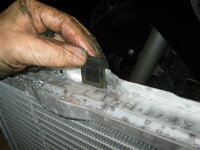
Next up, for me, came a small complication. Although the Nissens radiator was nearly identical to the stock Behr in almost all ways, it did not include the riveted angle brackets on the bottom of the radiator, that serve as supports for the transmission cooler line. This, I had to drill out the rivets and obtain the angle brackets, and then create a new setup with small machine screws. This was about a 30-minute diversion to drill out the rivets and source bolts, nuts and washers for the make-do setup.
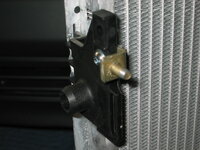

Dropping the radiator into the engine compartment ... CAREFULLY !!!


Next it's time to secure the radiator to the core support by inserting the spring clips and making sure the bottom of the radiator are inserted into the rubber feet cups.


The next step is to remove the plastic shipping plugs from the transmission cooler banjo bolt connections, and insert and tighten the banjo bolts attached to the transmission fluid lines. Be sure to use new copper washers at these connections!! Tightening torque is 30 Nm ... so pretty tight. These banjo bolts use a 19mm wrench, so use a long one that gives you some leverage before torquing it down with a socket and torque wrench.


Then, after you have attached the transmission oil lines with the banjo bolts, you can attach them to the angled "holder" brackets at the bottom of the radiator. These are the brackets that I attached earlier with the nuts and bolts after having to drill out the rivets that attached the angle brackets to the original radiator.


Then continue re-attaching the coolant hoses. This photo illustrates re-attaching the overflow tank hose to the fitting on the top of the radiator. You can also see me attaching the cleaned-up length of drain hoses to the outlet nipple at the pet-cock, which will make it very easy the next time I want to drain the radiator. You can also see me re-attaching the large upper radiator hose. Be sure to also attach the large lower hose at the bottom of the radiator (not shown here).


Lastly, insert the two metal spring clips that hold the top half of the plastic radiator fan shroud to the core support, AFTER using the three bolts to mate the two halves of the fan shroud together. Do note that the lower part of the fan shroud fits into two elongated slots in the lower core support, so be sure that these tabs on the lower half of the fan shroud are inserted into these slots before tightening things up.


After everything is done, you need to re-add coolant and transmission fluid into the system. What I did was to remove the large upper radiator hose at the water pump (engine side) and pour a fresh mixture of Zerex G05 coolant and water (50-50 mix) into the end of the hose, so that it flowed down into the radiator. It took about a gallon this way. Next I re-attached this hose and then poured about another two quarts or so into the coolant overflow reservoir, bringing it up to the line. Then I started the engine and brought it up to operating temperature at idle, running the cabin heater at full heat and fan to circulate the coolant.
For the transmission fluid, you should bring the car up to operating temperate at ldle as mentioned above. Once it's hot, get in the car and run it once or twice through the gears: Park, Reverse, Neutral, Drive...and do it once or twice more while sitting in the garage with your foot on the brake. Put the transmission back in Park. Let it idle for a minute or two and then remove the transmission dipstick to check the fluid level. Use ONLY a piece of leather or a lint-free cloth to wipe off the transmission dipstick. Check the fluid level and add fluid accordingly, to bring it up to the proper level. Draining the transmission oil cooler should have probably drained about 1/4 to 1/2 a quart, so it shouldn't require much transmission fluid to bring it back up to the proper level.
After everything is done, start up the engine to check for leaks. Pay close attention to the banjo bolt fittings at the transmission cooler lines, as well as (of course) the coolant hose connections. If you have any leaks, tighten and/or adjust the connections accordingly. This is what everything should look like once completed.
Don't forget to also replace the plastic belly pan once the job is complete, and you are sure there are no leaks.

Part numbers:
- Radiator (same part for 036 and 034 chassis): 124 500 14 02 - Behr or Nissens are fine. Approximately USD $200 via AutohausAZ.com
- 2 copper washers for transmission cooler banjo bolts):
007603-012102007603-014106 (14x20x1.5) - approximately USD $0.25 each via AutohausAZ.com - 1 gallon MB or Zerex G05 coolant - approximately $15 per gallon via O'Reilly Auto Parts or $20+ per gallon at the MB stealership (blue fluid)
- 1 quart Dexron III compatible transmission fluid - approximately $5.00 at any auto parts store
Tools needed:
- Medium flat-blade screwdriver
- 1/4" ratchet with 8mm, 10mm and 13mm sockets
- 19mm box-end or open-end wrench
Recently, the day before I left for Europe on June 16th, I was out nd about the north Houston area (I-45 corridor) in my E500, when I noticed that it was running a solid 110C on the freeway, when the speed should have had it at 100C or below. Arousing my suspicion, I downshifted the car at freeway speed into 3rd gear in an attempt to spool up the fan, to see if it would engage and cool things down a bit. It did not. At this point, being about 10-12 miles from home, I went into "emergency" mode and opened the windows and turned the heater on full blast. The temperature of the car continued to climb to the 110-115 mark -- causing me a lot of alarm. The last 5 miles home after getting off the freeway were especially nerve-wracking, because of the stoplights I had to endure. I revved the engine up to 3,000 RPM at each stoplight to keep the coolant circulating and the fan spooled up.
I got home luckily without overheating the car, but just barely avoided the dreaded 120C mark. I immediately pulled the car into my garage nose-first and popped the hood, and immediately saw the culprit -- the car was blowing steam out the front and rear of the upper driver's side of the radiator, and one could see dried coolant all over the engine compartment. The car was hissing and steam was escaping, and it continued to do this for a good 10 minutes after shutting the car off.
Finally, after letting the car cool down considerably, I decided to fill the bone-dry coolant overflow tank to see how much coolant had actually leaked/escaped from the cooling system. I only had 5 quarts of pre-mixed 50-50 MB coolant on hand, but the car took this and I was only at the very bottom of the coolant tank, so it probably would have taken at least another 1.5 quarts. So this means I had burned through at least 6.5 out of the car's 12-13 quarts of coolant. Oy!
Here are some photos of the carnage that I found inside of the engine compartment, once things had cooled down:
Now, I was leaving for GVZ Euro Tour 2013 literally the NEXT DAY, so I had no time to deal with this situation. So, I left the car parked in the garage with the hood up as a reminder to my wife not to drive it while I was gone.
By a stroke of good fortune, back in February my mechanic mentioned casually to me that he had a spare 500E radiator (a Nissens, new in box) that another customer had ordered a couple of years ago, but never picked up / paid for. So it was sitting around, and he wanted to get rid of it. I offered him $150 for it (AHAZ sells them for $200) and he was glad to oblige. I purchased the unit knowing that my car was still on its original radiator, and thus I got it as an insurance policy for the future. Little did I know that I would be using it in a matter of mere months...
Anyway, job #1 upon my return has been to get the radiator replaced. I got the spare unit down from my attic where I'd stored it, and the went about the task of replacing it. I spent a lot of time cleaning the engine bay of dried coolant and taking photographs; I'd say normally this job would require about 2-3 hours for the moderate do-it-yourselfer.
As with just about any job that is engine-related with our cars, remove the plastic belly-pan by removing the eight bolts that hold it to the car via 8mm socket and 1/4" ratchet. The first REAL step of the job, is then to remove the front cover from the engine. You can see some coolant had actually sprayed on the underside of this as well !! It's also a good time to remove the foam air tubes too.
The next step is to remove the upper radiator fan shroud and to loosen the lower half of the fan shroud. The lower half is not required to be removed from the car; it can be moved aside as needed. The upper part of the fan shroud attaches via two metal spring-clips, and then to the lower half with three 10mm bolts, which can easily be removed with a 10mm socket on a 1/4" ratchet.
Just for giggles, and while I was "down there" -- I decided to take a quick peek inside of the power steering reservoir to ensure that my recent tandem pump rebuild project was holding up, and PS fluid was not leaking from the reservoir or pump. I am happy to say that things are just fine.
Next up continues with the removal of the three bolts holding the two halves of the plastic fan shroud together.
Then, carefully separate the two halves of the shroud, and lift the top half out from the engine compartment. Look how much dried coolant is on that piece !!
A quick check of the decal at the top of the Behr radiator indicates that it is the original unit as installed on the car. I can't complain that it lasted 120,000 miles....
Next up, we start getting into the hose removal phase from the radiator. There are three coolant hoses to remove, and two transmission fluid lines on the passenger side. The coolant lines are the small top line to the overflow tank; the main top hose leading to the water pump, and the large bottom coolant hoses. All three of the coolant hoses are held on by ring clamps; the two transmission fluid lines are connected by banjo bolts and copper washers. These washers should be renewed upon installation of the new radiator.
First up, removing the small overflow hose. Notice that I leaned it up against the hood of the car so it would be out of the way, and any coolant inside would drain back down into the overflow tank.
Next up, it's time to drain the radiator using the built-in pet-cock on the bottom of the radiator, passenger side, behind the bumper. My car had a short length of rubber hose already installed onto the outlet, making draining a simple matter of pointing the end of the hose to my drain pan. Although the coolant looks like the green stuff, please rest assured that it is the proper MB coolant (old/yellow style). Remember, I had just added 5+ quarts of the MB stuff into the cooling system just before I left for Europe...
It's probably not a bad idea to loosen the overflow tank cap to ensure there is no vacuum in the system...
Next up, it's time to remove the two nuts that hold the transmission coolant line to the bottom of the radiator. These brackets basically just hold the line in place, but have to be removed. A 10mm socket, and moving the bottom part of the fan shroud out of the way, makes fairly short work of these two nuts. Be sure to set them aside in a safe place.
Next up, it's the banjo bolts that connect the transmission lines to the transmission oil cooler. Have a pan ready (a different one than your coolant pan) to catch the transmission fluid that will drain when you loosen the banjo bolts -- particularly the bottom one. Note that 1/2-1 cup of transmission fluid will leak out.
Next up is the large upper radiator hose. Good time to inspect these hoses and order new ones if need be... I bent the large upper hose up and stuck it behind the cap of the power steering pump reservoir, which held it very nicely.
Do the same with the lower hose (loosen clamp and remove hose).
Then, remove the two metal spring clamps that hold the radiator to the core support. Note that the clamps clamp down on rubber pads that are attached to the radiator. You will need to remove these rubber pads and transfer them to the new radiator.
Next you will need to CAREFULLY lift the radiator out of the car. You will need to wiggle it and jigger it to get it out, but it will come out in a couple of minutes, with patience. Take special care to have the lower radiator hose neck and the flange for the transmission cooler line holding clamps clear the fan clutch. Also, BE CAREFUL so as not to damage the A/C condenser coils that are right in front of the radiator.
Here you see a couple of views of the old and new radiator, immediately after removal. Note that some transmission fluid and coolant will continue to run out of the old radiator, so take caution with regard to spills.
Next up is an inspection of the radiator area. See all of the crud that attaches to the bottom of the radiator and condenser area over the years, and UNDERNEATH the radiator? You should all of this ick out at this time. You can sweep most of it away with your hand. Also, you will want to retrieve the two rubber feet that mate into the lower radiator support, and insert them in the holes there. That way it is very easy to align the new radiator's feet into these rubber feet. I cleaned up my feet with a shot of brake cleaner.
Also you can see me removing the rubber bits from the old radiator and preparing to transfer them to the new unit - the mounting clip sleeves, and the short length of drain hose at the pet-cock.
* Next up, for me, came a small complication. Although the Nissens radiator was nearly identical to the stock Behr in almost all ways, it did not include the riveted angle brackets on the bottom of the radiator, that serve as supports for the transmission cooler line. This, I had to drill out the rivets and obtain the angle brackets, and then create a new setup with small machine screws. This was about a 30-minute diversion to drill out the rivets and source bolts, nuts and washers for the make-do setup.
Dropping the radiator into the engine compartment ... CAREFULLY !!!
Next it's time to secure the radiator to the core support by inserting the spring clips and making sure the bottom of the radiator are inserted into the rubber feet cups.
The next step is to remove the plastic shipping plugs from the transmission cooler banjo bolt connections, and insert and tighten the banjo bolts attached to the transmission fluid lines. Be sure to use new copper washers at these connections!! Tightening torque is 30 Nm ... so pretty tight. These banjo bolts use a 19mm wrench, so use a long one that gives you some leverage before torquing it down with a socket and torque wrench.
Then, after you have attached the transmission oil lines with the banjo bolts, you can attach them to the angled "holder" brackets at the bottom of the radiator. These are the brackets that I attached earlier with the nuts and bolts after having to drill out the rivets that attached the angle brackets to the original radiator.
Then continue re-attaching the coolant hoses. This photo illustrates re-attaching the overflow tank hose to the fitting on the top of the radiator. You can also see me attaching the cleaned-up length of drain hoses to the outlet nipple at the pet-cock, which will make it very easy the next time I want to drain the radiator. You can also see me re-attaching the large upper radiator hose. Be sure to also attach the large lower hose at the bottom of the radiator (not shown here).
Lastly, insert the two metal spring clips that hold the top half of the plastic radiator fan shroud to the core support, AFTER using the three bolts to mate the two halves of the fan shroud together. Do note that the lower part of the fan shroud fits into two elongated slots in the lower core support, so be sure that these tabs on the lower half of the fan shroud are inserted into these slots before tightening things up.
After everything is done, you need to re-add coolant and transmission fluid into the system. What I did was to remove the large upper radiator hose at the water pump (engine side) and pour a fresh mixture of Zerex G05 coolant and water (50-50 mix) into the end of the hose, so that it flowed down into the radiator. It took about a gallon this way. Next I re-attached this hose and then poured about another two quarts or so into the coolant overflow reservoir, bringing it up to the line. Then I started the engine and brought it up to operating temperature at idle, running the cabin heater at full heat and fan to circulate the coolant.
For the transmission fluid, you should bring the car up to operating temperate at ldle as mentioned above. Once it's hot, get in the car and run it once or twice through the gears: Park, Reverse, Neutral, Drive...and do it once or twice more while sitting in the garage with your foot on the brake. Put the transmission back in Park. Let it idle for a minute or two and then remove the transmission dipstick to check the fluid level. Use ONLY a piece of leather or a lint-free cloth to wipe off the transmission dipstick. Check the fluid level and add fluid accordingly, to bring it up to the proper level. Draining the transmission oil cooler should have probably drained about 1/4 to 1/2 a quart, so it shouldn't require much transmission fluid to bring it back up to the proper level.
After everything is done, start up the engine to check for leaks. Pay close attention to the banjo bolt fittings at the transmission cooler lines, as well as (of course) the coolant hose connections. If you have any leaks, tighten and/or adjust the connections accordingly. This is what everything should look like once completed.
Don't forget to also replace the plastic belly pan once the job is complete, and you are sure there are no leaks.
Last edited:



 I got headache now