

People are catching on to what we all knew 20 years ago...


 carbuzz.com
In 1985, Mercedes-Benz launched the W124 in America. Slowly but steadily, the platform grew to become a renowned foundation for German luxury and quickly established itself as a resilient example of understated greatness. The W124 made its way into households across the nation, where people found it ideal for long-distance interstate trips or commuter routes across town, and it ingratiated itself so much with those buyers that people simply couldn’t part with it.
So, the US-spec W124 became irreplaceable for families, professionals, or fleet operators alike, and it could easily survive with three generations of owners. And it became such a legend in its lifetime mainly because Mercedes focused carefully on the fundamentals and – unlike some rivals – didn’t major on ever-changing technology or chase passing fads.
 Bring a Trailer
It’s difficult to find many cars throughout US history that can last quite as long as a W124. After all, the E-Class sedans and wagons can routinely top 200,000 miles, and there are examples of daily-driven vehicles with 300K or even 400K on the clock. Savvy used-car buyers will often scour classifieds and enthusiast auctions looking for high-mileage examples, as they know these can still resist wear and depreciation better than many other luxury vehicles. And it’s not unusual to find E-Class diesels in taxi fleets that have reached half a million miles on their original drivetrains.
Drivetrain resilience is one of the reasons why airport shuttle operators often use W124 wagons for their high-impact work, as these vehicles not only have a sturdy engine but also a robust transmission. Rust-resistant panels and well-built interiors can withstand decades of abuse, and that’s something that contemporary rivals like Jaguar, BMW, or other American luxury carmakers cannot often claim. Mercedes set out to make a car that would stick around, and to make something US owners could trust for the long haul.
 Bring a Trailer
One of the biggest E-Class plus points is its engineering setup, and every detail of the W124’s design shows how Mercedes engineers focused on durability for the American lifestyle specifically.
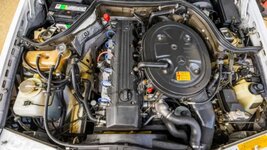
Take the engines, for example, including the 300E’s inline-six or the legendary 300D turbodiesel. Mercedes chose these because they deliver their power smoothly and very ruggedly. You’d get 177 hp and 188 lb-ft of torque from the 300E’s 3.0-liter straight-six, and when Mercedes matched this to a bulletproof four-speed automatic transmission, you’d get exemplary reliability. This is why wagons like the 300TE or the later E320 wagon grew to become family workhorses throughout the country.
Mercedes also focused carefully on the body of the W124 by, for example, using zinc-coated panels and robust rust protection so that it would stand up to potential corrosion from salting on US roads. The company also favored a special independent front strut/wishbone layout with its signature five-link independent rear axle to make the car predictably stable and comfortable over rough American pavement. It even added ABS brakes as standard some years before most of its rivals, while airbags were arriving as early as1990 1986.
Inside, designers chose durable cloth, genuine leather, or MB-Tex vinyl because these materials were highly resistant to wear. And if you bought a wagon, you’d get self-levelling rear suspension to help you cope with the heaviest loads without compromising ride quality. Meanwhile, if you were looking for performance, there was always the 500E that Mercedes built in collaboration with Porsche. This would give you 322 hp and get you to 60 mph in about5.5 6.0 seconds to put it firmly in performance-icon territory.
Still, every vehicle has problems somewhere, and while the car’s reliability is legendary, some do develop issues with climate-control modules, aging suspension bushings, or biodegradable wiring insulation. But none of these challenges are particularly serious, as parts are readily available, US mechanics are very familiar with the model, and there are numerous Mercedes clubs around the country to support owners when needed.
 Bring a Trailer
The W124 steadily became a fixture in American family life as well as in professional circles. Well-heeled suburban families would choose a wagon as their default choice of transportation. Companies would choose sedans to ferry their executives from meeting to meeting, and sunbelt buyers loved coupe and convertible options that would give them some German refinement in open-air form.
Today, enthusiasts and collectors know that the W124 is a modern classic, and auction prices tend to reflect this. You may have to pay between $10,000 and $20,000 for a clean E-Class sedan within 100,000 miles, but a pristine wagon can reach $25,000.
And don’t be surprised if you need to pay more than $60,000 for an outstanding 500E or E500 model at auction. Most collectors look for cars from those sunbelt states with full service records, and if vehicles have some rare factory options like heated seats or walnut trim, collectors will pay a bit more.
It’s very easy to own an older Mercedes-Benz in the US, as there are many independent specialists around. Mercedes-Benz USA has its Classic Center, and there’s a strong aftermarket to help keep high-mileage cars on the road. It’s also feasible to restore some of these cars with a reasonable amount of knowledge and find the vast majority of parts without hassle.
 Bring a Trailer
Bruno Sacco made a lasting impression on the American luxury market with his W124 design. Its understated appearance was quite formal, and its flush-mounted glass and prominent front grille helped to define Mercedes sophistication.In the US, the W124s had larger bumpers so they would meet DOT safety codes, as well as DOT-spec composite headlamps.
Family buyers loved the wagons’ rear-facing child seats and most everything about the interior exhibited quality, too. You’d get American-market sound systems, power-adjustable seats, broad dash layouts with crystal-clear gauges, and very effective climate control.
 Bring a Trailer
In the tough American marketplace, few German luxury cars have lasted the way the Mercedes W124 E-Class has. The company carefully engineered and built these vehicles so they could provide decades of service, outlast most of the competition, and see their way through multiple owners. And across the majority of states, there are examples of W124s that have covered hundreds of thousands of miles, making this vehicle a prime example of enduring European luxury.
When you consider the effort Mercedes put into its manufacture, it’s not surprising to see that the W124’s resilience, practical comfort, and timeless design have outlasted rivals. After all, this is a vehicle that bridges generations and is likely to continue inspiring Americans for additional generations to come.
The German Luxury Car That Will Outlast Your Grandkids' Grandkids
From family workhorses to performance icons, this Mercedes classic has stood the test of time.
carbuzz.com
In 1985, Mercedes-Benz launched the W124 in America. Slowly but steadily, the platform grew to become a renowned foundation for German luxury and quickly established itself as a resilient example of understated greatness. The W124 made its way into households across the nation, where people found it ideal for long-distance interstate trips or commuter routes across town, and it ingratiated itself so much with those buyers that people simply couldn’t part with it.
So, the US-spec W124 became irreplaceable for families, professionals, or fleet operators alike, and it could easily survive with three generations of owners. And it became such a legend in its lifetime mainly because Mercedes focused carefully on the fundamentals and – unlike some rivals – didn’t major on ever-changing technology or chase passing fads.
How The W124 Became The Benchmark For Longevity
Bring a TrailerIt’s difficult to find many cars throughout US history that can last quite as long as a W124. After all, the E-Class sedans and wagons can routinely top 200,000 miles, and there are examples of daily-driven vehicles with 300K or even 400K on the clock. Savvy used-car buyers will often scour classifieds and enthusiast auctions looking for high-mileage examples, as they know these can still resist wear and depreciation better than many other luxury vehicles. And it’s not unusual to find E-Class diesels in taxi fleets that have reached half a million miles on their original drivetrains.
Drivetrain resilience is one of the reasons why airport shuttle operators often use W124 wagons for their high-impact work, as these vehicles not only have a sturdy engine but also a robust transmission. Rust-resistant panels and well-built interiors can withstand decades of abuse, and that’s something that contemporary rivals like Jaguar, BMW, or other American luxury carmakers cannot often claim. Mercedes set out to make a car that would stick around, and to make something US owners could trust for the long haul.
Engineering Made To Endure, Not Necessarily To Impress
Bring a TrailerOne of the biggest E-Class plus points is its engineering setup, and every detail of the W124’s design shows how Mercedes engineers focused on durability for the American lifestyle specifically.
Take the engines, for example, including the 300E’s inline-six or the legendary 300D turbodiesel. Mercedes chose these because they deliver their power smoothly and very ruggedly. You’d get 177 hp and 188 lb-ft of torque from the 300E’s 3.0-liter straight-six, and when Mercedes matched this to a bulletproof four-speed automatic transmission, you’d get exemplary reliability. This is why wagons like the 300TE or the later E320 wagon grew to become family workhorses throughout the country.
Mercedes also focused carefully on the body of the W124 by, for example, using zinc-coated panels and robust rust protection so that it would stand up to potential corrosion from salting on US roads. The company also favored a special independent front strut/wishbone layout with its signature five-link independent rear axle to make the car predictably stable and comfortable over rough American pavement. It even added ABS brakes as standard some years before most of its rivals, while airbags were arriving as early as
Inside, designers chose durable cloth, genuine leather, or MB-Tex vinyl because these materials were highly resistant to wear. And if you bought a wagon, you’d get self-levelling rear suspension to help you cope with the heaviest loads without compromising ride quality. Meanwhile, if you were looking for performance, there was always the 500E that Mercedes built in collaboration with Porsche. This would give you 322 hp and get you to 60 mph in about
Still, every vehicle has problems somewhere, and while the car’s reliability is legendary, some do develop issues with climate-control modules, aging suspension bushings, or biodegradable wiring insulation. But none of these challenges are particularly serious, as parts are readily available, US mechanics are very familiar with the model, and there are numerous Mercedes clubs around the country to support owners when needed.
The Everyday E-Class Becomes a Cult Classic
Bring a TrailerThe W124 steadily became a fixture in American family life as well as in professional circles. Well-heeled suburban families would choose a wagon as their default choice of transportation. Companies would choose sedans to ferry their executives from meeting to meeting, and sunbelt buyers loved coupe and convertible options that would give them some German refinement in open-air form.
Today, enthusiasts and collectors know that the W124 is a modern classic, and auction prices tend to reflect this. You may have to pay between $10,000 and $20,000 for a clean E-Class sedan within 100,000 miles, but a pristine wagon can reach $25,000.
And don’t be surprised if you need to pay more than $60,000 for an outstanding 500E or E500 model at auction. Most collectors look for cars from those sunbelt states with full service records, and if vehicles have some rare factory options like heated seats or walnut trim, collectors will pay a bit more.
It’s very easy to own an older Mercedes-Benz in the US, as there are many independent specialists around. Mercedes-Benz USA has its Classic Center, and there’s a strong aftermarket to help keep high-mileage cars on the road. It’s also feasible to restore some of these cars with a reasonable amount of knowledge and find the vast majority of parts without hassle.
The Design That Defined Mercedes for a Generation
Bring a TrailerBruno Sacco made a lasting impression on the American luxury market with his W124 design. Its understated appearance was quite formal, and its flush-mounted glass and prominent front grille helped to define Mercedes sophistication.
Family buyers loved the wagons’ rear-facing child seats and most everything about the interior exhibited quality, too. You’d get American-market sound systems, power-adjustable seats, broad dash layouts with crystal-clear gauges, and very effective climate control.
Looking for the Best Examples
Today, there’s plenty of support for those who would like to have some W124 reliability in their life. Such shoppers can join Mercedes-Benz clubs that host regular meetings and technical sessions, and these are particularly strong in areas like California or Florida where you can find rust-free survivors. Buyers are particularly interested in cars that have stayed within a single family all their life, or low-mileage examples, and especially vehicles that have accurate service documentation or original finishes. Families look for E320 wagons, performance-minded buyers gravitate towards the 500E, and even untouched 300Es could serve well as ideal daily classics.The Enduring Classic
Bring a TrailerIn the tough American marketplace, few German luxury cars have lasted the way the Mercedes W124 E-Class has. The company carefully engineered and built these vehicles so they could provide decades of service, outlast most of the competition, and see their way through multiple owners. And across the majority of states, there are examples of W124s that have covered hundreds of thousands of miles, making this vehicle a prime example of enduring European luxury.
When you consider the effort Mercedes put into its manufacture, it’s not surprising to see that the W124’s resilience, practical comfort, and timeless design have outlasted rivals. After all, this is a vehicle that bridges generations and is likely to continue inspiring Americans for additional generations to come.
Sources: Classics World, Mercedes-Benz, Car and Classic, Mercedes Blog, Octoclassic


