• Hi Guest !

    Welcome to the 500Eboard forum.

    Since its founding in late 2008, 500Eboard has become the leading resource on the Internet for all things related to the Mercedes-Benz 500E and E500. In recent years, we have also expanded to include the 400E and E420 models, which are directly related to the 500E/E500.

    We invite you to browse and take advantage of the information and resources here on the site. If you find helpful information, please register for full membership, and you'll find even more resources available. Feel free to ask questions, and make liberal use of the "Search" function to find answers.

    We hope you will become an active contributor to the community!

    Sincerely,
    500Eboard Management

Ball Joint replacement tips?

Duh_Vinci

E500E **Meister**
Member
Cheers all!

I need to tackle my brother's R129 lower balljoints today, he really needs to have it done this weekend to get at least 1 drivable car for the week.

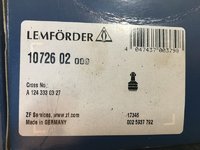
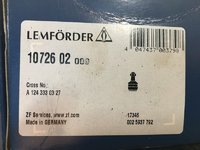
I tried to search but didn't see any "how to" here (couldn't find, if there is one, please, could you point to the article?). It is the early LCA on his car, press in ball joints (same setup as w124). Just so "happens" that I have an extra pair of Leforder balljoints in my parts bin... :alky:

I stumbled on this video, a little primitive, cruel, but seems effective:


Is it really as simple as that? I would certainly rent the ball joint press from Autozone, and it almost feels like I need to compress/secure the coil spring for safety (I do have internal compressor)? But otherwise, nothing else to remove according to the video?

Regards,
D
 
Last edited:
Hi D_V,

I have not done this job on a W124, only on the W126 which is totally different. You are right, that video is quite crude in terms of how the job was done, but it is correct as far as what NEEDS to be done in terms of the steps taken.

I would VERY DEFINITELY compress the front spring (even remove it) to improve safety, and employ a ball joint press (rented?) to do this correctly. I'm sure the @gsxr will have some tips and tricks.

Good luck ! And be thankful the LCAs are the early type with removable BJs....
 
Wait a min... Gerry, there is something you have not done on W124??? The only reason I can think of would be because you replaced the entire LCA 😜

The spring, most definitely! Watching this short video, hammering out the joint, couldn't help but catching myself cringing with each hammer blow just looking at that spring!!!

Will report later today I hope...

Regards,
D
 
I have never had to replace an LCA on my W124s. Well, I did on my ex-wife's former S124 wagon, but I had that job professionally done many years ago.

Looking forward to your HOW-TO article :detective:
 
All 124's with M104 or M119 engines have non-replaceable ball joints (except early 500E). So, a lot of folks haven't had to DIY this.

Tip: The ball joints are directional!! There is a notch on the joint, this MUST be aligned properly with the LCA. This is sort of shown at 1:43 in the video but it wasn't clear.

Of course, I don't recommend imitating anything you see in that video...

:run:
 
Ok, replaced his ball joints - the horrid squeak/screech is gone! The short response to that video and R129 LCA/Ball joint - no way in hell this can be done without removing the calipers and the rotors because of how the dust shield is formed around the ball joint seat on these cars...
...Looking forward to your HOW-TO article :detective:
Going to sort through the pics shortly, will post in a little bit...
All 124's with M104 or M119 engines have non-replaceable ball joints (except early 500E). So, a lot of folks haven't had to DIY this.

Tip: The ball joints are directional!! There is a notch on the joint, this MUST be aligned properly with the LCA. This is sort of shown at 1:43 in the video but it wasn't clear.

Of course, I don't recommend imitating anything you see in that video...

:run:
Learn something new every day!

Regards,
D
 
Lower ball joint replacement... The following steps for illustration purposes, if you break things, it's on you (not on me) :wormhole:

First and foremost, if your W124/R129 car is equipped with the LCA that uses replaceable lower ball joint, despite the few videos one may find online – not going to happen with out removing the caliper and and the rotor. Not unless one wants to butcher the dust shield.

The dust shield is shaped where it “hugs/cups” around the ball joint receiving end/knuckle, and the clearance between this part of the shield is only few millimeters. Not enough to “move” the shield out of the way and pull LCA down.

Once the caliper and the rotor removed, dust shield now has room to move outward, bending it slightly out of the way, and with that, the ball joint section of the LCA can easily be separated and clear the assembly.

Tools:

17mm wrench
19mm socket
19mm wrench
Extensions
Punch
Spring compressor
Jack
Jack stands
Wheel chucks
Ball Joint Extraction/press tool set
Ratcheting strap
Hanger wire for the caliper


With the car secured, hand brake on and the wheels chucked, loosen the wheel bolts, jack the car, remove the wheel/tire, secure the car with jack stands for safety.

Over all there are only 4 bolts to be removed, but it will take a little time... Be prepared to move the steering wheel clock to clock for better access to those bolts.

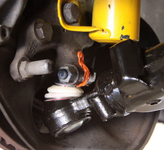
Removed the 17mm steering stop bolt/pin (I don't know what else to call it), this would be much easier to access the 19mm nut of the ball joint

IMG_0768-X2.jpg

Onto the ball joint retaining bolt/nut combo, using 19mm socket
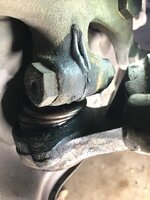
IMG_0767-X2.jpg

Loosened them up, did not remove the nut all the way, just taped it a little, to start the "extraction".

Using appropriate spring compressor, partially compressed the spring. This relieved the pressure from the LCA.
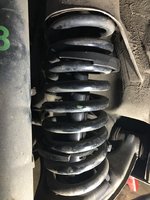
IMG_0769-X2.jpg

Placed the jack under the outer part of LCA, and jack up LCA just enough where one can see the shock assembly starting to move up, stoped right there. Now is the time to punch out the 19mm ball joint nut/bolt assembly. New bolts and nuts are included with Lefmorder kit.
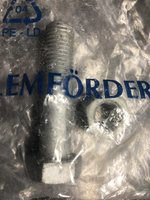
IMG_0782-X2.jpg

Now it is time to remove the rotor and the caliper: 1 set screw and x2 caliper bolts (19mm) Hanged the caliper safely where no strain on the sensor or the brake line is introduced.

Bent the dust shield outward a little, and now it will clear the knuckle... Inserted the pry-bar in the suitable area and began the separation from the shaft. Once loose, started lowering the jack slowly, and separated completely.

Moved the strut hub assembly out of the way and secure it with the strap, needed this room maneuver around with the ball joint press tool
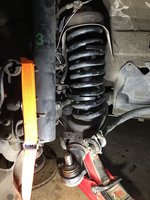
IMG_0770-X2.jpg

Tool kits are different, almost like a little puzzle. I borrowed this set from a friend, however, Autozone rents similar kit.

Before proceeded any further, please, note, there is a notch on the ball joint base:

IMG_0786-X2.jpg

Look at the car's old ball joint, note the position of the notch and make sure the new one goes in the same position/orientation of the notch.
[Admin edit: This assumes the "old" joint was original, and/or installed correctly. FSM job 33-0440 (link) has a diagram which shows the orientation of the notch, with the text "...the [notch] on the joint is aligned with the center of the control arm"


Found the appropriate size fitting, press the ball joint assembly out
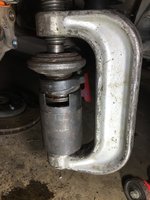
IMG_0771-X2.jpg

This old one came out in 3 pieces, definitely old and tired

IMG_0784-L.jpg

Ensured that all the surfaces are clean prior to installation of the ball joint!

Placed the jack under the LCA and move LCA upwards, definitely need that clearance at the bottom to press the new ball joint in.

Positioned the new ball joint into receptacle, ensuring the proper orientation of the notch. This is the combination I found worked the best with this ball joint tool set:

IMG_0773-X2.jpg

Once firmly sited/pressed in, lowered the jack, released the strut/hub assembly and it is now the time to mate them together.

When the assembly is on the shaft of the ball joint, placed the jack back under the LCA:
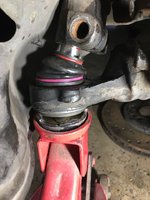
IMG_0777-X2.jpg

Jacked it up to the point where the shaft is all the way in and the shock assembly starting to move upwards... Ensured that the steering wheel is straight, looked into the hole where the 19mm, at this point it should be perfectly round. That opening should perfectly correspond with the notch on the shaft of the ball joint for that 19mm bolt to clear
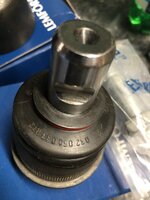
IMG_0781-X2.jpg

I used the original bolt to test fit, just to make sure (that way there is no chance to damaging the treads of the new hardware):

IMG_0778-X2.jpg

With jack still under the LCA, remove the old "test" bolt, installed new bolt and nut supplied with the kit. Tightened down.

Bent the dust shield back to it's original orientation. Installed the rotor. Secured with set screw, I always like to apply a bit of anti-seize to that screw.

Installed the caliper back, securing it with 19mm bolts/hardware, torque to specs (115nm if I'm not mistaken), new hardware is recommended.

Re-installed the 17mm steering stop/bolt/pin.

Checked for completeness of all steps. Onto the other side you go... Hope this helps.

Regards,
D

P.S @gerryvz please feel free to make any changes to make into the standard format? And if any one can provide proper torque specs for the 19mm ball joint bolt/nut, that would be great!

If anyone have any additional tips/pointers/corrections, please, chime in!

 

Attachments

  • IMG_0779-L.jpg
    IMG_0779-L.jpg
    111.3 KB · Views: 12
Last edited:
Great writeup, D_V! Gerry may be able to copy this to a "HOW-TO" thread.

FSM procedure shows the orientation of the joint notch vs LCA, see first screenshot below.

Torque spec for the 19mm pinch bolt for the joint is mentioned in job 33-0510 for the LCA removal, at 125Nm:

Job 33-0510 also mentions to pack the slot in the steering knuckle with wax, to keep the joint from rusting into the knuckle. See second & third photos. I used RTV applied externally as I didn't have any beehives nearby. Anything that keeps water & dirt out of the slot, and won't fall out over time, is acceptable.

Final tip: After cleaning thoroughly, apply anti-seize to the joint/socket at the steering knuckle, including the bolt hole. This will prevent future corrosion, along with sealing the slot as described above. I've seen some knuckles with significant internal rust in this area, to the point where the joint (and pinch bolt) were partly seized had to be hammered out. Use a round wire bore brush (link) on a drill to make the cleaning process quick and painless.

1605450623892.png 1605450857874.png 1605451005133.png
 
Great writeup, D_V! Gerry may be able to copy this to a "HOW-TO" thread.

FSM procedure shows the orientation of the joint notch vs LCA, see first screenshot below.

Torque spec for the 19mm pinch bolt for the joint is mentioned in job 33-0510 for the LCA removal, at 125Nm:

Job 33-0510 also mentions to pack the slot in the steering knuckle with wax, to keep the joint from rusting into the knuckle. See second & third photos. I used RTV applied externally as I didn't have any beehives nearby. Anything that keeps water & dirt out of the slot, and won't fall out over time, is acceptable.

Final tip: After cleaning thoroughly, apply anti-seize to the joint/socket at the steering knuckle, including the bolt hole. This will prevent future corrosion, along with sealing the slot as described above. I've seen some knuckles with significant internal rust in this area, to the point where the joint (and pinch bolt) were partly seized had to be hammered out. Use a round wire bore brush (link) on a drill to make the cleaning process quick and painless.

View attachment 118348 View attachment 118349 View attachment 118350
Dave, as always, great info, appreciate it! Very very useful details that you'd find nowhere else!!!

Regards,
D

P.S. Say, yellow... B6 or B8?
 

Who has viewed this thread (Total: 3) View details

Back
Top