• Hi Guest !

    Welcome to the 500Eboard forum.

    Since its founding in late 2008, 500Eboard has become the leading resource on the Internet for all things related to the Mercedes-Benz 500E and E500. In recent years, we have also expanded to include the 400E and E420 models, which are directly related to the 500E/E500.

    We invite you to browse and take advantage of the information and resources here on the site. If you find helpful information, please register for full membership, and you'll find even more resources available. Feel free to ask questions, and make liberal use of the "Search" function to find answers.

    We hope you will become an active contributor to the community!

    Sincerely,
    500Eboard Management

OWNER Surf Blau (Norsker)

Yes! Actually that should boost power on your 1993 to low 330ps range. Details here.

It almost certainly will need new capacitors installed though... if you have the ability, replace those before installing in your car.
Nice, that should definitely make it worthwhile! And thanks for the link - I love the trademarked ButtDyno™️ , that's what really matters!

I want to be able to see live data from the engine before I swap it into my car though, which leaves me some time to do the capacitors - is there a How-to for this, or is it apparent enough what I need when I open the unit? I have played around enough with arduinos and hobby electronics to feel confident in performing such a procedure. ✊
 
There's not a how-to as it's standard electronics / soldering, but this thread has more info. I use the automotive-rated Nichicon UBT's like Alphasud. I've found the factory solder to require ridiculous amounts of heat before it liqifies, need to have my Weller soldering station pegged at 850°F and that barely does the job. You don't need to remove all the old goopy conformal coating, just around the 6 (or sometimes 7) capacitor leads underneath. If possible, practice on a spare/junk/low-value LH module before attempting it on your good one. Plan on it taking 1-2 hours the first time.

:shocking:
 
Yikes, hefty temperatures for some tiny components! Thanks for the link, I'll see if I can source them locally as well (y)
 
I had an issue with the outside temperature gauge in my car, which acted all crazy and never showed anything meaningful:


The PO told me that some (self proclaimed) experts he had discussed the matter with, diagnosed it to a faulty temperature sensor and thus he had bought a new one that I got with the car. I tested this briefly, not expecting anything as I couldn't see this effect from a faulty signal, and as expected nothing changed.

Last week I found a cheap, used replacement display from an early 90s S124, and decided to test it today. Unfortunately the display had started leaking, so I couldn't read the values it showed clearly, but at least the display appeared to be on in a stabile fashion and not crazy like the original one. I bought this damaged display planning to combine the two into one working one, so I began taking them apart and noticed that the colours of the wiring inside them were completely different:

IMG_7563.jpeg

From what I have found so far, grey is lighting, white+brown is power+ground, green is temperature signal and yellow is speed sensor. I assume this color usage is the same for all model years, but as I started looking closer I noticed that the one that was installed in my car had a date marking indicating 02/1994, which is almost a full year after my car was manufactured. Someone has been in here before - confirmed by the fact that some of the screws (6 in total) were in the wrong place..

This date marking awoke a distant memory from the website of Marcel Deijkers, where he sells new LCD screens for these display units - in his listings he makes a point of selling displays before 1988, and between 1988 and 93/94. I don't know if this is related, nor have I been able to find any documentation confirming a change of this in the last facelift of the 124s..

Anyway, I made one working unit from the two I had, and installed it in the car quite hopeful at this point. However, it seems to be showing a way too low temperature - I mean, it's still pretty cold here (we still have night frost 😱), but not this cold!

IMG_7566.jpeg

After covering the sensor with my fingers for a minute or so, the indicated temperature goes up, so the functionality of it is there, it's just not very well calibrated 😄

IMG_7567.jpeg

Soo, I fixed one problem and found another one I guess.. My working theory is that a PO noticed that the temperature was off, and tried to remedy it with a new display - which didn't work due to incompatibility between years - opened it up to see if there was an easy fix, and then gave up on it - or yanked out the cable for the speed signal, which I tried soldering back in without any change. But then again, this could also just be part of a bigger issue - the sensor is not installed correctly either, so who know what might have happened over the years.

IMG_7569.jpegIMG_7568.jpeg

Oh well, at least my instrument cluster looks like it's working correctly now (ignore the ASR-light please):

IMG_7570.jpeg
 
Last edited:
After replacing both tie rods, center link, pitman arm bushings and steering damper, I decided to adjust the tracking myself using a kit from TrackAce. This is a simple kit that merely shows the angle of two tires in correlation to each other. For it to be exact (enough) both wheels need to be adjusted straight in relation to the car, and the steering wheel needs to be locked. It was a bit of a faff to use, but after a few attempts I understood its possibilites and limitations better, and thus ended up with a result I can live with until I'll have the car professionally aligned.

First the laser and measuring gauge is placed on the right side of the car in front of the right front wheel, after which it is adjusted to zero position based on its laser being reflected from the mirror on the accompanying rod which is placed onto the left front wheel. Then you move said rod with mirror to the right front wheel, and the scale gives you a total value between the two wheels.

IMG_7711.jpeg

After a bit of adjusting and testing, this is what I ended up with. Keep in mind the value is a total value, meaning that it should be split in two to get the value per wheel. In my case it's about 20' (minutes) toe-in, which is about within spec and - based on my experience - an ok result to maintain stability in the car and reduce excessive tire wear.

IMG_7717.jpeg

Everything was done after locking the wheel in the centre position using a seemingly flimsy, but amazingly sturdy, little butler placed between the steering wheel and seat.

IMG_7715.jpeg


Now, I mentioned this having limitations and possibilities, and the latter is easy enough; Being able to adjust your wheels at home is a major convenience for anyone who works on their own car (or just care about their car). One limitation though, is the fact that everything pretty much has to be squared up before you begin adjusting; The first attempt I made resulted in a crooked steering wheel, meaning that both wheels pointed slightly towards one direction and thus my measurements were fine when you considered the two wheels alone, but not in relation to the rest of the car. This limitation can only happen on a fairly small scale though, as you will not be able to align the laser and mirror to each other if the wheels are too much off centre.

Test-driving the car in the end confirmed that I had been able to straighten the steering wheel as wheel as the wheels themselves; With the steering wheel straight the car goes dead ahead (and not towards the ditch as it did the first time). However, throwing parts at the steering setup has not fixed my initial problem, which is a slight vibration, noises while turning (at standstill or at low speed) as well as visible slack in the steering. The latter is very visible with both wheels in the air, where especially the right side wheel can be moved quite a bit when jerking from side to side at 9 and 3. I put my '66 250SE on the lift an hour later and did the same, and compared to this 60 year old soft-as-a-spunge car the 500E feels noticeably looser. It's difficult to see where it's coming from, but even with the steering position locked dead center there is movement in the arm coming from the steering gear box.

With the wheels on the ground I'm also able to push the "front" or "rear" of the tire in/out quite a bit on the right side in particular, enough to affect the aforementioned alignment noticeably (for now it's set to "neutral" position, ie where the tire is at after rolling to a stop).

I still haven't had a chance to thoroughly inspect the LCA(s), but as far as I can understand it must be either those or the steering gear box - there aren't that many components in this setup after all 😄
 
That is normal. I believe it allows airflow for the engine oil cooler (not present on USA/Japan models).
Yeah, that might be - glad nothing is missing at least. I've never understood why cars destined for the US and Japan never got this cooler - do you have any info on that?
 
Yeah, that might be - glad nothing is missing at least. I've never understood why cars destined for the US and Japan never got this cooler - do you have any info on that?
I believe it was due to the the low speed limits in both countries... MB felt the oil cooler was unnecessary, and deleted it to boost profit margin. Similar deal with the brake upgrade as of around 03/1993, USA and Japan did not get the fancy switching master cylinder and other components of that system.

:klink3:
 
I believe it was due to the the low speed limits in both countries... MB felt the oil cooler was unnecessary, and deleted it to boost profit margin. Similar deal with the brake upgrade as of around 03/1993, USA and Japan did not get the fancy switching master cylinder and other components of that system.
Aah, that might be - although, with the amount of heat this engine generates, I would be surprised if the external oil cooler is only needed at prolonged higher speeds 😅

Tell me more about the brake upgrades you mention - I thought it was only a matter of front rotor sizing? According to LastVIN mine is made right smack in the middle of those changes...
 
Aah, that might be - although, with the amount of heat this engine generates, I would be surprised if the external oil cooler is only needed at prolonged higher speeds 😅
Oil temperature is more related to engine load, than coolant temperature. IIRC the oil cooler thermostat doesn't open until the oil is at 110°C.


Tell me more about the brake upgrades you mention - I thought it was only a matter of front rotor sizing? According to LastVIN mine is made right smack in the middle of those changes...
It's in the FSM. The Euro/RW .036, in addition to the larger brakes all around (320mm front, 300mm rear) also got a switching MC, different brake booster, different ASR/ABS module, and another electronic module under the rear seat. See section G at this link (FSM).

USA/Japan only upgraded the fronts to 320mm but retained the 278mm rears, and the "standard" MC/booster/etc.

:124fast:
 
It's in the FSM. The Euro/RW .036, in addition to the larger brakes all around (320mm front, 300mm rear) also got a switching MC, different brake booster, different ASR/ABS module, and another electronic module under the rear seat. See section G at this link (FSM).

USA/Japan only upgraded the fronts to 320mm but retained the 278mm rears, and the "standard" MC/booster/etc.
Wow, cool - maybe ze Germans considered US roads too straight to ever have issues with the added braking in the rear 😅
 
After replacing both tie rods, center link, pitman arm bushings and steering damper, I decided to adjust the tracking myself using a kit from TrackAce. This is a simple kit that merely shows the angle of two tires in correlation to each other. For it to be exact (enough) both wheels need to be adjusted straight in relation to the car, and the steering wheel needs to be locked. It was a bit of a faff to use, but after a few attempts I understood its possibilites and limitations better, and thus ended up with a result I can live with until I'll have the car professionally aligned.

First the laser and measuring gauge is placed on the right side of the car in front of the right front wheel, after which it is adjusted to zero position based on its laser being reflected from the mirror on the accompanying rod which is placed onto the left front wheel. Then you move said rod with mirror to the right front wheel, and the scale gives you a total value between the two wheels.

View attachment 237152

After a bit of adjusting and testing, this is what I ended up with. Keep in mind the value is a total value, meaning that it should be split in two to get the value per wheel. In my case it's about 20' (minutes) toe-in, which is about within spec and - based on my experience - an ok result to maintain stability in the car and reduce excessive tire wear.

View attachment 237151

Everything was done after locking the wheel in the centre position using a seemingly flimsy, but amazingly sturdy, little butler placed between the steering wheel and seat.

View attachment 237153


Now, I mentioned this having limitations and possibilities, and the latter is easy enough; Being able to adjust your wheels at home is a major convenience for anyone who works on their own car (or just care about their car). One limitation though, is the fact that everything pretty much has to be squared up before you begin adjusting; The first attempt I made resulted in a crooked steering wheel, meaning that both wheels pointed slightly towards one direction and thus my measurements were fine when you considered the two wheels alone, but not in relation to the rest of the car. This limitation can only happen on a fairly small scale though, as you will not be able to align the laser and mirror to each other if the wheels are too much off centre.

Test-driving the car in the end confirmed that I had been able to straighten the steering wheel as wheel as the wheels themselves; With the steering wheel straight the car goes dead ahead (and not towards the ditch as it did the first time). However, throwing parts at the steering setup has not fixed my initial problem, which is a slight vibration, noises while turning (at standstill or at low speed) as well as visible slack in the steering. The latter is very visible with both wheels in the air, where especially the right side wheel can be moved quite a bit when jerking from side to side at 9 and 3. I put my '66 250SE on the lift an hour later and did the same, and compared to this 60 year old soft-as-a-spunge car the 500E feels noticeably looser. It's difficult to see where it's coming from, but even with the steering position locked dead center there is movement in the arm coming from the steering gear box.

With the wheels on the ground I'm also able to push the "front" or "rear" of the tire in/out quite a bit on the right side in particular, enough to affect the aforementioned alignment noticeably (for now it's set to "neutral" position, ie where the tire is at after rolling to a stop).

I still haven't had a chance to thoroughly inspect the LCA(s), but as far as I can understand it must be either those or the steering gear box - there aren't that many components in this setup after all 😄
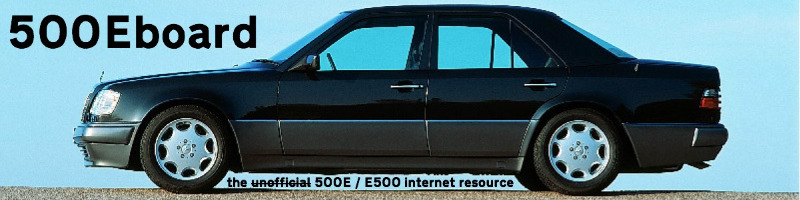
Du er også nødt for å ha spredestag,for å få juster disse riktig.
 
Disse er riktige ja...men det er ikke disse du har fått..


Disse er dem du har fått,og dem er ikke riktige :)
Er du sikker? Ut fra bildene på Kurth så ser 600-festene mye enklere ut i formen:

1780558968619.png

Translation: Are you sure these aren't correct? Based on the photos on their website, the V12-mounts look smoother/simpler..
 
Er du sikker? Ut fra bildene på Kurth så ser 600-festene mye enklere ut i formen:
Ja jeg er 100 prosent sikker
View attachment 237661

Translation: Are you sure these aren't correct? Based on the photos on their website, the V12-mounts look smoother/simpler..
Disse ER v12 festene,,og det bildet du posta av girkassefeste,traversforingene og motorfestene du fikk...det er identisk med det v12 feste.Studer toppen,så ser du det. v12 feste har en " konisk" topp...imens w140/w124 v8 festene har flat topp. Gummien rundt er jo også sånn sett forskjellig.

Du ser jo her at festene dine er dønn identisk med det du selv poster at er 600 festene på Kurth sin side..
 

Attachments

  • [500Eboard] IMG_4850.jpeg
    [500Eboard] IMG_4850.jpeg
    1.5 MB · Views: 7
Last edited:
Ja jeg er 100 prosent sikker

Disse ER v12 festene,,og det bildet du posta av girkassefeste,traversforingene og motorfestene du fikk...det er identisk med det v12 feste.Studer toppen,så ser du det. v12 feste har en " konisk" topp...imens w140/w124 v8 festene har flat topp. Gummien rundt er jo også sånn sett forskjellig.

Du ser jo her at festene dine er dønn identisk med det du selv poster at er 600 festene på Kurth sin side..
Ja, sant, jeg la ikke merke til den koniske toppen, bare resten av formen.. Jeg får ta kontakt med Kurth og høre hva han sier, takk for input 👍

Translation; The top of the mounts are indeed conical like the V12-ones, I hadn't noticed that. I'll contact Kurth and see what he says.
 
Surf Blau, the 500E engine mounts are still available from the dealer... why not buy Genuine MB? They are still the original Boge mounts that should last a very long time. Odd that Kurth is offering "replacements" for stuff that isn't yet NLA.

:scratchchin:
 
Surf Blau, the 500E engine mounts are still available from the dealer... why not buy Genuine MB? They are still the original Boge mounts that should last a very long time. Odd that Kurth is offering "replacements" for stuff that isn't yet NLA.
Maybe because in Norway ,these engine mounts are like 680 dollars a piece,,retail..So its kindof one hefty expence replacing these.Though getting poor aftermarked ones might cost more if you end up getting the original ones after initially getting the cheap ones. Like i am at this point.
 
Last edited:
Yeah - that price is crazy. Look for aftermarket 036 mounts locally. They're all the same SuperChina stuff so get the cheapest you can find. They won't last as long as OE, but for $1500/pair...

:run:
 
Yeah - that price is crazy. Look for aftermarket 036 mounts locally. They're all the same SuperChina stuff so get the cheapest you can find. They won't last as long as OE, but for $1500/pair...
Ive got an engine/transmission drone/ resonance now in my car,at 1500revs,,which most likely is the Febi engine mounts i replaced 1000km"s ago.Ive ordered a set of Optimal engine mounts to put in and test,,and i also took the plunge into ordering two original w124xxx engine mounts.So i am doing some dissecting of the Febi mounts soon. My theory is that the Febi mounts,,,and more than likely all these engine mounts that looks the same as the Febi"s, are actually not Hydro mounts,,,but are cheaply made in solid rubber. I dont know yet..but i have a 50/50 gut feeling about it.Cause i had a w140 420SE in at work today,,and the engine felt soo much smoother ,than my 500e,,eventhough my car has these brand new Febi mounts...
 
Last edited:
I must admit I didn't think much about it, and just assumed they were NLA like the transmission mount - which is what I originally made the order for in the first place.. I'll contact Kurth and see what they say about the wrong shape of the engine mounts.
 
New badge in honour of the car’s history;

IMG_8547.jpeg

Magnetically attached, so no harm done should I get tired of the joke. Nowadays I suspect the few who still knows what the badge means, also knows what this car actually is, so it’s more for humour than deception 😅
 

Who has watched this thread (Total: 3) View details

Back
Top