• Hi Guest !

    Welcome to the 500Eboard forum.

    Since its founding in late 2008, 500Eboard has become the leading resource on the Internet for all things related to the Mercedes-Benz 500E and E500. In recent years, we have also expanded to include the 400E and E420 models, which are directly related to the 500E/E500.

    We invite you to browse and take advantage of the information and resources here on the site. If you find helpful information, please register for full membership, and you'll find even more resources available. Feel free to ask questions, and make liberal use of the "Search" function to find answers.

    We hope you will become an active contributor to the community!

    Sincerely,
    500Eboard Management

Hanging up/Stumbling at 4000 RPM

Post number 66 has been selected as best answered.

emerydc8

E500E **Meister**
Member
I have been troubleshooting this problem for the past week with no luck. Maybe someone else can throw in some suggestions since I'm running out of ideas.

At 45 mph, I can put the car in neutral and rev the engine all the way to redline without any apparent hesitation or stumble. But if I hold it down in first or second gear, when I accelerate and reach 4000 RPM, it hangs up and doesn't want to go past 4000 even when it's floored. If I try to push it past 4000 it will act as if the ignition is dropping off and misfires violently. Even with fairly new motor mounts I can feel the engine jerking around. I hate to say it but I think I even heard some popping at that point. It's almost like there's a governor at 4000 RPM whenever the car is in drive or a lower gear. In neutral while moving forward with no load on the engine, it seems to be okay all the way to the redline.

I'm getting one recurring code now -- the transmission overload protection switch does not close (DTC 8 on the EZL/DI module 17). I have the switch on order and will change it this week. I am aware of the note in the service manual that states, "In the event of the complaint 'misfiring at high speed' the transmission overload protection switch . . . should be checked."

The problem I have is that the car is really sluggish to get up to 4000 RPM with a load on it and there is also an intermittent stumble at idle (about once every ten seconds), so there is a problem below 4000 RPM where the overload protection switch should not even play a role. The idle stumble seems to get worse after it's come down from an attempt to force it past 4000 RPM. At one point, it actually stalled when I tried to force it past 4000.

This is what I've done to troubleshoot so far:

Replaced plugs with F8DC4;
Replaced rotors and caps (distributor dust guards are in good condition);
Replaced five plug boots (now all within 2K Ohms +/- .15 K Ohms, as measured from the distributor end to the bottom end of the plug boot);
Checked conductivity of both coil wires (zero resistance);
Installed known good ignition coils from my other E420;
Installed known good LH module from my other E420;
Replaced crank position sensor at back of engine;
Replaced IAT sensor; and
Fuel filter was replaced several months ago.

Aside from the overload protection switch, does anyone have any thoughts on what could cause the car to act like this?

Thanks.
 
Hi Jon,
You have done everything that others have done with similar problems.
Since you can go all the way to redline in neutral, I would not think the problem would be in fuel or ignition.

Let's see what happens after you replace the transmission overload protection switch.
 
Jon, if the trans OL switch fails open, it will have basically no effect on engine operation. However, I'm not certain how the engine will act if the OL switch fails closed. Try disconnecting the switch, let the wire hang loose, and go for a drive... also measure the resistance of the switch on the car now, I believe it should be open (infinite resistance) with no pressure applied.

Clogged cats will usually not cause the symptoms above, although it could be possible if the cats were massively plugged. You'd need an exhaust backpressure gauge connected so you could watch the pressure while driving. The pressure (pre-cat) should generally be under 1psi, probably no more than ~3psi at WOT at high rpm.

:detective:
 
Thanks, guys. I'm not ruling out clogged cats, but if the cats were clogged, would the RPM's still jump effortlessly up to the redline when not under a load? Can cats be inspected off-vehicle to determine if they are clogged?

I'll change the transmission overload protection switch this week. The way I'm reading the DTC 8 on the EZL/DI module, the switch is failing open. Am I looking at this correctly, Dave?

If the knock sensors were picking up a detonation/preignition and retarding timing due to bad gasoline, would that throw a code, or would I only get a code if the knock sensors were inop?
 
Jon,

All good information above.

If the following was already addressed, I missed it. This sounds like a textbook example of a failed range position indicator in the transmission "neutral safety / reverse light switch" located on the left side of the transmission. There are separate contacts in these switches on vehicles with LH engine management. They report the position of the selector lever by way of switched series resistors ("voltage coding" as you may be familiar with the concept). These indicator circuits tend to fail by way of cracked circuits inside the switch, and /or moisture entry by way of constant wetting by the left side air conditioner drain. Sometimes the "sealed" (not so much) wiring harness that attaches to these switches is corroded beyond repair and will need to be replaced. If that is the case, spliceable repair harnesses are available.

Do you have any codes in your throttle control system? That's E-gas if you have ASR, or Cruise control / idle speed control if you don't have ASR. If you have ASR, these faults will often cause a car to go into limp throttle as well, but not always. That being the case, failing tranny range switches are almost always diagnosed and remedied on ASR cars because they go into full limp throttle (you never get to your 4K rpm range), but they are almost always missed on non ASR cars because there they tend to only cause symptoms similar to yours. Also note that in rare situations, these switches can be defective and not throw a code. Since it's a switchable resistance, the control units can simply be fed a resistance signal corresponding to a gear other than that actually selected. I'm sure there are already extensive threads available addressing these switches on other forum topics. They may be listed along with ASR limp throttle topics since all 500s had ASR, and that's the primary fault these switches cause on ASR cars.
 
Last edited by a moderator:
I have been troubleshooting this problem for the past week with no luck. Maybe someone else can throw in some suggestions since I'm running out of ideas.

At 45 mph, I can put the car in neutral and rev the engine all the way to redline without any apparent hesitation or stumble. But if I hold it down in first or second gear, when I accelerate and reach 4000 RPM, it hangs up and doesn't want to go past 4000 even when it's floored. If I try to push it past 4000 it will act as if the ignition is dropping off and misfires violently. Even with fairly new motor mounts I can feel the engine jerking around. I hate to say it but I think I even heard some popping at that point. It's almost like there's a governor at 4000 RPM whenever the car is in drive or a lower gear. In neutral while moving forward with no load on the engine, it seems to be okay all the way to the redline.

I'm getting one recurring code now -- the transmission overload protection switch does not close (DTC 8 on the EZL/DI module 17). I have the switch on order and will change it this week. I am aware of the note in the service manual that states, "In the event of the complaint 'misfiring at high speed' the transmission overload protection switch . . . should be checked."

The problem I have is that the car is really sluggish to get up to 4000 RPM with a load on it and there is also an intermittent stumble at idle (about once every ten seconds), so there is a problem below 4000 RPM where the overload protection switch should not even play a role. The idle stumble seems to get worse after it's come down from an attempt to force it past 4000 RPM. At one point, it actually stalled when I tried to force it past 4000.

This is what I've done to troubleshoot so far:

Replaced plugs with F8DC4;
Replaced rotors and caps (distributor dust guards are in good condition);
Replaced five plug boots (now all within 2K Ohms +/- .15 K Ohms, as measured from the distributor end to the bottom end of the plug boot);
Checked conductivity of both coil wires (zero resistance);
Installed known good ignition coils from my other E420;
Installed known good LH module from my other E420;
Replaced crank position sensor at back of engine;
Replaced IAT sensor; and
Fuel filter was replaced several months ago.

Aside from the overload protection switch, does anyone have any thoughts on what could cause the car to act like this?

Thanks.

Not completely related to your fault, but it got me thinking when you said "Replaced rotors and caps (distributor dust guards are in good condition)". Did you mean the external covers or did you mean the insulator plates behind the rotors? The only reason I'm commenting on these it that they are chronically undiagnosed. In fact I've had a theory forever that these devices are the primary thing causing the rotors and caps to accumulate that coating that ultimately shorts them out. I think that the "moisture" and coating that we find in the failed caps is in fact an emission from these insulator plates as they revert back to their constituent molecules. This emission either has a fluid component, and /or it is hydrophilic in nature. Just what we need in a distributor. If one removes these plates, he will usually find that the greatest concentration of the "moisture" is between these plates and the metal of the cylinder head. Metal that I am certain is not somehow "sweating". Usually when these motors develop "capitis" it's the plates that are the root cause. These cars that "need new caps every year or so"? Replace the plates at the same time and now it's 5 years or so. Seen it countless times.
ALSO, hot running such as one gets from the chronically underdiagnosed fan clutches, massively speeds the disintegration of these plates. And everything else made of rubber or plastics, for that matter. Regarding 119 fan clutches, I can't tell you how many of these we had to replace under warranty even on brand new cars, or how many times we had to re-replace them two or three times fresh out of the box just to find one that worked. If I had a 119 running hot in the early to mid '90s I would order 4 of them so I had a chance to have a working one for the customer the next day...
 
Thanks, klink, for the great information. I will be ordering a NSS today and will change that out this week. I don't have ASR on this car and you raised a good point--most ASR cars go into limp home mode when a problem occurs with the NSS, so they never get to 4000 RPM. The only other code was the CPS but it hasn't appeared since I changed that sensor a few days ago.

With regard to the dust covers, I was referring to the insulator plates behind the rotors. They are in good condition. I actually have a new insulator in my spare parts but saw no reason to change either of them. Since the humidity out here in the desert is usually less than 10%, I don't run into moisture problems too often.
 
Maybe I should move this post to the trouble shooting section. I replaced the NSS, adjusted as per the manual, and the problem still exists.

I can rev it right up to 5500 RPM in neutral while driving forward but I just can't get past 4000 in a drive gear. It coughs and sputters. I'm still getting the hiccup at idle about every 10 seconds or so.

I just bought a new fuel pressure regulator and I'll probably throw that in tonight as well when I check for new codes.

Is there any chance it could be a malfunctioning cam advance solenoid? :banghead:
 
On the positive side; when you finally find the culprit, you will have replaced EVERYTHING else.
So, you'll have a great car.

Just trying to be encouraging.

Here is where we all think you live: :tumble:
 
Well nobody's giving up yet but dammit I had high hopes for the switch. This is particularly frustrating because while I could be wrong, in most cases a problem like this can be sorted out pronto with a live scanner or an SDS machine. How did it look inside the connector harness plug? How do the terminals look on your old switch? Look particularly carefully at the two tiny terminals in the bottom of the plug connection. Are they heavily corroded? A tiny bit of white corrosion is pretty common. A heavy white or green corrosion is bad as that sometimes indicates that the female sockets in the bottom of that connector plug have corroded away to where they no longer conduct well if they even still grip the pins at all. Can you post up a good photo of your old switch, with a particular focus on the terminals? Tell me or even better show me what you see and we'll keep going. There are still lots of good previously offered ideas and I've still got some more as well.


Sent from my iPhone using Tapatalk
 
There is little to no chance that it's a cam advance issue. Cats are possible but let's not go there yet.


Sent from my iPhone using Tapatalk
 
The contacts looked great on both sides. I'd p#@s on a spark plug if I thought it would fix the problem.
 

Attachments

  • Tucson-20140520-00032.jpg
    Tucson-20140520-00032.jpg
    384.3 KB · Views: 14
If you decide to do that do it only with the engine off!


Sent from my iPhone using Tapatalk
 
+1 on both. And the spark plug watering too.

:shocking:
After I posted that I almost went back to edit it to include the Shocking face. Then the wife got home and I went to help her carry some stuff in the house. Thanks for taking up the slack on that Dave
 
Do you have access to a vacuum gauge? It can be used for a quick dirty test for exhaust restriction.
 
I'm definitely not ruling that out. The car was hit from behind a few months ago and it really jarred the exhaust system. I repaired the bend in the under-axle pipe and the cats didn't look like they suffered any damage when I had the exhaust off (pic).

I don't know if a sudden impact could cause the cats or muffler to clog. The cats are pretty far forward, as you know. Could a muffler clog if it was jarred from another car?
 

Attachments

  • Tucson-20140214-00749.jpg
    Tucson-20140214-00749.jpg
    300.5 KB · Views: 18
  • Tucson-20140214-00736.jpg
    Tucson-20140214-00736.jpg
    373.5 KB · Views: 18
Do you have access to a vacuum gauge? It can be used for a quick dirty test for exhaust restriction.

I have a vacuum pump but no vacuum gauge. I need to get one.

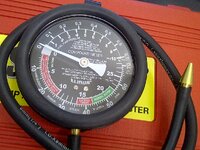
UPDATE: Klink, I pulled this gauge from my Craftsman vacuum pump. Is this what you are talking about or is there a special gauge for exhaust systems?
 

Attachments

  • Vacuum Gauge.jpg
    Vacuum Gauge.jpg
    394.9 KB · Views: 13
Last edited:
I'm definitely not ruling that out. The car was hit from behind a few months ago and it really jarred the exhaust system. I repaired the bend in the under-axle pipe and the cats didn't look like they suffered any damage when I had the exhaust off (pic).

I don't know if a sudden impact could cause the cats or muffler to clog. The cats are pretty far forward, as you know. Could a muffler clog if it was jarred from another car?

Well that's a nice big fat sweaty piece of omitted information! Not that you meant to do that. Yep, sure is possible, I'm sorry to say... Impact often damages the cats.
 
Is that picture from just now ? If your neighbors are in a good mood at this hour blast the thing up the block once without the muffler on it. If it's fixed you probably need the exhaust system from the cats back. It could simply be the mufflers that are clogged up. If an impact jars a baffle loose the right way that sure could give you your problem. If driving it with the muffler off fixes it and you're happy, don't go drive a happy dance, you'll catch the ass end of the damn car on fire. Blast it once or twice then don't do it anymore.

Let me know what you're up to at this point, before I pack it in. It's too late for a 5:30 AM alarm here back east.


Sent from my iPhone using Tapatalk
 
I have a vacuum pump but no vacuum gauge. I need to get one.

UPDATE: Klink, I pulled this gauge from my Craftsman vacuum pump. Is this what you are talking about or is there a special gauge for exhaust systems?

Yes, we can use that if we need to.
 
That was from a few months ago. I can take it off again from the cats back and do a test flight during the day. Maybe there's a way to pinpoint which component is out: either cat, or either muffler.

Sorry I left that piece of information out.
 
I have had failing fuel pumps cause an issue like you describe, have you checked fuel flow rate as well as pressure?

Richard is spot on with that, and it is definitely one of the arrows in the quiver of what to check next. If those items will be easier for you to check next as opposed to simply un bolting the exhaust system then by all means let's check the fuel flow and pressure next. Whatever's easier for you Jon.


Sent from my iPhone using Tapatalk
 
You can get an exhaust back pressure gauge to test the cats...
http://www.amazon.com/s/ref=nb_sb_n...ve&field-keywords=Exhaust Back Pressure gauge

The pressure (pre-cat) should generally be under 1psi, probably no more than ~3psi at WOT at high rpm. I've seen 10-15psi on the gauge (with plugged cats) where the car ran just fine, pulled to redline cleanly, but was down on power noticeably at high revs.

I've dealt with failed fuel pumps too, they never caused an RPM-specific limit, but hey, you never know...


:wormhole:
 
I've dealt with failed fuel pumps too, they never caused an RPM-specific limit, but hey, you never know...
+1 ... one reason why our cars have dual fuel pumps.

That said, the ethanol in our gas these days slowly kills fuel pumps. I have had to replace the pumps on my higher-mileage cars ... the E320 wagon and the 560SEC. Luckily all of my cars use the identical pumps !! And they are cheaply available via Amazon.com.
 
You can get an exhaust back pressure gauge to test the cats...
http://www.amazon.com/s/ref=nb_sb_n...ve&field-keywords=Exhaust Back Pressure gauge

The pressure (pre-cat) should generally be under 1psi, probably no more than ~3psi at WOT at high rpm. I've seen 10-15psi on the gauge (with plugged cats) where the car ran just fine, pulled to redline cleanly, but was down on power noticeably at high revs.

I've dealt with failed fuel pumps too, they never caused an RPM-specific limit, but hey, you never know...


:wormhole:
Yep. He may be able to get one a local NAPA or something like that. Test isn't a 4 letter word after all...
 
NAPA didn't know what I was talking about. I ended up finding one at Harbor Freight. It's cheap but will do the job. Rather than screw with unscrewing the O2 sensor, I was planning to just drill a 1/4" hole in the pipe right before the cat. I can plug it up with a 1/4" rivet. I'm not sure if it's the cat or the muffler so even if I get a high pressure in front of the cats, I'm going to have to look downstream too.

This epic troubleshooting venture has been frustrating and expensive, but at least I'm learning new things and even acquiring some tools I wouldn't otherwise have.

I have had failing fuel pumps cause an issue like you describe, have you checked fuel flow rate as well as pressure?

If the exhaust checks out okay and the fuel pressure regulator doesn't help, that would probably be my next thought.
 

Attachments

  • Pressure Gauge.jpg
    Pressure Gauge.jpg
    458.9 KB · Views: 21
Last edited:
Today I replaced the fuel pressure regulator, removed the rear muffler and checked the fuel pumps. The new fuel pressure regulator and removal of the rear muffler did nothing to affect the 4000 RPM limit. I used a stethoscope to listen to the fuel pumps. They were both running and making the same pitch noise. It sounded normal, although I still can't rule out a decreased volume from the pumps at high load.

Next, I am thinking about getting some high pressure line and a fitting that I can tap and screw into the exhaust pipe at various points for testing. I can run the hose into the cockpit with an air pressure/vacuum gauge and see what's going on.

I am leaning more toward a restriction in either the center resonator or the cats because with the muffler off the car, it didn't sound much louder that with it on the car. At idle I couldn't tell the difference.
 
With the muffler removed, the car is still pretty quiet... but you should be able to hear a difference. Inside the car under load (foot into the loud pedal) it should be very obvious the muffler fell off.

The resonator is a straight-through design, pretty much impossible to plug up. The stock 400E exhaust has the resonator+muffler as a single piece assembly, if you were able to remove the muffler separately, it's gotta be a replacement unit. Note that the exhaust backpressure test is very low pressure (normally) but deals with fairly high temp. You want high temperature hose more than high pressure. Did the HF gauge kit include some method to connect to a pipe? Doesn't appear like it in the photo.

:star:
 
Okay, I T'd a vacuum/pressure gauge into the line going to the yellow pods behind the brake master cylinder so I have a source of vacuum. Then I taped the gauge to my window. Here's what I'm seeing between the two cars.

1995 (problem child):

When I force it to stay in first and floor it, the vacuum goes to zero and the RPM's will not go past 4000. When I come off the throttle, the manifold goes to as low as 21" Hg.

1994 (good car):

When I force it to stay in first and floor it, the vacuum never gets to zero--only down to about 5" Hg--and the engine will accelerate effortlessly all the way up to the redline. Even at 5000 RPM I am seeing 5" Hg of vacuum. When I abruptly come off the throttle, the manifold pressure only drops down to 17" Hg. I could not get the manifold vacuum to go any lower than that during the entire test drive.

So, it's sounding like Herr GVZ was right--clogged cats; especially if the resonators do not clog up as Dave mentioned.

I did hear a difference in sound at 4000 RPM with the muffler removed, but it wasn't what I expected. (My 92 Z28 sounds louder than that with the muffler installed.)

The rear muffler was easily removable because, when the car was hit from behind, it bent the under axle pipe and I had to patch it with a flex tube. So it was pretty easy to remove (see pics).

This thing just passed emissions without a hitch. Has anyone just tried to hammer these cats out with a rod? Maybe I can do that while I search for a new set.

You want high temperature hose more than high pressure. Did the HF gauge kit include some method to connect to a pipe? Doesn't appear like it in the photo.

The gauge was a cheap Harbor Freight gauge. I will have to find some high temp hose and figure out how to connect it to a nipple that I can thread into the side of the exhaust pipe.

Addendum: Come to think of it, the gauge only goes up to 10 psi, so if I am going to tap into the exhaust system, I'll probably need a gauge that goes up to 50 psi, won't I?
 

Attachments

  • Tucson-20140522-00044.jpg
    Tucson-20140522-00044.jpg
    379.1 KB · Views: 22
  • Tucson-20140522-00043.jpg
    Tucson-20140522-00043.jpg
    264.6 KB · Views: 18
Last edited:
.

Just a thought, have you tried swapping the EZL?

Is the vacuum line from the intake manifold good? Check for vacuum at the EZL.

You can also try disconnecting the MAF, that will put the LH in default mode.
If the MAF is bad, you'll go past 4000 no problem

Both quick and easy (free) tests
 
Last edited:
Also, you really need to get a scanner on there, like the others have said that is text book NSS

The scanner can read/display the gear position as you change it.

The switch is new, but is the LH module "seeing" it.
 
Just a thought, have you tried swapping the EZL?

I did that already. No help.
Is the vacuum line from the intake manifold good? Check for vacuum at the EZL.

I just measured it by tapping into the line that goes to the EZL. At idle it is about 18" Hg.
You can also try disconnecting the MAF, that will put the LH in default mode.
If the MAF is bad, you'll go past 4000 no problem

I'll have to try that later tonight if I can get to it. I also have a spare MAF that I can try.

As for a scanner, yes that would tell definitely help; but since the only one in town I know who has one is the dealer, I would prefer to continue to investigate for a bit before throwing in the towel.

When I installed the NSS, I aligned it with the holes and the reverse lights illuminated when I selected reverse. I guess it could be two bad switches but what are the chances?
 
The NSS could be good, and probably is but you need to know if the signal is getting to the LH module.

This is exactly why everyone should do a full throttle 1-2 shift at least once a week
This way you know if your dealing with a "sudden problem" or "gradual problem"

Clogged cats are generally gradual

I personally do one every time I drive my car
 
"This thing just passed emissions without a hitch."
Yep, they will do that with clogged cats. At the low load during the emission test your system was able to flow and clean enough. And at those loads, there isn't much cleaning to do.
 
This is exactly why everyone should do a full throttle 1-2 shift at least once a week
This way you know if your dealing with a "sudden problem" or "gradual problem"

Thanks, Clark. Since this is my wife's daily driver, I really hadn't driven it much to know if it was gradual or not. I rarely go above about 3500 RPM in these 034's anyway. It's not like you're going to get any impressive, neck-snapping acceleration. I'm sure the 500E is different.

Does anyone know if there is a way to visually inspect to see if the cats are clogged once they are off the car? I haven't even priced a new set of cats and I'm almost afraid to look.
 
You can also try disconnecting the MAF, that will put the LH in default mode.
If the MAF is bad, you'll go past 4000 no problem

Replaced MAF sensor. No cigar. I'm still limited to 4000 RPM.
 
It's not like you're going to get any impressive, neck-snapping acceleration. I'm sure the 500E is different.

That's an interesting statement. Here's my take on it.

I've driven some pretty fast cars in my life, drove a highly modified 300ZX twin turbo with over 500hp at the wheels.
I don't think my neck snapped from that, as I can still walk, but that car pulled very hard.

So I do have a base line for what is, or is not impressive.

The 93-95 034 is, as you know 275hp, 290hp with the 92 LH module
I would hardly call a 290hp car slow or unimpressive, that honor would go to a W123 240D or the first year W201 190D 2.2

82-85 380SL with the M116 was also lackluster. The M117 560SL was a huge jump in performance with around 245hp

And yes, the 500E is different partly because of the 312/322hp, but also the 2:82 rear axle ratio vs the 400E 2:24

Think of it as two identical hp stick shift cars, one in 3rd gear, the other in 4th. Which one will accelerate faster from 60mph.

Hope that makes sense.
 
That's an interesting statement. Here's my take on it.

I've driven some pretty fast cars in my life, drove a highly modified 300ZX twin turbo with over 500hp at the wheels.
I don't think my neck snapped from that, as I can still walk, but that car pulled very hard.

So I do have a base line for what is, or is not impressive.

The 93-95 034 is, as you know 275hp, 290hp with the 92 LH module
I would hardly call a 290hp car slow or unimpressive, that honor would go to a W123 240D or the first year W201 190D 2.2

82-85 380SL with the M116 was also lackluster. The M117 560SL was a huge jump in performance with around 245hp

And yes, the 500E is different partly because of the 312/322hp, but also the 2:82 rear axle ratio vs the 400E 2:24

Think of it as two identical hp stick shift cars, one in 3rd gear, the other in 4th. Which one will accelerate faster from 60mph.

Hope that makes sense.

there have been a few 500E owners that have swapped the 2.82 for the 2.24 rear end.

i wish I knew the numerical differences it terms of acceleration/mpg, etc . . .
 
there have been a few 500E owners that have swapped the 2.82 for the 2.24 rear end.

i wish I knew the numerical differences it terms of acceleration/mpg, etc . . .

Rather large difference, all thing being equal, tire size, both transmission having equal 4th gear ratio, which they do
the difference at 150mph is over a 1000 rpm.

2:82 is 5685 rpm, almost at redline

2"24 is 4516 rpm, almost loafing along at 150 mph

The 2:24 ratio is why the 034 hets the same or better highway fuel mileage as a M104 E320
But it also makes it a little weak off the line, that's why the transmission has a 1st gear start valve body


proxy.php


proxy.php
 
Last edited:
Not that it makes much of a difference in actual numbers but the E500E has a slightly taller tire, about .75" taller then narrow body W124s.
 

Who has viewed this thread (Total: 8) View details

Who has watched this thread (Total: 2) View details

Back
Top