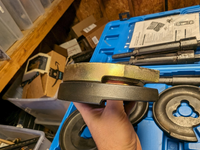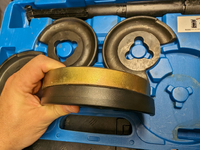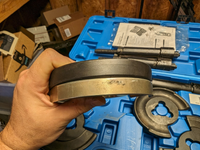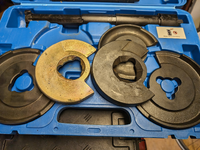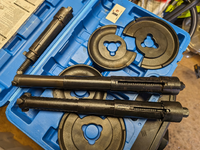

I recently acquired a Klann spring compressor, complete with MB logo and part numbers. I look forward to trying it out. It will replace my Sir Tools version.
I only have experience using the ST so I don't know first hand how well the K works. The ST worked perfectly on both my W126 and my W124 front springs.
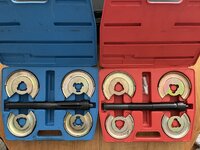
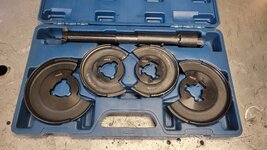
Both tools came with the compressor shaft and spring plates for W126 and W124 cars. Cases appear to be identical except for color. In all pics, the Klann is on the right.
Compressor Shafts:
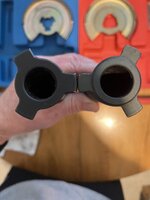
There are noticeable differences between the two compressor shafts.
1. The K shaft has two guide slots in the first (bottom) and middle sections. The ST has two guide slots in the first section but the middle is solid.
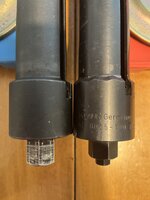
2. The K has a fluted bottom plate retaining surface which matches fluting on each bottom plate. This prevents the bottom plate rotating on the compressor and I assume could also be used to rotate the plate in the spring using the bottom of the compressor as a handle. The ST compressor and bottom plates are both smooth here.
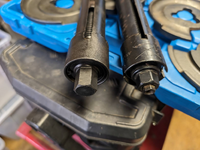
3. The K has a sacrificial pin design so that the 19mm main drive will shear a pin and free spin if the compressor is over-tightened. If this happens, the 10mm secondary drive is used to loosen the compressed spring. The set came with five spare pins. The ST does not have this feature.
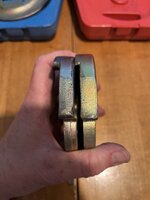
4. The K is slightly shorter than the ST in extended length and about 8mm shorter in compressed length.
Spring Plates:
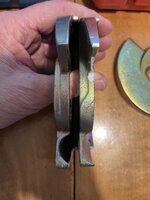
The plates between the two are similar but have some distinct differences.
1. The K has flats (for clamping a compressed spring in a vice for decompression) on just the bottom plates. The ST has flats on both top and bottom plates. The flats are a little more finished on the K.
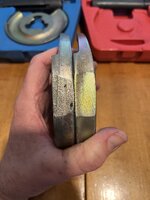
2. The surface where the spring sits differs between the two. The K is more flat than the ST.
3. The top of the K compressor passes easily through the top plate with plenty of clearance. It's not a problem if the top plate is not perpendicular to the compressor shaft. The ST is much snugger in this area and less tolerant of misalignment as the shaft passes through the top plate. The O.D. of the top of the ST shaft is only slightly less than the I.D. of ST top plates. This is a bit cumbersome when trying to insert the compressor into the top plate since the plate is usually canted before compression begins.
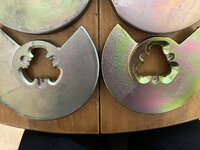
4. The K plates seem to have more metal in the center of the top plate. The ST has rather large cutouts for the top of the compressor to pass through.
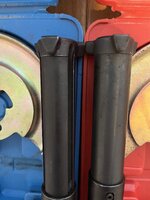
5. The retaining notches in the top plates of the K are narrower than the ST while the tips of the K compressor triangles are rounder than the ST. This results in the K compressor fitting more tightly when seated in the top plate. The ST has much more rotational play here.
6. The K has larger ramps than the ST for guiding the top of the compressor out of the top plate when removing.
I only have experience using the ST so I don't know first hand how well the K works. The ST worked perfectly on both my W126 and my W124 front springs.
Both tools came with the compressor shaft and spring plates for W126 and W124 cars. Cases appear to be identical except for color. In all pics, the Klann is on the right.
Compressor Shafts:
There are noticeable differences between the two compressor shafts.
1. The K shaft has two guide slots in the first (bottom) and middle sections. The ST has two guide slots in the first section but the middle is solid.
2. The K has a fluted bottom plate retaining surface which matches fluting on each bottom plate. This prevents the bottom plate rotating on the compressor and I assume could also be used to rotate the plate in the spring using the bottom of the compressor as a handle. The ST compressor and bottom plates are both smooth here.
3. The K has a sacrificial pin design so that the 19mm main drive will shear a pin and free spin if the compressor is over-tightened. If this happens, the 10mm secondary drive is used to loosen the compressed spring. The set came with five spare pins. The ST does not have this feature.
4. The K is slightly shorter than the ST in extended length and about 8mm shorter in compressed length.
Spring Plates:
The plates between the two are similar but have some distinct differences.
1. The K has flats (for clamping a compressed spring in a vice for decompression) on just the bottom plates. The ST has flats on both top and bottom plates. The flats are a little more finished on the K.
2. The surface where the spring sits differs between the two. The K is more flat than the ST.
3. The top of the K compressor passes easily through the top plate with plenty of clearance. It's not a problem if the top plate is not perpendicular to the compressor shaft. The ST is much snugger in this area and less tolerant of misalignment as the shaft passes through the top plate. The O.D. of the top of the ST shaft is only slightly less than the I.D. of ST top plates. This is a bit cumbersome when trying to insert the compressor into the top plate since the plate is usually canted before compression begins.
4. The K plates seem to have more metal in the center of the top plate. The ST has rather large cutouts for the top of the compressor to pass through.
5. The retaining notches in the top plates of the K are narrower than the ST while the tips of the K compressor triangles are rounder than the ST. This results in the K compressor fitting more tightly when seated in the top plate. The ST has much more rotational play here.
6. The K has larger ramps than the ST for guiding the top of the compressor out of the top plate when removing.
Attachments
-
 klann 1.jpg2.9 MB · Views: 43
 -
 klann 2.jpg2.1 MB · Views: 42
 -
 klann 3.jpg1.8 MB · Views: 40
 -
 klann 4.jpg1.9 MB · Views: 40
 -
 klann 5.jpg1.9 MB · Views: 41
 -
 klann 6.jpg2.5 MB · Views: 41
 -
 klann 7.jpg2.4 MB · Views: 40
 -
 klann 8.jpg2 MB · Views: 36
 -
 klann 9.jpg1.9 MB · Views: 36
 -
 klann 10.jpg3.9 MB · Views: 42









![[500Eboard] 20231215_224221.jpg](/forums/data/attachments/180/180347-7475199616486ed006bdfaed240e461e.jpg?hash=dHUZlhZIbt)