• Hi Guest !

    Welcome to the 500Eboard forum.

    Since its founding in late 2008, 500Eboard has become the leading resource on the Internet for all things related to the Mercedes-Benz 500E and E500. In recent years, we have also expanded to include the 400E and E420 models, which are directly related to the 500E/E500.

    We invite you to browse and take advantage of the information and resources here on the site. If you find helpful information, please register for full membership, and you'll find even more resources available. Feel free to ask questions, and make liberal use of the "Search" function to find answers.

    We hope you will become an active contributor to the community!

    Sincerely,
    500Eboard Management

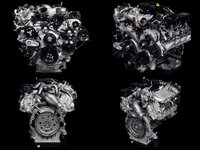
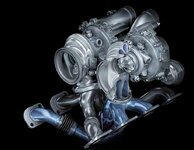
AMG 4.0 biturbo engine

This is essentially the same turbo setup ford uses on it's 6.7L turbo diesel. Air comes into the cylinders from the sides of the block, and exits in the middle, into the turbo. It has been quite successful for Ford so far.
 
And similar to the BMW 4.4 liter TT in the M5 too...sounds like AMG is playing copycat.
 
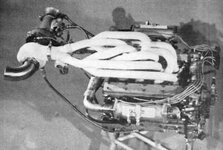
Actually, just about everything that we ever see in production is copycat to some degree, usually in fact to a great degree. The old euphemism that "there is nothing new under the sun" is pretty much correct. Center flow V-engine exhaust placement even as an optimization for turbocharging is an older idea than you might think. Ford in particular did some of this with it's racing engines in the 60s. Here's their mid '60 Indy motor. As you can imagine it's all over the net if you want to read about it, and some of it is quite interesting.
68-indy.jpg


Here's a Ferarri F1 engine, circa 1981 using the so called "hot V" architecture.
turbocharged-engines-in-formula-one-18108_5.jpg


I thought it also interesting that Ford was the first to reintroduce the concept, this time in a production engine when they did so with their medium duty diesel just a few years ago. And It was indeed Ford. They designed that engine in house. It is not the design of another major engine builder as had always been the case with their "pickup" diesels in the past. Ford Europe has lots of diesel experience, and they had a hand in it's design.
Here's a few views of that beast. Note that the exhaust outlet can be seen exiting at the rear of the cylinder valley. The air inlet to the turbo are seen on the front top of the valley. Heat retention and minimizing turbo lag were some of the design considerations mentioned.
6_7L_PowerStroke.jpg


Note also when looking at the pictures of the 60s Ford turbo Indy engines that while they are only using one turbocharger, they are still optimizing the header lengths and the cross bank cylinder allocations to smooth out the exhaust pulses to the turbine. That's the same thing that BMW recently did with the new TT "M" V8 motor, only it is being done with two smaller turbochargers instead of one big one. Turbo lag was not as much of a concern on an Indy engine designed to go very fast in a very large circle. In that case, one big turbo got the job done. Also, I don't know if turbos had yet been miniaturized enough at that point in time for a multiple turbo installation to have been a practical consideration for the Ford engineers, or if the rules at the time also may have specified that only one was permitted. Interesting considerations, I don't know the answers.


For reference, here's the "Normal" BMW TT V8. Note that each turbo is simply "driven" by it's nearest bank.
bmw-x5-petrol-engine.jpg


Here's the "exhaust pulse" flow optimized header pipe layout that they did for the "M" version of this engine architecture.
s63-engine-4.jpg


Make no mistakes however. Corporate average fuel economy requirements in America and carbon emission requirements in the ECE are what is driving this thing. That does not mean that the result won't operate wonderfully and feel great. It probably will. It's simply going to be diabolically expensive.

:klink:
 
Last edited:
I put some photos and additional text with my previous "copycat" post, FYI.
 

Who has viewed this thread (Total: 1) View details

Back
Top