• Hi Guest !

    Welcome to the 500Eboard forum.

    Since its founding in late 2008, 500Eboard has become the leading resource on the Internet for all things related to the Mercedes-Benz 500E and E500. In recent years, we have also expanded to include the 400E and E420 models, which are directly related to the 500E/E500.

    We invite you to browse and take advantage of the information and resources here on the site. If you find helpful information, please register for full membership, and you'll find even more resources available. Feel free to ask questions, and make liberal use of the "Search" function to find answers.

    We hope you will become an active contributor to the community!

    Sincerely,
    500Eboard Management

ASR/ABS Help (With SDS/Codes)

ninetytwo

E500E Enthusiast
Member
I found a dead-end post with a similar issue: Intermittent ASR/ABS lights w/o limp home mode. Hopefully with these codes, we can create a post with answers.

I've had this issue since I received the car: the occasional road bump will light up the warning triangle, ASR, ABS, and snow chain lights but without any change in performance (never limp home mode). If I go down a bumpy road on Tuesday, each bump might be, fine/lights/fine/lights etc. The next day it might be smooth sailing.

So I bought a SDS/Xentry kit that arrived installed on a venerable Dell battle station. I finally figured out how to use it (still can't seem to access the body modules to turn off the darn seat belt buzzer) but I have been able to pull codes. I'll post the pictures as well in case my descriptions are incomplete:

ASR / Fault Memory / 032 / CAN: no reception from EZ N1/3 N1/4 N1/5

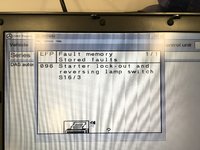
EFT / Fault Memory / 096 / Starter-lockout and reversing lamp switch S16/3

Questions:
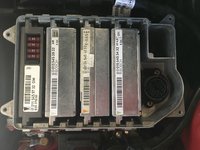
EZ is actually the EZL (digital injection) module? The oddly shaped black module that sits on the driver side bay wall? ICM module (014-545-45-32)? On the DTC List from 124Performance, page 6 references 3 different units? Right, left, and a central? Or are those the connections? I'm guessing connections. I pressed on each one and only one seemed to move back into place.

If there really is "no reception" it seems like the car wouldn't run. Am I being too literal in my interpretation? "Distortion" is mentioned in the guide but that's a bit vague for this armchair mechanic. Would that suggest a bad wire?

As for the EFT faults, that seems like a classic ASR failure mode, yes? I haven't had any issues with getting into gear but haven't checked if the reverse lights worked yet. It passed inspection so I'm assuming it works. If there are no gear selection or light issues, is it just a faulty switch? Neutral safety switch?

For more background: the upper wiring harness is in proper shape (and the updated part) but the lower wiring harness has not yet been replaced.

IMG_0487.JPG
IMG_0480.JPG

And for those who helped/followed along, the inaugural drive with the correct lights in. I have to say, I kind of miss the DOT units; its how I got to know the car. Although I'm sure I'll get over it when I drive at night.
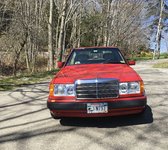
IMG_0451.jpg
 
So I bought a SDS/Xentry kit that arrived installed on a venerable Dell battle station. I finally figured out how to use it (still can't seem to access the body modules to turn off the darn seat belt buzzer) but I have been able to pull codes.
There are no body modules on the 124. You are thinking of newer chassis. The seat belt buzzer has to be defeated manually, search the forum.


ASR / Fault Memory / 032 / CAN: no reception from EZ N1/3 N1/4 N1/5

EFT / Fault Memory / 096 / Starter-lockout and reversing lamp switch S16/3

Questions:
EZ is actually the EZL (digital injection) module? The oddly shaped black module that sits on the driver side bay wall? ICM module (014-545-45-32)? On the DTC List from 124Performance, page 6 references 3 different units? Right, left, and a central? Or are those the connections? I'm guessing connections. I pressed on each one and only one seemed to move back into place.
EZ = DI (Digital Ignition) = EZL. Same thing. The W124+M119 has N3/1. The reference to left & right is for the M120 engine which has two of them (N3/3 and N3/4). The code translation is for all LH injection, not M119 specific, which is why it shows all three.


If there really is "no reception" it seems like the car wouldn't run. Am I being too literal in my interpretation? "Distortion" is mentioned in the guide but that's a bit vague for this armchair mechanic. Would that suggest a bad wire?
Correct - if there was no reception, the car either wouldn't run, or would run poorly. NOte this error is on the ASR module, not the EZL. It may be a faulty ASR module, or bad connection at the ASR module - not the EZL.


As for the EFT faults, that seems like a classic ASR failure mode, yes? I haven't had any issues with getting into gear but haven't checked if the reverse lights worked yet. It passed inspection so I'm assuming it works. If there are no gear selection or light issues, is it just a faulty switch? Neutral safety switch?
EFT = E-GAS module. The NSS has multiple fuctions... starter lockout, reverse light, AND gear position indicator to the module. Code 096 is reporting faulty gear position signal. This often causes limp mode, but not always. If the NSS is original, replacing it AND adjusting it correctly should cure code 096. However it is unlikely to cure the ABS/ASR lights turning on.


For more background: the upper wiring harness is in proper shape (and the updated part) but the lower wiring harness has not yet been replaced.
The upper harness has nothing to do with ASR or ABS; ditto for the lower harness to starter/alternator.


I'm suspicious of both the BM/GM (power supply module) and the ASR module. Do you have spares to swap in for testing? If not, I would consider that next. I recommend all owners of 034/036 chassis have a full set of known-good modules for test purposes. These 2 are relatively cheap due to low failure rates, i.e. supply exceeds demand.

:cel:
 
As always, thank you gsxr. Your reply is great for my notes. I

No, I don't have spares to try but my shop might. I'll check the BM/GM fuses. I did not look at those last time I had the module box open. Is there a known failure mode with the modules? Capacitor leak/solder fail? Is that your suspicion?
 
There isn't a "known" failure of the BM/GM that I know of, i.e. where a particular component is known to fail. I've opened one up but other than the couple of good-size relays, don't really know what I'm looking at. I'm not an electronical guy. But I'm pretty sure it's not as simple as failed capacitors, which cause LH module fuel pump relay clicking.

In one of my parts cars, a failed BM/GM was not powering the ABS module, and would not communicate with SDS. Swapped it for a spare and all the problems went away. I did not attempt to diagnose the module itself. A different BM/GM failure I experienced was always powering the LH module, even with the ignition off, causing a battery drain and running the fuel pumps when battery initially connected. Again, I just swapped it out...

:shocking:
 
Swapped it for a spare and all the problems went away.

:shocking:
Now that's good to hear! If I go with that thought, perhaps my BM/GM unit is intermittent. As my lights come and go usually with bumps, I'll try tapping the module. I did a parts search for the BM (#0115459732) and from Pelican Parts, its a very expensive module. I suppose known-good modules from eBay might be a good starting point?
 
I suppose known-good modules from eBay might be a good starting point?
Yes. Just make sure the seller has good feedback and return policy. Most will sell "untested" modules because they don't know how to test, and/or have no way to test...

:rugby:
 
Good point.

I pulled the GM fuses and they all look good. The modules seem firmly seated as well. If we go by what I assume are date codes, the E-Gas and LH modules seem original to the car and possibly the GM. Is the '99M01' on the ASR module a date code?

IMG_0560.JPG
 
Yes, 99M01 = January 1999, so it's been replaced at some point. There's a date code stamped on the GM label but it's often difficult to read.
 
I'm waiting for a "known good" used GM out of a R129 to arrive and test out that theory. Considering the ASR module has clearly been replaced once (and I would imagine by MB, given the original owner) I wonder if its another faulty module or problem deeper in.

The car is going into my shop tomorrow. At the very least we can probably replace the NSS & switch and see if that helps. The Xentry setup has been great. Knowing more now, it does feel like overkill given the HHT could have manged most of this...but there's always my 129. Can't wait to turn off that "follow me home" fog light feature.
 
Hi Gerry,
Time has escaped me. The report is good but mixed. My shop re-soldered bad joints in the GM. The attached image might more clearly express it. In any event, the lights stayed off for a while have blinked on an off once so far. Its a huge improvement but an event today has me suspicious that there's more going on.

Today, after loafing along back roads, I came to a stop and the idle became rough. When I accelerated, there was almost no power and lots of stumbling. I got up to speed very slowly (no choice) and pulled over at the exit. Cycled the engine, still rough.

I drove home slowly and on the way, everything returned to normal. I plugged in DAS. No stored faults BUT it cannot access the EZ modules.
"EZ1, EZ2 does not answer" I tried several times and they won't respond. This makes me think that there's a fault with the digital ignition modules. Sound possible?
 

Attachments

  • [500Eboard] IMG_0741.jpg
    [500Eboard] IMG_0741.jpg
    1.7 MB · Views: 11
  • IMG_1228.JPG
    IMG_1228.JPG
    3.5 MB · Views: 10
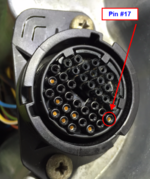
It is extremely unlikely that the EZL module is bad, if there is no communication. It is much more likely to be a connection problem at the 38-pin diagnostic socket. Verify that socket #17 is present and clean, and also verify that your DAS multiplexer has pin #17 present and straight. I've seen bent pins on the MUX and bad/corroded sockets. Photo below courtesy of @JC220. Note that V8 cars only have EZ1 as there's only one. V12 cars have two (EZ1 and EZ2). The DAS fault description is generic.

The rough idle, lack of power, and acceleration stumble (all of which went away) may be related to caps/rotors/etc... how old are these items, and when were they last inspected?

:shocking:

1626993896974.png
 
Hi Gerry,
Time has escaped me. The report is good but mixed. My shop re-soldered bad joints in the GM. The attached image might more clearly express it. In any event, the lights stayed off for a while have blinked on an off once so far. Its a huge improvement but an event today has me suspicious that there's more going on.

Today, after loafing along back roads, I came to a stop and the idle became rough. When I accelerated, there was almost no power and lots of stumbling. I got up to speed very slowly (no choice) and pulled over at the exit. Cycled the engine, still rough.

I drove home slowly and on the way, everything returned to normal. I plugged in DAS. No stored faults BUT it cannot access the EZ modules.
"EZ1, EZ2 does not answer" I tried several times and they won't respond. This makes me think that there's a fault with the digital ignition modules. Sound possible?
It is probably not a fault of the EZL but of the used multiplexer (C4?).

The diagnostic output signal of the EZL is much lower than the other modules (only about 4 Volts in comparison to about 10 Volts). That’s a problem for the chinese multiplexers.
 
Last edited:
The diagnostic output signal of the EZL is much lower than the other modules (only about 4 Volts in comparison to about 10 Volts). That’s a problem for the chinese multiplexers.
Ahhhhh, interesting. This might be why we encountered a number of defective Chinese C3 multiplexers a few years ago that could not communicate with the EZL, but worked fine with all other pins/modules. Do you know any way to "fix" a Chinese C3 MUX with this problem?

EDIT: There are also some C3 MUX's that would not communicate with EZL/DI, EFP/E-GAS, or DM but would communicate with LH, ASR, and BM/GM. Click here.

:rugby:
 
Last edited:
The solution should be to look for bad soldering and defective components inside the multiplexer. In my case this was helpful, but the communication to the EZL ist not always possible from the beginning on. Sometimes I have to try it several times until the communication is possible.

I do not exactly know what is necessary for the EZL to switch from the "normal" impulse-code-mode to the digital communication mode. I think there is a switching command necessary which the multiplexer does not always send in the expected way.
 
@gsxr The caps and rotors were done in 2018, roughly 9k miles ago but haven't been inspected since. I saved the originals (or perhaps 1st replacement) for comparison. What is the check-interval and is it easy for a novice to follow a guide? I did read a post where the cap failed causing weak voltage to the plugs.

Thank you for the pin diagram. The C3 multiplexer is MB-branded by Actia made in 2002. A few months ago, I could access these modules. I'll check the pins again. There were two bent ones and I'll make sure its not the ones needed for the EZL connection.

The battery is at least 4 years old (Interstate Diehard) but probably older. I keep it on a smart charger out of habit. The plugs were changed at the same time as the rotors with the correct German-made Bosch units.

My shop isn't sure that they can squeeze me in before September (which would be awful, our season is so short). If they can't, I'm hoping the "collective we" might be able to problem solve. I'll check the pins and wait to hear about checking the rotors/caps. In the meantime, would another test drive make sense?
 
Caps and rotors 9kmi old *should* be ok, but do you know what brand was installed? And if the insulator cups were replaced or not?

What you describe sounds a lot like the issue with liquid on the back of the insulators. If you do any DIY work, pull the cap, rotor, rotor bracket, and inspect the back side of the insulator. Click here and see the photos attached to post #81. It's likely the rough running will disappear until the car is parked for 1-2 weeks or longer.

:scratchchin:
 
Interesting, I wonder what fluid accumulates there. The car had been sitting in the garage for about two weeks (but it also sits all winter and hasn't had this problem). The issue also developed after about 15 minutes of driving.

I'm not sure of the brand, but I always insist on OE. From my records I have: 7/2019 Distributor Cap 2x 119 158 01 02, Distributor Rotor 2x 119 158 02 31

There's even less mileage than I thought, about 6,200 since then. I'm looking up YouTube videos on pulling these parts. MercedesSource has an abridged video that provides some insight. Are there any go-to videos for this? I'm assuming I should disconnect the (+) battery cable first?

Is there a modified change interval for the caps & rotors at this point?
 
No need to disconnect the battery when working on the ignition system, just don't crank the engine when it's apart. :shocking:

The caps/rotors should last 50-100kmi, IMO. I don't know of any videos to recommend, but it's a straightforward process. Don't use a ball-end Allen wrench on the 3mm rotor bolts when breaking them loose, or torqueing down. During final reassembly, apply a dab of blue threadlock on the single rotor bracket bolt, and all three small rotor bolts. If the insulators have liquid and/or are old/original, I'd replace them with new Bosch (about $50/ea aftermarket).

BTW, as described in the other threads on this subject, the typical scenario is the car being parked for 1-2 weeks or longer, starts perfectly, runs perfectly for 10-20 minutes, then either starts to misfire/bog badly, OR the engine is shut off after 10-20 mins and won't re-start for another 30-45 minutes. After re-start the problem often goes away until the next time the car is parked for 1-2 weeks. Lather, rinse, repeat.

200.gif
 
Well, that might cure my caffeine addiction... It sounds like I've got to add a few more tools to my DIY box (threadlock). Speaking of threads, this one will help.

Good point about the sequence of events. Oddly, my bag of original parts doesn't seem to include the old caps so let's see what I find...
If that's the replacement range, then the 2019 service might have removed the originals.
 
I ran my E500's caps and rotors for something like 60+K miles with zero issues. Would have continued to use them if I had not changed everything out last year as part of my Top-End Refresh.
 
That's a solid interval, Gerry. One of the first surprises of this car relative to my others was the spark plug change interval. I have yet to remove the covers and pull the rotors. But I have been thinking about this issue along the lines of, "why now?"

Its been unusually humid here so I've been dehumidifying the garage. When I pull the cars out, they're covered in condensate until the temperatures equalize. I'm only seeing the surface action so I'm assuming that in those caps as they heat up from a dry/cool garage to hot/humid environment, condensation is going to form.

Tomorrow tomorrow. I'm always afraid of not being able to get things back in despite being methodical in my efforts.
 
Factory spec for spark plug replacement is 30kmi, although I've seen them go 50kmi+ with the engine running flawlessly. The ignition systems are quite powerful and can fire across a wide gap with worn electrodes. 30kmi sounds like a short interval relative to newer cars with fancy exotic-electrode plugs, designed for much longer intervals. For reasons I don't understand, these old distributor ignitions don't work well with the exotic fine-wire plugs. The old-skool non-resistor thick-electrode F8DC4 plugs are cheap, which helps.

Tip for the R&R work: Do one side at a time. If you forget how something goes, you can look at the other side. No need to remove the wires from the cap, just tie the cap out of the way.
 
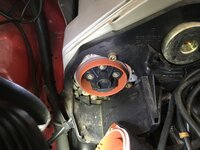
Moderate success. I was able to pull the distributor cap off on the passenger side. Its a Bosch unit. Unfortunately, I don't have the right tools to finish this side and start the other. My 3mm is basically an allen wrench L-shape tool that doesn't have the strength the break the remaining two bolts free. My 5mm is too fat to reach in on the driver side bolt, closest to the power steering reservoir.

I did find the same moisture/liquid behind the cap Its also along the exposed section of the insulator cap. Even the black rotor has a coating. This side looks nothing like the failed examples.

So this liquid, just wipe it out? And as for tools, is there a particular name for a thin 5mm wrench? Mine aren't ball ends, just a little blunt for some of the locations.
 

Attachments

  • IMG_1304.JPG
    IMG_1304.JPG
    2.3 MB · Views: 14
  • IMG_1315.JPG
    IMG_1315.JPG
    1.8 MB · Views: 13
  • IMG_1306.JPG
    IMG_1306.JPG
    2.6 MB · Views: 13
Forgot to mention: the insulator cap in the back is loose. Is that normal?

Also, thanks to some ingenuity, I did get the other cap off. There was less of that filmy moisture on the driver's side.
 
Last edited:
The liquid on the caps and rotor should wipe clean. The caps look good. But, you'll need to check the back side of the insulator, and verify the cam seals aren't leaking.

The insulator is normally "loose", it will be pressed tightly into place when the cap is screwed down.
 
Yep, the insulator will be loose until things are sungged down at the cap. No worries there. No apparent tracks on that cap. I'd clean it with brake cleaner and re-use it. Maybe do the slots in it as described.

I am waiting for @JC220 to do a 100-page white paper on sunroof maintenance and/or body rust repair. Because, outdo.
 
Wow! Now this is a whole new level of intensity (and I like it!) Thank you for the link @Jlaa (and @JC220 and @maw1124). That's exceptionally useful. The additional exit slots look interesting. I'd be happy to make that change.

I wiped them clean but wasn't able to get the insulators out, yet. New tool time. Fingers crossed that the cam seals aren't leaking.

Ah, that makes perfect sense that the insulators will snug down when the cap is removed. I'll take the car out this week and see how it goes.

Thank you all for your help. I sincerely appreciate it. I'll report back when I get the right driver and remove the insulators.
 
Wow! Now this is a whole new level of intensity (and I like it!) Thank you for the link @Jlaa (and @JC220 and @maw1124). That's exceptionally useful. The additional exit slots look interesting. I'd be happy to make that change.

I wiped them clean but wasn't able to get the insulators out, yet. New tool time. Fingers crossed that the cam seals aren't leaking.

Ah, that makes perfect sense that the insulators will snug down when the cap is removed. I'll take the car out this week and see how it goes.

Thank you all for your help. I sincerely appreciate it. I'll report back when I get the right driver and remove the insulators.
If you haven't seen it yet there is a recent thread below detailing m119 ignition tips as these cars are several decades old 😀

Thread 'Essential M119 Ignition "Tune Up" mods' FYI - Essential M119 Ignition "Tune Up" mods | M119 Engine
 
Last edited:
Update: I took the car out today and all was well for 20 miles. As soon as I stared going up a hill, power vanished again, the engine was lumpy, and I had to pull off.

Park and neutral were about the same: rough but with normal oil pressure. Reverse was awful. Extremely rough, shaking like a paint can, and very low oil pressure. I did manage to get home (oil pressure in drive returned to normal) but now I'm disheartened.

The hill is odd though, as hills were the worst the last time this happened. My driveway is steep but after a cold start, there was no problem. I made an appointment with my shop, but its not for three weeks. In the meantime, I can pull the rotors again and see if the moisture returned.
 
Only 6 screws to open the 2 caps!
Simple to check if there is moisture/liquid inside the caps.
Tip: dry the caps and spray an isolation layer on to the orange material (not the contacts). Do the same with the insulators.
 
Are you still using the same caps / rotors / insulators? And did you ever remove both insulators to inspect the back side?

Your last posts said you had not been able to remove the insulators.

The lack of power, lumpy engine, extremely rough running is almost guaranteed to be related to the above components. If you don't pull the cap(s) to check immediately when the rough running is occurring, they will appear fine. BT, DT.
 
I'm picking up the right tools today, but no, I haven't pulled the insulators to inspect yet (tonight, hopefully). Yes, these are the same caps/rotors/insulators. It sounds like the fix is to replace these parts and make sure that the there isn't any issue with the cam seals.

That's a good idea, frall. I do need to do more testing. Even replacing the parts, I'd like to know why this happened so suddenly. Last summer was just as humid, so maybe the seals gave way.
 
The liquid caused by humidity has not much to do with the seals. The plastic /melamine of the caps/insulators/fingers stores water inside the material.
In the old days the factory applied layer of isolation on top. But today they save this important step because of cost cutting.
 
Back
Top