• Hi Guest !

    Welcome to the 500Eboard forum.

    Since its founding in late 2008, 500Eboard has become the leading resource on the Internet for all things related to the Mercedes-Benz 500E and E500. In recent years, we have also expanded to include the 400E and E420 models, which are directly related to the 500E/E500.

    We invite you to browse and take advantage of the information and resources here on the site. If you find helpful information, please register for full membership, and you'll find even more resources available. Feel free to ask questions, and make liberal use of the "Search" function to find answers.

    We hope you will become an active contributor to the community!

    Sincerely,
    500Eboard Management

Oil Pump Gear Concerns

Seangbadee

E500E Guru
Member
What started as a simple oil pan gasket leak has turned into a bit more of a project. Since I already had the pan off on my 1995 M104 E320, I decided to go ahead and reseal the lower front timing cover as well—seemed like the smart move while everything was apart.
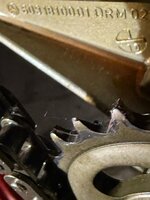
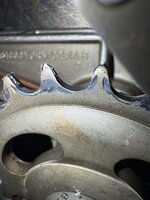
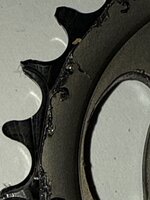
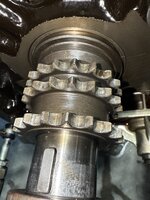
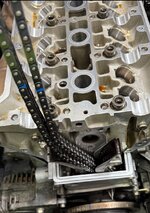
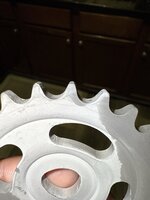
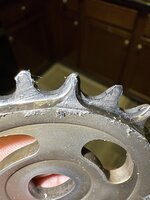
While I was in there, I noticed that the oil pump gear teeth looked unusually sharp—more than they should be. On closer inspection, it looks like the gear is beginning to wear down. The oil pump chain isn't exactly loose, but it definitely has more slack than I’m comfortable with.
I already have a new chain on hand, but I’m unsure of the next step:
Has anyone else run into this? Is gear wear like this normal at higher mileage?
Should I be thinking about replacing the gear too?
I hadn’t planned on replacing any chains, especially with just 150,000 miles on the car. The timing chain sprocket looks fine, and oil pressure has always been solid, so the pump itself seems to be working well. However, after noticing unusual wear on the oil pump gear, I’m considering replacing the oil pump chain while the timing cover is off. Any tips or advice from those who’ve done this job would be greatly appreciated.

Update!
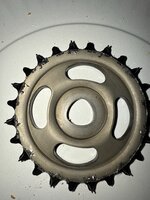
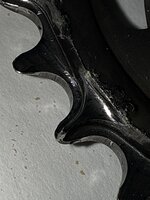
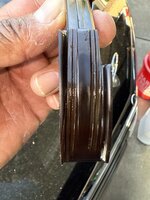
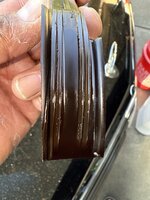
This morning, I set out to remove the oil pump chain and gear, and what I found was surprising—the inside of the chain where it rides on the gear, and the underside of the gear itself, are badly worn. On one hand, I’m glad I decided to pull the cover when I did, but on the other, it’s a bit concerning to see this level of wear given the car’s solid oil pressure and relatively low mileage. I wasn’t planning to change anything initially, but now it seems like the right call. If anyone has experience with this or advice on best practices for replacing the oil pump chain and gear, I’d really appreciate it.
 

Attachments

  • IMG_5641.jpeg
    IMG_5641.jpeg
    1.3 MB · Views: 12
  • IMG_5642.jpeg
    IMG_5642.jpeg
    762.3 KB · Views: 11
  • IMG_5644.jpeg
    IMG_5644.jpeg
    648 KB · Views: 11
  • IMG_5647.jpeg
    IMG_5647.jpeg
    810.6 KB · Views: 11
  • IMG_5650.jpeg
    IMG_5650.jpeg
    805.4 KB · Views: 8
  • IMG_5653.jpeg
    IMG_5653.jpeg
    445.6 KB · Views: 8
  • IMG_5651.jpeg
    IMG_5651.jpeg
    411.8 KB · Views: 8
  • IMG_5655.jpeg
    IMG_5655.jpeg
    365 KB · Views: 9
  • IMG_5656.jpeg
    IMG_5656.jpeg
    517.7 KB · Views: 9
Last edited:
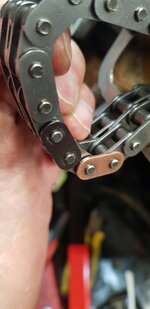
There is more wear than I'd expect to see - very odd. I'd replace both chain & sprocket. Fortunately, the sprocket is still available new... 603-181-01-12, $47 list, ~$35 discount. Chain 003-997-74-94 is $56 / ~$45.

I'll leave it to @Klink to speculate what caused this.

:klink:
 
There is more wear than I'd expect to see - very odd. I'd replace both chain & sprocket. Fortunately, the sprocket is still available new... 603-181-01-12, $47 list, ~$35 discount. Chain 003-997-74-94 is $56 / ~$45.

I'll leave it to @Klink to speculate what caused this.

:klink:
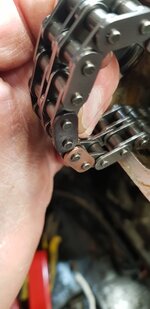
Dave, I’m smiling my way through this—thankfully, the crankshaft sprockets are intact. I appreciate the part numbers; that’s exactly where I planned to start. Now I just need to figure out how to properly crimp the chain. This project has definitely turned out to be more than I bargained for!
 

Attachments

  • IMG_5658.jpeg
    IMG_5658.jpeg
    945.5 KB · Views: 2
  • IMG_5657.jpeg
    IMG_5657.jpeg
    951.5 KB · Views: 2
Dave, I’m smiling my way through this—thankfully, the crankshaft sprockets are intact. I appreciate the part numbers; that’s exactly where I planned to start. Now I just need to figure out how to properly crimp the chain. This project has definitely turned out to be more than I bargained for!
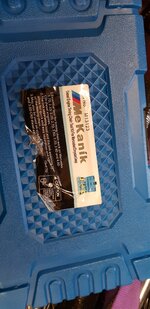
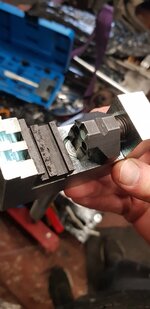
If it helps I use a chain crimper like this which produces factory quality crimps on MB timing chains

20210131_122125.jpg20210131_121606.jpg20210131_121852.jpg20210131_122014.jpg
 
Dave, I’m smiling my way through this—thankfully, the crankshaft sprockets are intact. I appreciate the part numbers; that’s exactly where I planned to start. Now I just need to figure out how to properly crimp the chain. This project has definitely turned out to be more than I bargained for!
The oil chain rail is nothing to write home about either 😕
 

Attachments

  • IMG_5661.jpeg
    IMG_5661.jpeg
    732.8 KB · Views: 5
  • IMG_5660.jpeg
    IMG_5660.jpeg
    741.6 KB · Views: 5
The oil chain rail is nothing to write home about either 😕
I change my oil regularly—every 3,000 to 3,500 miles—and as I mentioned in another thread, the top of my cylinder looks clean. There’s good cross-hatching with no visible wear on the cylinder walls. The only issues I've had up to this point were tappet noise and, more recently, some oil leaking from the right rear of the cylinder head.
Because I’ve never found any metal fragments in the oil filter, sump, or on the strainer (which is completely clean), I’m leaning toward this oil pump gear damage being a very recent development. The engine has always run clean, so this kind of wear or failure is surprising.
One thing I’m considering is whether this could be related to revving the engine while stationary. That’s the only out-of-the-ordinary thing I’ve done recently that comes to mind.
I plan to replace the oil pump spring and bushing, along with any other associated components. When I get back home, I’ll also be rechecking the oil pump bolts just to be sure.
What I’m really trying to figure out is: why would the chain move out of alignment? That’s the biggest mystery right now, and any insight would be appreciated.
 

Attachments

  • IMG_5625.jpeg
    IMG_5625.jpeg
    697.8 KB · Views: 5
  • IMG_5490.jpeg
    IMG_5490.jpeg
    395.1 KB · Views: 5
My guess is the oil sprocket wear may have occurred earlier in the car's life, before you started your frequent oil changes.

The chain should not move out of alignment. I don't know what might cause that.

:scratchchin:
 
Klink here,

Sorry to disappoint, but I have never yet seen oil pump sprocket wear to the extent that we are seeing here. I've seen very high mileage engines with wear like that, but a similar amount of wear was also on the cam chain sprocket. For rampant speculation? Defective metallurgy on the sprockets). Severely incompatible motor oil that aggravated that particular metallurgy. Engine tuning modifications that put a lot of carbon particulates in the oill. That doesn't generally cause damage, however it has recently been determined to be the cause of severely premature chain wear in some of the newer direct injection engines which generally have a greater average concentration of carbon particulates in the oil. A thickerer is betterer mindset on the part of whoever's been changing its oil for a number of years. Think higher than average loading of the oil pump drive. The pump sprocket appears to have some offset to it. If it does, can it also be installed onto the pump backwards? A little bit of side loading could tightly cinch the cranky pants onto the oil pump drive components. Has the engine gone unused for some period of time? These last speculations ASSUME lots of idle time and/or a period of extended disuse: Maybe the contact surfaces of the OP drive components are more corrosion sensitive than the cam sprockets. Maybe the low design position of the pump sprocket gives it greater exposure to crankcase contaminants than components mounted higher up in the engine? Maybe during periods of low usage the engine was subjected to overly frequent and/or inadequate duration startups? That's an extremely common practice even though one would think its obvious counter-productiveness would be more generally acknowledged by now.
 
Klink here,

Sorry to disappoint, but I have never yet seen oil pump sprocket wear to the extent that we are seeing here. I've seen very high mileage engines with wear like that, but a similar amount of wear was also on the cam chain sprocket. For rampant speculation? Defective metallurgy on the sprockets). Severely incompatible motor oil that aggravated that particular metallurgy. Engine tuning modifications that put a lot of carbon particulates in the oill. That doesn't generally cause damage, however it has recently been determined to be the cause of severely premature chain wear in some of the newer direct injection engines which generally have a greater average concentration of carbon particulates in the oil. A thickerer is betterer mindset on the part of whoever's been changing its oil for a number of years. Think higher than average loading of the oil pump drive. The pump sprocket appears to have some offset to it. If it does, can it also be installed onto the pump backwards? A little bit of side loading could tightly cinch the cranky pants onto the oil pump drive components. Has the engine gone unused for some period of time? These last speculations ASSUME lots of idle time and/or a period of extended disuse: Maybe the contact surfaces of the OP drive components are more corrosion sensitive than the cam sprockets. Maybe the low design position of the pump sprocket gives it greater exposure to crankcase contaminants than components mounted higher up in the engine? Maybe during periods of low usage the engine was subjected to overly frequent and/or inadequate duration startups? That's an extremely common practice even though one would think its obvious counter-productiveness would be more generally acknowledged by now.
Wow, that’s a lot to take in! As for my cam sprocket—it's clean as a whistle. I’ve honestly never seen anything like this before. And I’ve never seen a gear this badly damaged in a Mercedes. It’s really surprising, especially considering how well the rest of the engine has been maintained. When I bought the car, the previous owner was using 0W-40 oil. Since I’ve had it—going on six years now—I’ve always run 15W-40. Occasionally, I’ve added Liqui Moly Hydraulic Lifter Additive, and just once, I used Ceratec.
Over the past 8 months, the car has mostly been used for short-distance trips with frequent start-ups. After that, it spent a good amount of time sitting while it was in for bodywork and paint.
At this point, I’m replacing the oil pump gear, chain, chain rail, and bushing. The only thing I haven’t been able to source yet is the tension spring.
 
Klink here,

Sorry to disappoint, but I have never yet seen oil pump sprocket wear to the extent that we are seeing here. I've seen very high mileage engines with wear like that, but a similar amount of wear was also on the cam chain sprocket. For rampant speculation? Defective metallurgy on the sprockets). Severely incompatible motor oil that aggravated that particular metallurgy. Engine tuning modifications that put a lot of carbon particulates in the oill. That doesn't generally cause damage, however it has recently been determined to be the cause of severely premature chain wear in some of the newer direct injection engines which generally have a greater average concentration of carbon particulates in the oil. A thickerer is betterer mindset on the part of whoever's been changing its oil for a number of years. Think higher than average loading of the oil pump drive. The pump sprocket appears to have some offset to it. If it does, can it also be installed onto the pump backwards? A little bit of side loading could tightly cinch the cranky pants onto the oil pump drive components. Has the engine gone unused for some period of time? These last speculations ASSUME lots of idle time and/or a period of extended disuse: Maybe the contact surfaces of the OP drive components are more corrosion sensitive than the cam sprockets. Maybe the low design position of the pump sprocket gives it greater exposure to crankcase contaminants than components mounted higher up in the engine? Maybe during periods of low usage the engine was subjected to overly frequent and/or inadequate duration startups? That's an extremely common practice even though one would think its obvious counter-productiveness would be more generally acknowledged by now.
@Klink, could the problems I had 2 years ago (link below) have contributed to the current issue with the oil pump gear?
 
@Klink, could the problems I had 2 years ago (link below) have contributed to the current issue with the oil pump gear?
In my last post, I shared what I found—visible wear on the oil pump gear and the inside of the oil pump chain. Since then, I’ve been retracing steps, timelines, and old notes trying to piece together the why. And truthfully, I still don’t have a clear answer.
Oil pressure has always looked stable—never dropped below 2 bar on the dash. Filters were clean whenever I checked. Mechanically, things seemed sound. But I can’t shake the feeling that something’s been slowly working its way through the system for a long time—just subtle enough to stay under the radar.
One thing that’s stuck with me is the high idle issue—but only during cold starts. The engine would spike to around 2200 RPM for a few seconds before settling. No codes, no real performance issues—just a startup that never felt quite right.
Around that same time, I also heard a brief grating noise on startup. Not a loud rattle, just a quick sound that made me uncomfortable enough to pull the top timing cover. That led to a new guide rail, tensioner, and a cruise control module swap. The idle settled down after that, but the engine never quite returned to its original cold-start smoothness. It ran—but never like before.
Now I’m looking harder at the ETA. I rewired the harness two years ago—sourced and built it myself. I’ve been asking myself: could the wire gauge or insulation quality matter long-term? Could tiny variations introduce inconsistencies in how components like the ETA behave?
And then there's the OVP relay. I've since replaced it, but if the original was delivering unstable voltage over time, could that have been slowly wearing down components without me realizing it?
As a precaution, I pulled the lower timing cover and took a long look around. I'm honestly glad I did—because if I hadn't, the gear wear could have gone unnoticed until it became a much bigger problem. Imagine what might’ve happened if I buttoned everything up and fired the engine without checking. It could’ve meant catastrophic failure down the road—or at the very least, another full teardown.
While I had everything open, I also pulled the lower baffle to inspect the inside of the engine. The contours and surfaces looked clean—no obvious scoring, pitting, or discoloration. I chose not to pull the caps or inspect the bearings, though. With oil pressure historically strong and no signs of debris, I didn’t feel it was necessary at this stage.
Right now, everything’s been replaced: oil pump gear (old one is pictured on the right), oil pump, oil pump chain, timing chain (which looked fine), and the OVP. The only major component I haven’t touched is the ETA—and that’s why I’m not starting the engine yet. I want to be sure I’m not missing a root cause hiding in plain sight.
 

Attachments

  • IMG_5677.jpeg
    IMG_5677.jpeg
    912.1 KB · Views: 4
  • IMG_5679.jpeg
    IMG_5679.jpeg
    709.6 KB · Views: 5
  • IMG_5680.jpeg
    IMG_5680.jpeg
    823.2 KB · Views: 4
Last edited:
It looks like MB redesigned that sprocket and improved / beefed-up the new one... interesting.

:detective:
 
After reviewing all of this again, I'm convinced that this condition was caused by defective metallurgy and/or under-treating (hardening, etc.) of the oil pump sprocket. It definitely had nothing to do with post start idle speed, or anything else that I've seen in this thread.
 
Klink here,

Sorry to disappoint, but I have never yet seen oil pump sprocket wear to the extent that we are seeing here. I've seen very high mileage engines with wear like that, but a similar amount of wear was also on the cam chain sprocket. For rampant speculation? Defective metallurgy on the sprockets). Severely incompatible motor oil that aggravated that particular metallurgy. Engine tuning modifications that put a lot of carbon particulates in the oill. That doesn't generally cause damage, however it has recently been determined to be the cause of severely premature chain wear in some of the newer direct injection engines which generally have a greater average concentration of carbon particulates in the oil. A thickerer is betterer mindset on the part of whoever's been changing its oil for a number of years. Think higher than average loading of the oil pump drive. The pump sprocket appears to have some offset to it. If it does, can it also be installed onto the pump backwards? A little bit of side loading could tightly cinch the cranky pants onto the oil pump drive components. Has the engine gone unused for some period of time? These last speculations ASSUME lots of idle time and/or a period of extended disuse: Maybe the contact surfaces of the OP drive components are more corrosion sensitive than the cam sprockets. Maybe the low design position of the pump sprocket gives it greater exposure to crankcase contaminants than components mounted higher up in the engine? Maybe during periods of low usage the engine was subjected to overly frequent and/or inadequate duration startups? That's an extremely common practice even though one would think its obvious counter-productiveness would be more generally acknowledged by now.
I finally got to the bottom of the issue, @Klink, it turns out the previous owner had installed the oil pump gear backwards. Naturally, when I tried to install the new gear the same way, nothing lined up—it all looked off (see picture).
The repair manual states that "the convex surface of the gear should face the oil pump." Once I followed that simple instruction, every lined up nicely.
 

Attachments

  • IMG_6122.jpeg
    IMG_6122.jpeg
    713.6 KB · Views: 5
Last edited:
Back
Top