• Hi Guest !

    Welcome to the 500Eboard forum.

    Since its founding in late 2008, 500Eboard has become the leading resource on the Internet for all things related to the Mercedes-Benz 500E and E500. In recent years, we have also expanded to include the 400E and E420 models, which are directly related to the 500E/E500.

    We invite you to browse and take advantage of the information and resources here on the site. If you find helpful information, please register for full membership, and you'll find even more resources available. Feel free to ask questions, and make liberal use of the "Search" function to find answers.

    We hope you will become an active contributor to the community!

    Sincerely,
    500Eboard Management

Camshaft oil seal leak

Just to update, both cars eventually started passing small amounts of oil again in one or both caps... leaving me embarrassingly stranded in petrol stations and car parks. The worst is outside kids school in a busy car park and my car starts to pop and bang.....

Luckily i am now carrying around 5mm allen keys and brake cleaner cans!

So i bought the front covers, seals etc etc and did it "properly".

So what have i learnt?

I think the issue with replacing without removing front covers is, that no matter how good your tool, you cannot clean up the end of the camshaft properly.
I found that when the end of the camshaft is in front of you, the issue is obvious. A relatively thick layer of dry corrosion will make it difficult for any rotating rubber seal to effectively do its job.

I guess this may not be such a problem in some climates but condensation within an engine is going to be pretty normal so i would have thought it would be a universal issue.

When installing the seal with a new front cover (pre pressed into the cover), with the camshafts cleaned up, the seal glides on effortlessly.

Now i will need to test both cars but i feel much more confident that this issue is behind me now.

Also its a more satisfying job, new sealant on the cam magnets, new rocker cover seals etc.

Ps i have worked on M119 for years... i dont remember the back corner rocker cover bolts being such a PITA!!

I used new front covers just because I didnt want to do this job for the umpteenth time.

Thanks
 
Last edited:
Hi, No i didnt take them apart to that extent. i only resealed them back onto the front cover using Mercedes sealant.
There was no leaks from them before.
 
Ps i have worked on M119 for years... i dont remember the back corner rocker cover bolts being such a PITA!!

I used new front covers just because I didnt want to do this job for the umpteenth time.

Thanks
The condition of the motor mounts affects accessibility to the rear valve cover bolts. I don’t remember which is more difficult—new mounts or worn mounts, but I do remember there was a difference.
 
Hi, No i didnt take them apart to that extent. i only resealed them back onto the front cover using Mercedes sealant.
There was no leaks from them before.
OK... if they are original (104- part number prefix), keep an eye on them over time. These can leak oil from the seam between the metal sandwich as shown in that other thread. If you have the newer 119- prefix magnets, those may be fine.

:rugby:
 
I recently noticed that the front crankshaft seal comes from the factory partially set inward, by approx 1.5mm. I've found this on several different motors which appear to have original seals, so I'm assuming this was the factory installation position. The problem is, when installing a new seal, the tool will only set the seal either flush, or inset 3mm. That means the new seal will be ±1.5mm from the old seal, which I don't think is quite adequate to move the new seal to a completely fresh area on the hub. For the last seal I did, I installed it ~3mm out from factory, which is ~1.5mm out from flush. It's not easy to do this as the tools weren't designed for it. So far, this has worked well, it's 100% dry. I plan to do the same on the next one too.
How do you measure this depth? Might be a dumb question but I figure I'd ask, lol
 
How do you measure this depth? Might be a dumb question but I figure I'd ask, lol
After removing the balancer & hub, you get creative with a straightedge and feeler gauges.

Also read this entire thread for the front crank seal:

 
Very good point Dave. It’s okay to shift the position of the installed depth whenever possible change the wear point on the pulley. Otherwise you might end up with the same leak as before or the new seal will not last as long as the original.
 
Sorry to dredge this up again but I was out for a long drive yesterday in the silver car... and just as i was explaining to my boys the mightyness of the 500E and how they were both brought home for their first ever journey from the maternity ward, the car started to cough and splutter.

So starbucks car park and both caps off revealed a fair amount of oil in both.

Im gutted really. I thought this was finally sorted.

I dont now know, if i ever sorted my black car, as i sold it last year when i was need of some $. Damn i miss that car....

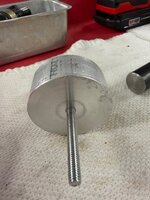
I have this time ordered some "Elring" seals. I think i need to fashion a nylon sleeve possibly to help it glide on? I already made a press tool with sockets and threaded bar etc.

i really cant understand what im missing. After all, ive done this job in the past and never faced any issue.
 
Sorry to dredge this up again but I was out for a long drive yesterday in the silver car... and just as i was explaining to my boys the mightyness of the 500E and how they were both brought home for their first ever journey from the maternity ward, the car started to cough and splutter.

So starbucks car park and both caps off revealed a fair amount of oil in both.

Im gutted really. I thought this was finally sorted.

I dont now know, if i ever sorted my black car, as i sold it last year when i was need of some $. Damn i miss that car....

I have this time ordered some "Elring" seals. I think i need to fashion a nylon sleeve possibly to help it glide on? I already made a press tool with sockets and threaded bar etc.

i really cant understand what im missing. After all, ive done this job in the past and never faced any issue.
@jaymanek — I have the tool that goes in the center of the cam but I found that it’s really not needed.
@jaymanek I second what @emerydc8 said. I used patience, mallet and a socket that encompassed the size of the ring (roughly) + some oil to help it glide on, i also used the Elring seals. I followed his previous posting in this thread pretty spot on and my seal has not leaked in the year since. Make sure you measure how far it goes in. Gsxr noted previously in this thread to pay attention to the depth you inserted it that also helped with my issues.

Best of luck.
 

Attachments

  • IMG_7193.jpeg
    IMG_7193.jpeg
    1.8 MB · Views: 12
Interesting thread. New member here. My son bought a 1991 500SL a while back. We immediately found coolant leaking into #2 cylinder. The car went into storage for a year (logistics issues at the time). We finally puled the engine and located the leak - corrosion of the block. We sent the long block to Metric Motors in California for repairs. We finally are starting to break in the engine - has 199 miles on it at present. Today I pulled the distributor caps to inspect them and found oil leaking from the camshaft seals. See photos. I noticed that the seals a slightly proud rather than inset. Reading this thread I am speculating that that is what is causing the leak. Since the engine was down for a full "rebuild" I'm hoping the camshaft isn't grooved. Thoughts? Obviously, this is a warranty issue with Metric. But I'm tempted to just try to reseat the seals to the correct depth. Probably a bad idea. But we've been the a lot of tough issues and hard work with this car.
 

Attachments

  • IMG_6556.jpeg
    IMG_6556.jpeg
    572.4 KB · Views: 13
  • IMG_6564.jpeg
    IMG_6564.jpeg
    755.7 KB · Views: 13
Interesting thread. New member here. My son bought a 1991 500SL a while back. We immediately found coolant leaking into #2 cylinder. The car went into storage for a year (logistics issues at the time). We finally puled the engine and located the leak - corrosion of the block. We sent the long block to Metric Motors in California for repairs. We finally are starting to break in the engine - has 199 miles on it at present. Today I pulled the distributor caps to inspect them and found oil leaking from the camshaft seals. See photos. I noticed that the seals a slightly proud rather than inset. Reading this thread I am speculating that that is what is causing the leak. Since the engine was down for a full "rebuild" I'm hoping the camshaft isn't grooved. Thoughts? Obviously, this is a warranty issue with Metric. But I'm tempted to just try to reseat the seals to the correct depth. Probably a bad idea. But we've been the a lot of tough issues and hard work with this car.
Oh wow, they didn't seat those far enough into the covers to really make a proper seal. You want it to sit ~3mm inwards, but maybe there was some level of wear on the camshaft that they wanted to avoid (doubtful but possible)

[Moderator edit - deleted reference to crank seal tools (not cam seal)]
 
Last edited by a moderator:
Damaged cam sealing surfaces should have been caught during the rebuild. The cam seal in the position shown in your photo (flush to surface) should have sealed. You can try pressing the seal inward about 3mm to see if there is any difference, but otherwise the seals will need to be removed to inspect the sealing surface for damage.

Where exactly was the block corrosion, btw?

Welcome to the forum!

:welcome4:
 
Here are a couple of posts I did a few years back about installing the new cam seal. You can see the depth I used, was to the bottom of the chamfer in the front of the cylinder head cover.

I just checked both seals last fall, about five and a half years after I replaced them, and I didn't have a single drop of oil leakage with them installed at factory-ish depth. You can see my photos of both seals as of 2025 in this post.


Depth of the original factory cam seals: RESTO PROJECT: M119 / W124 / E500 Engine Top-End Refresh | Member Roadtrips and Project Journals


You can see here I pressed it in, and then pushed it in more: RESTO PROJECT: M119 / W124 / E500 Engine Top-End Refresh | Member Roadtrips and Project Journals
 
Damaged cam sealing surfaces should have been caught during the rebuild. The cam seal in the position shown in your photo (flush to surface) should have sealed. You can try pressing the seal inward about 3mm to see if there is any difference, but otherwise the seals will need to be removed to inspect the sealing surface for damage.

Where exactly was the block corrosion, btw?

Welcome to the forum!

:welcome4:
Thanks to all with the quick replies. I appreciate it. I agree that and damage to the camshaft surface should have been caught. But I would be surprised if there was damage - the car has under 50k on the clock and the original seals were not leaking. The seals are actually proud - not flush. The corrosion was right next to the cylinder, about 13mm long and about 1mm deep. See photos. The second photo shows where the corrosion finally broke through the fire ring. We speculate that the coolant services were well overdue We'll see what Metric says regarding the warranty claim and where they would have the work done. We have yet to find anyone in this area (Richmond, VA) with any real experience with these cars.
 

Attachments

  • IMG_6289.jpg
    IMG_6289.jpg
    1 MB · Views: 14
  • IMG_6290.jpg
    IMG_6290.jpg
    480.1 KB · Views: 14
Back
Top