• Hi Guest !

    Welcome to the 500Eboard forum.

    Since its founding in late 2008, 500Eboard has become the leading resource on the Internet for all things related to the Mercedes-Benz 500E and E500. In recent years, we have also expanded to include the 400E and E420 models, which are directly related to the 500E/E500.

    We invite you to browse and take advantage of the information and resources here on the site. If you find helpful information, please register for full membership, and you'll find even more resources available. Feel free to ask questions, and make liberal use of the "Search" function to find answers.

    We hope you will become an active contributor to the community!

    Sincerely,
    500Eboard Management

Switched from double fuel pumps to single fuel pump

Christian_K

I do believe...!
Member
Hi, i switched from the double fuel pump package to the later style single fuel pump. This design is better because its just one Pump to pay for, its stronger (more Liter per minute) at same pressure (4 bar) and the pumps are close to non-audible - they are very silent. Mercedes switched to this Design in nearly all Benzes at the very End of the Year 1994. The Bosch or Pieburg OEM Pumps are very reliable. Usually they last 10-15years if you change the fuel filters regularly, in order to reduce backpressure to work against, for the pump.

The switch to single pump is actually quite easy and if you already have old or noisy pumps, i would consider a switch to the single fuel pump. Here is what you have to do and to get:

Parts List in EPC:
500E_single_pump_overview.jpg
I Ordered the Bosch Pump with Part-Nr. "Bosch 0 986 580 372". I was a little disappointed because they are no longer made by Bosch Germany themselves, they are now made in Poland by a company called "TI Automotive" and there is just a Bosch sticker on the pumps. I assume TI Automotive is owned by Bosch anyway. Same like the new Bosch Coils that are made in Slovenia by another company and only have a Bosch sticker on them nowadays... Well but thats a different story.


Installation is quite Easy:
1. Jack up the rear of the car. I used two ramps to drive on them. Or use a large car jack to have enough room while lying under the car around the fuel pump area, near the right rear wheel. At best use a car lift. Remove "-" Pole from battery and secure it. Better safe than sorry.
2. Remove the plastic cover from the Pumps. Its just a few 10mm Plastic nuts.
3. Use a hose-clamp to clamp/block the thicker rubber fuel-line/hose coming from the tank
4. Remove electrical lines from the old pumps
5. Remove fuel-line from tank to the first pump
6. Cut the fuel-Line from the old Filter to the steel fuel-line that later ends in the engine bay. See the Pics for at which length to cut.
7. Pre-Assemble the whole new unit (pump with new filter and short fuel inbetween them + the new metal braket/holder).
8. "Hang" the new Unit in its place with the 4 little rubber hangers. Now connect the electrical lines. I used to isolate two of the four lines, because you now only need two lines for one pump obviously. You can see them covered in layers of "Wire Harness Tape" on my Picture. I assume you also could just connect all 4 lines to the pump aswell. But it was too much hassle for me since then you have a problem with the rubber covers of the other two electrical lines.
9. Connect the Fuel-lines from Tank to the pump and from the filter to the previously cut fuel-line.
10. Run the car and check for leaks.
11. Reassemble the plastic cover around the pump.
12. Enjoy!

Pics:
old_pump_package_with_cut_line.jpg pump_connection_filter.jpg pump_Installed_with_description.jpg

The Principle of the single pumps flow is simple:
Fuel Tank -> Larger Hose -> Fuel Pump -> Smaller short (approx. 120mm) hose -> Fuel Filter -> Medium outer diameter hose -> Steel fuel line -> Flex line engine bay -> Fuel distributor ring -> etc....
 
Last edited:
Last edited:
The single pump is actually SMALLER than one the dual pumps!!

:tumble:
 
The single pump is actually SMALLER than one the dual pumps!!

:tumble:
 
My error. I just presumed that the higher output single pump would be larger.
It's definitely counter-intuitive. I was surprised when I first saw it as well. On the bright side, you can use a Walbro high-flow pump, which is the same outer diameter as the OE single pump. I've heard the Walbro is louder but haven't heard one myself. Sauceman has a single Walbro on his car to feed his engine's thirst for nitrous.

:nos:
 
I have a 95 E420 with chassis C187002 and it still has the dual pumps (003 091 53 01). Did they phase these out earlier in Europe and go to a single pump?
 
I have a 95 E420 with chassis C187002 and it still has the dual pumps (003 091 53 01). Did they phase these out earlier in Europe and go to a single pump?
The single pump did come to USA but it was later... as of chassis C226336. It was strange that MB even bothered to make the change so late in 124 production.

:watermelon:
 
The single pump did come to USA but it was later... as of chassis C226336. It was strange that MB even bothered to make the change so late in 124 production.

:watermelon:

Later 1995 E320 wagons also switched to a single pump, though mine has two.


Sent from my iPad using Tapatalk HD
 
Yes, the Walbro is a noisy bugger. I do manage to forget about it, but it still catches my attention pretty regularly. Even after 3 years with it, I wouldn't say I'm totally used to it. And this is coming from a guy who used to have a railroad track running 200ft away through his neighbors back yard, and got used to that after a week.
 
For single pump configuration, please consider bosch -044. It is bit thicker than original but easy to install. The bottom end connector is M18x1.5 so it needs adapter to fuel tank hose.
 
I don't know so much about this single pump business. I'm not convinced. It just seems to me like more cost cutting at a time when MB was already doing too much cost cutting.

Yes, the Walbro is a noisy bugger. I do manage to forget about it, but it still catches my attention pretty regularly. Even after 3 years with it, I wouldn't say I'm totally used to it.

The solution to that is a lower restriction exhaust system!

Regards,
Eric
 
Last edited:
For single pump configuration, please consider bosch -044. It is bit thicker than original but easy to install. The bottom end connector is M18x1.5 so it needs adapter to fuel tank hose.


The Bosch 044 is the shit.

More the enough output and the threaded inlet means you can use an AN fitting and steel braided hose to the tank.
 
I'm confused- how do we know the 044 is good for 500 hp? Is there a published flow rate that I'm missing or is it used on later cars which are 500 hp?

Just curious- I put new stock ones on my car.. maybe a mistake.

Michael
 
The 044 has much higher GPH rate.

Also draws 16 amps compared to 7 or 8 for stock pumps
 
The Bosch 044 is the shit.

More the enough output and the threaded inlet means you can use an AN fitting and steel braided hose to the tank.

What size (4AN, 6AN, etc.) and length of hose is recommended? Do you also recommend a steel braided hose from pump to filter?
 
How does the Bosch 044 compare to the Walbro GSL392 that was recommended (AFAIK) by BergWerks for their upper-level NOS kit?

:apl:
 
proxy.php
 
The main difference I see is the inlet port

044 has a 18mm X 1.50 and the Walbro has a 10mm X 1.0
 
The double fuel pumps in the stock setup are cheap enough and easy enough to mess with that I'm happy to just keep using them. Though I appreciate the experimentation others have and are doing with the Walbro and Bosch pumps.

I never had BergWerks specify anything other than the stock pumps for NOS usage, at least up to and including the 125-shot that I tested fuel pressure reserve for but never installed. That's the max I discussed with Carl anyway, at the time.
 
Wierd to see the Walbro spec same size inlet and outlet. Suction line is usually always bigger to minimize capitation problems. Also removes the possibility of installing a pump backwards=0)

Bosch 044 gets my thumbs up!


Michael
 
Gerry, for non-NOS setups, you are correct... stock pumps are fine.

The Walbro fittings play nicer as replacements for the early stock/twin pump setup, as the stock pumps are also M10. the Bosch 044 would require a bit more in the way of adapters.

I believe BergWerks indicates a pump upgrade would not hurt for ~125 shot but as you stated, it may not be required if the pressure under load tests out OK. It would still be a good safety item as the ~125 shot is getting on the edge of stock pump fuel delivery. I'd rather not have an unexpected lean condition while spraying, the pump upgrade is cheap insurance. Beyond the ~125 shot, the pump upgrade is required, not optional. On a side note, I believe most of BW's claimed "shots" are about 25 high... meaning their 100-shot is closer to 75-80 in reality, and their 125-shot is closer to 100. That's getting into a different technical discussion, but anyway, stock pumps should be able to support up to 350-370hp at the rear wheels (est 425-450 crank hp), as measured on a DynoJet.

:nos:
 
The stock pump has a 15mm or so large inlet that's part of the pump housing.

The 044 has a large 18mm threaded hole that can take a stock type fitting (pictured) or AN

proxy.php


proxy.php


proxy.php
 
I'm really liking that 044 pump. I've got a new GSL-392 sitting on the bench, but now I gotta figure out if I want to use the 044 instead. Grrr!!!!

:seesaw:
 
I'm confused- how do we know the 044 is good for 500 hp? Is there a published flow rate that I'm missing or is it used on later cars which are 500 hp?

Just curious- I put new stock ones on my car.. maybe a mistake.

Michael

Info:
http://www.rx7club.com/2nd-generation-specific-1986-1992-17/bosch-044-fuel-pump-1023484/
http://www.rx7store.net/Bosch_044_Fuel_Pump_p/bosch044.htm

These guys who have 500+ HP RX7's, some use the Bosch 044:
http://www.rx7club.com/time-slips-dyno-128/500-hp-club-675579/

TAKE NOTE: THESE PUMPS ARE LOUD!

:-) neil
 
The 044 is good for 80 gallons per hour (GPG)

The example below only needs 47.5 GPH for 500hp


proxy.php


proxy.php
 
Last edited:
Found dimensions on the 044 pump... it's larger diameter and longer than stock, so it may not play nice with the factory mounting brackets available. The Walbro will fit in the late/single pump factory bracket, for those interested in that swap. Both will require plumbing modifications. Haven't found anything that discusses the noise level between the Walbro and 044, I think both are louder than stock, but the 044 could be worse that the Walbro. (??)

:scratchchin:
 
That is interesting. Are there any known disadvantages of going with a single pump, outside of the obvious fact that its failure means you are down hard? How much was the single larger pump as compared to the stock?

ADDENDUM: I see the larger Bosch is $198 here in the US. Isn't that about twice the price of the stock pump?

http://www.autohausaz.com/search/product.aspx?sid=rfev4su1cspmc5fbhb1iwbbb&partnumber=0 986 580 372
In germany the Pump was 118€. The normal/early ones are around 90€/piece here in germany, so it was quite obvious for me to go with the later style ans since i had to replace the 20€/piece china pumps anyway, it was clear for me.
Also i HATE all the rusted threads and all the trouble i have EVERYTIME when fiddling around with fuel filter replacement and/or pump replacement on the early style dual pumps on any W124 car. I hate it. For that reason alone, i would have payed even double the price, just to now only have to mess around with ordinary hose clamps.
Cheers ;-)
 
.... just to now only have to mess around with ordinary hose clamps.
Funny, that is one thing I do not like about the newer single-pump setup, it uses "ordinary hose clamps" for the pressurized side, both at the filter, and from the last rubber hose to the metal fuel pipe that goes towards the front of the car. This was very likely cheaper for MB.

The older dual-pump setup uses compression fittings and there are no "ordinary hose clamps" except on the pump inlets... I personally think this is a more bulletproof design, although probably overkill and over-engineered. I haven't heard of any issues with the new style, but I still like the old one better, even if it does cost a bit more to maintain!

:seesaw:
 
Funny, that is one thing I do not like about the newer single-pump setup, it uses "ordinary hose clamps" for the pressurized side, both at the filter, and from the last rubber hose to the metal fuel pipe that goes towards the front of the car. This was very likely cheaper for MB.

The older dual-pump setup uses compression fittings and there are no "ordinary hose clamps" except on the pump inlets... I personally think this is a more bulletproof design, although probably overkill and over-engineered. I haven't heard of any issues with the new style, but I still like the old one better, even if it does cost a bit more to maintain!

:seesaw:


The dual series setup is arguably a better arrangement both for the redundancy, and for the general "damn this is well made" ishness of it. And it is overbuilt as hell for this application, as the architecture was intended to support K-jet / CIS.

However as I rethink this, Christian does have a point here. Changing fuel filters goes from a being a potential cussing job to an absolute piece of cake. And that is true in multiples if the car in question gets exposed to thawing agents. It was not uncommon for northern winter and ocean beach cars to just have the electric wires disconnected from the pumps and the entire fuel pump/filter assembly, brackets and all thrown in the scrap metal pile if it needed a pump or a filter. It was all one solid piece. They weren't coming apart, and even if it did, it was not going to be reassembled with out leaks.

As I think I said (?) on the "Bosch fuel pumps - reduced price" thread, I'd never change to the single pump set up just to do it but thinking out loud here, If I had a situation as I've described above and as it appears that Christian has experienced, then I'd consider it. It is so much easier to change filters, and that screw pump design has proven to be extremely reliable in the real world. Additionally, consider that almost none of us would change only one pump without feeling like we were only buying one new shoe. Even more so if it was the first pump that failed and now we have to consider that it may have put some of it's guts or wear debris into the second pump. And if the total price of the parts was less than buying two new pumps at the time I needed them, hummm...
:scratchchin:

Do any of the grownups here think that this thread should be merged with Bosch fuel pumps - reduced price ? Works for me.
 
The dual series setup is arguably a better arrangement both for the redundancy, and for the general "damn this is well made" ishness of it.

How does the 500E/E420 two-pump setup run if one pump fails? Would it be kind of like the limp home mode or would you not notice it for normal driving?
 
How does the 500E/E420 two-pump setup run if one pump fails? Would it be kind of like the limp home mode or would you not notice it for normal driving?
Usually they are low on power and / or the RPM won't climb above a certain point under hard acceleration. A lot like what you experienced with your plugged cats, but usually not quite as abrupt. That is to say the power goes away more gradually as the vehicle gains speed instead of "running into a wall" as it does with an exhaust restriction. People that drive really gently could be running only one pump for a long time before either that one fails or somebody else drives their car and discovers it.
 
Thanks, Dave. I like the two-pump setup, if for nothing else but the redundancy.
+1. I would never change as I just don't see the clear-cut benefits. It's not like I'm changing fuel filters (and accumulator in my CIS-E car) once a month or anything.

Just take my advice ... don't EVER get a shot of gasoline down your ear canal like I did a couple of years back while changing pumps and filter. You have not experienced pain until you get gasoline down your ear. I could not walk after that and thankfully had my swimming pool within crawling distance to douse my head into. Still didn't kill the pain immediately, but helped.....
 
+1. I would never change as I just don't see the clear-cut benefits. It's not like I'm changing fuel filters (and accumulator in my CIS-E car) once a month or anything.

Just take my advice ... don't EVER get a shot of gasoline down your ear canal like I did a couple of years back while changing pumps and filter. You have not experienced pain until you get gasoline down your ear. I could not walk after that and thankfully had my swimming pool within crawling distance to douse my head into. Still didn't kill the pain immediately, but helped.....

Been there, done that once! Took the cover off of an outboard to see what was what and fuel from a broke hose shot right in my ear. I jumped straight in the lake. Gasoline in or on any of the more sensitive areas burns like hell.

BTW, Honch, what to you think of somehow merging these FP threads as I asked above? Lots of overlapping information on what is essentially the same discussion?
:klink:
 
Last edited:
Ouch!! Gerry, I understand that one completely. That's just a great reason you need a lift=0). I have not experienced ear, but I did get a dousing up my armpit. I think all our sensitive skin areas would hurt.


I have been working down here for months in SA, on a gulfstream which uses Skydrol hydraulic fluid like all fixed wing airplanes. That stuff is non-flammable, but everyone mechanic said residue will BURN if you go pee, even after washing hands. We use caster oil, then isopropl alcohol prior to soap and water.

WEAR safety glasses and it's a good thing fuel filters are only every 60,000 miles.


If I understand Christian here, the last W124's had the 044 pump- so we should be able to order all factory parts for the conversion? If they are so noisy- maybe put a piece of dynamat on the mounting bad (bottom of the floor board)??


Michael
 
Other than nitrile gloves, long sleeves, protective eye-wear, a hat (I'm bald), I also have a scrap piece of cloth I tie just under my elbow to provide a stop/soak-up point for any gasoline or other fluids that might (will) dribble down my arms when changing out filter/fluid lines that are above my head.

Although I de-pressurize the various systems where possible, I also like to cover the fitting/joint/connection with a rag.

:-) neil
 
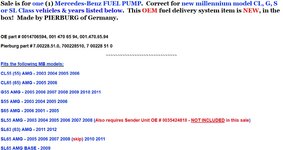
Since this thread was about switching to a SINGLE pump, has anyone considered the Pierburg screw-type fuel pump pn# 7.00228.51.0 used in some of the latest AMG models ?

This baby is good for 300-360 LPH at 16-amps (but only 5-bar, I think the 044 is 6-bar). That's 79-95 Gallons Per Hour (GPH) vs. the 044's 80 GPH.

I've also been told that these screw-type fuel-pumps aren't so fragile to infrequent use and ethanol-flavored gasoline as the technology in our current fuel-pumps and the 044 which I believe are toothed-ring types of pumps (can someone verify?).

IMHO, I think in our current fuel-pumps the toothed-ring get "frozen"/stuck in place, which is why tapping around them the fuel-pump sometimes frees them.

As for the screw-type, if anything causes the screws to "freeze"/get stuck, I think you're "screwed".

Retail/new is similar to the Bosch 044, but sometimes you can find them under $100.

:-) neil
 

Attachments

  • pierpurg application.jpg
    pierpurg application.jpg
    171.5 KB · Views: 30
  • Pierburg_brandstofpompen.pdf
    Pierburg_brandstofpompen.pdf
    1.3 MB · Views: 7
  • Pierberg 7 0028 51 0.jpg
    Pierberg 7 0028 51 0.jpg
    174.5 KB · Views: 43
  • fuel pump architecture.jpg
    fuel pump architecture.jpg
    219.3 KB · Views: 35
Last edited:
If I understand Christian here, the last W124's had the 044 pump- so we should be able to order all factory parts for the conversion?
No. The 044 pump is physically larger than either the early or late factory pumps. It is a high volume, high flow pump, which was never used from the factory, and is NOT plug and play, at all.

Early 124 (dual) pump diameter = 52 mm (<-- approximate size, need to confirm)
Late 124 (single) pump diameter = 43 mm (<-- same diameter as Walbro GSL392)
Bosch 044 pump diameter = 60 mm


If they are so noisy- maybe put a piece of dynamat on the mounting bad (bottom of the floor board)??
I believe the noise may be most objectionable outside the car. From inside, just crank up the stereo.

:bbq:
 
The single pump did come to USA but it was later... as of chassis C226336. It was strange that MB even bothered to make the change so late in 124 production.

:watermelon:

When you say: "as of chassis C226336", you are referring to the last part of the VIN number correct? So my 212546 VIN numbered 12/94 built 95 034 should also have dual pumps correct?
 
Yes he is referring to the last six digits of the VIN. Ignore the C.

Indeed, your car should have dual pumps from the factory. It was relatively late in 1995 production that they moved to the single Pierburg pump design. My (former) 1995 wagon was 11/94 or 12/94 production (IIRC) and it definitely had dual pumps, as I had to replace them a couple of years ago.....

Cheers,
Gerry
 
Yes he is referring to the last six digits of the VIN. Ignore the C.
Nooo! Don't ignore the "C". :duck:

B226336 is way earlier than C226336.

B226336 is chassis 1,226,336 (circa 1991)
C226336 is chassis 2,226,336 (circa 1995)

:mushroom:
 
We're talking 1994 & 1995 series models here.......to me the C is assumed.


Sent from my iPhone using Tapatalk
 
We're talking 1994 & 1995 series models here.......to me the C is assumed.
For 1994-1995, yes, the C is assumed.

However I don't want to people to think the preceding letter can normally be ignored for EPC chassis break points.

:mushroom: :mushroom: :mushroom:
 

Who has watched this thread (Total: 3) View details

Back
Top