• Hi Guest !

    Welcome to the 500Eboard forum.

    Since its founding in late 2008, 500Eboard has become the leading resource on the Internet for all things related to the Mercedes-Benz 500E and E500. In recent years, we have also expanded to include the 400E and E420 models, which are directly related to the 500E/E500.

    We invite you to browse and take advantage of the information and resources here on the site. If you find helpful information, please register for full membership, and you'll find even more resources available. Feel free to ask questions, and make liberal use of the "Search" function to find answers.

    We hope you will become an active contributor to the community!

    Sincerely,
    500Eboard Management

Best way to clean gunk from spark plug well

Kyiv

1993 400E | Azov мой кумир!
Member
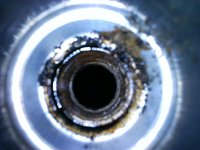
My spark plugs were changed about 4 years ago, and I assume the gunk is from them not being tightened enough(?) Any ideas on how to clean the gunk? Sorry the picture is out of focus.

20190908191750.jpg
 
If the top of the bore is clean, and you only have gunk at the bottom, it may be crud leaking upward past the threads.

If the top of the bore has a trail down to the bottom, it was more likely from the valve cover donut seal.

Vacuum & compressed air are a good start to remove loose debris, then I use a solvent-soaked rag with a long skinny tool of some sort to wipe the bottom clean. Repeat as necessary. Not fun. Remember when installing new plugs, don't apply any anti-seize to the threads; the threads are coated and don't need additional help.

:tumble:
 
Remember when installing new plugs, don't apply any anti-seize to the threads; the threads are coated and don't need additional help.
:tumble:

Did I miss something because none of my spark plugs from Naperville appear to have any coating on the threads? Is there a coating build into the thread material or maybe sprayed on that I'm not seeing?
 
Did I miss something because none of my spark plugs from Naperville appear to have any coating on the threads? Is there a coating build into the thread material or maybe sprayed on that I'm not seeing?

I think the Gixer is referring to the spark plug material plating described as follows;

NGK spark plugs feature what is known as trivalent plating. This silver- or chrome-colored finish on the threads is designed to provide corrosion resistance against moisture and chemicals. The coating also acts as a release agent during spark plug removal. NGK spark plugs are installed at the factory dry, without the use of anti-seize. NGK tech support has received a number of tech calls from installers who have over-tightened spark plugs because of the use of anti-seize. Anti-seize compound can act as a lubricant altering torque values up to 20 percent, increasing the risk of spark plug thread breakage.
 
Last edited by a moderator:
+1
This is very important to keep in mind! Also when reinstalling the same spark plugs, the threads must be cleaned. The threads in the plug hole should be cleaned as well to achieve friction as close as possible to dry condition.
 
Did I miss something because none of my spark plugs from Naperville appear to have any coating on the threads? Is there a coating build into the thread material or maybe sprayed on that I'm not seeing?
Joe is correct... I meant the threads are plated and don't need additional paste, and also do not have any paste pre-applied. Just install clean & dry.

:banana2:
 
+1
This is very important to keep in mind! Also when reinstalling the same spark plugs, the threads must be cleaned. The threads in the plug hole should be cleaned as well to achieve friction as close as possible to dry condition.

What would you clean threads and the gunk with? I'm concerned that some of the gunk will fall into the cylinder during cleaning. With spark plug in place the gunk can't be reached...
 
Small amounts of gunk falling into the cylinder shouldn't hurt anything, it will blow out when the engine is started.

Normally I'd start by vacuuming each bore prior to removing the plug, then using compressed air, then you can vacuum again after removing the plug, to suck out any loose dirt. Then when using a rag wet with solvent, most gunk will stick to the rag. Repeat as necessary.

I've never done anything to clean the threads in the head.
 
I'd use a spray or two of brake cleaner, letting it soak the gunk for 30 seconds or so and then blown out with compressed air, in each plug hole BEFORE you remove the plug. Then vacuum it with a shop vac. THEN remove the plug. Then use @gsxr's wet rag with solvent to clean it better.

This process should get each hole pretty clean, with minimual crud falling into each combustion chamber. The spark plug threads will clean the cylinder head threads good enough, through the acts of being removed and then re-inserted and torqued.
 
Small amounts of gunk falling into the cylinder shouldn't hurt anything, it will blow out when the engine is started.

Normally I'd start by vacuuming each bore prior to removing the plug, then using compressed air, then you can vacuum again after removing the plug, to suck out any loose dirt. Then when using a rag wet with solvent, most gunk will stick to the rag. Repeat as necessary.

I've never done anything to clean the threads in the head.
What would you clean threads and the gunk with? I'm concerned that some of the gunk will fall into the cylinder during cleaning. With spark plug in place the gunk can't be reached...
I think Dave explained it very well.👍 I do also tape up a tiny plastic/rubber house on the vacuum cleaner hose end giving better access to the bottom in the cavity. For the plug hole threads I use a tiny wooden pin, wrap a rag around to make it about the same size as a spark plug, and screw it down the plug hole. The reason for using a wooden pin is if the pin for any unknown reason should fall into the cylinder, it won't make any scratches in the process fishing it out.
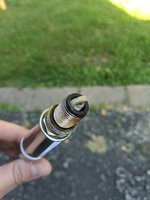
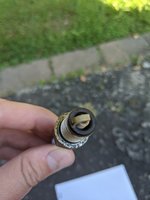
 
So spraying brake cleaner with plugs screwed in and then blowing the puddle out with compressed air worked well: got rid of most gunk.

Changed the spark plugs that are about 4 years/12k miles old while at it with a Mercedes-branded set I got from @gerryvz about 3 years ago. Most were about hand-tight...

They all looked about the same as in the photos below. Threads are gunky. Tips are tan-ish. Top of the spark plugs wells were clean so I assume the gunk is blowby from the cylinders because plugs were not tightened properly (?)

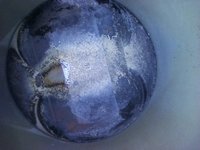
For fun peered into the cylinders with a borescope camera. All looked more or less similar. Could even see digits stamped on top of the pistons
 

Attachments

  • IMG_20190919_174847.jpg
    IMG_20190919_174847.jpg
    1.2 MB · Views: 16
  • IMG_20190919_173048.jpg
    IMG_20190919_173048.jpg
    1 MB · Views: 20
  • 20190919181607.jpg
    20190919181607.jpg
    286.6 KB · Views: 21
Last edited:
Tan tips are normal and a good thing. They look a little dark around the bottom rings to me, but I don't believe that is a necessarily bad thing.
 
That's great looking spark plugs after 4 years, though depending on their mileage, but your power plant appears healthy. I think the engine has to run on high load for longer periods to burn off the black deposits. Good idea to do a borescope inspection. :)
 
Your plugs look normal... gunk on the threads, tan insulator/electrode. If anything, they appear slightly lean, there is some white on the insulator, which I don't normally see. But it might be the lighting from your camera/phone.

Odd the plugs were slightly loose, but I've run into that before as well, don't lose sleep over it. Nice borescope shot btw!

used_plugs1.jpg used_plugs2.jpg
 
@gsxr, can't trust anyone, even with properly tightening spark plugs. We have a member here, I forgot who exactly, who had oil changed at dealership and it was overfilled. Scary times we live in 😁

As to color of the tips, they look faded beige in-person, like the left-most plug in your picture. Camera does make them seem whiter.

This is the bore-scope camera I used, $30 on Amazon. Acts as a hot spot to which your phone connects wirelessly and controlled via app. Takes 1440p resolution pictures and videos. Everything works properly, quick and not buggy at all.

 
I think Dave explained it very well.👍 I do also tape up a tiny plastic/rubber house on the vacuum cleaner hose end giving better access to the bottom in the cavity. For the plug hole threads I use a tiny wooden pin, wrap a rag around to make it about the same size as a spark plug, and screw it down the plug hole. The reason for using a wooden pin is if the pin for any unknown reason should fall into the cylinder, it won't make any scratches in the process fishing it out.

A bag of bamboo skewers you can find at the grocery store are an important addition to any workshop. They work well in a situation like this - I use them for agitating the detritus that collects in the drains below the hood hinges with a shop vac nozzle close by to suck the stuff out as it’s moved around, too.

They’re also too long to drop into the cylinder...

Dan
 
I recall reading somewhere, maybe I'm not remembering it correctly, but some Benz motors actually had a small drain hole at the 6 o' clock positon to drain potential spilt oil away from the spark plug hole. Or am I way off base here (won't be the first time:hammerhead:)?
 
Back
Top