• Hi Guest !

    Welcome to the 500Eboard forum.

    Since its founding in late 2008, 500Eboard has become the leading resource on the Internet for all things related to the Mercedes-Benz 500E and E500. In recent years, we have also expanded to include the 400E and E420 models, which are directly related to the 500E/E500.

    We invite you to browse and take advantage of the information and resources here on the site. If you find helpful information, please register for full membership, and you'll find even more resources available. Feel free to ask questions, and make liberal use of the "Search" function to find answers.

    We hope you will become an active contributor to the community!

    Sincerely,
    500Eboard Management

Lean on the lean condition (M104 HFM)

jftu105

E500E Guru
Member
Well, I thought that I fixed the lean condition of my E320, 1994 by finding some hidden vacuum leaks. It came back!

The check engine light is showing error code 3, which is lamda control overlimit. Put in the Hfmscan, sure enough, the lamda control was hitting 25%, the limit, when I was cruising on highway. The O2 sensor signal stayed at 10 mv, even though ECM was sending 25% more fuel based on the air measurement. Otherwise, it was within the lamda control range. The gas milage is still lower than before, just about 19.5 miles per gallon, instead of 20.5 to 21.5 in the past.

Double checked on vacuum leaks. Absolutely no leaks. Checked the fuel pressure, it was 50 psi and hit 60 when the vacuum was pulled from the fuel pressure regulator. Therefore, no fuel pressure or fuel pump issues.

The MAF is fine. Put in a spare, the symptom is the same.

I was puzzled. Then, I went back to my data records for the same car. I can replot all the engine data I took with Hfmscan in the past and compare them. After going through the data from last year and now, I finally noticed one pattern. The O2 sensor signal barely hit over 0.7V now, but in the past it would be over 0.75 easily. I figured it might be the O2 sensor has developed a bias, indicating the combustion condition incorrectly. This subsequently messes up the engine control, resulting in this lean condition.

I decided to pull out the O2 sensor and do some cleaning by burning it with a torch. Put it back in, now the O2 sensor is dead, staying at 10 mV all the time. Did the burning kill it? I did that before without issues. This O2 sensor was put in in Oct. 2014.

I have a Denso O2 sensor I bought long ago. I did not use it because its heater resistance is too low. I decided to put it in anyway.

Mistake! ECM sensed that the heater current is too high, so it just shuts down the O2 control and likely the heater current. As a result, the Densor O2 sensor does not work right. It stays low and gets up to 0.4V slowly. In the meantime, my fuel tank gauge goes down fast, indicating very poor gas miliage. Took the Denyyso out and burned it with a torch and measure the voltage. It hits 0.9V easily when under full flame.

Decided to put in an old Bosch I replaced before. Before putting it in, I did the burning test too and measured the voltage. It was pretty, jumping to 0.9V easily when fully in flame and dropping back to nearly zero once I moved the torch away.

Put it in. That was IT! Hooked up Hfmscan and drove on highway. All good.

All these diagnoses are not possible without Hfmscan.

Something new I learned here. Even though the O2 sensor is fluctuating fast, it could still have problems. I also have a bad MAF before which under-reported the air flow, causing the lean condition. I have to lean on Hfmscan to deal with all these lean conditions.

Ordered two new Bosch O2 sensors today after everything is back to normal.

jftu105
 
Last edited:
One more thing about this lean condition and diagnosis with Hfmscan. If I do not have the real time data while driving with my laptop hooked up to display the engine operating parameters, I will not be able tell if ECM is in closed-loop or open loop control. When the Denso O2 sensor was installed, ECM shut off the lambda control and the engine was run using some open loop map. The lambda control was showing 0%, without changes, indicating open-loop control. The car still drives fine, perhaps a bit sluggish, but I won't be able to tell if Hfmscan is not connected.

jftu105
 
The latest milage test came out as 21.2 miles per gallaon, vs 19.0 miles per gallon before the lean condition was corrected and the O2 sensor was replaced.

I still don't like the shudder during idling. It could be smooth, but 1 minutes into idling, the shake starts. Before the engine warms up, the idling is very smooth. The idling speed is 600 rpm plus minues 25 rpm. I think it is too low but no way to adjust it.

My theory is that the shudder comes from torque converter. As idling becomes too long, the heat dissipates at the torque converter thins out the transmission fluid, causing the flow to become turbulent, which presents more loading to the engine. The engine at a low idling speed does not provide sufficient power to handle the increase loading and the engine becomes less steady. It forms a unstable cycle.

Shifting to neutral, immediately removes the shudder as the engine speed creeps up and runs more steadily. I want stillness and I have that in my 1995 E320. May be I need to replace the engine mounts with new ones. I put in a set of good used ones I have at hands. The sudder is a lot less than before the lean condition was corrected. Still, I don't like any shakes.

Transmission fluid is quite new, replaced not too long ago.

jftu105
 
OK, in my last effort to eradicate the idling shudder, I replaced the spark plug wires. It helped, but not completely. Finally, I had to admit to myself that it was a bad idea to put in used engine mounts that still look good and with Mercedes stars. Ordered two new mounts from Lemforder but they are made in Kina (yak!). That only choice from FCP. Put them in and the shudder, though not completely gone, definitely is damped out substantially. It is not the complete stillness like my 1995 E320, but really faint. I must be paranoid because some people might ask, "what vibration?" while sitting in my car.

jftu105
 
I too bot the Lemforder mounts from FCP but for my 400E. When they arrived I noticed they were made in China. I returned them and bot OEM at what I'm sure you also found a significant cost over the Lemf mounts. Always kinda wondered how the Lemf mounts would have done?
 
I noticed that on RMeuropean they carry a different kind of Lemforder mount, which more resembles the MB mount, with a smooth round top and a letter B written on the rubber. The one sold by FCP is the one with ribbed top. I need another pair for my other car. I will check out RMeuropean next week. I think they work but don't know for how long. FCP offers life time. I know very well how to replace them after I acquired a 17mm offset tool. A small job now.
 
Last edited:
I noticed that on RMeuropean they carry a different kind of Lemforder mount, which is more resemble the MB mount, with a smooth round top and a letter B written on the rubber. The one sold by FCP is the one with ribbed top. I need another pair for my other car. I will check out RMeuropean next week. I think they work but don't know for how long. FCP offers life time. I know very well how to replace them after I acquired a 17mm offset tool. A small job now.
If it has the "B" on the mount, it's likely (at least the one in the photo) a "real" old-school Lemf mount. Unfortunately I think they may all be sold out of that old-stock produced in Europe, replaced with Chinese-made ones that folks are finding are available.

If you are able to get the old-school mounts through RM, good for you ! But don't be surprised if what you see pictured (back from when they WERE indeed available) doesn't match what you receive. Hopefully they have a good return policy.
 
That is what I am afraid of. RM claimed that they have 56 of them. Really doubtful. There are some on eBay with the B. I will email the seller for confirmation.

jftu105
 
If you are basing this on the photo shown on their website... don't plan on old, "good" stock. Especially at $28. You get what you pay for. These vendors almost never replace the photos with new ones, when the manufacturer makes a minor change in the part. As far as they are concerned, it's the same brand, same part number, and no big deal. The photo is "representative", not necessarily exact.

Hope you get what you are looking for, but I suspect you'll only find it at the MB dealership now. $136 each, free shipping from Naperville, for a 1994 E320 sedan:
https://www.mboemparts.com/oem-parts/mercedes-benz-front-insulator-1242401917

Buy from FCP and swap them out every 2 years when they fail, just pay return shipping!

:banana1:
 
I think that I would do just that, taking advantage of the life time thing from FCP. Today, I got a ride from a tennis friend with a Mini-Cooper with a stick shift. After I got off, I check the vibration at the steering wheel when the clutch is off and engine at idling, it vibrates more than my car. I must be really paranoid with idling smoothness. By the way, I won my match today, #1 double. All good.

jftu105
 
Just a recap to summarize what I have done to get my E320 back in order, as a good closure to this thread.

1. Engine mounts and transmission mount replaced, no difference. The engine mounts are the "good" used ones I had. The old ones have rubber cracks. Transmission mount was new from Coteco. Mistakes. Never put in any "used" rubber parts.

2. Discovered vacuum leaks, through three places, MOT, cross-pipe, and off throttle body. Correct them all. Was better, but did not cure it.

3. Replaced fuel filter and the old one was nearly plug-up. Did not make much change.

4. Thinking that this might be due to torque converter turbulence because of heat shearing, add a tube of instant shudder fix from Lubegard. No change. Yes, I fell for the snake oil again.

5. Finally, put in Hfmscan and realized that I had the lean condition. Replaced the MAF and it was better. Thought it was done, but shudder gradually got worse after two weeks.

6. Put in Hfmscan again, and noticed that the lean condition was back. Measure the fuel pressure and it was good.

7. After more digging into the Hfmscan data, concluded that the O2 sensor might be the culprit. It was! No more lean conditions, but the shudder was still there even though the car now runs properly, low speeds and high speeds.

8. Did the 10 gallon mileage test. It is back to 21 mpg from 19 mpg. Shudder still is noticable as I am paranoid.

9. Decided to replace the ignition wires. Easy job and the shudder was improved.

10. Finally, put in legit new engine mounts. And this was the last piece of puzzle.

I guess my endeavers above could be a roadmap for others to do their own diagnosis. However, without Hfmscan, it would be tough to succeed.

My theory of idling shudder is as follows: First, at low speeds, engine will always have some unbalance vibration due to uneven combustion and uneven forces to the crankshaft from different cylinders. More cylinders, less vibration. V8 is better than I6, and I6 better than V6, while V6 is better than I4. Good ignition wires will ensure more even combustion. Clean fuel injectors too. Combustion chamber compression should be even too. The harmonic balancer supposely should damp out some of this vibration source.

The engine has to overcome the loading from the transmission during idling. Torque converter at D represents a difficult loading because the engine does not produce much torque at low speeds. As a result, the engine and the torque converter form a closed-loop system, and a unstable condition, called limit cycle, can form. I notice this. When I first come to full stop, I feel no vibration at all. After about 30 seconds to 1 minutes, some shaking starts and the engine speed will change. The shaking gets worse and then it gets better, and repeats. If I shift to neutral, it would be all quiet because no loading from the transmission and engine can rev at a higher speed and thus smoother operation. I notice this phenominon of my other 1994 E320, but it is much fainter (now the one I fixed is just as faint). My 1995 E320 is dead quiet, almost total stillness, but if I pay a closer attention, this limit cycle thing can still be observed. The only way to reduce the influence of this limit cycle is a good damping, by the engine mounts and the transmission mount.

By the way, I assume that all the pulleys, belt tensioner, belt shocks, AC, power steering, water pump, generator, air pumps, fan clutch and clutch bracket are all in good order.

jftu105
 
Last edited:
It just dawned on me how to handle the perpetual check engine light due to the upshift delay stuff. Due to the vacuum no longer holding to the transmission upshift module (no harm), my engine constantly throws code 26. I cleared it and it came back a few days later. I don't want to remove the light bulb, as other conditions might be masked.

So, I put a two-side tape behind a quarter and paste over the check engine light. The size is perfect and now, instead of seeing a red check engine light, I see a nice $, a mere quarter. To see if the light is on, I simply tilt my head a bit to the side, then I see it. Otherwise, it is completely blocked.

Which one do I prefer to see, red light or $ sign?

jftu105
 
Help Needed!!!!

This car has been running really nice for a few hundred miles since I got the lean condition fixed. However, early this week, I noticed a new symptom during idling. The idling would be smooth, but suddenly, it feels that the engine might stall, then the engine will jolt, or thump, to a higher rpm. Then it becomes all normal. This symptom has become progressively worse to the end of this week. At high speeds, it runs just fine, accelerating well.

Therefore, I put in Hfmscan to find out what's going on. First, I noticed that the O2 control was way high during idling, nearly12-15%. During driving, it is normal. I figured that vacuum must be an issue. Sure enough, one vacuum line came off. Put it back. The O2 control became -10%, indicating it is rich. The idling became smooth without the symptom. Drove around and decided to reset the ECM via Hfmscan.

It was resetted and the O2 control is now back to normal around -2-5% during idling. However, the symptom has returned. Drove around and come back at idling, the knock or engine thump have become more frequent, every 8 to 15 seconds. When it thumps, Hfmscan will indicate Knock Control.

I plot the data and clearly see when the knock control was activated, the engine rpm would jump to 675 rpm from 600 rpm or lower, two to three seconds before. In the mean time, injection time increases, showing the same spike with the rpm, so is the engine load, etc. It is like that the engine is about to stall and ECM ordered an injection of gasoline, which jolt the engine back to life.

If I put the transmission in N, the jump is not as strong but I can still feel it, but so much fainter. I shut off AC to see if AC is a factor. With AC off, it still thumps.

This is the first time I have this symptom of this engine. It is different from when I had the blown head gasket when coolant was burned in the combustion chamber, for which the engine was rough all the time. This one is smooth and then the thump every 10 seconds or so.

I also added 5 gallons of premium gas to make sure it was not due to bad gas. I used BP 89 in the last tank and it was perfect, with 21 mpg. I filled the same BP89 at the same gas station and this symptom started. I have since added another 5 gallons of BP premium to see if gasoline is an issue.

So, HELP! SOS!!!

jftu105
 
Last edited:
No help?

After taking care of all vacuum and ensuring the EGR valve is working properly, the jump or the jolt is less severe. EGR might still malfunction sporactically. May be the switch over valve can go bad occasionally. I did block the vacuum to EGR but it still happens. Could be also a dirty injector or two. The car drives absolutely fine. When it comes to stop, it is very quiet and smooth. After about 10-15 seconds, the first jolt will occur and it repeats more frequently after the first occurance, and can last for 10 seconds, then it is better. It can repeat again.

When it happens, typically RPM will drop to 525 rpm, and the jolt brings it back up to 675 rpm. The injection time to shoot up, to bring up the rpm. The O2 control looks fine. If the trasmission is in N or P, the jolt is less severe, but can still happen. If I use my left food to hold down the brake and use my right foot to hold down the gas pedal to increase rpm to be over 700 rpm, then no jolt.

So this is my guess: For some reason, engine is low in power at idling (dirty fuel injector, vacuum leaks, EGR open, bad coils) and ECM injects more gas to bring it back up, causing the jolt. I just could not find exactly what causes the low power. At any other speeds other than idling, it is perfectly fine, even excellent, smooth and powerful.

Any thought?

jftu105
 
Have you got a fuel pressure gauge? It would be interesting to monitor the fuel rail pressure when it stumbles and also do check the "How to" on here detailing how to function test the fuel pressure regulator.

Outside of that, any idling issues I have had with the m104 engine have been MAF related or the spark plug boots being faulty. Now when I service my m104 cars I try to replace the spark plug boots with new Bosch items
 
Thanks for the comments. I do have a gas pressure gauge and I measured it before. It was fine. I also replaced spark plug wires earlier before this happened and replaced one coil too.

Now, the symptom is a lot less. After coming to stop, it might take about 20 seconds to happen. If I put it in P or N, it won't happen. If I put it in D and shut off AC, it happens much less severely. I am thinking that the premium gas and a bottle of liqui molly valve/injector cleaner, and some highway driving start to clear up the inject a bit.

Other than this idling thing (not all the time), the car accelerates well, easily going up to 80 mph without much effort. When cruising at 70 to 75 mpg, it has that nice cool MB (airplane like) wooing sound, as heard on movies. Hfmscan also confirms everything is running well. Hfmscan data can show when the jolt happened but it does not indicate the cause as coil voltage normal, O2 sensor normal, MAF normal, O2 control normal (no vacuum leak), ... When the symptom occurs, injection time jumps, ignition angle changes, rpm drops and up, engine load fluctuates, etc.

jftu105
 
Have you watched fuel pressure while the problem is occurring? Not that I think fuel pressure is the cause of the issue, but it would help to rule out one more item.
 
Thanks for the comments. I do have a gas pressure gauge and I measured it before. It was fine. I also replaced spark plug wires earlier before this happened and replaced one coil too.

Now, the symptom is a lot less. After coming to stop, it might take about 20 seconds to happen. If I put it in P or N, it won't happen. If I put it in D and shut off AC, it happens much less severely. I am thinking that the premium gas and a bottle of liqui molly valve/injector cleaner, and some highway driving start to clear up the inject a bit.

Other than this idling thing (not all the time), the car accelerates well, easily going up to 80 mph without much effort. When cruising at 70 to 75 mpg, it has that nice cool MB (airplane like) wooing sound, as heard on movies. Hfmscan also confirms everything is running well. Hfmscan data can show when the jolt happened but it does not indicate the cause as coil voltage normal, O2 sensor normal, MAF normal, O2 control normal (no vacuum leak), ... When the symptom occurs, injection time jumps, ignition angle changes, rpm drops and up, engine load fluctuates, etc.

jftu105

ON/OFF ratio ?
Is it fixed with A/C on ?
 
Thank you for comments.

I really cannot measure fuel pressure during idling when it happens. It pretty happens when I am in D with AC on, typically after 10 to 20 seconds after coming to complete stop. I measure the pressure with the key on, thus, fuel pump activated, and I have 55 psi. I pull the vacuum to the fuel pressure regulator, and it rises to 60 psi. Looks normal to me.

This is what I do now. When I am coming to stop, I shut off AC. The idling would be just fine for an extended period. At P or N, no problem either.

I am still inclined to think that it is due to dirty injectors, which give out insufficient fuel to sustain the idling after the gas in the intake manifolds is used up after coming to a complete stop (10 seconds after stopping). The problem is more pronounced if the engine load is high, such as AC on and on D. The higher engine load brings down RPM and ECM orders a sudden increase of injection time to keep engine from stalling, causing a jolt and a higher engine RPM. When the symptom was really bad (the jolt was huge), I also had vacuum leak, causing the lean condition. No vacuum leak now.

I will report back if the symptom is getting better after premium gas and injector cleaner do their jobs.

jftu105
 
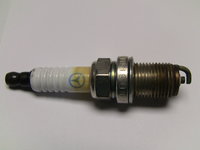
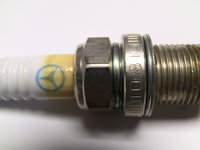
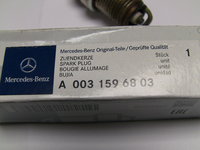
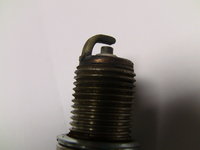
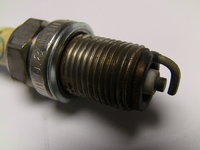
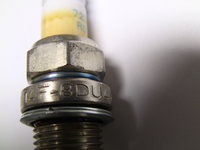
Today, I decided to check into the coils and the spark plugs. The spark plugs were genuine MB, bought from FCP, if I remember it correctly. They were put in when I replaced the head gasket early last year. I also replaced the coils. The old spark plugs look clean (?) but the ceramic body has signs of being over-heated (see images). They were used for less than 8000 miles. All the lean condition running probably took its toll. I have six MB plugs left. Put them in. Do the old plugs look normal?

Anyway, did a test drive and came to stop, idling at D for over 30 seconds. No jolt. Will do more driving tomorrow to see if the symptom is really gone.

The jolt is not just rough idling, but more like misfire. It also feels like bombs exploding, bong! bong! bong-bong!... I guess the coils and spark plugs could be the problem for misfire. However, I don't quite understand why the car can run so nice other than idling. Perhaps, it is due to a combination of mixture and spark at idling.

I did not try to regap the spark plugs. These plugs were made in France and I paid just over $2 for each if memory is correct.

jftu105
 

Attachments

  • IMG_3823.JPG
    IMG_3823.JPG
    605.8 KB · Views: 6
  • IMG_3824.JPG
    IMG_3824.JPG
    559.6 KB · Views: 6
  • IMG_3825.JPG
    IMG_3825.JPG
    713 KB · Views: 6
  • IMG_3826.JPG
    IMG_3826.JPG
    515.9 KB · Views: 5
  • IMG_3827.JPG
    IMG_3827.JPG
    623.9 KB · Views: 5
  • IMG_3828.JPG
    IMG_3828.JPG
    553.3 KB · Views: 5
Those look pretty normal to me. I'm not certain if the discoloration is from over-heat, but if you haven't tried a 1.0mm gap, it's worth a shot...
 
Dave, Thanks for the tip on the spark plugs.

I can confirm now that the problem is solved. Test drove it around and also put in Hfmscan to look at the data. After idling more than one minute, multiple times, all good. The Hfmscan data shows that the idling speed now never drops below 575 rpm. When the engine load increases, due to AC or other reasons, the fuel injection time increases but did not cause the jolt (or bombing shock). The O2 control is also normal without any indication of the lean condition. It hovers around 0%. When I accelerate, it goes up to 7 or 8%, never higher, and when I let go the gas pedal, coasting to stop, it drops down to 0%. If I am cruising at a constant speed, it could be -2%.

As I replaced all three coils and all six plugs at the same time, I don't know if it is the coil or the plug as the problem. I am just glad it is now cured. I measured the coils and the resistances between primary and the secondary and they are all within specs. All spark plugs have proper connection from the connector to the tip.

I never tried regapping and the factory gap is 0.8 mm, marked on the plug. I assume that a larger gap produces a larger spark path, but also potentially a weaker spark. How that affect the combustion is a research problem. The tip of plugs has heavily oxidized. I had to scratch it hard to get a connection to measure it with a DMM. This might be the reason for weak sparks. During idling, the mixture probably leaner, combined with weak sparks, triggered the misfire and the jolt when the idling speed got too low. ECM injected more fuel as the speed got too low; thus a higher increase in RPM, making the jolt more apparent.

jftu105
 
Last edited:
By reviewing the Hfmscan data when I had the engine jolts during idling vs the data now without issues, I gradually see a pattern. I would summarize what I think had happened for this "bombing" incident (the jolt really feels like a little bomb goes off).

Probably due to heavy oxization of the spark plugs (caused by extended period of running the engine at the lean condition), the sparks were weak. Weak sparks led to incomplete combustion, in particular, when the air flow was low and the mixture was not rich, typically during idling. Incomplete combustion left O2 in the exhaust, which represented a lean condition. Therefore, the O2 control tended to hover around 5% during idling, instead of near 0%. Because of the incomplete combustion during idling, the engine power output was not sufficient. The engine load would increase during idling when the AC turned on or something. The insufficient engine power could not maintain the engine rpm, and it dropped to below 550 rpm (in normal situation, it would be mainted over 600 rpm most of the time, according to data). ECM sensed that the engine might stall, it sent a large injection of fuel to jolt it back to life, causing the rpm to jump up to 650 or higher. This 100 rpm jump during idling felt like a jolt or a little bomb went off. The Hfmdata showed clearly, before the jolt, the O2 sensor would be low (lean) and the rpm got drawn down. If this was followed by a big engine load increase, then a big spike in fuel injection time, leading to the jump in rpm, and everything else. If I shut off AC during idling, the problem was not there. If I put it in N or P, it was fine too.

By replacing the spark plugs (and coils), the combustion during idling is now complete producing adequate engine power for stable idling.

At higher speeds, when I accelerate, the mixture is rich and enough power was produced, even if the combustion was not 100%. We are probably lookint at 10% loss in power during idling, which was enough to upset things.

I still got 21 mpg. Will check on the new mpg with the problem fixed.

jftu105
 
I would think that a spark misfire would cause a rich condition, as the incomplete combustion would cause rich exhaust fumes to enter the exhaust making the O2 sensor send a high voltage feedback to the ECU, which responds by decreasing injection time.

What is the spec injection time at closed loop idle for this engine? is it increasing or decreasing?
Shouldn't the ON-OFF ration be hovering around 50% ?
 
The O2 sensor only measures the O2 content, not the fuel content. An incomplete combustion means that there would be O2 left even if the mixture is in a correct ratio. There will be fuel left too in the exhaust. Because the O2 sensor only measures O2, sensing the existence of O2 indicates a lean condition, despite the existence of the fuel.

The fuel injection is determined by the injection time. During idling, it is typically about 3 ms. It can go up to 5 ms or down to 2 ms. When I accelerate, it is typically 8-9 ms. I don't have a lead foot.

jftu105
 
Then your best bet is an multi-channel engine analyzer/picoscope. unfortunately these are rare and even more rare is to find a diagnostic technician that knows what he is looking at.
 
Hfmscan is as good as a multiple-channel engine analyzer, if not better. I have access to over 30-40 engine operating variables. The data can be displayed real time or be plotted later for analysis. Having the data and being able to analyze the data are two different things. It took me awhile to come to my conclusions. By the way, MikeK, the author of Hfmscan, is always ready to help. When I could not figure out the problem, I often sent him the data file and he would reply with some intelligent suggestions.

jftu105
 
Hfmscan is as good as a multiple-channel engine analyzer, if not better. I have access to over 30-40 engine operating variables. The data can be displayed real time or be plotted later for analysis. Having the data and being able to analyze the data are two different things. It took me awhile to come to my conclusions. By the way, MikeK, the author of Hfmscan, is always ready to help. When I could not figure out the problem, I often sent him the data file and he would reply with some intelligent suggestions.

jftu105

I looks like a good tool, certainly more convenient than Star diagnosis. what I was referring to is an auto oscilloscope that can show the ignition pattern.
 
For the scope capability, Hfmscan is not able to do it. Basically, Hfmscan reads the data from ECM. It can show O2 sensor signal in real time with a pretty high sampling rate. Yes, indeed, if I had had a scope, I would be able to detect the spark plug issue. I probably can use a Tektronics digital oscilloscope to do it, but I really don't want to deal with very high voltage. I won't be able to see the sparks, but the voltage sent to the spark plug.

jftu105
 
Just when I thought the "bombing" problem during idling was solved by changing the spark plugs, it came back after two weeks. Took a long trip to Atlanta. While the car was great at crusing speeds, at idling, the "bombing" or jolts came back, and progressively got worse. I got over 28 mpg on highway.

After returning, took the spark plugs out and gapped them to 1.0 mm as promoted by Dave and Gerry on this board.

Put them back, it got a lot worse. The "bombing" now is non-stop. Even at higher speeds, engine just did not run right.

In fact, this is a good news. This confirms that misfire is the reason for the "bombing" caused by weak sparks. Check the ignition angle with Hfmscan. The ignition angle reacts to the "bombing" quite sensitively. In normal running engines of my other E320's, during idling, the ignition agle is about 7.5 degrees +- 0.5 degrees. However, with this car, it started at about 7.5 degrees and then suddenlyt it would drop to 3 degrees and shot up to voer 12 degrees, coinciding with the "bombing". Knock sensors also signaled alarm and the ignition angle would fluctuate from here on and the "bombing" would continue.

Took the spark plugs out and gapped them to 0.032" or 0.08 mm as the factory setting. The engine instally ran better. The "bombing" still happens, but not as severre.

Well, why not? Went ahead to gap them to 0.028, or 0.07 mm. With my Craftsman vintage gage sets, I make sure that the 0.030" gage won't fit between the gap, while the 0.028" gage is a transition fit. In this way, 0.028" (0.711 mm) is ensured and it is for sure below 0.030".

Put them all back. Yes, the "bombing" is gone. I don't know how long it would hold up. I am amazed by the difference 0.004" can make.

Why the 1.0 mm sworn by Dave and Gerry won't work on this car of mine? A few reasons I think.

1. When I rebuilt the head gasket, I knew my timing chain was stretched a bit.
2. The coils are all used, although showing correct resistances, it might not be as good when it becomes hot.

Anyway, at least I know what is causing the "bombing" and how to deal with it.

jftu105
 
Unfortunately i don't think its going to solve you problem.

Had the car tested with an oscilloscope to see the ignition patterns?
 
Also, I think the "bombing" I was experiencing should be called back fire, not misfire, leading to knock. I believe that the weak spark leads to longer ignition delay. The expansion of the combustionn gas still happens when the piston reaches the low end limit. The force pushing down with the piston rod and crankshaft aligned causes the "bombing". Now, by narrowing the plug gap, the spark is stronger, leading to more rapid combustion. I don't know for what reasons, the ECM of my engine will delay the ignition angle to only 3 degrees instead of 7.5 degree.

At cruising, the ignition is advanced so much, back fire does not occur.

Anyway, this is the case of my abnormal but otherwise nice running engine. I wonder what kinds of benefits were observed by setting the gap to 1.0 mm instead of factory setting of 0.8 mm in a "normal" engine?

jftu105
 
I guess that my comment on the spark strength and the gap is wrong. Here is what I found from a website,

  1. narrow-gap risk: spark might be too weak/small to ignite fuel;
  2. narrow-gap benefit: plug always fires on each cycle;
  3. wide-gap risk: plug might not fire, or miss at high speeds;
  4. wide-gap benefit: spark is strong for a clean burn.
This particular engine of mine runs better at 0.7mm and "bombed" badly at 1.0 mm. So, if the above statements are right, at 1.0 mm, for my engine, plug probably mis-fire.

jftu105
 
I agree that a scope test should be performed to find out once and for all what is going on.

jftu105

Don't assume the tech would know what he is looking at (he won't !), have some spec sheets ready with the secondary ignition voltage values and combustion duration (not just ignition timing).

Check for weak voltage at particular cylinder/s as well as spikes. Something that points to spark or fuel

Good luck
 
Anyway, this is the case of my abnormal but otherwise nice running engine. I wonder what kinds of benefits were observed by setting the gap to 1.0 mm instead of factory setting of 0.8 mm in a "normal" engine?
It was Klink who explained why the wider gap usually helps. The M117/M119 engines run lean at idle when they are fully hot, and a small spark doesn't always fully light the mixture. There were apparently quite a few customers who would bring their MB into the dealer for new spark plugs, and immediately return complaining the car ran worse with new plugs. Root cause was the old plugs had a wider gap (1.0-1.1mm) and the new plugs were at spec of 0.8mm. The techs started gapping new plugs to 1.0+ and the problem went away. Klink, please chime in if I got any of this wrong.

For the M104 that misfires at 1.0mm and is running well at 0.7mm... I'd suspect something wrong with the coil packs, wires, or plug boots. MB ignition systems should have plenty of firepower to run smoothly with gaps over 1mm.

:klink: :blink:
 
I have many sets of coils and wires. I switched them around and noticed little difference. They all work fine with my other cars. I checked their conductivities and they are all good. The plug gap makes the most difference for this particular engine. Hfmscan now indicates everythign is fine and the car runs nicely. The ignition angle during idling is about 7 degrees, no bombing so far. Before the bombing happened the first time a few months ago, the car was running just fine, despite some lean conditions.

Just went through some youtube video on the scope test.

Read more about the science of sparks. It is affected by the mixture, the gap, the connections of the wires, the coil, etc. The initial voltage reaches over 13kV to ionize the mixture so that the impedence between the electrodes drops and a spark forms at about 3-4 kV which lasts for a few miliseconds to ignite the mixture.

I guess that a scope test will explain what is going on. I wonder why the MB dealer won't do a scope test after they changed the spark plugs. They would know the engine is not running right after the new plugs. There are many laptop based scopes. I am thinking about acquiring one.

jftu105
 
Last edited:
Wow, I can't believe that you popped those two forbidden questions.

All updated or checked to be perfectly working.

Interestingly, last week, one of my E320's developed a high idling problem. Hfmscan returned a error: Supply Voltage to Hfm control module implausible. The car would start fine and then withing 30 seconds, the idling would rise to over 1000 rpm, and the radio starts to flash.

The first reaction is of course OVP. However, a meter test indicated that the voltage regulator was damaged and the charging voltage becomes 18V and fluctuating. The OVP for E320, 1994-5 does not have the over-voltage protection capability anymore. On pin 2 of OVP, which supplies voltage to MAF and ECM, is only through a relay when the key turned. As a result, the OVP was fine, but it sent an 18 V (half AC) straight to MAF and ECM, triggering additional errors.

I went ahead to replace the alternator (as it is old) and everything is normal again. My daughter is driving this car and she is alert and told me the problem. If continuing driving, I don't know how many things would be burned by a fluctuating 18 V.

jftu105
 
OK, I think the problem is finally solved, AND GUESS WHAT? GSXR is right again!!!! Can he be wrong once?

Very true when he said that a normal MB should be able to run the plug at 1.0 mm or higher. The fact that mine had to do 0.7 mm to avoid bombing (misfire) indicates that something was wrong.

When I was trying to figure out the lean problem earlier, I shuffled so many parts and I lost track of them. Now, I think about it. The "bombing" started when I finally got the lean condition solved, and during that time, I replaced a set of spark plug wires. This set of wires have metal casing. The bombing happened the entire time when this set of wires were in place.

So, I took them out and put another set in. Definitely no bombing. Even at 0.7 mm, the bombing happened once or twice during long idling at the light with the "bad" wires. Now, it is none!

To furhter verify it, I decided to regap the plugs. I did not want to go completely over to the dark side and join the 1.0 mm club. So I do the almost dark side at 0.9 mm, or 0.035" (0.889 mm). Even with the good wires and at 0.7 mm, I felt the engine was a bit under powered and Hfmscan showed that it was a bit toward lean during idling (6% O2 control).

Regapped and put them all in. Set Hfmscan and started the engine. NO BOMBS!!! Even at 0.9 mm.

I also have to agree that the engine runs better at 0.9 mm. Perhaps even better at 1.0 mm, but I am OK for now.

Over at the BZ-underworld, I was always right even though those trolls won't admit it. They called me names instead of admitting I was right. However, over here, I have been proven wrong again and again. For my self-respect, I probably should go back to the BZ-underworld. I can entertain those two questions: "OVP?" "Harness?" Anyone?

jftu105
 
Glad to hear you solved it!
But how did the wires cause a lean condition reading? what was different between the two plug wires?
 
I think this is what happened. The bad wires, which for whatever reasons, are bad because they offered a separate path to the ground (it has a metal casing, which probably does not help). Not all the time, but enough times when the mixture is lean, which is more often during idling. When the mixture is lean, the voltage needed to initiate a spark is higher. This higher voltage found a way to the ground through the bad wire. As a result, a missfire happened.

When there is a missfire, the engine fails to produce a torque, but to ECM, it is equivalent to a sudden increase in engine load. To me, it is like a little bomb. You get similar feeling when you lift the gas pedal after hard acceleration. There is no increase in load to the car, but it feels like one.

With a narrower gap, the voltage needed to start a spark is lower; therefore, less misfire happens with 0.7 mm gap.

Now with the good set of wires, no missfire even at a wider gap. As the gap is wider, the voltage to start a spark is higher, which ionizes the mixture better and the spark burns nice and bright to have a more complete combustion. With the good wire but with a narrower gap, the opposite happens. Because the combustion is not as complete, O2 is left behind and ECM thought it was lean based on the report from the O2 sensor. The engine feels a bit sluggish with a narrower gap.

Anyway, this is how I interpret it. I hope that I don't have any more bombs.

I am in this club of one, the timid bunch with 0.9 mm, not daring to go over 1.0 mm.

jftu105
 
You could always point Q*baert, Shepster, Jayar and the LeftCoastGeek to this thread and let them ruminate. There’s no doubt that Q*baert would have some sort of smart rejoinder, though he would never directly or indirectly put GSXR down. Even that crew have enough grudging respect for GSXR that they won’t insult him publicly.
 
I think this is what happened. The bad wires, which for whatever reasons, are bad because they offered a separate path to the ground (it has a metal casing, which probably does not help). Not all the time, but enough times when the mixture is lean, which is more often during idling. When the mixture is lean, the voltage needed to initiate a spark is higher. This higher voltage found a way to the ground through the bad wire. As a result, a missfire happened.

When there is a missfire, the engine fails to produce a torque, but to ECM, it is equivalent to a sudden increase in engine load. To me, it is like a little bomb. You get similar feeling when you lift the gas pedal after hard acceleration. There is no increase in load to the car, but it feels like one.

With a narrower gap, the voltage needed to start a spark is lower; therefore, less misfire happens with 0.7 mm gap.

Now with the good set of wires, no missfire even at a wider gap. As the gap is wider, the voltage to start a spark is higher, which ionizes the mixture better and the spark burns nice and bright to have a more complete combustion. With the good wire but with a narrower gap, the opposite happens. Because the combustion is not as complete, O2 is left behind and ECM thought it was lean based on the report from the O2 sensor. The engine feels a bit sluggish with a narrower gap.

Anyway, this is how I interpret it. I hope that I don't have any more bombs.

I am in this club of one, the timid bunch with 0.9 mm, not daring to go over 1.0 mm.

jftu105

Nicely Explained, I suggest admin make this thread as a sticky. Its an unusual case of bad spark wires causing lean condition.
 
Back
Top