• Hi Guest !

    Welcome to the 500Eboard forum.

    Since its founding in late 2008, 500Eboard has become the leading resource on the Internet for all things related to the Mercedes-Benz 500E and E500. In recent years, we have also expanded to include the 400E and E420 models, which are directly related to the 500E/E500.

    We invite you to browse and take advantage of the information and resources here on the site. If you find helpful information, please register for full membership, and you'll find even more resources available. Feel free to ask questions, and make liberal use of the "Search" function to find answers.

    We hope you will become an active contributor to the community!

    Sincerely,
    500Eboard Management

M119 Closed-deck Block Production Cutoff

gerryvz

Site Honcho
Staff member
I read tonight in some MB technical documents that the open-deck M119 engines were phased into production as of April, 1993. So this would mean that the MAJORITY of M119s manufactured in model year 1993 .034s and .036s would be closed-deck units.

Had not known what that breakpoint was.

The oil galleys were changed as of this same time, because of the move to the open-deck blocks. I wonder if that is similar time frame breakpoint from the metal to the plastic cam oiler tubes, as well....

Also saw that the valve guides were changed during 1993. Anyone have more info as to what that change was all about, and why it was made? Was there a problem with the design and/or materials for the earlier M119 valve guides?
 
I read tonight in some MB technical documents that the open-deck M119 engines were phased into production as of April, 1993. So this would mean that the MAJORITY of M119s manufactured in model year 1993 .034s and .036s would be closed-deck units.

Had not known what that breakpoint was.

The oil galleys were changed as of this same time, because of the move to the open-deck blocks. I wonder if that is similar time frame breakpoint from the metal to the plastic cam oiler tubes, as well....

Also saw that the valve guides were changed during 1993. Anyone have more info as to what that change was all about, and why it was made? Was there a problem with the design and/or materials for the earlier M119 valve guides?

A host of changes were made to the M119 in what corresponded to the USA model year '93. Almost all of these changes were made to increase fuel mileage in the European tests, most especially in the 140. Almost everyone is familiar with the much fetishized elimination of wide-open throttle enrichment. Some are also familiar with the thinner, lower friction belt drive, but most people do not realize that the complete list of changes was extensive, encompassing almost all of the internal moving parts of the engine.

These changes are possibly relevant to your question about the valve guides:
The outside diameter of the valve guides was reduced by 1mm to 12.5mm. The valve springs were changed to a conical design, and the spring force was reduced on the 4.2 L engines. Camshaft lift was reduced, and overall valve timing was modified. The weight of the bucket tappets was reduced from 82g to 64g. The WIS notes that "sintered metal valve guides" were "phased-in 1993." I know of no problem with any M119 valve arrangement. I suppose it is possible that the material was actually changed when the diameter was reduced, but I don't know for sure...
 
Last edited:
I can vouch for the increased fuel economy between my 92' and 93'.

The 93' averages 10% greater fuel economy.
 
Thanks for the updates. I suppose it's possible to do enough research to gather together a list of the sum-total of the changes - perhaps a research project for someone, some day.

I think a second/dual purpose for many of the changes, in addition to increased efficiency/mileage, was cost reduction of production and componentry as part of a general cost reduction program in that time frame for the W140 and W124 models. There were made other, engine and non-drivetrain changes made (the metal to plastic oiler tubes being a "much fetishized" one) whose goal was more cost reduction than anything.

I have always said that there was a tangible difference in feel/materials/quality between my 1992 300TE wagon and the two 1995 wagons I owned. It was subtle, and in many cases made up for by the (IMHO better) M104 engine vs. M103, but it was definitely there.

I have NOT been able to discern a distinct quality/materials difference in the early vs. later 500Es although perhaps a case could be made. There are many small touches that the 500Es had that were phased out, that portended a desire to reduce parts/production cost. One such thing would be the silver lettering and silver MB star on the top of the airbox on the earlier cars. In 1993, the silver letters and MB star were phased out to an unpainted (i.e. cheaper) setup.

Cheers,
Gerry
 
Thanks for the updates. I suppose it's possible to do enough research to gather together a list of the sum-total of the changes - perhaps a research project for someone, some day.

I think a second/dual purpose for many of the changes, in addition to increased efficiency/mileage, was cost reduction of production and componentry as part of a general cost reduction program in that time frame for the W140 and W124 models. There were made other, engine and non-drivetrain changes made (the metal to plastic oiler tubes being a "much fetishized" one) whose goal was more cost reduction than anything.

I have always said that there was a tangible difference in feel/materials/quality between my 1992 300TE wagon and the two 1995 wagons I owned. It was subtle, and in many cases made up for by the (IMHO better) M104 engine vs. M103, but it was definitely there.

I have NOT been able to discern a distinct quality/materials difference in the early vs. later 500Es although perhaps a case could be made. There are many small touches that the 500Es had that were phased out, that portended a desire to reduce parts/production cost. One such thing would be the silver lettering and silver MB star on the top of the airbox on the earlier cars. In 1993, the silver letters and MB star were phased out to an unpainted (i.e. cheaper) setup.

Cheers,
Gerry

No doubt, cost reduction drove many of the changes, most notably the oil tubes (grrr...)
 
Last edited:
There was also a significant wave of changes to the M119 engine (I'd say even more extensive than in the 1993 time frame) in the spring and fall of 1995, particularly as the ME-based M119s debuted (119.98X).

It is interesting that the M119 lasted through three distinct generations of fuel injection/engine management technology ... CIS-E, then the LH/HFM generation, and capping off with ME/Motronic.

Klink, from your perspective, were the successive generations of fuel/engine management always tangible improvements? I don't know much about ME (other than it is modernized and more integrated than the LH system) so specifically I'm wondering from a performance, complexity and reliability standpoint, if it ended up being a major step forward, a moderate step forward, or just a "mehh" thing vs. our LH-based cars. Upsides vs. downsides?

I [think I] feel a KlinkRant® a-comin' .....

Chees,
Gerry
 
My green E500 (C060xxx) was built in October 1993 and has a closed-deck engine. The VIN numbers for USA models indicate there were 150 built with closed deck, 242 open deck, which is roughly a 40/60 ratio. It appears for the USA 036 production at least, the cutover was somewhere in October-December 1993. The official break is by engine number, btw, not any particular date.

The 1993 updates are covered in this factory document:
http://www.w124performance.com/docs/mb/M119/M119_1993_updates.pdf

:pc1:
 
My high miler also has a closed-deck block, eng # 8060. The silver one does not.
 
My 1993 has the silver lettering and star on the air box, but not sure if the air box is original to the car.
My car also had the aluminum oiler tubes, but I am not sure if those were original with the car either.

...I have NOT been able to discern a distinct quality/materials difference in the early vs. later 500Es although perhaps a case could be made. There are many small touches that the 500Es had that were phased out, that portended a desire to reduce parts/production cost. One such thing would be the silver lettering and silver MB star on the top of the airbox on the earlier cars. In 1993, the silver letters and MB star were phased out to an unpainted (i.e. cheaper) setup.

Cheers,
Gerry
 
My E500 engine number is 008486 (chassis 052693), production date 10/18/1993. I've always believed it to be a closed-deck block.
 
My 1993 has the silver lettering and star on the air box, but not sure if the air box is original to the car.
My car also had the aluminum oiler tubes, but I am not sure if those were original with the car either.
Hard to say with a 1993 model, but I do believe that aluminum-->plastic oiler tube switchover, and silver-->unpainted airbox letters happened at different points in time -- not part of a major, wholesale change-over of a bunch of things.

Also note, that MB went from a "silver letter + silver star" schema on the airbox, to a "black letter + silver star", and then to a "black letter + black star" setup during model year 1993. By the time that model year 1994 rolled around, everything on the airbox was black/unpainted.

I think the cam oiler tube switchover happened very early in the 1993 model year production -- likely in the first couple or three months of production.

Cheers,
Gerry
 
Are there any pictures of what a ‘closed deck’ block looks like vs. an ‘open deck’ block?

I read these terms all the time, but am having a hard time conceptualizing the physical difference.


Sent from my iPhone using Tapatalk
 
Yes, I believe GSXR has photos on his site, but I can’t access them right now.

Basically the area directly around the cylinder bores is open on an “open deck” block, whereas it’s car closed/solid on a closed deck block. There are more “openings” on the top of the open-deck block where the head gasket rests.

IIRC there are different head gaskets for the M119 versions, as well.

I believe the move to open-deck blocks was a subtle thing they did to reduce production cost. There is no performance or operating temp differential between the two versions
 
Yes, I believe GSXR has photos on his site, but I can’t access them right now.

Basically the area directly around the cylinder bores is open on an “open deck” block, whereas it’s car closed/solid on a closed deck block. There are more “openings” on the top of the open-deck block where the head gasket rests.

IIRC there are different head gaskets for the M119 versions, as well.

I believe the move to open-deck blocks was a subtle thing they did to reduce production cost. There is no performance or operating temp differential between the two versions

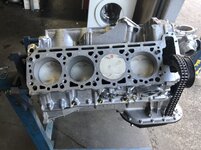
Can you tell by the pics of the engine for sale if it is open or closed?
 
Simple to tell visually. That’s why I said with Robert’s short block for sale that it’s a closed-deck block.

Trust me, GSXR would have given me a Triple-Jelmerian Award with Mushroom Clusters if I’d have said that short-block was an open-decker.....
 
proxy.php
 
Yes, I believe GSXR has photos on his site, but I can’t access them right now.

Basically the area directly around the cylinder bores is open on an “open deck” block, whereas it’s car closed/solid on a closed deck block. There are more “openings” on the top of the open-deck block where the head gasket rests.

IIRC there are different head gaskets for the M119 versions, as well.

I believe the move to open-deck blocks was a subtle thing they did to reduce production cost. There is no performance or operating temp differential between the two versions

Are there any pictures of what a ‘closed deck’ block looks like vs. an ‘open deck’ block?

I read these terms all the time, but am having a hard time conceptualizing the physical difference.


Sent from my iPhone using Tapatalk

Can you tell by the pics of the engine for sale if it is open or closed?

Simple to tell visually. That’s why I said with Robert’s short block for sale that it’s a closed-deck block.

Trust me, GSXR would have given me a Triple-Jelmerian Award with Mushroom Clusters if I’d have said that short-block was an open-decker.....
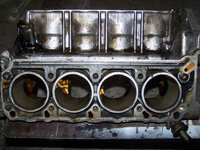
Here are photos of M119 closed- and open-deck blocks:

CLOSED-DECK BLOCK

139.jpg


OPEN-DECK BLOCK (courtesy of GSXR)

158.jpg
 

Attachments

  • Screenshot 2018-04-21 18.05.40.jpg
    Screenshot 2018-04-21 18.05.40.jpg
    130.8 KB · Views: 72
Wow! That is pretty obvious.

I would assume there is a weight savings with the ‘open’ block design? Along with a decrease in block rigidity and cylinder wall strength?


Sent from my iPhone using Tapatalk
 
Wow! That is pretty obvious.

I would assume there is a weight savings with the ‘open’ block design? Along with a decrease in block rigidity and cylinder wall strength?
A small amount, but probably, yes. IIRC, the FSM stated the reason as cost reduction due to easier manufacturing process.

Interestingly, a 6.0L (or larger) displacement M119 can only be made from a closed-deck block. Seems there is not enough meat with open-deck to allow the 100-101mm bore.

:sawzall:
 
The only possible, maybe, a little, advantage might be that a closed-deck block could be more tolerant of higher boost pressure in forced induction applications.

Ditto for large amounts of nitrous (i.e., more than 30-40% stock rated power increase, for example more than a "100-125 shot" on a 5L engine).

Under normal conditions and near-stock power levels, there is zero advantage either way as Gerry mentioned above in pretty red text.

:nos:
 
There was also a significant wave of changes to the M119 engine (I'd say even more extensive than in the 1993 time frame) in the spring and fall of 1995, particularly as the ME-based M119s debuted (119.98X).

It is interesting that the M119 lasted through three distinct generations of fuel injection/engine management technology ... CIS-E, then the LH/HFM generation, and capping off with ME/Motronic.

Klink, from your perspective, were the successive generations of fuel/engine management always tangible improvements? I don't know much about ME (other than it is modernized and more integrated than the LH system) so specifically I'm wondering from a performance, complexity and reliability standpoint, if it ended up being a major step forward, a moderate step forward, or just a "mehh" thing vs. our LH-based cars. Upsides vs. downsides?

I [think I] feel a KlinkRant® a-comin' .....

Chees,
Gerry

Ha! Missed this invitation!
The CIS engines are more responsive than the LH engines, even with throttle management by ASR (1991-on in USA 129).

The ME (Bosch "DME" digital motor electrics) engine management [used from 1996-1999 USA model years in USA] makes the LH seem like a Rube Goldberg complication. NO clumsy backup throttle linkage with a WAY more reliable E-GAS, NO distributors and all of their troubles, and stronger spark from 8 individual coils. NO EGR. Counterintuitively, the hot film air mass sensors aren't quite as reliable as the LH wire sensor, but they're still damn good. Early versions of the 8 individual coils did fail...
:klink:
 
IIRC there are different head gaskets for the M119 versions, as well.
Versions of the head gasket for the E500E:

RIGHT SIDE HEAD GASKET UP TO ENGINE #001893 (approximate production date up to September, 1991): 119 016 22 20
RIGHT SIDE HEAD GASKET FROM ENGINE #001894 (Sept., 1991) TO ENGINE #008819 (up to December, 1993): 119 016 19 20
LEFT SIDE HEAD GASKET UP TO ENGINE #008819 (approximate production date up to December, 1993): 119 016 18 20


LEFT SIDE HEAD GASKET FROM ENGINE #008820 (approximate production date of December, 1993 onward): 119 016 37 20
RIGHT SIDE HEAD GASKET FROM ENGINE #008820 (" " " "): 119 016 38 20

So, it appears that the switchover date from closed-deck to open-deck blocks, at least for the E500, would have been part-way through the 1994 model year, starting with cars produced in the December, 1993 time frame.

Cheers,
Gerry
 
My car is a 1998 E60 with a 119 Motor, will that be a closed Block?
I'm trying to add pics but I think I haven't enough posts
 
Note the added strengthening ribs along cylinder walls on the open deck block in Gerrys' pictures. I'm curious as to why they were able to halt the use of Heli-Coils for head bolts in the open deck blocks.

drew
 
My car is a 1998 E60 with a 119 Motor, will that be a closed Block?
I'm trying to add pics but I think I haven't enough posts
Any [4.2L or 5.0L] M119 produced during and after December, 1993 is going to be an open-deck block.

There is no upside or downside to having an open- or closed-deck block. All work the same, cool the same, create the same horsepower per spec the same, and so forth.

The only thing is that, as has been said, any M119 that is bored out to 6.0L and beyond, requires a closed-deck block for the additional rigidity and "meat" around the cylinder bores.
 
Note the added strengthening ribs along cylinder walls on the open deck block in Gerrys' pictures. I'm curious as to why they were able to halt the use of Heli-Coils for head bolts in the open deck blocks.

drew
I didn't know that the closed-deck blocks were Heli-coiled from the factory. Interesting.

I wish they'd have done same with the M117s -- would have saved a lot of people a lot of heartburn over the years. I was lucky when I pulled my heads that I didn't have to Heli-coil anything upon re-assembly and head-bolt torquing. Many many people have.....
 
Versions of the head gasket for the E500E:

RIGHT SIDE HEAD GASKET UP TO ENGINE #001893 (approximate production date up to September, 1991): 119 016 22 20
RIGHT SIDE HEAD GASKET FROM ENGINE #001894 (Sept., 1991) TO ENGINE #008819 (up to December, 1993): 119 016 19 20
LEFT SIDE HEAD GASKET UP TO ENGINE #008819 (approximate production date up to December, 1993): 119 016 18 20


LEFT SIDE HEAD GASKET FROM ENGINE #008820 (approximate production date of December, 1993 onward): 119 016 37 20
RIGHT SIDE HEAD GASKET FROM ENGINE #008820 (" " " "): 119 016 38 20

So, it appears that the switchover date from closed-deck to open-deck blocks, at least for the E500, would have been part-way through the 1994 model year, starting with cars produced in the December, 1993 time frame.

Cheers,
Gerry

Funny enough, one of the things that went wrong with some early open deck motors that caused some people to mistakenly think they might not be as durable involved a mixing up of open and closed deck closed head gaskets.
Good times, that...
 
Klink,
Did the mix up happen at assembly from the factory?
Funny enough, one of the things that went wrong with some early open deck motors that caused some people to mistakenly think they might not be as durable involved a mixing up of open and closed deck closed head gaskets.
Good times, that...
 
Open Deck Blocks hypothetically should run cooler, but I have no data to support this statement.


Closed Deck Blocks hypothetically would be stronger for forced induction. When you take into consideration turbocharger size for a linear power curve, and a reasonable amount of boost to rationalize an à la carte build, +0.75Bar or +11psi kind of the gray line for a purpose built motor. A mild build with a 5.0L closed deck and a modern single or twin turbo setup is easily +725hp. So the whole thing daisy chains into a soup-to-nuts engineering exercise applying power to the pavement. A smaller turbo will give you a torque curve that will eat the transmission +600ftlbs at 1500rpm, and a bigger turbo will give you +80mph traction issues.

If you want to read about Closed Deck Block(s) even though we can debate the differences between hot rolled(cast) vs cold rolled(forged/billet)... Here in the USA people commonly refer to closed deck blocks as Dart Blocks in the same way tissue is referred to Kleenex.

Feel free to correct me, if anyone has some better insight, my goal was to give a rational summary or thought process on whether or not to embark down this path without overstepping the logic/practical details of application.

It can be done and it would be epic, but it won't just be a motor build.
 
Last edited:
Funny enough, one of the things that went wrong with some early open deck motors that caused some people to mistakenly think they might not be as durable involved a mixing up of open and closed deck closed head gaskets.
Good times, that...

Klink,
Did the mix up happen at assembly from the factory?

Factory. It caused problems very early in the warranty period. There would not be any of them still in service.
 
I think the cam oiler tube switchover happened very early in the 1993 model year production --
likely in the first couple or three months of production.

Cheers,
Gerry

My April 1993 .034 had plastic tubes.


I didn't know that the closed-deck blocks were Heli-coiled from the factory. Interesting.

I wish they'd have done same with the M117s -- would have saved a lot of people a lot of heartburn over the years. I was lucky when I pulled my heads that I didn't have to Heli-coil anything upon re-assembly and head-bolt torquing. Many many people have.....

The block thead issue was mainly an early M116 thing 81-83
In 1984 the head bolts were updated to a nickel finish
to prevent pulling the threads on removal as well as a double row
timing chain from single. M117 never used a single row.
 
The 400E that I recently came across was an April 1993 production, WDBEA34E3PB974725

It had (unfortunately) plastic cam oiler tubes, as well.

Cheers,
Gerry
 
Versions of the head gasket for the E500E:

RIGHT SIDE HEAD GASKET UP TO ENGINE #001893 (approximate production date up to September, 1991): 119 016 22 20
RIGHT SIDE HEAD GASKET FROM ENGINE #001894 (Sept., 1991) TO ENGINE #008819 (up to December, 1993): 119 016 19 20
LEFT SIDE HEAD GASKET UP TO ENGINE #008819 (approximate production date up to December, 1993): 119 016 18 20


LEFT SIDE HEAD GASKET FROM ENGINE #008820 (approximate production date of December, 1993 onward): 119 016 37 20
RIGHT SIDE HEAD GASKET FROM ENGINE #008820 (" " " "): 119 016 38 20

So, it appears that the switchover date from closed-deck to open-deck blocks, at least for the E500, would have been part-way through the 1994 model year, starting with cars produced in the December, 1993 time frame.

Cheers,
Gerry
Any [4.2L or 5.0L] M119 produced during and after December, 1993 is going to be an open-deck block.

There is no upside or downside to having an open- or closed-deck block. All work the same, cool the same, create the same horsepower per spec the same, and so forth.

The only thing is that, as has been said, any M119 that is bored out to 6.0L and beyond, requires a closed-deck block for the additional rigidity and "meat" around the cylinder bores.
According to XENTRY, my 93 400E has a shipment date of 4/26/1993 and an engine # 119975-12-010669. What I think is a head gasket for open-deck engine, is to be used on engines as of # 975 010592. So looks like 400Es switched to open deck in April of 93. My 975 engine was a #78 with an open-deck. Non painted air filter box and plastic oiler tubes too

opendeck.png
 
kiev, you can confirm open/closed deck block by looking at the casting numbers on the driver side, behind the engine mount area. See post #26 above for details. Sometimes the EPC data isn't 100% correct, doesn't hurt to double-check.

If yours is indeed open-deck, it may be the 4.2L engines switched over sooner in 1993 than the 5.0's did.

:detective:
 
Versions of the head gasket for the E500E:

RIGHT SIDE HEAD GASKET UP TO ENGINE #001893 (approximate production date up to September, 1991): 119 016 22 20
RIGHT SIDE HEAD GASKET FROM ENGINE #001894 (Sept., 1991) TO ENGINE #008819 (up to December, 1993): 119 016 19 20
LEFT SIDE HEAD GASKET UP TO ENGINE #008819 (approximate production date up to December, 1993): 119 016 18 20


LEFT SIDE HEAD GASKET FROM ENGINE #008820 (approximate production date of December, 1993 onward): 119 016 37 20
RIGHT SIDE HEAD GASKET FROM ENGINE #008820 (" " " "): 119 016 38 20

So, it appears that the switchover date from closed-deck to open-deck blocks, at least for the E500, would have been part-way through the 1994 model year, starting with cars produced in the December, 1993 time frame.

Cheers,
Gerry
Hello Gerry, my car engine number is: 11997412000479
So i think the correct part numbers for the head gaskets are: Right: 119-016-22-20 / Left: 119-016-18-20
Bcoz im planning to change the head gaskets as a puff of white smoke appears on engine startup
Thanks
 
Any [4.2L or 5.0L] M119 produced during and after December, 1993 is going to be an open-deck block.

There is no upside or downside to having an open- or closed-deck block. All work the same, cool the same, create the same horsepower per spec the same, and so forth.

The only thing is that, as has been said, any M119 that is bored out to 6.0L and beyond, requires a closed-deck block for the additional rigidity and "meat" around the cylinder bores.
Any way to determine if I have a 4.2 or 5.0L engine from the engine or crankcase#? I have a 119.985
12 024195
the crankcase #119 011 22 01 and appears to be “open deck”
 
Any way to determine if I have a 4.2 or 5.0L engine from the engine or crankcase#?
Yes. This is the most positive proof if a block is open or closed deck. Look for the casting number on the block (driver side) and compare to the FSM chart in job 01-1100. See post #26 earlier in this thread.


I have a 119.985
12 024195
the crankcase #119 011 22 01 and appears to be “open deck”
Yep, that is open deck.

1665061224766.png
 
Yep, that is the casting number. And it matches your late-production .985 engine number.

:mushroom:
 
From the thread @036 created, if you look at the 4th photo you can see the engine serial number being 008940.

Block_8940.jpegBlock_8940_Zoom.jpegDatacard.jpeg

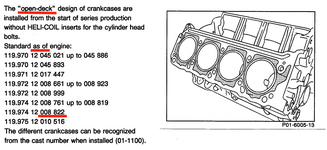
It's indicated that the "open-deck block is as of serial number 008822 but the above engine is 008940 that's a "closed-deck."
Open_Deck_Start.png

Am I missing or interpreting the info incorrectly? Does anyone have photos of a block with it's serial number to compare against the cutoff?
 
Looks like yet another instance where the published break points are close, but not exact. :facepalm:

The definitive check is to read the casting number on the side of the block.

:yayo:
 

Who has watched this thread (Total: 5) View details

Back
Top