• Hi Guest !

    Welcome to the 500Eboard forum.

    Since its founding in late 2008, 500Eboard has become the leading resource on the Internet for all things related to the Mercedes-Benz 500E and E500. In recent years, we have also expanded to include the 400E and E420 models, which are directly related to the 500E/E500.

    We invite you to browse and take advantage of the information and resources here on the site. If you find helpful information, please register for full membership, and you'll find even more resources available. Feel free to ask questions, and make liberal use of the "Search" function to find answers.

    We hope you will become an active contributor to the community!

    Sincerely,
    500Eboard Management

[SOLVED] A/C Compressor not working -- tracking down the cause

Gerry, the pressures you measured (90-100psi both sides) are normal with the compressor off in 85F ambients.

About the only remaining test I would consider is manually hotwiring the clutch to engage. There's a faint possibility the clutch coil may be acting up? If you can turn it on & off by directly applying 12v, there may still be an issue on the control side, or with the wiring. No need to have the engine running (or even key turned on), you can see/hear the clutch engage when you apply voltage. You won't be happy if the same issue remains with a new Denso installed. If the clutch does engage manually, next you could tap into the wires to the compressor and see if there is a +12v signal present to engage the clutch with the engine running and HVAC set to max cold so the compressor should be on.

For grins, also check for codes on pin #16 and see if anything interesting appears. And if you haven't swapped the pushbutton unit with a spare, definitely swap that first!

@JC220, no, there's no SDS activation to manually engage the compressor (that I know of). I think the only activation for the BM/GM is to manually turn on the CAN box cooling blower.

:scratchchin:
 
How and where would I manually hotwire the clutch?

I have a spare PBU, and can swap that in and see if anything changes. That's a relatively easy thing I can hopefully do tonight. I will report back.

And I can't find my spare PBU. I'll have to keep looking. I thought I had a couple of them. Found my spare 126 PBUs....
 
Last edited:
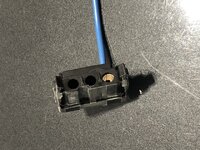
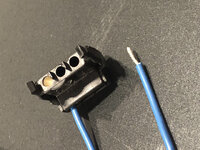
There's a 3-pin connector on the top of the compressor. You'd need to connect to that. I believe only 1 wire is +12v and it uses the engine/bracket as ground. The other 2 wires are for the speed sensor, IIRC. The connector is the same 3-pin type with 4mm female pin bushings, as seen on the blower regulator connector located on the firewall behind the brake booster. If you have a spare plastic connector you can build a test harness with 1 wire.

:shocking:
 
For grins, also check for codes on pin #16 and see if anything interesting appears. And if you haven't swapped the pushbutton unit with a spare, definitely swap that first!
I checked pin #16 with my mushroom and hand-held home-made code reader, and got one blink out of it. I believe this means that there were no stored codes.

My Trisco PalmScan also noted that the system was normal (no stored codes).
 
There's a 3-pin connector on the top of the compressor. You'd need to connect to that. I believe only 1 wire is +12v and it uses the engine/bracket as ground. The other 2 wires are for the speed sensor, IIRC. The connector is the same 3-pin type with 4mm female pin bushings, as seen on the blower regulator connector located on the firewall behind the brake booster. If you have a spare plastic connector you can build a test harness with 1 wire.

:shocking:
So, I would need to find the one of the three wires that the black plastic three-wire connector connects to, and apply 12V to that? Or build a test harness with a single wire in one of the pins (I guess trial and error) in a spare three-wire connector (I think I have a spare) to determine which one controls the clutch, applying 12V to the end of that wire?
 
@gerryvz thanks for the update. I don't know jack about AC systems (I mean technically I seldomly use it) but I am learning vicariously through you. I think the biggest surprise so far from this thread is that you own a PITTSBURGH branded set of Harbor Freight gauges. 😁
 
@gerryvz thanks for the update. I don't know jack about AC systems (I mean technically I seldomly use it) but I am learning vicariously through you. I think the biggest surprise so far from this thread is that you own a PITTSBURGH branded set of Harbor Freight gauges. 😁
I also own a set of Snap-On A/C gauges.
 

Attachments

  • CB90FBD9-AA2A-477D-8A13-FE05AE837E61.jpeg
    CB90FBD9-AA2A-477D-8A13-FE05AE837E61.jpeg
    307.9 KB · Views: 11
So, I would need to find the one of the three wires that the black plastic three-wire connector connects to, and apply 12V to that? Or build a test harness with a single wire in one of the pins (I guess trial and error) in a spare three-wire connector (I think I have a spare) to determine which one controls the clutch, applying 12V to the end of that wire?
@Jlaa posted the schematic in post #16. Looks like the thicker wire which goes to pin/socket #3 on the connector will engage the clutch.

FWIW, the clutch itself can be replaced separately, but must be sourced from a spare compressor (not sold separately). However, I'd be surprised if the clutch was electrically bad. Should either work, or be dead, not intermittent... assuming there's not a damaged wire somewhere.
 
I found a three-pin bushing housing and a couple of extra aluminum pin bushings to solder a wire into. This is going to take some methodical work this week to try to diagnose. Sigh.
 
@gerryvz this is where a Power Probe comes in really handy. It would detect a circuit of the AC clutch for example and safely activate it. I have a cheapie version this side of the pond that works excellent I grab it quite alot for any electrical testing
 
@gerryvz this is where a Power Probe comes in really handy. It would detect a circuit of the AC clutch for example and safely activate it. I have a cheapie version this side of the pond that works excellent I grab it quite alot for any electrical testing
Good thought! I actually have one as well, and I haven't yet used it. I can do this...
 
I put my hands on a spare PBU. I will temporarily replace my stock PBU with this spare, to see if the PBU is an issue.

So, a quick summary (as this thread is turning into quite a saga):
  • I have generally speaking, eliminated the pressure switch as a cause of the compressor not firing. I did this by attempting to "jump" the two leads that plug into the terminals on the top of the pressure switch. This did not cause the compressor to begin running, which means that there is another cause of the compressor not firing.
  • I have replaced the Base Module with a spare unit, and it did not make a difference. I have a second spare BM that I will also swap in, to see if that makes any change. I do not expect that I have two faulty BMs, so I am expecting also that the BM is NOT the cause of the problem. Both my original and first spare BMs resulted in the same (intermittent) compressor behavior.
For upcoming tests:
  1. I will swap in the third BM next, to see if this makes any difference. As mentioned, I do not believe that it will. If not, I will replace the second spare with the original BM that came with the car.
  2. I will temporarily swap in my original ACC "pushbutton unit" (PBU) in the dashboard with a spare unit that I have. If there is no change in the behavior of the system, and the compressor does not fire, then I can also preliminarily eliminate the PBU as the cause of the problem (unless it is also faulty, but it is somewhat unlikely that I have two faulty PBUs).
  3. I created, as shown above, a test lead harness that I can use a Power Probe to apply 12V to the wire that directly powers the clutch. I am going to try to get to this step in the next day or two.
I will report on these tests as my next post.
 
Following up on my previous post, I have a bit of positive progress to report. FYI -- ambient temperature was exactly 90 degrees.

85DF16A6-4B14-4160-9C5B-F90F36A998CA.jpeg

First, I changed in the SECOND spare Base Module that I had, and started up the engine. No change from previous behavior at all. I removed the two leads from the pressure switch, and jumped them with a wire (I had also done this previously). Compressor did not activate, except for about 1 second I could see the clutch turn, before it immediately stopped again.

Second, leaving the spare BM in place, I changed out the original Push-Button Unit (PBU) in the dash, with the exact replacement part I had. Again, no change from previous behavior at all. I found that everything worked (which confirmed that the replacement PBU was working as it should). When I activated A/C on HIGH, and COLD, and AUTO fan, I then went to the front of the car and looked down. The compressor clutch activated for about 1-1.5 seconds, and then shut off again.

Then, on a whim, I went back and sat down in the driver's seat. I decided to rev the engine with the car in PARK, and revved it up to 3,000-3,5000 RPM with a few blips of the throttle. Immediately the compressor activated once the RPMs climbed, and I could feel cold air coming out of the dashboard vents.

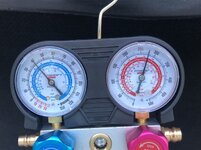
Getting out and looking at the compressor clutch, it was spinning, and it was staying spinning. So I connected the pressure gauges. As I expected, the pressure on the low and high sides were a bit low, because I had (purposely) vented a bit of refrigerant last weekend out of the low-side port into a rag. Here is what the pressure gauges showed, with the compressor spinning.

9F1E824C-0907-4F4B-9BE6-1625E8AB3D8F.jpeg

Next, I decided to charge the system back up to normal refrigerant pressure. After adding about 1/2 to 2/3 of a can of R-134a, this was the reading on the gauges. Pretty much right where it needed to be given the ambient temp. Low side - 40; High side - 270. System was blowing nice cold air into the car's interior.

59598118-2504-4B31-927A-634E61466072.jpeg

From there, I decided to remove the gauges and take the car for a test drive. I drove about a mile with the compressor running just fine, and then I felt (from the slightly warming air coming out of the dash vents) the compressor went off. I pulled over and popped the hood, and confirmed that the clutch was NOT spinning. I got back in the car, with the hood up, and slowly revved the throttle. Immediately cold air again started coming out of the vents, indicating the compressor was again running, and I confirmed this visually.

Continuing my test drive about 4-5 more miles, the compressor cut off again one time, and then once I got onto the freeway and the car was turning higher revs, the compressor again came on, and stayed on until I got home.

When I got home I turned the car off, and replaced the PBU with my car's original PBU, and started it up again. The compressor immediately ran upon startup.

So, concluding tonight's diagnosis work, I can conclude the following:

1) the pressure switch is working
2) the original Base Module is fully functional and working
3) the original dashboard PBU is fully functional and working

At this point, I am about 80% sure that the compressor is bad -- specifically the RPM sensor on it, which activates the clutch. My reasoning for this is as follows:

1) several codes (code 6 and 7) relating to belt slippage/breakage/clutch jamming and RPM discrepancies between the engine and the compressor
2) being able to activate the compressor by revving the engine, evidently triggering the RPM sensor to work at higher RPMs.

I am going to proceed with a compressor replacement, and at the same time will replace both switches and perhaps the receiver/drier when I do this. When I do the compressor replacement, I will do a HOW-TO on this.

Let me know if you have any thoughts or comments.

Cheers,
Gerry
 
Picking up on yesterday's work, and doing a little more thinking/reasoning, I have two next steps that I am going to pursue.

The thought I have been having has been that the A/C worked just fine, for the past ~18 years, UNTIL last summer when I was working in the area on my Top-End Refresh (removing the tandem pump, cleaning the area, removing the serpentine belt, adding new wiring sheathing, etc.).

When you have a problem, if you did anything previously that was related to the cause of the problem, or in the same area of the engine compartment, that immediately preceded the issue, then you MUST examine what you did, and if what you did could have caused any issues. Using this line of reasoning .... in the case of the Top-End Refresh, though I did not directly disturb the compressor or any related parts, I did move and flush a lot of accumulated dirt and grime that was on the top of the A/C compressor around with brake cleaner as I was hosing down the area. And it is VERY likely that some of this dirt and grime could have been flushed down into the compressor clutch area, behind the clutch, and so forth.

The A/C compressor clutch has an air gap, and when this gap is clogged by dirt and grime (or increased by wear and tear on the A/C clutch material, past its' spec), it can cause intermittent or non-activation of the clutch. So....

1) I will clean and flush the air gap at the A/C compressor clutch. There is a decent chance that when I did my Top-End Refresh last year, and when I flushed the grime and debris from the top of the A/C compressor and surrounding area (due to the weeking tandem pump short hose), I inadvertantly flushed some crud into the area behind the A/C compressor clutch.

2) I will use the test harness I made a couple of days ago, to attach to the three-prong electrical plug on top of the compressor, to apply 12V and activate the clutch with a Power Probe.

I will inform on how these steps go. Your thoughts and comments are always welcome.

P.S. Here's a view of the A/C compressor clutch with the crap all around it that I blasted/cleaned off last year. It is possible that some of this got into the clutch air gap and may be throwing things off.

img_9060-jpeg.101519
 
Last edited:
A couple of quick updates as I get into today's work.

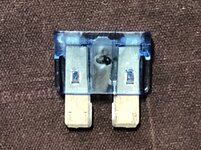
1) I pulled the two relays in the relay box that control the aux fans. My reason for doing this is that I never saw the aux fan on low speed when the compressor was operating, and it should be running pretty much at any time the compressor is operating. I found that the relay "B", with the 15Amp fuse, had a blown fuse. I replaced the fuse with a new one and then replaced the relay.

507700C7-558B-4BAB-9912-91DF937F1C86.jpeg 32068A03-680E-4142-8C19-47B9C4DB765C.jpeg

2) I tested the fans' high speed operation, by unplugging the red pressure/temp switch and jumping the two leads together with a wire. The aux fan immediately went on High speed. HOWEVER, ONLY the left-side fan (as you stand facing the engine) went on -- NOT both of the fans. So evidently, I have a bad aux fan unit, with only one of the two fans turning. This means that I will likely have to replace the aux fan assembly with a replacement.

Any comments on this are welcome.

3) Jumping the two leads at the pressure switch did NOT result in the compressor running. I am going to work on applying 12V to the compressor clutch via my harness and Power Probe, to see if I can activate the compressor clutch.

4) While I'm in there, I am going to thoroughly clean the compressor clutch at the air gap area where it sits proud of the front of the compressor. I'll use some dental floss to "floss out" the area to hopefully clear any debris that was flushed in there last year from my cleaning of the front of the engine. There is a small chance that debris could be resulting in the clutch failing to make a proper magnetic coupling when signaled to do so.

More soon.....stay tuned.
 
Last edited:
Replace both auxiliary fans, if 1 is bad. I did this on my '92 years ago for the same reason. The brushes looked nearly new despite the age and miles, I still don't know why the one was intermittent (it would start up if I tapped the fan). Details here:


The clutch face can be removed for additional cleaning / inspection of the friction surfaces, if desired, but this is time consuming.

:drink:
 
I am happy to report that this issue has been definitively SOLVED!!! Aux fan issue too.

Building on my previous post where I thought back to what I did last year during my Top-End Refresh, hosing and cleaning down the front of the engine/compressor area with Brake Cleaner to get everything nice and clean, I thought and thought about what I had done.

And I had done two things:

1) Likely hosed some dirt and crap down into the air gap between the compressor and clutch; and

2) Replaced the low-speed resistor for the auxiliary fan.

And here is how I solved the issue: I hosed down the compressor clutch air gap area with about 1/4 can of brake cleaner, from above and below (I had removed the belly pan), and the I took a simple two-foot length of dental floss, and "Flossed" the air gap. I did this from below the car, and was JUST able to work the floss into the gap, and then up and around the top of the clutch. Then I literally flossed it, just like I'd floss my teeth.

The floss came out very very dirty.
AEDB2ED0-693C-40B6-B1DC-EC1A240735AE.jpeg 9A04710B-569D-494E-8640-6D811B516D4A.jpeg

And when I turned the car on, the compressor IMMEDIATELY came on and stayed on. After about 30-60 seconds of the compressor running, the left-hand aux fan came on. The right one did not. However, I touched the right hand aux fan hub lightly with my gloved fingertips, and it started rotating immediately.

From there, after about another 30-45 seconds, I saw some modest smoke rising from right behind the driver's side headlight. This is the area where the new low-speed aux fan resistor was replaced last year. I turned the car off, then started it again after inspecting the resistor very carefully with a flashlight. Everything looked OK -- right and tight. Wiring was all good.

What that was, was "initial bake-off" from the manufacturing process for the resistor. I turned the car back on again (compressor went on immediately), and then on cue a few seconds later BOTH of the aux fans came back on. The resistor continued to smoke lightly for a few more seconds, then stopped as the chemicals and/or coating on it were baked off. I continued to run the car and watched the resistor for another couple of minutes until I was sure that everything was OK and correct with the resistor -- no more smoke or smell emanating from it.

The reason why it came on was because the 15A fuse in the low-speed aux fan relay in the relay box was now making proper contact, and thus allowing the fans to run (and current to flow through the new resistor for the first time). I do not know how long that low-speed aux fan relay fuse had been busted, but evidently for at least a couple of years. I do seem to recall it working when I lived in Texas.

So .... two words of advice to folks --

1) As you troubleshoot A/C related things in the future, DO NOT FORGET that the air gap between the compressor clutch and the compressor MUST be clean, so that a proper magnetic contact can be made. This is ESPECIALLY important if you clean the area (front of the engine) if you are working in that area.

2) When troubleshooting, after something stops working immediately after you have done other work or disturbed something in the immediate area, mentally backtrack to reason out what you could have done that could have caused things to stop working. Meaning, a compressor or evap temp sensor or A/C pressure switch failure is MUCH LESS LIKELY to happen, becuase all of them were completely unrelated to what I had been doing last year with the Top-End Refresh. It was MUCH more likely (given the dirtiness of things in the photo above) that disturbing the dirt in the area, and somehow forcing it down into the gap between the clutch and compressor, would have been the cause of the problem.

I am going to keep my eye on this aux fan setup, to ensure that both fans continue to run in the future. I think I will order an aux fan setup just to have it, in case I need it.

In the meantime, I have a nice new Denso compressor arriving in a few days. I guess I'll keep it as a spare for the future, in case the current original compressor ever fails....

Let me know if you have any thoughts or questions. Turned out to be quite a bit simpler than I thought things were going to be.

Cheers,
Gerry


:update:

I've started the car several times since completing things, waiting for a little while in between starts. Compressor fires up every time, no problems. Both fans have fired up every time.
 
Last edited:
I am going to keep my eye on this aux fan setup, to ensure that both fans continue to run in the future. I think I will order an aux fan setup just to have it, in case I need it.
This post refreshed my recollection of an issue I had with my AC conpressor cutting out prior to the saga of the Base Module going bad. When the ambient temp was high, my AC compressor would cut out. I put a set of gauges on the system and couldn't figure out why the pressure kept rising to the point that the compressor would cut out. It took a while to figure it out, but on one occasion when I had the gauges hooked up, I happened to notice the low speed fan on the driver's side wasn't turning. It must have been very weak before and not putting out much flow. Anyway, I used The @gsxr HOW-TO for replacing the electric fans and the new fan solved the problem. I only replaced the driver's side but I suspect I would get better performance from my AC if I replace both.

Recently, I noticed a squeaking noise from the engine compartment of my other E420 and I traced it to the bearing of the driver's side fan. (What is it about the driver's side that goes out first?) I ordered another from AutohausAZ but have been procrastinating on the job. I was happy to see it was at least not made in China.

Congratulations on solving the problem, Gerry.
 

Attachments

  • Febi Fan.jpg
    Febi Fan.jpg
    20.7 KB · Views: 13
I am happy to report that this issue has been definitively SOLVED!!! Aux fan issue too.

Building on my previous post where I thought back to what I did last year during my Top-End Refresh, hosing and cleaning down the front of the engine/compressor area with Brake Cleaner to get everything nice and clean, I thought and thought about what I had done.

And I had done two things:

1) Likely hosed some dirt and crap down into the air gap between the compressor and clutch; and

2) Replaced the low-speed resistor for the auxiliary fan.

And here is how I solved the issue: I hosed down the compressor clutch air gap area with about 1/4 can of brake cleaner, from above and below (I had removed the belly pan), and the I took a simple two-foot length of dental floss, and "Flossed" the air gap. I did this from below the car, and was JUST able to work the floss into the gap, and then up and around the top of the clutch. Then I literally flossed it, just like I'd floss my teeth.

The floss came out very very dirty.
View attachment 134100 View attachment 134101

And when I turned the car on, the compressor IMMEDIATELY came on and stayed on. After about 30-60 seconds of the compressor running, the left-hand aux fan came on. The right one did not. However, I touched the right hand aux fan hub lightly with my gloved fingertips, and it started rotating immediately.

From there, after about another 30-45 seconds, I saw some modest smoke rising from right behind the driver's side headlight. This is the area where the new low-speed aux fan resistor was replaced last year. I turned the car off, then started it again after inspecting the resistor very carefully with a flashlight. Everything looked OK -- right and tight. Wiring was all good.

What that was, was "initial bake-off" from the manufacturing process for the resistor. I turned the car back on again (compressor went on immediately), and then on cue a few seconds later BOTH of the aux fans came back on. The resistor continued to smoke lightly for a few more seconds, then stopped as the chemicals and/or coating on it were baked off. I continued to run the car and watched the resistor for another couple of minutes until I was sure that everything was OK and correct with the resistor -- no more smoke or smell emanating from it.

The reason why it came on was because the 15A fuse in the low-speed aux fan relay in the relay box was now making proper contact, and thus allowing the fans to run (and current to flow through the new resistor for the first time). I do not know how long that low-speed aux fan relay fuse had been busted, but evidently for at least a couple of years. I do seem to recall it working when I lived in Texas.

So .... two words of advice to folks --

1) As you troubleshoot A/C related things in the future, DO NOT FORGET that the air gap between the compressor clutch and the compressor MUST be clean, so that a proper magnetic contact can be made. This is ESPECIALLY important if you clean the area (front of the engine) if you are working in that area.

2) When troubleshooting, after something stops working immediately after you have done other work or disturbed something in the immediate area, mentally backtrack to reason out what you could have done that could have caused things to stop working. Meaning, a compressor or evap temp sensor or A/C pressure switch failure is MUCH LESS LIKELY to happen, becuase all of them were completely unrelated to what I had been doing last year with the Top-End Refresh. It was MUCH more likely (given the dirtiness of things in the photo above) that disturbing the dirt in the area, and somehow forcing it down into the gap between the clutch and compressor, would have been the cause of the problem.

I am going to keep my eye on this aux fan setup, to ensure that both fans continue to run in the future. I think I will order an aux fan setup just to have it, in case I need it.

In the meantime, I have a nice new Denso compressor arriving in a few days. I guess I'll keep it as a spare for the future, in case the current original compressor ever fails....

Let me know if you have any thoughts or questions. Turned out to be quite a bit simpler than I thought things were going to be.

Cheers,
Gerry


:update:

I've started the car several times since completing things, waiting for a little while in between starts. Compressor fires up every time, no problems. Both fans have fired up every time.
I am happy to report that this issue has been definitively SOLVED!!! Aux fan issue too.

Building on my previous post where I thought back to what I did last year during my Top-End Refresh, hosing and cleaning down the front of the engine/compressor area with Brake Cleaner to get everything nice and clean, I thought and thought about what I had done.

And I had done two things:

1) Likely hosed some dirt and crap down into the air gap between the compressor and clutch; and

2) Replaced the low-speed resistor for the auxiliary fan.

And here is how I solved the issue: I hosed down the compressor clutch air gap area with about 1/4 can of brake cleaner, from above and below (I had removed the belly pan), and the I took a simple two-foot length of dental floss, and "Flossed" the air gap. I did this from below the car, and was JUST able to work the floss into the gap, and then up and around the top of the clutch. Then I literally flossed it, just like I'd floss my teeth.

The floss came out very very dirty.
View attachment 134100 View attachment 134101

And when I turned the car on, the compressor IMMEDIATELY came on and stayed on. After about 30-60 seconds of the compressor running, the left-hand aux fan came on. The right one did not. However, I touched the right hand aux fan hub lightly with my gloved fingertips, and it started rotating immediately.

From there, after about another 30-45 seconds, I saw some modest smoke rising from right behind the driver's side headlight. This is the area where the new low-speed aux fan resistor was replaced last year. I turned the car off, then started it again after inspecting the resistor very carefully with a flashlight. Everything looked OK -- right and tight. Wiring was all good.

What that was, was "initial bake-off" from the manufacturing process for the resistor. I turned the car back on again (compressor went on immediately), and then on cue a few seconds later BOTH of the aux fans came back on. The resistor continued to smoke lightly for a few more seconds, then stopped as the chemicals and/or coating on it were baked off. I continued to run the car and watched the resistor for another couple of minutes until I was sure that everything was OK and correct with the resistor -- no more smoke or smell emanating from it.

The reason why it came on was because the 15A fuse in the low-speed aux fan relay in the relay box was now making proper contact, and thus allowing the fans to run (and current to flow through the new resistor for the first time). I do not know how long that low-speed aux fan relay fuse had been busted, but evidently for at least a couple of years. I do seem to recall it working when I lived in Texas.

So .... two words of advice to folks --

1) As you troubleshoot A/C related things in the future, DO NOT FORGET that the air gap between the compressor clutch and the compressor MUST be clean, so that a proper magnetic contact can be made. This is ESPECIALLY important if you clean the area (front of the engine) if you are working in that area.

2) When troubleshooting, after something stops working immediately after you have done other work or disturbed something in the immediate area, mentally backtrack to reason out what you could have done that could have caused things to stop working. Meaning, a compressor or evap temp sensor or A/C pressure switch failure is MUCH LESS LIKELY to happen, becuase all of them were completely unrelated to what I had been doing last year with the Top-End Refresh. It was MUCH more likely (given the dirtiness of things in the photo above) that disturbing the dirt in the area, and somehow forcing it down into the gap between the clutch and compressor, would have been the cause of the problem.

I am going to keep my eye on this aux fan setup, to ensure that both fans continue to run in the future. I think I will order an aux fan setup just to have it, in case I need it.

In the meantime, I have a nice new Denso compressor arriving in a few days. I guess I'll keep it as a spare for the future, in case the current original compressor ever fails....

Let me know if you have any thoughts or questions. Turned out to be quite a bit simpler than I thought things were going to be.

Cheers,
Gerry


:update:

I've started the car several times since completing things, waiting for a little while in between starts. Compressor fires up every time, no problems. Both fans have fired up every time.
Nice sleuthing and congrats on the solutions. Question: On this project, did you have any issues buying a refurbished Denso compressor instead of a new unit concerning performance and service life? I "hear" in various discussions that factory fresh units are the safest most reliable course while others say Denso rebuilds in particular perform as new... and "hear" the same goes for steering box replacements as well. Any thoughts are kindly appreciated. Alan
 
My original compressor (a factory Denso) ended up being OK, so I didn't replace it. However the Denso that I bought on Amazon for $209 was a NEW production Denso unit (I haven't yet received it). Personally, given the choice between a new and a refurbished unit of any type, I would generally take the new unit as long as the new unit was manufactured by the OEM (as Denso was in this case).

The Denso compressor design is very very reliable, and to be honest the compressors themselves don't typically wear out. It is more the accessory items -- the clutch, the front bearing, the front seal, or the rear RPM sensor, that tend to wear out -- not the compressor internals themselves. Many if not most of these parts are available separately and can be replaced. I considerd this in the case of the clutch, but the cost of just the clutch itself, as opposed to the entire compressor (which was like $50 more) prodded me to make the decision to just buy the entire compressor. That way one is getting the entire unit new, instead of just one part.

I have never heard of quality issues with the Denso compressors, and as long as you order the correct number, it is the exact same part as the MB part, and an exact fit. The units as used in the E500E are shared with a whole host of MB models, so they are very common. Note though, that there are two different part models -- one for the earlier "8-rib belt" 500E models (there is a VIN breakpoint), and one for the later "6-rib" 500E and E500 models. Same as with buying a serpentine belt. I think the pulley can be retrofitted, though, and as far as I know the rest of the compressor and accessories are the same between the 8- and 6-rib pulley variants.
 
Dave, last year I replaced the compressor in my E320 with a new Denso purchased from Amazon. I don't remember the COO but looking today at the same part # 471-1224 Amazon shows COO as China. Not sure if E500E uses same compressor.

Regards,
Peter Weissman
 
Gerry, when you receive the new Denso, could you post the COO? I'm curious if they are still made in Japan.
They are still made in Japan. I’ve had this part for a few months now in storage, still sitting in the box. The box says “made in Japan” even though the Amazon listing says “China.” I’m only replacing mine due to the front seal leaking, but it’s a great idea to just order it to have as a backup anyway, as we don’t know how long they will be available for only $200.

It actually seems to be excellent quality, and I was happy to see it’s made in Japan.
 
Gents just a quick question that arise during reading Gerry's thread. You are saying that aux fans should ALWAYS operate on low speed when the compressor is engaged? Mine switch on from time to time on HIGH speed (this is not temp related) when AC is on. I thought it is normal and depends on the pressure in the system?
 
Gents just a quick question that arise during reading Gerry's thread. You are saying that aux fans should ALWAYS operate on low speed when the compressor is engaged? Mine switch on from time to time on HIGH speed (this is not temp related) when AC is on. I thought it is normal and depends on the pressure in the system?
On a cool day, with a/c compressor running I have noticed that my low speed fans will cycle on and off. They are triggered by a pressure switch on the receiver/dryer. The high speed fans are triggered by a water temp sensor mounted on the front of the intake manifold and are the last line of defense to save the engine from overheating. I have a resistor soldered between the leads of my sensor so my high speed fans come on earlier (around 92 degrees). In the summer here, the fans will cycle on and off in stop-and-go traffic.

I recently sat in a parking lot, idling in neutral for over an hour when it was 110 F outside. My high speed fans activated at 92 C and ran continuously with the coolant temp creeping up to 100 C. It stabilized there. That was pretty much the operational limit of my cooling system, but I was happy with that, especially with the a/c on high. [Admin edit: High speed fans normally engage at 107°C, but can turn on at lower temps with a "CoolHarness" modification.]

It sounds like something is wrong if your a/c compressor is running and your high speed fans activate without low speed fans being on continuously. Are you low on refrigerant?
 
Last edited:
Yes, there are certain conditions where the low speed fans will not operate (or will cycle on and off) when the compressor is running. But in most conditions / the bulk of the time, the low speed fans will be running. I thought I made that caveat when I said this.

The high speed fans as Jon said operate independently from the A/C system, and are 100% dependent on coolant temp.

The low speed operation has input from A/C system operation.

Some cars when idling with the A/C on will have a temp rise, and the high speed will kick in when the temp reaches 105-107C, and then shut off when the temp gets down to around 90-95C. It will continue to cycle this way, and this cycle happens completely independently of the A/C system operating.

That said, I have found the following over the weekend after I fixed my low-speed fan:
  • The engine tends to run about 5C hotter with the A/C running than with it not running, ambient temps the same and no low-speed fan running (mine was inop)
  • Under conditions from previous bullet, coolant temps on hot ambient (85-95F) days could get up to the 100-105C indicated temp with the A/C running, and up to 100C indicated with the A/C not running. All of this is with no low-speed fan running ever, all new cooling system components, and high speeds (60+ MPH) being driven.
  • With the low-speed fan running when the A/C is operating, at 85+F ambient temps, the highest indicated temp I have seen is 100C under high speed and heavy load. More typical indicated temps with low speed fan operating, 85+C ambients and normal driving are in the 90-95C range, with up to 100C at stoplights.
  • With the A/C not operating, 85+ ambient temps, I see 87-95C temps while driving. Up to 100C sitting at stoplights. This is with no fan operating.
With all new cooling system components (radiator, thermostat, water pump, sensors, etc) I believe that a properly operating cooling system should really never have to go above 105C, and this is in extreme conditions (long idling, high engine load, 95+ ambient with 75+% humidity, etc). 95-100C temps should be the more typical norm for hotter ambient temps, and 87-90C should be the norm for ambient temps below 75-80F.

As contrast, interestingly, since replacing the thermostat on my G320 (M104) I cannot get that engine to go above 90-92C indicated in any condition. Same for my M117 — can’t get it above 95C indicated in any condition. I believe this is because there is more circulating airflow in the engine compartments of these vehicles. The M119 as found in the W124 has less airflow and just runs 5+C hotter as a matter of course.

If you are seeing sustained >105C indicated coolant temps on the E500E, there is something wrong with the system. If it hits 105+, it should immediately go down by the high speed fan cycling on. 105C at a long stoplight on a 95F day with a hot engine would not bother me, as long as it goes down quickly by the high speed fans. Anything at 110C or higher is “oh shit — something is very wrong” territory.

All that said, the car can continue to operate just fine at 110-115C temps for extended periods. My M104 in the G-wagen did it. The 120C Mark starts making me pretty nervous, though.
 
Gents just a quick question that arise during reading Gerry's thread. You are saying that aux fans should ALWAYS operate on low speed when the compressor is engaged? Mine switch on from time to time on HIGH speed (this is not temp related) when AC is on. I thought it is normal and depends on the pressure in the system?
You are correct. The LOW speed fans turn on at 16 bar / 230psi system pressure, and turn off at 12 bar / 175psi. This means that the low speed fans will not run if ambient temps are low, OR if the system is low on refrigerant charge, or there is some other problem with the AC system. The low speed fans do not run at all times when the compressor is engaged. System pressure varies from car to car and with ambient temperatures. To troubleshoot, you need to connect manifold gauges.

High speed is entirely separate, as described in the previous posts. Stock setup is high speed turning on at 107°C coolant temp. If a "Cool Harness" modification is in place, the fans will turn on somewhere between 92-98C. The down side to the cool harness is that once the fans turn on high speed, they may never turn off until the ignition is switched off, and they are somewhat noisy.
 
Gents many thanks for your replies, extra thanks to Gerry for his detailed description :worshippy:
My cooling system is totally fine with new pump, thermostat and G12+ coolant, I can hardly see 100 deg. C in heavy traffic and 28-30 C ambient temps. I think what I took for HIGH speed was actually LOW speed :doh: Shame on me! It looks like 500E aux fans are much louder and spin faster on low sped that other cars fans that I have or had... My AC system behaves exactly like gsxr described above, it was checked earlier this year and no top up of R134a was needed. It blows ice cold air when set up to min :)
 
I think what I took for HIGH speed was actually LOW speed :doh: Shame on me! It looks like 500E aux fans are much louder and spin faster on low sped that other cars fans that I have or had...
Test your high speed fans just to confirm that is working correctly, and so you can hear what high speed sounds like.

:coolgleam:
 
Gerry, when you receive the new Denso, could you post the COO? I'm curious if they are still made in Japan.

Dave, last year I replaced the compressor in my E320 with a new Denso purchased from Amazon. I don't remember the COO but looking today at the same part # 471-1224 Amazon shows COO as China. Not sure if E500E uses same compressor.

Regards,
Peter Weissman

My compressor’s Amazon entry also says COO is China. I will take photos of the box for your web site to go along with your previous Made in Japan photos.

They are still made in Japan. I’ve had this part for a few months now in storage, still sitting in the box. The box says “made in Japan” even though the Amazon listing says “China.” I’m only replacing mine due to the front seal leaking, but it’s a great idea to just order it to have as a backup anyway, as we don’t know how long they will be available for only $200.

It actually seems to be excellent quality, and I was happy to see it’s made in Japan.

Mine should be here in a couple of days, and I'll definitely post photos of the box and the unit.
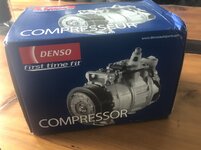
Compressor received today.

Confirming that the COO is Japan.
 

Attachments

  • D8639676-65D0-450D-AB3C-459C13407906.jpeg
    D8639676-65D0-450D-AB3C-459C13407906.jpeg
    196.5 KB · Views: 145
  • DB8A7CDF-2970-40A1-8559-988CE4A24627.jpeg
    DB8A7CDF-2970-40A1-8559-988CE4A24627.jpeg
    197.5 KB · Views: 24
  • 2E5B4E9E-738C-4218-BD74-21343349824D.jpeg
    2E5B4E9E-738C-4218-BD74-21343349824D.jpeg
    237.9 KB · Views: 27
  • 1D125616-2BDB-4002-995F-FC5DEDB56AA1.jpeg
    1D125616-2BDB-4002-995F-FC5DEDB56AA1.jpeg
    358.7 KB · Views: 138
  • 2B137FCF-CBE1-4118-8DA8-9B9EBB92752D.jpeg
    2B137FCF-CBE1-4118-8DA8-9B9EBB92752D.jpeg
    310 KB · Views: 26
The compressor speed sensor is not available as a separate part. It is integrated with the compressor, although I think it can be removed & swapped? Never done this so I'm not certain.

:klink:
I agree with Dave. I have not seen the compressor speed sensor available as a separate part. However, on some compressors it can be successfully removed, cleaned and reinstalled with a new O-ring. The ones I am familiar with are very similar to an ABS brake sensor and sometimes get a build up of metallic debris on the tip. Since I haven’t had the problem on my 500E, I haven’t checked it specifically.
 
I've decided, seeing as I have all new replacement pressure switches, and a receiver-drier, and now the compressor, just to replace the whole entire thing. I will do a HOW-TO on this, though I know that @LWB250 did a quasi HOW-TO on compressor replacement in his OWNER thread. I have never done much A/C work, so this will be some new ground for me, but should be educational.

I just had the old refrigerant professionally evacuated today by a local shop, in preparation for the coming replacement.
 
Cool! *slaps knee*

Gerry, do you have an AC vacuum pump? If not, that's the one item you'll need to obtain to recharge the system.

Also, if you don't have a new OE or OEM Hansa receiver/dryer (both NLA), you may want to leave the original in place. I asked Klink about this and he said (paraphrasing) that if there was not a catastrophic failure that dumped debris in the system, and there's no reason to believe the system is moisture-saturated, vacuuming the system for an extended time should be adequate to allow re-using the existing dryer.

🐧
 
I've decided, seeing as I have all new replacement pressure switches, and a receiver-drier, and now the compressor, just to replace the whole entire thing. I will do a HOW-TO on this, though I know that @LWB250 did a quasi HOW-TO on compressor replacement in his OWNER thread. I have never done much A/C work, so this will be some new ground for me, but should be educational.

I just had the old refrigerant professionally evacuated today by a local shop, in preparation for the coming replacement.
Gerry, I‘ll watch this thread. I have extensive experience in this area. Happy to help
 
Cool! *slaps knee*

Gerry, do you have an AC vacuum pump? If not, that's the one item you'll need to obtain to recharge the system.

Also, if you don't have a new OE or OEM Hansa receiver/dryer (both NLA), you may want to leave the original in place. I asked Klink about this and he said (paraphrasing) that if there was not a catastrophic failure that dumped debris in the system, and there's no reason to believe the system is moisture-saturated, vacuuming the system for an extended time should be adequate to allow re-using the existing dryer.

🐧
Agreed. Evacuate for at least an hour, with both the high and low side service gauge valves open, to remove as much moisture as absolutely possible. Also securely cap off any open fittings when changing parts on the refrigerant system such as the compressor. I’ve heard of people actually baking a receiver dryer in the oven to dry it out, but I have never confirmed this personally. One trick I’ve learned regarding refrigerany oil…After ensuring the compressor has the correct oil amout (drain, measure and pour it back in) and the system has been evacuated, nearly fully recharged and is cooling….Remove the high side pressure gauge hose form the service port on the car and use a small screw driver to release a short “spurt” or refrigerant onto you GLOVED hand and screwdriver tip. If you have a film of oil on your glove and screwdriver tip, your system has enough oil. Remember to be absolutely sure that your high side pressure gauge valve is always fully closed when charging the air conditioning system. Only the low side pressure gauge valve should be open while charging the air conditioning system. It is very important that you observe all the instructions and safety wanting to associated with handling refrigerant and pressurized air conditioning systems.
 
Cool! *slaps knee*

Gerry, do you have an AC vacuum pump? If not, that's the one item you'll need to obtain to recharge the system.

Also, if you don't have a new OE or OEM Hansa receiver/dryer (both NLA), you may want to leave the original in place. I asked Klink about this and he said (paraphrasing) that if there was not a catastrophic failure that dumped debris in the system, and there's no reason to believe the system is moisture-saturated, vacuuming the system for an extended time should be adequate to allow re-using the existing dryer.

🐧
I have a pump, yes. Got it from Clark Vader (RIP). I have a replacement receiver-drier. But to be honest, I was just planning to re-use the old one and replace the two pressure switches that screw into it. I was planning to pull vacuum after buttoning the system back up for 90-120 minutes.
 
Gerry, regarding replacement of your receiver/dryer tank... check the install pamphlet from Denso. The one with my compressor stated a new R/D must be installed to maintain the compressor warranty. These things are long lived so maybe not an issue for you.


Regards,

Peter Weissman
 
Hi Peter,

Yes, the Denso instruction booklet does say that. Since I don't care much about a warranty for a $200 part (let alone my old compressor as a core, although I am going to save it for an external reseal), and as far as I know there are no real defects with the system or shrapnel floating around inside the A/C system, I'm not going to worry about the R/D replacement.

Cheers,
Gerry
 
Hi Peter,

Yes, the Denso instruction booklet does say that. Since I don't care much about a warranty for a $200 part (let alone my old compressor as a core, although I am going to save it for an external reseal), and as far as I know there are no real defects with the system or shrapnel floating around inside the A/C system, I'm not going to worry about the R/D replacement.

Cheers,
Gerry
Gerry, pour the oil out of the old compressor and let it sit in a cup for a while. Then run a magnet around the bottom of the cup and see if you pick up metal debris. If the oil looks like glitter, you will need to replace the receiver dryer, flush the evaporator and lines and replace the expansion valve. Be sure you get all of the flush out of the system. That is critical…even a small amount of the flush will dilute the oil and likely damage the compressor quickly. I almost always just replace the condenser as it is extremely difficult to adequately flush them, though on the 500E, the tube and fin condenser generally flushes pretty well. I like to use dry nitrogen to blow the flush out of the components. The receiver dryer has a filter in it which will ultimately plug up with any debris from the defective compressor. just FYI…. I design mobile air conditioning systems so I have a pretty good background on the topic. 😊
 
Last edited:
Was this recent? It’s still listed on Pelican & some other sites:

Yes, the receiver/drier for the E500E is NLA from MB. Unless someone has a NOS unit, they are going to cancel the order if you place it.

It appears that in the future, R/D units for other MB models will have to be adapted for E500E use.
 
Gerry, pour the oil out of the old compressor and let it sit in a cup for a while. Then run a magnet around the bottom of the cup and see if you pick up metal debris. If the oil looks like glitter, you will need to replace the receiver dryer, flush the evaporator and lines and replace the expansion valve.
I did this with the ~1.5 ounces of PAG oil that I drained out of the old compressor. There were a few grains of dirt and such in the bottom of the measuring cup. I took a magnet to it and none of the dirt or crap moved, so I guess it wasn't metallic. I don't think there was any shrapnel in my system. I actually had a high level of confidence that my receiver-drier, expansion valve, and pressure sensors were OK and working fine, so even though I had all of these components, I did not actually replace them.

One other note -- the suction hose for the .036 and the .034 (a part that is specific to those models) is NLA from MB. It was quite expensive even when it was available. It is available on the aftermarket from ACM, at a price of ~$275. It may be a good idea to get one of these hoses as a spare to have on hand, although many folks have said that using the original hose hardware, a good A/C or hydraulic shop can whip up a new hose if one is needed, for far less than the ACM or old factory hose price.

But, another important .036 part that has gone NLA, sadly.
 

Who has watched this thread (Total: 7) View details

Back
Top