• Hi Guest !

    Welcome to the 500Eboard forum.

    Since its founding in late 2008, 500Eboard has become the leading resource on the Internet for all things related to the Mercedes-Benz 500E and E500. In recent years, we have also expanded to include the 400E and E420 models, which are directly related to the 500E/E500.

    We invite you to browse and take advantage of the information and resources here on the site. If you find helpful information, please register for full membership, and you'll find even more resources available. Feel free to ask questions, and make liberal use of the "Search" function to find answers.

    We hope you will become an active contributor to the community!

    Sincerely,
    500Eboard Management

Sway bars / Anti-roll bars. A highly invited discourse.

runningtoohot

E500E Enthusiast
Member
There is a lot of discussion regarding sway bars, and I don’t want to pollute somebody else’s thread with this. Also, please note that it is not my intention to pee on anybody’s parade - but you may want to take this into consideration.

From a chassis / suspension engineering point of view, bigger anti-roll bars are not always the right way to go. They are definitely not a panacea. It depends upon what your goals are. (Is anyone here planning on running a lot of slalom or gymkhana courses with their .036 versus road course “activities”?)

It is a common mistake for street car ‘tuners’ to make a car’s suspension stiffer to resolve “handling issues”. In a misguided effort to balance against whichever end of the car is *not* ‘sticking’ enough, they stiffen up the opposite end so that it will have less mechanical grip – so it will essentially ‘stick less’. This is in direct contrast with the most basic premise of suspension engineering, which is to make whichever end is washing out *stick better* - which ultimately yields the highest overall cornering force.

Larger anti-roll bars will obviously inhibit body roll, therefore providing greater transient response, which most people will perceive as “better” handling - when in fact it may actually cause the car to be slower through turns.

For example, if a car presents with steady-state understeer (i.e., all street cars) then tuners typically install larger front & rear bars, with a greater (percentile over stock) bias towards the rear bar. What that does is cause more lateral weight transfer by shifting the loading towards the outside (in this case, rear) tire, and therefore a reduction of mechanical grip. This causes the previously ‘sticky’ (rear) end to develop higher slip angles during steady-state cornering.

Therefore larger anti-roll bars, assuming proper front-rear balancing, may indeed coax the chassis into a more neutral cornering state, but at the expense of overall lateral grip. Less maximum lateral “G’s” = slower around a corner. Larger bars also inhibit (independent) suspension compliance, which means that bumpy surfaces will have an even larger influence in causing diminished lateral grip.

By inhibiting body roll, larger bars also reduce (per given lateral load) camber gain on the loaded side & camber loss on the unloaded side. This is where the basic (fixed) suspension geometry and alignment settings come into play. If you change alignment parameters to match the new camber gain curve (plotted against applied lateral force), you may benefit in the corners – but then your straight-line tire contact patch area will be compromised. That would decrease longitudinal grip (primarily braking, and potentially acceleration), therefore less available (longitudinal) G’s again. (Not to mention tire wear issues.)

Larger bars also adversely affect ride characteristics, which may or may not matter to each individual here – but again, these are first & foremost street driven vehicles. (Note the McLaren MP4-12C’s suspension and the accolades it receives for its ride AND handling characteristics – sans (traditional) anti-roll bars.) On a well engineered suspension design, anti-roll bars are typically very light, as they are used mostly as a fine-tuning element, not a primary body control element. (Which is what proper spring & damper rates are for.)

Bottom Line: On a road course, a really good driver can compensate for body roll during corner-entry transition, oftentimes enough so that increased mid-corner mechanical grip will more than offset any lost time during corner entry transition. This means that (even with ‘more’ body roll) a car can oftentimes set faster lap times due to increased suspension compliance and mechanical grip.

A recent representative example is the Nissan GTR, in which they finally figured out that by *softening* their kidney-buster suspension, they could set faster Nurburgring lap times. I still question what happens when/if a fuse blows and the computer nannies suddenly quit and allow the laws of physics to revert to full driver control. :) Yet, once again, I digress…

This may be relatively basic information for a lot of you guys, but I felt that this may serve as educational material for people in the future who may seek out this type of information.

NOTE: I’m truly not intending to cause controversy in the other thread – I hope that my experience in this realm can be helpful. But, as a preventative measure, I’ve got my ancient Nomex suit on.
 
Re: Sway bars / Anti-roll bars. An uninvited discourse.

I think it's a thoughtful post. Look forward to discussion.


Sent from my iPhone using Tapatalk
 
Re: Sway bars / Anti-roll bars. An uninvited discourse.

I'm definitely in the "bigger is NOT necessarily better" camp when talking anti-sway bars on a street driven car. It's hard to make generalizations because the term "better handling" is not well defined. Plus, there are so many variables to take into account even when the discussion focuses on only one model of car.
 
Re: Sway bars / Anti-roll bars. An uninvited discourse.

I think one of the considerations is if the car is under-bar'd from the factory. In the case of the C126 (which I installed the Feind larger rear bar on) it was. It's probably a good debate for the .036. I'm going to forge ahead with the 036 bars, and will probably end up being the guinea because of my proximity to the Jack-Man. Will do another HOW-TO when we install.

Beware though -- these bars will likely use stiffer urethane bushings. I get a bit of squeak from my C126 rear because of the urethane.
 
Re: Sway bars / Anti-roll bars. An uninvited discourse.

As Dave mentioned in the other thread, the factory 20mm bushings for the E55 should work fine on the 21mm bar and be squeak free.

Gerry, are you planning to get the Stage 2, 32/25 f/r bars?
 
Re: Sway bars / Anti-roll bars. An uninvited discourse.

runningtoohot, I was going to post a question in the other thread, but this may be a better place to put it. I agree 100% with what you posted about the tradeoffs when making suspension mods. I am a former SCCA road racer/instructor and while the 500E is used mostly for street driving, I would like to make the car neutrally balanced without getting it too stiff.

My '92 500E needs a lot of suspension work, so my impressions on how to modify it are somewhat based on possibly flawed data. That said, I think there is way too much understeer and also more body roll than I expected. While I am more concerned about the balance, I am also concerned about the amount of camber gain I am encountering. How much of it is from loose bushings and how much from the actual design and component selection is not easy for me to tell.

My question is for some of the folks who actually track their cars, but have not made any big suspension mods to them. I suspect what will make me happy is to completely go through the suspension/subframe and replace all the bushings, and possible a bigger rear bar. If I can get away without lowering the car or replacing the springs/struts, I will be quite happy, though I suspect I will need to put new stock dampers in. I intend to keep the SLS.

I am an aggressive driver on back roads and want the car to do its part. On the highway, I want to maintain a comfortable ride. Any recommendations?
 
Re: Sway bars / Anti-roll bars. An uninvited discourse.

runningtoohot, I was going to post a question in the other thread, but this may be a better place to put it. I agree 100% with what you posted about the tradeoffs when making suspension mods. I am a former SCCA road racer/instructor and while the 500E is used mostly for street driving, I would like to make the car neutrally balanced without getting it too stiff.

My question is for some of the folks who actually track their cars, but have not made any big suspension mods to them.
The problem here is, I can count on one hand the number of forum members who I know have tracked their 500E on a road course, or even autox course (Jono, Neil, Vookster, and Jimbo are the ones I can think of at the moment). So we don't have a lot of data available, nor people who can test different combinations. Fresh suspension rubber can really help, especially if the current stuff is original from 20+ years ago. That's the starting point, front & rear. I've done this on two of my 500's and the third should be done later this year.


My '92 500E needs a lot of suspension work, so my impressions on how to modify it are somewhat based on possibly flawed data. That said, I think there is way too much understeer and also more body roll than I expected. While I am more concerned about the balance, I am also concerned about the amount of camber gain I am encountering. How much of it is from loose bushings and how much from the actual design and component selection is not easy for me to tell. ... I suspect what will make me happy is to completely go through the suspension/subframe and replace all the bushings, and possible a bigger rear bar. If I can get away without lowering the car or replacing the springs/struts, I will be quite happy, though I suspect I will need to put new stock dampers in. I intend to keep the SLS
If your '92 needs a suspension refresh, definitely start there. New late OE LCA's & strut mounts, struts, and steering links up front; plus a full rear subframe rebuild. It's a billion times easier to R&R the rear bar with the subframe removed, so if you can combine the rear sway bar upgrade with your suspension project, I'd highly recommend it.


I am an aggressive driver on back roads and want the car to do its part. On the highway, I want to maintain a comfortable ride. Any recommendations?
One thing I have noticed is the stock 500E front struts seem a bit too soft, even when new. Bilstein Sports may provide an improvement in control without a significant loss of ride comfort. KONI Yellows are another option, with the bonus of adjustable rebound damping. I wouldn't lower too much, if at all. Keeping the wheels/tires to 17" should help with the ride comfort. There isn't much we can do with the rear SLS except send them out to a race shop for re-valving internally, which might be an interesting project.

:scratchchin:
 
Re: Sway bars / Anti-roll bars. An uninvited discourse.

It's hard to make generalizations because the term "better handling" is not well defined.

Agreed. Blondes vs. brunettes. Chocolate vs. vanilla. I'm sure that those dorky kids driving their Civics with the suspension slammed against the bump-stops think their cars handle just Greaaaat. They look like bobble-head dolls on the concrete super-slabs in Southern California.

I think one of the considerations is if the car is under-bar'd from the factory. In the case of the C126 (which I installed the Feind larger rear bar on) it was. It's probably a good debate for the .036. I'm going to forge ahead with the 036 bars...

Beware though -- these bars will likely use stiffer urethane bushings. I get a bit of squeak from my C126 rear because of the urethane.

I've driven only two SEC's through the years (a 380 & a 560). Since the 126 coupes were intended as a sporty version of their luxo car, they undoubtedly took that into consideration when tuning the suspension for the U.S. market. And I would agree with you - it seems that MBZ was erring on the side of caution, but in light of the intended market, that was a wise move. I drove a friend's beat-up 126 sedan a couple of weeks ago, and I forgot how amazing the suspension is on those cars. (But *not* 'sporty' at all, nor was it intended to be.)

As for forging ahead, it's always (usually?) a good idea to try something rather than speculate & hypothesize. "Try it, You'll like it" (another old-timer reference.)

As far as urethane on the anti-roll bar, it will transmit a bit more NVH. Mostly more of the N. This is making an assumption (which I HATE) about the durometer / shore rating though. Hint: if you can cut one or two small circumferential grooves on the inner surface of (any) urethane bushings AND a drill a hole leading to the groove(s) AND line up the hole with another hole that you've made in the retention device AND you add a Zerk fitting into *that* hole AND you have a dedicated grease gun filled with silicone grease (pool supply stores are a good cheap source)... well, you get the idea.


...the 500E is used mostly for street driving, I would like to make the car neutrally balanced without getting it too stiff.

My '92 500E needs a lot of suspension work... I think there is way too much understeer and also more body roll than I expected.... I am also concerned about the amount of camber gain I am encountering. How much of it is from loose bushings and how much from the actual design and component selection is not easy for me to tell.

... If I can get away without lowering the car or replacing the springs/struts, I will be quite happy... I am an aggressive driver on back roads and want the car to do its part. On the highway, I want to maintain a comfortable ride. Any recommendations?

First & foremost, as Dave said, all the bushings & joints need to be up to snuff before you can really get a baseline. As for understeer, ALL production cars, and I mean ALL of them are setup to understeer - it's baked into their basic geometry. The last time a volume production car had a propensity to be loose right out of the box, we ended up with Ralph Nader making a name for himself. (911's understeer like a pig when someone doesn't know what they're doing - *then* the pig turns around and rips their face off for not knowing how to drive it properly. But if it's driven correctly on a closed course it can be a fun pig to dance with.) :)

As far as camber gain is concerned, don't concern yourself with it. Unless of course you want to start relocating pick-up points or altering the control arms, steering knuckles, etc.. As for maintaining a comfortable ride on the highway, I think the original setup is pretty darn good. Suspension tuning is like a lot of things in life – always a compromise. I like to make the analogy of a water balloon: when you squeeze one part, another part oozes out to compensate. There's no free lunch. Except for Gerry. Anyone visiting him should be obligated to buy him lunch for giving us this playground. (Please don't bother pointing out that it would therefore not be a free lunch.)

...I can count on one hand the number of forum members who I know have tracked their 500E... ...So we don't have a lot of data available... ...Fresh suspension rubber can really help, especially if the current stuff is original from 20+ years ago.

One thing I have noticed is the stock 500E front struts seem a bit too soft, even when new.. Keeping the wheels/tires to 17" should help with the ride comfort.

+1 on everything Dave said. And thanks for that link - I'll check it out later tonight.

Funny, I have 17's on my '92, plus it has lower stiffer springs (from a PO, so I don't know which ones.) so it's pretty damn stiff. I'd just as soon put 16's back on it for the additional sidewall compliance. Blasphemy? Maybe, but I can deal with the additional tire squirm during corner entry - no big deal. It would probably be worth the tradeoff for reduced NVH. And I probably shouldn't open up Pandora's box about sprung vs. unsprung weight.

Dave, I'm curious - when you say you feel the stock struts are too soft, are you referring to jounce or rebound? Or both?
 
Re: Sway bars / Anti-roll bars. An uninvited discourse.

Now we are starting to get into some of the fun discussion!

Dave, thanks for jumping in with some good info -- I had not looked at the post John made in quite a while. Your info on the front struts being a bit weak is exactly the type of info I am looking for. I am finding it hard to make time for working on cars these days and I would like to do the whole suspension/subframe refresh/upgrade in a single pass if at all possible.

For my use, I don't want to lower the car at all. With all the speed bumps around here, I would be making a big mistake. Also, I don't want to run out of compression travel and be stuck with all rebound, which is a really bad place to be as some of the ricers eventually learn the hard way when they hit a bump and end up in the weeds. My wheels are 18" and I will be retaining them, even though the staggered configuration adds a bit of grip in the rear and exacerbates the understeer when pushing the car.

I do have the RDMtek rear LCA's ready to install to help reduce the negative camber in the rear. While this will help with tire wear, I am thinking it may also loosen up the rear a tiny bit by letting the tires roll over past perpendicular to the road when cornering under heavy load.

It was a good reminder from John's post that many minor suspension inadequacies can be resolved by tweaking the alignment, especially as in his case by using mild toe-out or 0 toe to help with turn-in. A bit of toe-out in the rear helps loosen up the rear as well, helping the car to rotate more easily.

Getting back to the discussion part of this thread, I think the challenge will be to find a balanced suspension setup for street use by driving enthusiasts. Like earlier said, few of us actually track our cars, so a race setup is not going to be where most of us end up. My experience has told me that people often get excited about a particular hot suspension item and lose sight of the overall picture. If you go to a much stiffer spring or anti-roll bar, you also need a stiffer damper to control it. Likewise, if you put a stiffer strut in without matching the spring and anti-roll bar, you end up with an over damped system that is lacking in compliance.

A big question for me is just how much you can play with the rear springs and anti-roll bar without overwhelming the SLS system. I am guessing you could get away with either slightly stiffer rear springs or a thicker rear bar, but not much else. Driving a car that is over sprung in the rear is not my cup of tea.

My current thought is to go to the 21mm rear bar, RDMtek LCA's and Bilstein Sport front struts and keep everything else stock. I am hoping to get a lot more info out of this thread when the rest of the crew chips in. :hugs:
 
Last edited:
Re: Sway bars / Anti-roll bars. An uninvited discourse.

While making a diversion into shocks….

Remember that when you have a larger bar, you are effectively increasing the spring rate as seen by the LCA on the loaded side *during cornering* (only). Therefore, if the shock is tuned for linear rate springs, it will be exerting less than ideal rebound damping force to control wheel movement, again, *while* cornering. This is definitely a non-linear response, and, in worst case instances, can lead to a pogo-stick like effect that manifests itself while cornering.

That is another reason to get the spring and shock rates right FIRST, then fine-tune with the bars.

Warning: Non-sequitur stuff ahead.

This is bringing back memories. (How unfortunate for you guys, as I ramble on.) By far, the worst ‘pogo’ offender in stock guise was the Delorean. (I actually developed a suspension kit for a DMC tuner outfit way back when the dinosaurs hadn’t turned into hydrocarbon fuel yet, but that’s a different story.)

I drove a friend’s stock DMC at Willow Springs for a horrid “B” movie shoot. When I turned in, it would sequentially: (in this example, a turn to the right)

1.) Roll to the left with more loading on the front as it developed understeer.
2.) Inadequate front damping caused the left front to ‘pogo’ upward
3.) The load was transferred to the right rear due to inadequate jounce dampening.
4.) The right rear would then pogo up due to almost non-existant rebound damping, but this time throwing the load laterally to the already loaded left rear
5.) This caused the left rear to bottom & hit the jounce snubber, and again the non-existent rebound damping caused the left rear to bounce up and send the load towards the left front again - which would do step #1 all over again.
6.) It would just continue to do this triangular 3-point monkey motion ALL the way through a corner. It was enough to make you seasick. What a piece of carp.

Rambling over… Carry on….
 
Re: Sway bars / Anti-roll bars. An uninvited discourse.

Great thread!

Was reading through the sway bar topic yesterday and mirrors my thoughts pretty much.


The primary issue is the lack of mechanical grip in the front we are discussing,right?

Reasonable(financial as well as daily driving,assuming all suspension parts are in perfect shape) improvements:

-The easiest way to compensate for that to a certain amount is more rubber on the road(and you can hide plenty of it under these massive fender flares).

-adjustable rear sway bar(makes more sense now with more grip on the front)


Should gain in every aspect higher corner speeds(entry,mid and exit) due to more lateral grip provided.

With proper brakes also later braking points.

Other dampers front and springs front and rear SHOULD help with reducing the body roll(assuming the SLS is up to task)


Everything else would involve ditching the SLS and go for a proper set of dampers/springs(something like a KW V3 with individual adjustment for high speed bump and rebound).
 
Last edited:
Re: Sway bars / Anti-roll bars. An uninvited discourse.

Great thread! Finally some long yearning guidelines on suspension mods. :nicethread:

I've also been in contact with John Bicht about his experience in the other thread. I guess I have to admit that for suspension mods - I belong to the "TPT-group" - Throwing Parts Together, it is fun but both expensive and frustrating. However, I can still read and pick up reasonable thoughts, so I look forward to this educating discussion - and in the end any set-up has to be test driven.
Thanks for posting this thread! :-)

-a-


(I'll definitely disconnect the SLS, replace with Yellow Koni Sports all around due to rebound adjustment, Brabus springs, a little lowering and levelling the car, RDMtek rear LCAs, I do also have RDMtek tower mounts available if necessary, staggered 18" wheel set-up. Stiffer swaybars is the last thought, but max. 30mm and 21mm for me, so I guess I have to hunt for a Brabus/E60 front swaybar then.)
 
Last edited:
Re: Sway bars / Anti-roll bars. An uninvited discourse.

Remember that when you have a larger bar, you are effectively increasing the spring rate as seen by the LCA on the loaded side *during cornering* (only). Therefore, if the shock is tuned for linear rate springs, it will be exerting less than ideal rebound damping force to control wheel movement, again, *while* cornering. This is definitely a non-linear response, and, in worst case instances, can lead to a pogo-stick like effect that manifests itself while cornering.

That is another reason to get the spring and shock rates right FIRST, then fine-tune with the bars.

On a smooth race track, I agree with this, but on a bumpy street, much less so. The anti-roll bars come into play any time the vertical position of the two wheels is not the same. Obviously, this happens when cornering on smooth roads as the weight transfers to the outside wheel. It also happens when an individual wheel encounters a bump or hole, which often happens and cannot be ignored.

With light sway bars, you can mostly ignore the bar when balancing spring and damper rates. As the anti-roll bars increase in force compared to the springs, you cannot ignore them or you will end up with an under damped suspension and end up bouncing the wheel excessively on a less than smooth surface and sacrificing grip. The only time it will work properly is when you hit the same magnitude bump (or hole) with both wheels at the same time. Obviously, the damping needs are quite different at different times, which might lead one to minimize anti-roll bars when possible to limit the variations in spring rate due to the actions of the bar. The trade-off comes on a street car where you might want to limit spring rate to improve compliance and maintain a comfortable ride. The compromise that I often end up most happy with is to avoid really stiff springs, select dampers that are a bit strong for the springs, and go with a modestly strong anti-roll bar.
 
Re: Sway bars / Anti-roll bars. An uninvited discourse.

My current thought is to go to the 21mm rear bar, RDMtek LCA's and Bilstein Sport front struts and keep everything else stock.

You should take my 036 for a spin (when the weather warms up) to see how the Bilstein Sport front struts feel.
 
Re: Sway bars / Anti-roll bars. An uninvited discourse.

To answer the question about the stock 500E struts: What I noticed is that any car I had them on (either 500E or other 124), when driving SLOWLY over a speed bump (like, 2mph) after going over the bump, the front end would dip down noticeably and then bounce back up to normal level. As if the compression damping was quite soft. This happened even with brand new 500E struts, so it wasn't due to them being worn out. With Bilstein Sports or KONI, there is not a pronounced dip in the front end after crossing the bump, i.e. they appear to have more compression damping.

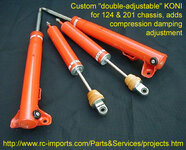
I wish the KONIs offered adjustable compression damping too, and they can be modified to add this (see below). In fantasy land, we could get both high-speed and low-speed adjustments for both compression and rebound, but that's moving into the realm of serious racing teams, and out of the DIY/hobbyist ability to properly adjust them. In theory, softer high-speed compression damping should help soften the ride on the street, while firmer low-speed damping would keep things controlled better under hard cornering (at least on smooth pavement).

I like the internal rebound limiting springs in the stock 500E dampers, but these are ride-height dependent, and require the ride height to remain at stock levels to perform as MB/Porsche intended. If you lower the car, the springs become less effective to nearly useless, depending how low the car is. Makes me wonder if the E60 AMG struts have modified internal springs along with different damping. It will only cost ~$650/each if anyone wants to find out (~$775/ea rears). The factory dampers only have a 1-year warranty, btw... Bilstein and KONI both have lifetime warranty. (for the original buyer - save your invoice). 500E front struts are down to ~$150/ea at the moment via parts.com.

:seesaw:
 

Attachments

  • KONI_custom1.jpg
    KONI_custom1.jpg
    91.5 KB · Views: 14
  • KONI_custom2.jpg
    KONI_custom2.jpg
    42.5 KB · Views: 10
Re: Sway bars / Anti-roll bars. An uninvited discourse.

On a smooth race track, I agree with this, but on a bumpy street, much less so. The anti-roll bars come into play any time the vertical position of the two wheels is not the same. Obviously, this happens when cornering on smooth roads as the weight transfers to the outside wheel. It also happens when an individual wheel encounters a bump or hole, which often happens and cannot be ignored.

With light sway bars, you can mostly ignore the bar when balancing spring and damper rates. As the anti-roll bars increase in force compared to the springs, you cannot ignore them or you will end up with an under damped suspension and end up bouncing the wheel excessively on a less than smooth surface and sacrificing grip. The only time it will work properly is when you hit the same magnitude bump (or hole) with both wheels at the same time. Obviously, the damping needs are quite different at different times, which might lead one to minimize anti-roll bars when possible to limit the variations in spring rate due to the actions of the bar. The trade-off comes on a street car where you might want to limit spring rate to improve compliance and maintain a comfortable ride. The compromise that I often end up most happy with is to avoid really stiff springs, select dampers that are a bit strong for the springs, and go with a modestly strong anti-roll bar.

You are obviously quite correct. I should not have used the phrase "*during cornering* (only)". Unfortunately, I still have my head wrapped around track based development. The main point that I did intend to get across however is what you stated more eloquently than I did, namely that when you run a large bar, you are varying the (effective) spring rate based upon the referential positions of the two wheels. A large bar can both increase or decrease the effective spring rate seen by (either side of) the suspension, and the shocks therefore cannot be perfectly tuned for the constantly varying forces - and things can get very sloppy. Now if we start talking about magnetorheological shocks and what could (in theory) be done with them by the control algorithms, then we're talking about a whole 'nother ballgame!

To answer the question about the stock 500E struts: What I noticed is that any car I had them on (either 500E or other 124), when driving SLOWLY over a speed bump (like, 2mph) after going over the bump, the front end would dip down noticeably and then bounce back up to normal level. As if the compression damping was quite soft. This happened even with brand new 500E struts, so it wasn't due to them being worn out. With Bilstein Sports or KONI, there is not a pronounced dip in the front end after crossing the bump, i.e. they appear to have more compression damping.

I wish the KONIs offered adjustable compression damping too, and they can be modified to add this (see below). In fantasy land, we could get both high-speed and low-speed adjustments for both compression and rebound, but that's moving into the realm of serious racing teams, and out of the DIY/hobbyist ability to properly adjust them. In theory, softer high-speed compression damping should help soften the ride on the street, while firmer low-speed damping would keep things controlled better under hard cornering (at least on smooth pavement).

I like the internal rebound limiting springs in the stock 500E dampers, but these are ride-height dependent, and require the ride height to remain at stock levels to perform as MB/Porsche intended. If you lower the car, the springs become less effective to nearly useless, depending how low the car is. Makes me wonder if the E60 AMG struts have modified internal springs along with different damping. It will only cost ~$650/each if anyone wants to find out (~$775/ea rears). The factory dampers only have a 1-year warranty, btw... Bilstein and KONI both have lifetime warranty. (for the original buyer - save your invoice). 500E front struts are down to ~$150/ea at the moment via parts.com.

:seesaw:

Dave, thanks for the observations. I'll hazard a bet that the speed-bump behavior you noticed was worse when you put them on other 124's due to the softer springs. (Unless of course you changed to higher rate springs at the same time, in which case ignore anything after this.) I would speculate that the soft compression damping of the stock .036 damper would have been due to the firmer factory spring being used, and they did not want to induce too much ride harshness. The same logic would dictate slightly firmer rebound damping in the same strut. IDK if that is in fact the case, but logically it should be.

Do they *have* speed bumps in Germany? :)
 
Re: Sway bars / Anti-roll bars. An uninvited discourse.

You know, now that I think about it…

Those internal rebound limiting springs in the stock .036 front struts are probably a (strong) clue that the Porsche guys felt that they had run up against the wall in regards to front anti-roll bar sizing.

Again, I hate to speculate, but the ride & handling development drivers probably nixed any further increase in front bar size, yet still wanted to control front roll a bit more – so they came up with a rather simple yet unique answer. As to why they didn’t want to increase the front bar size any further… well, read the prior posts.
 
Re: Sway bars / Anti-roll bars. An uninvited discourse.

Dave, your photo of the double adjustable KONI's led me to call Rick Ellinger, the owner of RC-Imports and an old racing buddy of mine. We had a nice chat about the KONI's, and the net result is that he no longer sells them. He thinks you could probably get KONI's racing department to make you a set for about $800-$1,000 if you ask nicely.

We also talked about front struts for a mostly stock 500E, and his recommendation is to go with the stock struts. Rick said that Bilstein Sport struts had too much damping and felt like you had really stiff springs. I know that we have them on an old Volvo 740 and they transformed the car into something that would be fun to drive on back roads if it just had about 5X more power.

Anyway, it was good to talk to an old friend!
 
Re: Sway bars / Anti-roll bars. An uninvited discourse.

You know, now that I think about it…

Those internal rebound limiting springs in the stock .036 front struts are probably a (strong) clue that the Porsche guys felt that they had run up against the wall in regards to front anti-roll bar sizing.

Again, I hate to speculate, but the ride & handling development drivers probably nixed any further increase in front bar size, yet still wanted to control front roll a bit more – so they came up with a rather simple yet unique answer. As to why they didn’t want to increase the front bar size any further… well, read the prior posts.

Interesting idea, and I think you might have hit on something here!

I forgot to add that Rick also mentioned the best way to reduce the understeer was play with camber, tire choice and toe settings.
 
Re: Sway bars / Anti-roll bars. An uninvited discourse.

Making things worse is staggered wheel/tire setups. A lot of folks (myself included) prefer staggered wheels for the menacing appearance, but it makes the understeer worse by adding more lateral grip at the rear.

Reducing negative camber in the rear (it's REALLY negative in stock form, typical 500E is -2° to -3° depending on ride height) may help, and this will also help with rear tire wear.

For track use, I suspect that using the same size wheel/tire on all four corners would likely help keep things better balanced.

:stirthepot:
 
Re: Sway bars / Anti-roll bars. An uninvited discourse.

...the best way to reduce the understeer was play with camber, tire choice and toe settings.

Making things worse is staggered wheel/tire setups.:stirthepot:

Hollybrook: As you well know from your racing experience, a dialed-in alignment makes a WORLD of difference. I'll take a flabby, bouncing, rolling POS (with proper alignment settings) and trounce a guy that has dialed-in springs & dampers but a botched up alignment. :)

Dave, How about a reverse staggered setup? That would look dorky as all hell, but the guys left in the wake of such a beast would look worse. :) :) :)
 
Re: Sway bars / Anti-roll bars. An uninvited discourse.

Dave, How about a reverse staggered setup? That would look dorky as all hell, but the guys left in the wake of such a beast would look worse. :) :) :)
We need to get one of you SCCA instructor types to get a 500E at a track day with a pile of components to try out, and go flog the beast. You know, trying different wheel widths and whatnot. Changing alignment in the pits might be the pits though. But I don't think it's easy to get a full Hunter alignment rack in your trunk.

I have a feeling that if rear camber was reduced to near zero, and front camber increased a bit past the OE limit (say, -2° up front, maybe more), that might take a big dent out of the understeer issue. The nice thing is, this would almost work on the street too. The front tires don't usually have excess wear on the inside shoulder with -1.0° to -1.5° camber. Aggressive cornering would help keep the wear even.

:hornets:
 
Re: Sway bars / Anti-roll bars. An uninvited discourse.

As Dave mentioned in the other thread, the factory 20mm bushings for the E55 should work fine on the 21mm bar and be squeak free.

Gerry, are you planning to get the Stage 2, 32/25 f/r bars?
Absolutely not. I don't need them. If I had a track rat....perhaps. But I'm totally game for the much milder Stage 1 rear.
 
Re: Sway bars / Anti-roll bars. An uninvited discourse.

You know, now that I think about it…
Those internal rebound limiting springs in the stock .036 front struts are probably a (strong) clue that the Porsche guys felt that they had run up against the wall in regards to front anti-roll bar sizing.
Again, I hate to speculate, but the ride & handling development drivers probably nixed any further increase in front bar size, yet still wanted to control front roll a bit more – so they came up with a rather simple yet unique answer. As to why they didn’t want to increase the front bar size any further… well, read the prior posts.

For some reason they increased the front swaybar on the E60 AMG to 30mm.

Interesting idea, and I think you might have hit on something here!
I forgot to add that Rick also mentioned the best way to reduce the understeer was play with camber, tire choice and toe settings.

Making things worse is staggered wheel/tire setups. A lot of folks (myself included) prefer staggered wheels for the menacing appearance, but it makes the understeer worse by adding more lateral grip at the rear.
Reducing negative camber in the rear (it's REALLY negative in stock form, typical 500E is -2° to -3° depending on ride height) may help, and this will also help with rear tire wear. For track use, I suspect that using the same size wheel/tire on all four corners would likely help keep things better balanced.

:stirthepot:
This leans towards what John Bicht experienced, so it has already been proven to affect in a positive way.

-a-

I like to say it again - this thread was highly wanted and needed here! :-)
 
Last edited:
Re: Sway bars / Anti-roll bars. An uninvited discourse.

For some reason they increased the front swaybar on the E60 AMG to 30mm.
Good point, Arnt. That was done in conjunction with different (stiffer/shorter) springs, and different dampers, presumably with different (stiffer?) valving. Oddly, AMG left the rear sway bar alone at 18mm. Hmmm....

:scratchchin:
 
Re: Sway bars / Anti-roll bars. An uninvited discourse.

Changing alignment in the pits might be the pits though. But I don't think it's easy to get a full Hunter alignment rack in your trunk.

For the purpose of playing with alignment at a race track, all you need is four jack stands, some string, a ruler and a relatively inexpensive camber gauge. Once you have the settings nailed down, you can go to an alignment shop for the final alignment.

I have a feeling that if rear camber was reduced to near zero, and front camber increased a bit past the OE limit (say, -2° up front, maybe more), that might take a big dent out of the understeer issue. The nice thing is, this would almost work on the street too. The front tires don't usually have excess wear on the inside shoulder with -1.0° to -1.5° camber. Aggressive cornering would help keep the wear even.

Dave, we are thinking along the same lines. When I look at my car, the rear camber is much greater than the front, though I need to go through the suspension before really knowing where it will end up. Play with the toe a little and disable the ASR and I may end up with something I like. The two things I am still considering are what front struts to select and if I want to go to a stiffer rear anti-roll bar.
 
Re: Sway bars / Anti-roll bars. An uninvited discourse.

Agreed. On the bright side, front struts are relatively inexpensive so you could try a couple different types and sell the ones you don't like. On a related note, I'm curious how much improvement there is with the RDM TEK style rigid strut mount, in place of the factory rubber strut mount. I've always suspected this was more of a track item, i.e. the OE strut mounts may be preferable for street use.

:wormhole:
 
Re: Sway bars / Anti-roll bars. An uninvited discourse.

I drove a W124 coupe this fall that had those shock mounts and they crashed over bumps. They definitely did not add anything to driving experience on the street.
 
Re: Sway bars / Anti-roll bars. An uninvited discourse.

For some reason they increased the front swaybar on the E60 AMG to 30mm.

Wouldn't that have been the AMG guys, not the Porsche development drivers? The Porsche guys were undoubtedly given parameters by MBZ to meet a broad audience appeal. The AMG guys had more latitude to allow people's heads to be tossed from side to side on rough roads. (Isn't that what the (modern) AMG buyers pay the big $$$ for? ;) ) I'm not saying that the AMG suspension guys were hacks, but note what Dave recognizes:


Good point, Arnt. That was done in conjunction with different (stiffer/shorter) springs, and different dampers, presumably with different (stiffer?) valving.

Not only were the AMG guys playing to a different market (more similar to *this* audience) but again *all* parameters were changed, they were not just throwing stiffer bars onto an otherwise stock setup. No way... uh-uh.


...Oddly, AMG left the rear sway bar alone at 18mm. Hmmm....

Again, that was likely due to compliance issues. If they stuck with an 18mm bar, it was because there was enough roll resistance to adequately address whatever camber gain/loss occurs in the rear. If there wasn't, they likely would have increased the spring rate even further before resorting to a larger bar - again for compliance reasons. (See what Hollybrook said earlier about light bars.)

Remember that IF the camber gain/loss (with the 18mm bar & stiffer springs) was already keeping the rear contact patches at their maximal values, skid pad numbers would not rise with a thicker bar. However, compliance issues brought forth by a too-stiff bar in the rear would manifest on uneven surfaces, making the rear more skittish. That particular type of 'skittish' does not lend itself towards allowing the driver to yaw/rotate the chassis at will (which is desirable) - it would force the driver to react to loss of rear grip *when it is not wanted*. The end result is again a slower lap time, and a frustrated driver with a 'poor handling' car. The AMG guys came to the conclusion of "If it ain't broke, don't fix it."


For the purpose of playing with alignment at a race track, all you need is four jack stands, some string, a ruler and a relatively inexpensive camber gauge. Once you have the settings nailed down, you can go to an alignment shop for the final alignment.

+1. I love it. Sometimes the 'old school' way of doing things persists for a good reason. Of course, nowadays you can't use just any old run-of-the-mill kite string. You MUST use AMG/MBZ officially sanctioned military aircraft grade precision calibrated multi-stranded braided Kevlar cord. List price: $78 per meter at your MBZ dealer :)
 
Last edited:
Re: Sway bars / Anti-roll bars. An uninvited discourse.

Not only were the AMG guys playing to a different market (more similar to *this* audience) but again *all* parameters were changed, they were not just throwing stiffer bars onto an otherwise stock setup. No way... uh-uh.

+1. You certainly have to approach suspension mods from a system perspective. Just like throwing a big carb and headers on an engine -- without some head and intake work, you probably will not get much of a performance gain, and it sure won't run very well.
 
Last edited:
Re: Sway bars / Anti-roll bars. An uninvited discourse.

Agreed. On the bright side, front struts are relatively inexpensive so you could try a couple different types and sell the ones you don't like. On a related note, I'm curious how much improvement there is with the RDM TEK style rigid strut mount, in place of the factory rubber strut mount. I've always suspected this was more of a track item, i.e. the OE strut mounts may be preferable for street use.

I had not thought about reselling struts if I don't like them...

As for the RDMtek strut mounts, if they used spherical bearings, I would not want them on the street. On my race car, the spherical bearings in the camber plates only lasted for a race or two. I never found a brand that could take the abuse, so ended up buying them in bulk. For a street car, I would expect the same results, though it might take a few months before they loosened up. The amount of NVH would be outside my threshold of pain for a street car even when new. Once they started to get loose, it would be intolerable. Didn't you have similar problems with the adjustable LCA's that you had with spherical bearings?
 
Re: Sway bars / Anti-roll bars. An uninvited discourse.

Detailed photos of the RDM TEK strut mounts are here. I did not open the sealed portion which contains the bearing, or whatever they used. Austin may be able to explain what's inside there.

The problem I had was with rear camber arms with Heim joints. With them installed, I got rear wheel hop during burnounts. Switching back to stock camber arms cured it. Oddly, my W210 has three RENNtech rear links with Heim joints, and that setup does not have any wheel hop during burnouts... not sure why. I generally don't like the Heim joint links in the rear suspension, there are other solutions which are better, IMO. The rear suspension is designed to return to center (normal ride height) due to the bonded rubber bushings. Eliminating all of these bonded bushings and letting the suspension "flop around" would, IMO, require re-tuning the shock damping and possibly spring rates. (??) Click here for a video of the stock rear suspension action with spring removed.

:pc1:
 
+1. You certainly have to approach suspension mods from a system perspective. Just like throwing a big carb and headers on an engine -- without some head and intake work, you probably will not get much of a performance gain, and it sure won't run very well.

You are 100% right about the need for a “whole system” approach.
Do you think that may explain why the Weber side-draft 40DCOE carb didn't do too much for my lawn mower?


...The rear suspension is designed to return to center (normal ride height) due to the bonded rubber bushings. Eliminating all of these bonded bushings and letting the suspension "flop around" would, IMO, require re-tuning the shock damping and possibly spring rates. (??) Click here for a video of the stock rear suspension action with spring removed.

Interesting kinematics there. I haven't ever torn apart the rear suspension on any of my w124's, so I'm relatively ignorant of any first-hand observation as to how it's all working as a system. Having the spring out and moving through its range of motion (like you did) would be very educational & interesting to see.

I know the front LCA bushings have a specified (rotational) placement within the arms. (hint) A related question for the rear suspension: Is the return to 'neutral' position being driven by torsional resistance of the bonded bushings, or is it a combined link arm length/geometry & rubber bushing compression/decompression interplay that is pushing it back into the neutral position? (I have a guess as to which one it is.) There would be a HUGE difference between the two, but that would be waaaaay too long to get into here right now.


As for the strut mounts...

Straight from the Marquis de Sade's 'handbook on street car suspension modification':

Stage #1: Urethane control arm bushings. (Acceptable tradeoff for many people)
Stage #2: Spherical bearing strut mounts. (Acceptable if you are deaf and have a good dental plan.)
Stage #3: Fill struts with 140w hypoid oil. (For those that cannot figure out how to replace their springs with blocks of wood.)
 
A related question for the rear suspension: Is the return to 'neutral' position being driven by torsional resistance of the bonded bushings, or is it a combined link arm length/geometry & rubber bushing compression/decompression interplay that is pushing it back into the neutral position?
With the stock rubber bushings, AFAICT, it's Option #1: the return to 'neutral' position is being driven by torsional resistance of the bonded bushings. The same applies to the front LCA bushings, btw. With fresh bushings, you can easily see them twist when the car is in the air.

This is why the MB FSM says the bushing bolts for front AND rear suspension links must only be tightened with the car in "ready to drive" position. This can be approximated with the springs removed and lifting the hub to the correct location. Otherwise, the bushings will wear out faster, and the car will have abnormally tall ride height due to the bushings "pushing" it up, and it would mess with handling too.

With all Heim joint rear links, with the spring removed, there is no length/geometry pushing the wheel carrier to neutral position. It simply flops down with gravity. Guess I need to get a video of that too.

:watchdrama:
 
That kills off one of my hypothesisisisisis. :) Well, perhaps kills it off, as it may still be in play.

Question: When there are ALL heim joints, will it move with the same fluid ease through the *entire* length of travel? Or do you find some resistance at either extreme of travel?

A thought exercise & spatial relationship processing challenge: If the relative length of a link between two points changes (during wheel movement), and that causes compression (lateral, not rotational) in a bushing, that bushing would have greater resistance to further movement in that direction (duh) - yet continue to allow full compliance in other directions. That, in turn, would allow the use of softer or larger bushings than would otherwise be possible, because you are able to limit *specific* relative movements by the rising rate of the bushing *in that direction only* AND *only* during specific wheel displacement.

IF those type of kinematics were being used, then IF you were to remove all compressible components, the suspension would not have full free movement and would bind at certain points as it tried to bend metal (links or pickup points) to comply with the geometrically dictated kinematic path – where normally it would have rubber to pick up compliance and allow the displacement/interference to be ‘absorbed’.

The implications of this are difficult to explain further, and I don’t think I did a good job even trying to convey the basic concept and how it could be used to have a ‘best of both worlds’ effect for street driven cars. Anyways, this is probably way too esoteric to be of much use for people here, but interesting (to some) nonetheless.

P.S. If you’re wondering: YES, suspension engineers really do go to unfathomable lengths when designing & tuning designs. At least on truly excellent cars - like ours. :)

I’m sure they also cringe in horror at what some people do. Kind of like a chef at a really fine steakhouse, watching a customer flood an impeccably excellent filet mignon under a tidal wave of ketchup.
 
I think you guys are getting off on some rabbit holes here. This thread was about provided a little better sway bar than stock. I understand this "new" sway bar will be a little stiffer than the car came with but isn't intended to be an end all to handling. I guess it depends on what you're trying to do. For me I would just like to replace an old part that by now has done a lot of flexing and it could not possibly be functioning as well as it did when the car was new.
 
Yes. Waaaayy off, in a DEEEEEP dark & dank rabbit hole.

I wouldn't worry too much about it "wearing out". Change out the rubber bits, and be done with it. Seriously. You may be amazed at the difference.

I take it you don't want a PhD dissertation on the flexural modulus of your anti roll bar? :)
 
Last edited:
Re: Sway bars / Anti-roll bars. An uninvited discourse.

Detailed photos of the RDM TEK strut mounts are here. I did not open the sealed portion which contains the bearing, or whatever they used. Austin may be able to explain what's inside there.

The problem I had was with rear camber arms with Heim joints. With them installed, I got rear wheel hop during burnounts. Switching back to stock camber arms cured it. Oddly, my W210 has three RENNtech rear links with Heim joints, and that setup does not have any wheel hop during burnouts... not sure why. I generally don't like the Heim joint links in the rear suspension, there are other solutions which are better, IMO. The rear suspension is designed to return to center (normal ride height) due to the bonded rubber bushings. Eliminating all of these bonded bushings and letting the suspension "flop around" would, IMO, require re-tuning the shock damping and possibly spring rates. (??) Click here for a video of the stock rear suspension action with spring removed.

From the photos on your website, I could not tell for sure, but the RDMtek camber plates looked suspiciously like urethane bushings, but that probably would not work, so I am guessing they were some type of spherical bushing.

The reason you need something like a spherical bearing in a camber plate is that the angle of the strut rod relative to the plate changes as the suspension moves up and down and the steering is turned. Because the spherical bearings are kind of like a wedge at the bearing surface, the force on the bearing surface is much greater than the force exerted by the strut, so they tend to wear quickly, especially on a heavy car or a race car being subjected to high forces.

For those who are not suspension nerds, a heim joint is just a spherical bearing with a threaded rod coming off one side. Usually heim joints are loaded parallel to the threaded rod (perpendicular to the hole through the threaded rod), avoiding the wear problem when the load is parallel to the hole through the ball (like a camber plate). In that orientation, they tend to last MUCH longer. :geek:
 
I think you guys are getting off on some rabbit holes here.

Awwww....we were just having fun!

I do believe you cannot just change one part of the suspension without effecting the rest of it. If I end up with the 21mm rear bar, I will certainly be thinking about making the rear damper a bit stronger, if possible with the SLS system. Can you use a slightly thicker oil?
 
I don't know if the rear struts are officially serviceable, or if you can force the issue. - I'm sure that someone else here knows that answer. Dave..... you around?

I would think that a good starting point is to try just a touch more rebound control to deal with the (effective) increase in downward spring force when there is causal wheel movement. That will have an impact on straight line comfort, but hopefully not too much of a drop-bounce effect.

Being that stock rebound damping is stiffer than compression damping, a change in oil viscosity would be helpful. You'll find that even a small change in oil viscosity will make a fairly significant change in damping force. The valving will cooperate, but it is *not* a linear response - which will actually work in your favor, up to a point. You know, fluid dynamics and orifice flow velocity stuff - but we probably don't want to go pouring that oil down any rabbit holes. For now. Maybe later? And only if it is biodegradable oil, of course.

Motorcycle supply shops are a good source of fork oils in varying brands & viscosities, and you can mix & match to get whatever final viscosity you want. I learned about those sources waaay back when early VW Rabbits & Scirocco's had threaded-top struts, which made for interesting development potential for.... ahem..... showroom stock classes.
 
Oh - DUH! I had a major brain-fart when (not) thinking about changing the viscosity of the rear shock oil. ***SLS***. DUH!!!!!!! No need to be opening up shock bodies. DUH! _-_-_ DUH, DUH, DUH, DUUH!!!!!

I'll bet that the MBZ oil is not some proprietary magical unobtanium liquid extracted by squeezing little elves from the Black Forest. Speaking of black, maybe the guys at Blackstone labs could tell you what type of hydraulic fluid it is, and then recommend alternatives?

Oh the horrified looks on some people's faces when you start pouring some John Deere or Komatsu labeled oil into your system - priceless!
 
Best ...... Thread ..... Ever !!!

Again & always: Kudos to you Sir - for without you providing this wonderful resource for everyone… well…. what would we (collectively) all be doing? Then again, maybe I shouldn’t ask. :)

Onward…


I really need to backtrack now on what I said earlier – all due to the “SLS” factor. What I said about shock valving stands as factual for conventional shocks, but it may not specifically apply in the same way in the SLS system. It may, but I do want that caveat thrown out there.

I never really studied up on SLS much, and my cursory glances at how it works were from long ago – and I really didn’t pay much attention to it. Probably has something to do with my aversion to the thought of any possible link to Citroen’s nitrogen sphere fetish. Say any more, and I will really be in hot water. So…

On SLS, I don’t know if all valving is in the shock (aka “actuator”?) itself. Isn’t there some factor with fluid travelling back towards the spheres being damped too? If not by valving, the inside diameter of the hose will also play a role. (Hint – if so, hose diameter is another changeable parameter. As if there weren’t enough already.) IDK. Dave, please chime in here – have pity on the ignorant and lend a helping hand.
 
Last edited:
Awwww....we were just having fun!

I do believe you cannot just change one part of the suspension without effecting the rest of it. If I end up with the 21mm rear bar, I will certainly be thinking about making the rear damper a bit stronger, if possible with the SLS system. Can you use a slightly thicker oil?

I guess I should rephrase. I do find this thread exceptionally enlightening and I enjoy sitting at the feet of experts on just about any topic. I guess my experience comes from old GM muslcecars that only did one thing great; run fast in a straight line. Therefore, my elementary simplistic experience tells me that bigger is better and just about any stock suspension can be improved. My '70 Chevelle SS396 became a half way decent road car once I installed a hotchkiss suspension kit. On the other hand I hated the handling of my first gen Bronco when I installed sway bars and promptly removed them. The centrifugal force on a jacked up vehicle became too much to stay properly seated in the driver's seat. So, please carry on.
 
Re: Sway bars / Anti-roll bars. An uninvited discourse.

For some reason they increased the front swaybar on the E60 AMG to 30mm.
Wouldn't that have been the AMG guys, not the Porsche development drivers? The Porsche guys were undoubtedly given parameters by MBZ to meet a broad audience appeal. The AMG guys had more latitude to allow people's heads to be tossed from side to side on rough roads. (Isn't that what the (modern) AMG buyers pay the big $$$ for? ;) ) I'm not saying that the AMG suspension guys were hacks, but note what Dave recognizes:
I know, I know, the E60 suspension was a total upgrade. :-)

+1. You certainly have to approach suspension mods from a system perspective. Just like throwing a big carb and headers on an engine -- without some head and intake work, you probably will not get much of a performance gain, and it sure won't run very well.
He, He - I've been there too back in the days... Two huge dual Webers along with an aggressive cam on a tiny 1300cc Ford engine. Almost no power gain, heavy fuel consume, but a great sound...from the carb inlet ducts on full throttle.
Funny days, and the chicks did notice - veeeery important you know! :bartman:
 
Last edited:
Re: Sway bars / Anti-roll bars. An uninvited discourse.

He, He - I've been there too back in the days... Huge dual Webers along with an aggressive cam on a tiny 1300cc Ford engine. Almost no power gain, heavy fuel consume, but a great sound...from the carb inlet ducts on full throttle.

Been there.... ??? I'm CURRENTLY building a MGA 1622 engine with a HRG Crossflow head and dual 40DCOE's, mild 286 cam though....

Ron
 
Last edited:
Re: Sway bars / Anti-roll bars. An uninvited discourse.

From the photos on your website, I could not tell for sure, but the RDMtek camber plates looked suspiciously like urethane bushings, but that probably would not work, so I am guessing they were some type of spherical bushing.

The reason you need something like a spherical bearing in a camber plate is that the angle of the strut rod relative to the plate changes as the suspension moves up and down and the steering is turned. Because the spherical bearings are kind of like a wedge at the bearing surface, the force on the bearing surface is much greater than the force exerted by the strut, so they tend to wear quickly, especially on a heavy car or a race car being subjected to high forces.

For those who are not suspension nerds, a heim joint is just a spherical bearing with a threaded rod coming off one side. Usually heim joints are loaded parallel to the threaded rod (perpendicular to the hole through the threaded rod), avoiding the wear problem when the load is parallel to the hole through the ball (like a camber plate). In that orientation, they tend to last MUCH longer. :geek:
I haven't taken the RDMtek camber plates apart (..yet). It is hard to see what's inside the top part containing the damper element. They are made to allow 0,8 degrees camber adjustment and the mounting plates are spherical, so they likely has a urethane bushing.
 

Attachments

  • RDMtek camber plate1.jpg
    RDMtek camber plate1.jpg
    197.8 KB · Views: 3
  • RDMtek camber plate2.jpg
    RDMtek camber plate2.jpg
    151.1 KB · Views: 4
  • RDMtek camber plate3.jpg
    RDMtek camber plate3.jpg
    129.4 KB · Views: 3
  • RDMtek camber plate4.jpg
    RDMtek camber plate4.jpg
    105.6 KB · Views: 3
  • RDMtek camber plate5.jpg
    RDMtek camber plate5.jpg
    135.4 KB · Views: 4
  • RDMtek camber plate6.jpg
    RDMtek camber plate6.jpg
    142.2 KB · Views: 5
I really need to backtrack now on what I said earlier – all due to the “SLS” factor. What I said about shock valving stands as factual for conventional shocks, but it may not specifically apply in the same way in the SLS system. It may, but I do want that caveat thrown out there.

I never really studied up on SLS much, and my cursory glances at how it works were from long ago – and I really didn’t pay much attention to it. Probably has something to do with my aversion to the thought of any possible link to Citroen’s nitrogen sphere fetish. Say any more, and I will really be in hot water. So…

On SLS, I don’t know if all valving is in the shock (aka “actuator”?) itself. Isn’t there some factor with fluid travelling back towards the spheres being damped too? If not by valving, the inside diameter of the hose will also play a role. (Hint – if so, hose diameter is another changeable parameter. As if there weren’t enough already.) IDK. Dave, please chime in here – have pity on the ignorant and lend a helping hand.

I made a brief description about the SLS system function in post #53: http://www.500eboard.com/forums/showthread.php?1028-SLS-adjustment

The tubes from the SLS-valve/regulator out to the spheres and possibly the shocks too, has a steel strings inside, did the peps here know that?? I figure only two reasons for that;
- for fabrication reason, it's challenging to bend small size tubes without getting a flattening in sharp bends (yes, even with proper bending dies)
- it is a added for flow restrictions
..where my gut feeling is the restriction theory.

As for the oil viscosity, trying different mixturs of motorbike fork oil could be an idea, but quite time consuming and a messy excercise though. I've read a bit about hydraulic oils to try understand the reasons for Mercedes developing a specific oil for the SLS. One thing is finding a satisfactory viscosity for the system function, next is a low foam level due to quite high system pressure and high flow. The last subject is sludge formation in risk to clog up the system. This is partly an open to air system, or the reservoir is not completely sealed off preventing the oil to pick up moisture. Moisture and sludge formation is a killer in any hydraulic systems.

A good example can be my SuperMerc elevating to max and despite researching deeply I haven't up to now found the reason, but it is obvious - the return lines are partly clogged preventing circulation. The SLS system is a very robust system working fine for years under most conditions, so it is easy to neglect or forget the importance of oil change. However, the lines should from time to time be flushed too. Maybe it's stated in the FSMs, I dont' know..

-a-
 
Last edited:

Who has viewed this thread (Total: 2) View details

Back
Top