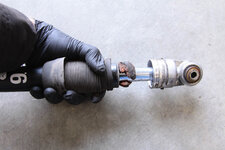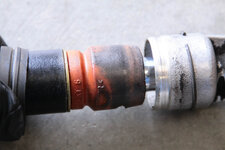

You are into something here. I guess at one point when the suspension movement is in the extreme positions it will probably produce bending forces, but that may not (hopefully) be in the suspension operational range during driving. That would cause major wear on the rubber or mechanical fracture, which the 124s has proven not to have.....
Question: When there are ALL heim joints, will it move with the same fluid ease through the *entire* length of travel? Or do you find some resistance at either extreme of travel?
A thought exercise & spatial relationship processing challenge: If the relative length of a link between two points changes (during wheel movement), and that causes compression (lateral, not rotational) in a bushing, that bushing would have greater resistance to further movement in that direction (duh) - yet continue to allow full compliance in other directions. That, in turn, would allow the use of softer or larger bushings than would otherwise be possible, because you are able to limit *specific* relative movements by the rising rate of the bushing *in that direction only* AND *only* during specific wheel displacement.
IF those type of kinematics were being used, then IF you were to remove all compressible components, the suspension would not have full free movement and would bind at certain points as it tried to bend metal (links or pickup points) to comply with the geometrically dictated kinematic path – where normally it would have rubber to pick up compliance and allow the displacement/interference to be ‘absorbed’.
....
The question about keeping the SLS or replacing with other shocks/springs is in my opinion not the big issue, because it's only a two different ways of damping. The challenges starts, as you are explaining very well IMO, when lowering the car and changing the geometry - tweaking the suspension intentional operating range. Next is to find proper dampers, springs and swaybars to fit for that situation.
The wheel grip surface during hard curving is interesting. I recall from being a guest mechanic once in a race team, we measured the tire temps and pressure during dialing in the suspension. First the driver warmed up "tasting" the track, then it was "re-gearing"(?) the transmission for optimal shift points on the track, and finally the suspension. It is amazing how accurate it could be set.
-a-
Last edited: