• Hi Guest !

    Welcome to the 500Eboard forum.

    Since its founding in late 2008, 500Eboard has become the leading resource on the Internet for all things related to the Mercedes-Benz 500E and E500. In recent years, we have also expanded to include the 400E and E420 models, which are directly related to the 500E/E500.

    We invite you to browse and take advantage of the information and resources here on the site. If you find helpful information, please register for full membership, and you'll find even more resources available. Feel free to ask questions, and make liberal use of the "Search" function to find answers.

    We hope you will become an active contributor to the community!

    Sincerely,
    500Eboard Management

Electric car impact on fuel availabilty and pricing in future(?)

Another Unintended Effect of EVs
Those electric cars are really fantastic ... until you have an accident and it ends up totaled.

01GA7617ACY3SAS9H3WJ0AV4F3.jpg

It's something that happens to almost everyone: an inattentive driver pulls out in front of you to crunch your fender or misjudges the distance on a sudden stop and bangs right into your trunk. Normally that's a time for a police report and exchanging information once it's established everyone is okay, followed by letting the insurance company sort out the damage toll.

With the slowly increasing number of electric cars on the road, though, Americans are finding that fender-benders aren't that simple anymore.

Besides the additional safety concerns from accidents involving an electric car, insurance companies are finding the assessment of damages to be far more complicated than standard body work. "For many electric vehicles, there is no way to repair or assess even slightly damaged battery packs after accidents, forcing insurance companies to write off cars with few miles — leading to higher premiums and undercutting gains from going electric," Reuters reports. "And now those battery packs are piling up in scrapyards in some countries, a previously unreported and expensive gap in what was supposed to be a 'circular economy.'"

Damaged electric vehicles are going to continue piling up, with totaled EVs relegated to an "isolation bay" at scrapping facilities because of the fire risk. Yes, imagine your brand-new Tesla 3 or Ford F-150 Lightning being towed to the junkyard because the replacement cost of the battery on top of body damage makes it too expensive to repair. That's the outcome drivers could have to endure thanks to the high cost of powering EVs.

While many EV batteries might survive an accident with little damage, their current technology doesn't allow for simple replacement of a handful of the potentially thousands of cells that make up their batteries. Teslas in particular are trouble: "A Tesla structural battery pack is going straight to the grinder," said automotive expert Sandy Munro. If a battery needs to be replaced, chances are the EV will be considered a total loss. Compare that to the replacement of a standard car battery: it's an inconvenience, but one that's easily handled by a repair shop or even a layperson with basic skills.

It's easy to make light of the situation, as some of us just love picking on those who believe in EVs as a virtue signal. But the truth is that the whole auto and insurance markets will get worse as federal and state governments foist these vehicles upon us through a combination of tax incentives and the simple browbeating of eventually banning the sale of cars with internal combustion engines.

In the meantime, though, Tesla is attempting to move in the direction of making the batteries easier to replace, territory Ford and GM are also exploring with their newest models. EV proponents claim the cost of batteries will come down as the market expands and technology improves, but it would have to come down significantly in order for batteries to lose their status as the biggest-ticket item in the car, not to mention a wallet drain thanks to higher insurance rates they make possible.

So the best advice we can give, particularly to EV drivers: If you really like your new car, exhibit strict situational awareness while on the road and don't be in a big hurry. In a way, that would work out better for everyone.

 
Interesting to see the divergence between the industry/investors and buyers. Perhaps driven by cost concerns in markets where inflation has taken hold.


View attachment 163640
By the way, EU countries are doing an about-face with regard to going all-electric by 2035. This past weekend they finally publicly admitted that the 2035 deadline for going all-EV is not realistic, and not achieveable in reality. This is the first of the dominos to fall, and the first realization by the global auto companies that the internal combustion engine isn't going to be going away any time soon.

Next up will be for the US auto makers (and eventually the government) to also realize and then admit this. The Europeans broke the ice first, so this makes it a bit safer to do this for the US government, politically.

Of course, the rest of us have known all of this from the get-go.

It really is difficult to think about the bubble that US politicians live in, once they move to Washington and away from their constituents. It's like they move to a completely different planet that clouds their thinking so that cannot realize what is clearly happening right in front of their noses.

Everybody knows that internal combustion engines are going to be around for decades into the future.

All of this is kind of like both California, and Germany, both of whom have been radically curtailing their "carbon emitting" power grids and sources in favor of "green" energy, realizing that it's not reliable and consistent and generating enough power, so they have had to halt their shutting down of nuclear power, natural gas and coal plants to maintain enough energy generation capacity to cover their populations' needs.

Again, of course, anyone with a brain in the real world knew that green energy is an expensive and non-performing boondoggle as compared to the perfectly acceptable natural gas, clean coal and "greenest possible" nuclear energy generation. But the politicians don't live in the real world, so they couldn't figure this out.
 
This person hit a manhole that wasn't flush with road surface and damaged the battery. They were operating the vehicle in a reduced ride height mode. It is lower that the default ride height.
Their vehicle is awaiting a new battery. Insurance is covering the loss.

But the driver wants a new car from the manufacturer.

Post #8 is where the threadjack begins.


We are well and truly fcuked.
 
OK, I have a question about these new cars, electric or otherwise.
Why do they put what looks like an iPad glued to the dash instead of integrating the screen(s)?
Is it because that's the way Tesla did it originally? To me, it looks like an add-on.
 
One small, integrated central screen. Physical buttons for climate, seat heaters, drive modes, etc.

ce854f9a6d12467bb78a57b6204e27a4x.jpg


I don't care for tacked-on displays. Our '13 G550 had on top of the dash, and it wasn't a great look.
 
US proposes to slash EV mileage ratings to meet fuel economy rules

The net effect of this rule would require more EV sales to meet CAFE standards. The belief is that the current EV calculation is too high, so that a few EV sales tilts the CAFE calculation too heavily.

maw


US proposes to slash EV mileage ratings to meet fuel economy rules

WASHINGTON, April 10 (Reuters) - The U.S. Energy Department (DOE) on Monday proposed reducing electric vehicles' (EV) mileage ratings to meet government fuel economy requirements, a move that could force automakers to sell more low-emissions cars or improve conventional models.

DOE wants to significantly revise how it calculates the petroleum-equivalent fuel economy rating for electric and plug-in electric hybrids for use in the National Highway Traffic Safety Administration's (NHTSA) Corporate Average Fuel Economy (CAFE) program. The current system has not been updated in more than two decades.

"Encouraging adoption of EVs can reduce petroleum consumption but giving too much credit for that adoption can lead to increased net petroleum use because it enables lower fuel economy among conventional vehicles, which represent by far the majority of vehicles sold," DOE said in its proposed regulation.

Miles Per Gallon equivalent (MPGe) ratings are determined by using values for national electricity, petroleum generation and distribution efficiency and driving patterns.

Environmental groups note fuel economy ratings for EVs is far higher for determining CAFE compliance than those listed on the government's consumer fueleconomy.gov website.

The Alliance for Automotive Innovation, which represents major automakers, warned last year that lowering the values could have far-reaching implications and would discourage EV adoption.

The group said on Monday it was unclear how the proposed DOE calculation would be incorporated in future CAFE standards.

A Volkswagen (VOWG_p.DE) ID.4 EV with a current 380.6 MPGe under CAFE would get 107.4 MPGe under the DOE proposal, while a Ford (F.N) F-150 EV drops from 237.1 to 67.1 MPGe and Chrysler Pacifica plug-in hybrid falls from 88.2 to 59.5 MPGe.

The Natural Resources Defense Council and Sierra Club petitioned for the change in 2021, arguing "excessively high imputed fuel economy values for EVs means that a relatively small number of EVs will mathematically guarantee compliance without meaningful improvements in the real-world average fuel economy of automakers' overall fleets."

Tesla (TSLA.O) backed the environmental groups petition.

The Environmental Protection Agency on Wednesday will propose new rules to spur sweeping cuts in vehicle emissions that will push automakers towards a big increase in electric vehicle sales, sources told Reuters last week.

The 2027 to 2032 model year pollution cuts are expected to result in at least half of the new U.S. vehicle fleet by 2030 being electric or plug-in hybrids, sources said, in line with a goal President Joe Biden outlined in 2021.

NHTSA is expected to soon propose parallel new stringent CAFE requirements. In 2022, NHTSA sharply boosted CAFE standards for vehicles, reversing former President Donald Trump's rollback.

Automakers buy credits or pay fines if they cannot meet CAFE requirements. Stellantis (STLAM.MI), then known as Fiat Chrysler, paid $152.3 million in total CAFE fines for 2016 and 2017 and faces additional civil penalties. In 2022, NHTSA more than doubled CAFE penalties.
 
I’m hoping that Toyota comes up with a better solution than the total EV push. They are working on better hybrid solutions including hydrogen powered vehicles.

I would think hydrogen is the right answer considering that the exhaust is water and oxygen. What could be better?

I know, I know that there in no real infrastructure for this solution but why waste time on electric charging stations when they could be building hydrogen facilities?

Think of it no more battery pollution to destroy the ozone belt and more water/ oxygen for the atmosphere. What’s No to like? :)

OK, Peanut Gallery start shooting holes in my theory.:jono:
 
What irritates me about any government mandate or regulation of the auto industry is that reducing emissions or increasing safety is their secondary concern. Their primary concern is and always will be how the government or the individual who created the regulation will profit from the legislation. It’s merely a transfer of wealth and power from the individual taxpayer to the government. I will drive a ICE vehicle for as long as I can. I embrace hybrid and hydrogen technologies but I don’t believe lithium battery technology is the answer. I certainly don’t want to rely on the grid to recharge my car.
 
They are using child slave labor in the Congo and China to extract lithium and other materials to make batteries, leaving a giant sized carbon footprint in their wake, to sell to Americans who think they're saving the environment.

What will we do with these batteries when they expire in 10 years? They are extremely toxic to the environment
and we currently have no place to store them.

Also, since we don't produce any of these batteries here, in the US, where does that leave our national security on the world stage?

Complete dependence on China?

We need energy independence, period. Let the free market work and science progress in all forms of energy. Wind, solar, EV, hydrogen, nuclear and other innovations will eventually surface.

But, to ban all combustion engines in the US is plain dumb.

Can't wait to see the size of a 60,000lb 18 wheeler or bulldozer battery.
 
Last edited:
Just a typo. They meant "motor oil change"... not engine oil. Could be the fancy Mercedes electric motors are oil-cooled and need that changed, right?

:whistling2: :choochoo:
 
5ae62161-2d61-40e7-b230-50c95aa960a5.jpg
3f688679-725b-4930-b20c-a7588dc2b4f6.png
Dear GSXR,
You're a valued member of the Mercedes‑Benz family, and we're dedicated to ensuring that your experience is nothing short of exceptional.
In 2022, we committed to electrifying our fleet in the U.S., supporting our ambition of making our fleet of new vehicles net carbon‑neutral over the vehicles' entire life cycle by 2039. We set the standard in the luxury electric segment and are excited to continue delivering cutting‑edge technology and exceptional performance to our customers.
As we look to 2023 and beyond, I'm proud to announce several initiatives and innovations to enhance your ownership experience further.
EQE SUV: Electric evolved.
The launch of the EQE SUV marks a momentous occasion to advance our family of five all‑electric vehicles, two of them made in the U.S. With this latest addition, our comprehensive electric vehicle selection now includes another option that fits your active lifestyle.
The EQE SUV perfectly blends innovation and tradition, embodying our commitment to constant progress. Equipped with cutting‑edge technology, the EQE SUV features our innovative MBUX infotainment system with navigation that considers charging stops, and a battery management software that receives over‑the‑air updates to ensure your vehicle always meets your needs. A spacious interior, ultra‑lux seats and generous trunk space elevate your ride for comfortable journeys. Plus, with the EQE SUV's impressive range of up to 279 miles on a single charge, you can go the distance and embark on unforgettable adventures with ease.
All five of our all‑new, all‑electric vehicles exemplify intelligence, design, safety and innovation. We have crafted these exquisite vehicles with your needs in mind as we strive to shape the future of automotive technology.
A charging network that serves you.
We understand that access to convenient charging options is an important part of electric living. That's why we're acting today to create a global high‑power charging network so you can confidently charge your vehicle whenever you need it. Our comprehensive charging network will elevate your charging experience with exclusive features integrated into Mercedes me Charge, for easy and secure charging at our Mercedes‑Benz High‑Power Charging Network, even on longer trips.
Exceptional charging options are crucial for maximizing the potential of your all‑electric Mercedes‑Benz. Our charging solutions extend beyond the road and into your home, providing advanced wall boxes and convenient home charging options.
Building a better future for all of us.
Last year, Mercedes-Benz USA launched our national corporate social responsibility mission, Driving Your Future, designed to empower the next generation. Our employees donated over 9,500 volunteer hours in 2022 to support organizations focused on education, career readiness, and child and teen safety.
I am incredibly proud of what the team has accomplished in our pursuit of building a better world, and eagerly anticipate our efforts in 2023.
We are dedicated to enhancing your experience as a valued customer and hope you share our excitement for these advancements. Of course, these announcements are among several examples of how we're transforming the driving experience. Please explore our full vision and current offerings of electric mobility to see the innovation and luxury that await you. >>
Thank you for your continued support and trust in us, and I look forward to a bright, electrified future together.
Sincerely,​
59e9f05f-c3ec-4412-b602-58fcb7d74098.png
President and CEO
Mercedes‑Benz USA
 
Dear GSXR,​
Youre a valued member of the Mercedes‑Benz family, and were dedicated to ensuring that your experience is nothing short of exceptional.​
In 2022, we committed to electrifying our fleet in the U.S., supporting our ambition of making our fleet of new vehicles net carbon‑neutral over the vehicles entire life cycle by 2039. We set the standard in the luxury electric segment and are excited to continue delivering cutting‑edge technology and exceptional performance to our customers.​
As we look to 2023 and beyond, Im proud to announce several initiatives and innovations to enhance your ownership experience further.​
EQE SUV: Electric evolved.
The launch of the EQE SUV marks a momentous occasion to advance our family of five all‑electric vehicles, two of them made in the U.S. With this latest addition, our comprehensive electric vehicle selection now includes another option that fits your active lifestyle.​
The EQE SUV perfectly blends innovation and tradition, embodying our commitment to constant progress. Equipped with cutting‑edge technology, the EQE SUV features our innovative MBUX infotainment system with navigation that considers charging stops, and a battery management software that receives over‑the‑air updates to ensure your vehicle always meets your needs. A spacious interior, ultra‑lux seats and generous trunk space elevate your ride for comfortable journeys. Plus, with the EQE SUVs impressive range of up to 279 miles on a single charge, you can go the distance and embark on unforgettable adventures with ease.​
All five of our all‑new, all‑electric vehicles exemplify intelligence, design, safety and innovation. We have crafted these exquisite vehicles with your needs in mind as we strive to shape the future of automotive technology.​
A charging network that serves you.
We understand that access to convenient charging options is an important part of electric living. Thats why were acting today to create a global high‑power charging network so you can confidently charge your vehicle whenever you need it. Our comprehensive charging network will elevate your charging experience with exclusive features integrated into Mercedes me Charge, for easy and secure charging at our Mercedes‑Benz High‑Power Charging Network, even on longer trips.
Exceptional charging options are crucial for maximizing the potential of your all‑electric Mercedes‑Benz. Our charging solutions extend beyond the road and into your home, providing advanced wall boxes and convenient home charging options.​
Building a better future for all of us.
Last year, Mercedes-Benz USA launched our national corporate social responsibility mission, Driving Your Future, designed to empower the next generation. Our employees donated over 9,500 volunteer hours in 2022 to support organizations focused on education, career readiness, and child and teen safety.​
I am incredibly proud of what the team has accomplished in our pursuit of building a better world, and eagerly anticipate our efforts in 2023.​
We are dedicated to enhancing your experience as a valued customer and hope you share our excitement for these advancements. Of course, these announcements are among several examples of how were transforming the driving experience. Please explore our full vision and current offerings of electric mobility to see the innovation and luxury that await you. >>
Thank you for your continued support and trust in us, and I look forward to a bright, electrified future together.​
Sincerely,​
President and CEO
Mercedes‑Benz USA
Run!

Joke aside. You should send him the rebuttal counter that he should join the 500eboard family instead and be prouder about how W124 is saving the planet with minimal maintenance for the environment and to the world and not this crap they are producing :)
 
:watchdrama:


Are EV sales declining? Electrifying the car market may be getting harder. Here's why


Electrifying the car market may be getting more difficult, with the share of Americans who say they’re “very unlikely” to consider an EV for their next vehicle purchase growing in each of the first three months of the year, according to a new report.

In March, 21% of new-vehicle shoppers said they were “very unlikely” to consider an EV, up from 18.9% in February and 17.8% in January, consumer analytics firm JD Power said in a monthly EV report. In contrast, the percentage of car shoppers who say they are “very likely” to consider an EV was 26.9% in March, largely flat this year.

Persistent worries about charging infrastructure and vehicle pricing’s dampening enthusiasm, the report said. EV’s market share of all new-vehicle sales dropped to 7.3% in March, down from a record high of 8.5% in February but up from 2.6% in February 2020. “Many new vehicle shoppers are becoming more adamant about their decision to not consider an EV for their next purchase,” JD Power said.

Why aren’t people more interested in EVs?

The lack of public charging infrastructure and price have consistently topped the reasons for the past 10 months, JD Power said.

Other reasons people cited for not wanting to buy an EV: range anxiety; time required to charge; power outage and grid concerns; lack of servicers for repairs and maintenance; and inadequate performance in extreme temperatures.

Even high-profile initiatives like “Walmart’s plan to dramatically expand its charging network and Tesla’s announcement it would open some of its supercharger network to non-Tesla vehicles have apparently had little effect on these consumer concerns, at least so far,” JD Power said.

Are EV prices dropping, though?

The high price tag for an EV compared with its fuel-powered counterpart remains a deterrent. Government subsidies for EVs initially boosted demand, but the IRS and the U.S. Treasury Department’s new guidance in mid-April on specific vehicle requirements that need to be met before EVs can be eligible for these tax credits sowed confusion and will likely raise the price again for EVs, generally.

New guidance included the location where the vehicle was assembled and details on the sourcing of critical minerals in the vehicle batteries. Batteries and components must originate in the U.S. or come from countries with which there is a free trade agreement for the vehicle to qualify.
“This new hurdle will affect the affordability of several EV models, while also likely introducing more confusion among buyers,” JD Power said. “Our data suggest that higher prices will negatively affect EV sales “

Shouldn’t people want to buy an EV to help the environment?

While about 4 in 10 U.S. adults think using EVs helps address climate change “a great deal” (12%) or “a fair amount” (27%), roughly 6 in 10 believe it helps “only a little” (35%) or “not at all” (26%), according to a Gallup poll fielded March 1-23.

Although 43% of U.S. adults said they might consider buying an EV in the future, 41% unequivocally say they would not, Gallup said. Only about 4% of Americans currently own an EV, Gallup said, and 12% are seriously considering purchasing one.

Who’s least likely to want an EV?

Most people born before 1965, whom JD Power describes as Boomers and pre-Boomers, are least likely to consider an EV, but one-third of Gen Zers (born between 1995 and 2004) aren’t either. Gen Z is seen as “the future of the marketplace,” the analytics firm said.

“It is clear in the data that price and charging infrastructure are significant obstacles for a wide spectrum of potential customers,” it said.
Geography and education also may influence your decision. Americans living in the Western U.S. and college graduates are more likely than their counterparts to report that they currently own an electric vehicle, are seriously considering the purchase, or might in the future, Gallup said.

Medora Lee is a money, markets, and personal finance reporter at USA TODAY. You can reach her at mjlee@usatoday.com and subscribe to our free Daily Money newsletter for personal finance tips and business news every Monday through Friday morning.


Source URL:
 
Can you imagine if 1/4 of gas pumps weren't functional?

"...researchers who checked public fast chargers at 181 charging stations in the Bay Area last year and found that about 23% weren’t functional."

🤯
 
@ace10,
Soooo are you having these issues with charging your Audi? Or do you just drive locally and charge at home?:pc1:

Just Curious :thought:

lol
It mostly gets charged at home.
But, TBH, the boss has gone back to riding the commuter bus some. So the car sits more days than it's driven.
It just went in for 10K service and a couple big software updates. Took 3 days, because large Audi dealer only has one tech and one bay to work on etron vehicles.

I'm planning a road trip up north next month. Might take the EV, but that area (my hometown) has exactly one DC fast charger location within about a forty mile radius. The infrastructure isn't anywhere near ready for prime time.
 
Yeah that was an interesting piece. Here's the document:

Toyota.jpeg

And here is the money shot:

1684524563684.png

Of course this depends on whether or not you believe Toyota.
 
Yeah that was an interesting piece. ... Of course this depends on whether or not you believe Toyota.
I trust Toyota's data far more than I trust any government data, or St. Greta. Plus, Toyota's data is logical and makes sense.

Problem will be getting people who don't want to hear this... to hear this. EV's are not the savior many have imagined it to be; at least not in the timeframes currently planned. Hybrid makes a LOT of sense and Toyota did a good job of mansplaining it.

:hiding:
 
As much as I love Mercedes-Benz (or maybe I'm in love with the past), I completely trust Toyota. They make legendary cars, IMO. If I didn't care about the way a car looks, rides, etc buying a Toyota would be a no brainer. Even the old ones do a great job of holding their value

I'm definitely sticking with gas/diesel until it's no longer feasible (for whatever reason) to own those vehicles. Hopefully, I'm old and dead when that time comes 😂

With Tesla in specific, I have 0 interest in shelling out > $100k USD on a car with bad panel gaps that doesn't even have CarPlay / Android Auto. Maybe the worst part about a Tesla (and other manufacturers too perhaps) is that they can shut your charging off by VIN and they are horrible about repairing your own car (they won't even sell basic parts).
 
Those of you who know me have know for many years that I have NEVER been a proponent of EVs.

This is why, as I have followed this technology for a long time. And not just the "old" hydrogen fuel-cell engines, but the newer generation units that Toyota has been developing.

In my view, THIS technology is the future of the car....not EVs, not hybrids, not hydrogen fuel cell engines.

 
Those of you who know me have know for many years that I have NEVER been a proponent of EVs.

This is why, as I have followed this technology for a long time. And not just the old hydrogen fuel-cell engines, but the newer generation units that Toyota has been developing.

In my view, THIS technology is the future of the car....not EVs, not hybrids, not hydrogen fuel cell engines.

90 second refueling and 300 mi range on 5kg of hydrogen ….. and no dependence on rare metals like lithium!
 
I expect we'll see various types of internal combustion engines for a long time but I think for the vast majority of consumers, BEV's are the future. For home owners, charging at home is more convenient than even a 90 second fill at a station you have to drive to. And with Toyota the only company still looking seriously at hydrogen, it will take decades before there are enough H2 cars on the road to make building an H2 filling infrastructure viable.

And then there's the maintenance side of things. An H2 combustion engine car will still require oil/filter changes, transmission service, antifreeze/coolant, t-stat, timing belt, and water pump repairs. A BEV does away with most of that and with regen, brake pads can last 100K or more miles.

I think BEV's will win out because of convenience and performance. Sure, there will always be specialty cars with ICE's for enthusiasts, at least I hope so, and historic and nostalgia cars like our E500E's but in the long run, BEV's will be the norm and everything else a nod to the golden age of cars.

Oh, did you hear that Ford just announced that it's future EV's will use Tesla's charging standard, I suspect other companies will follow suit...
 
I expect well see various types of internal combustion engines for a long time but I think for the vast majority of consumers, BEVs are the future. For home owners, charging at home is more convenient than even a 90 second fill at a station you have to drive to. And with Toyota the only company still looking seriously at hydrogen, it will take decades before there are enough H2 cars on the road to make building an H2 filling infrastructure viable.

And then theres the maintenance side of things. An H2 combustion engine car will still require oil/filter changes, transmission service, antifreeze/coolant, t-stat, timing belt, and water pump repairs. A BEV does away with most of that and with regen, brake pads can last 100K or more miles.

I think BEVs will win out because of convenience and performance. Sure, there will always be specialty cars with ICEs for enthusiasts, at least I hope so, and historic and nostalgia cars like our E500Es but in the long run, BEVs will be the norm and everything else a nod to the golden age of cars.
It is hard to argue with the relative simplicity of BEV drivetrains. That's a big plus.

However, the engineer in me also doesn't compute with BEV designs because they are such a resource hog and an inefficient use of raw material --- 5000+ lbs cars and 9000+ lbs SUVs (like the GM Electric Hummer) seem totally the wrong way to go....

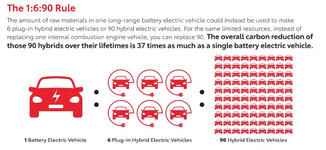
As well as the 1:6:90 rule mentioned a few posts above. BEV designs as they stand just seem to be such a waste of resources.

Tesla has recently decided to transition to cheaper, and even heavier LFP batteries ---- reducing dependence on cobalt ---- but at the expense of lesser range and even more weight. Tesla to use cheaper LFP batteries in small EV, truck

Maybe the right approach to benefit all of society (instead of just a few people) is a hybrid approach --- not just a hybrid powertrain, but also a hybrid of different powertrains across different industries and vehicles and transport mechanisms.

That being said, the Japanese, and, in general, most Asian societies, are very good at prioritizing the collective over the individual. "The good of the many outweigh the good of the few." In the States, we tend to be a more selfish lot....

20d5136533ae386eedf8d17a2463e95a.jpg
 
I also believe that a transition of existing gasoline fueling infrastructure to include hydrogen, and the overall mechanical familiarity of ICE engines to H2-type mechanical powertrains, would be something that many folks would be comfortable with. There is much innovation to come in this area. It will be interesting to see if it catches on.

The fact that Toyota is banking on it (and didn't follow/join the BEV-only pack) tells me that they are on to something big. They have the resources to continue to develop the technology.

As the @Jlaa mentions, the resource-intensiveness of BEV technology, in addition to the wholly inadequate current and projected charging infrastructure (both public and in private homes) is a huge counter-balance to the simplicity of the drivetrains. Plus, MAJOR resources still have to continue to be brought on-line to provide the electricity to power all of these vehicles. Where's all this incremental power going to come from in the next 5-10 years, given that the electrical grids overall are becoming less resilient and robust as they become more and more based on sun and wind power? Nuclear energy is the obvious answer here, but it's not going to happen at any scale. So natural gas and coal will continue to supply much of the power.

Also, everything I am seeing is showing that BEV efficiency is not generally meeting the "ratings" -- meaning when a BEV has an EPA rating of say, 350 miles, the real-world range with real-world driving tends to be half to two-thirds of that. Non-US manufacturers seem to be a little more accurate with regard to the numbers, than the US makers are.

Hydrogen is a nearly unlimited resource.

My take is that we are going to continue to see a combination of "legacy" ICE vehicles (which will still continue to be 75% of overall vehicle sales WELL into the future), "hybrid" vehicles that provide a good level of efficiency, and BEVs (which I believe will likely have 15-20% of the market in the coming years.

HOWEVER, BEVs and hybrids are going to be "transitory" or transitional vehicles until hydrogen power is fully perfected, which is going to take more time. I do not believe there is a long-term market for BEVs after H2/hydrogen gets perfected.
 
I think hydrogen has a future but not in everyday cars that the vast majority of consumers purchase. I can see hydrogen working in the trucking industry or possibly in rail applications where fuel storage containers can be mounted longitudinally under the chassis. The other big use, which is still decades away is in fusion reactors. At that point, we'll be able to generate all the clean electricity we will ever need.

In terms of vehicle weight...check the specs on a current BMW M2 Comp or an M5...or a new C, E, or S class. Those ICE cars aren't any lighter.
 
I do understand that current batteries may be detrimental to human and natural resources but you have to start somewhere. There is tons of research on developing new battery tech, it's only a matter of time. Remember, it took a long time before we removed lead from gasoline.
 
In terms of vehicle weight...check the specs on a current BMW M2 Comp or an M5...or a new C, E, or S class. Those ICE cars arent any lighter.
Well the 1:6:90 ratio --- same amount of resources can build 1 BEV vs. 6 Plug in Hybrid vs. 90 Regular Hybrids--- that's what I mean by wasteful.

When I bought my latest daily driver (a regular Hybrid), I was looking at weights. The Tesla Model Y is a good deal heavier than my Toyota Venza. Both are capable of driving all the wheels (for an apples to apples comparison).

I don't buy fancy new BMWs/Mercedes cars for daily driver duties. 😀

Screenshot 2023-06-07 at 8.46.37 AM.png


I do understand that current batteries may be detrimental to human and natural resources but you have to start somewhere. There is tons of research on developing new battery tech, its only a matter of time. Remember, it took a long time before we removed lead from gasoline.

Possibly. That's an argument that's been made for years (batteries getting lighter/better) , but it seems Tesla is going heavier and less energy dense in their latest battery compositions ---- seems to be going the reverse.

Screenshot 2023-06-07 at 8.55.03 AM.png
 
Re: range. Yes, in many cases, rear world range is often less than EPA estimated range. And in cold climates, it gets even worse. Again though, that's a now problem that will eventually get better. Another way to look at it, in many cases, the real world MPG of an ICE car is lower than the EPA estimate, maybe not by as large a margin but still lower.
 
Well the 1:6:90 ratio --- same amount of resources can build 1 BEV vs. 6 Plug in Hybrid vs. 90 Regular Hybrids--- thats what I mean by wasteful.

When I bought my latest daily driver, I was looking at weights. The Tesla Model Y is a good deal heavier than my Toyota Venza. Both are capable of driving all the wheels (for an apples to apples comparison).

I dont buy fancy new BMWs/Mercedes cars for daily driver duties. 😀

[ATTACH alt=Screenshot 2023-06-07 at 8.46.37 AM.png]168693[/ATTACH]
Again, this is a now problem.
 
Resources? Do you own more than one car? How many square feet is your home? Ever compare that to homes in the UK, Germany, Japan?
 
re: Tesla using LFP. I suspect that their 4680 production isn't ramping up as quickly as they expected and to meet their sales goals, they had to source alternative batteries. Or maybe they are stockpiling 4680s for the Cybertruck. With Tesla you never know, they change features and options every other week. Next week they may switch back.
 
Resources? Do you own more than one car? How many square feet is your home? Ever compare that to homes in the UK, Germany, Japan?
I understand your point; the argument about being wasteful is the that with X amount of natural resources*, you could make:
  • 1 Battery Electric Vehicle --> and reduce carbon emissions by Y amount
  • 90 Regular Hybrids --> and reduce carbon emissions by a 37*Y amount (if you believe Toyota's numbers), and benefit society to a much greater degree.
This is why I made the comments about some societies being more collective in nature and other societies being more individualistic in nature.

*I think this refers to batteries. My hybrid has a 0.9 KWHr battery, whereas a BEV will often have a 90 - 100 KWHr battery.
 
Back
Top