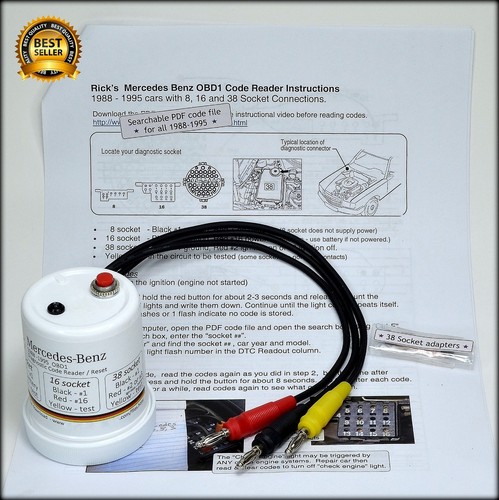

UPDATE: To buy a pre-built code reader, click here (NLA by 2023) or click here (still available in 2026) for an affordable one from eBay. If you do not have a "breakout box", make sure you select the type of reader with the small 1mm pins, i.e. for 400E, not the type with the large 4mm pins. A breakout box is highly recommended... this has numbered 4mm sockets, makes it much easier to use the code reader. The breakout box is $300+ from Mercedes as of early 2014, but clones are available from Chinese sellers on eBay for ~$35 delivered (click here). If you get the breakout box, make sure to get a reader with 4mm plugs. Remember to discard the code charts that come with the reader, and ONLY use the PDF file attached below!
There are a total of eight different computer modules used in most USA-spec 500E/E500 models (and also the 400E/E420). Codes are available from all eight modules, each module must be checked separately, and after reading codes, each module must have the codes cleared separately. Six modules are for engine/chassis management, one is for the SRS (airbags), and one for HVAC (climate control). Euro-spec cars may have additional modules (i.e. for the IRCL remote lock system), and Euro-spec cars will not have either a CEL (Check Engine Light) on the instrument cluster nor a DM (Diagnostic Module). The CEL and DM are USA-specific items.
All US-spec cars except some very early build 1992 models will have a CEL. The CEL will only turn on if there are emissions-related faults. When the CEL turns on, this indicates there is at least one code present on the DM. There can still be codes on the DM even with the CEL not on, but the reverse is not possible... if the CEL is on, there has to be at least one DTC on the DM. Checking and clearing codes on the DM does not check or clear codes on any other module, the others all must be checked (and cleared) separately! Most of the common error codes on the other modules will not trigger a CEL or any DM (emissions) codes. Do not think that just because your CEL is not on, there are no codes present.
For basic code checking, a hand-held blink code reader is required. The blink codes are also known as "analog" codes. US cars with a CEL and DM will also have a built-in button and LED in front of the CAN box; however this button+LED only will display codes from the DM. You still need the hand-held blinker box to check all the other modules. After checking all codes, clear all the codes, and check again frequently after driving the car to see which codes return quickly. Codes which come back right away indicate a definite problem that should be corrected. Intermittent codes may or may not be a problem; there are some which are known to occur occasionally that are not a concern (example: the "bad fuse" codes on the Basic Module, when the fuses are all ok).
There is also the capability to check the codes using a digital scanner, like the factory SDS (Star Diagnostic System). Digital communication is much faster than counting analog blinks. And, there is live data available as well, for advanced troubleshooting. The live data may not be of much help to a DIY mechanic; you need to understand the data you are looking at, otherwise it's just gibberish.
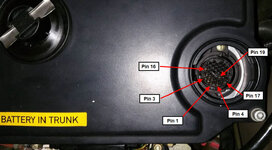
Both the analog blink code reader and the digital scanners connect at the same place, the 38-pin diagnostic port under the round cap on the CAN box, on the passenger side of the engine compartment, near the base of the windshield.
Please see the attached PDF documents for more details on how to connect the blink code reader, check and clear codes, and translate the code numbers into a fault description.
If you have not checked codes in a long time, write down all the codes present, then clear ALL of those codes. Now drive the car for a few days (or longer) and check the codes again. Any codes which re-appear quickly are the ones to be concerned about.
Only one module (E-GAS, for the electronic throttle actuator) has more digital DTC's than analog. This means that on the E-GAS module, a particular analog code can have several different meanings, and only a digital scanner can pinpoint the specific meaning. See screen shot below. All the other modules have the same codes for both analog and digital. This shows the code list for the E-GAS module for analog blink code #2. Note that ALL of the listed errors are possible for analog code #2. The three-digit digital code is somewhat more specific; however this still does not pinpoint an exact fault in all cases (except for 002 and 009, which each have only a single fault).


There are a total of eight different computer modules used in most USA-spec 500E/E500 models (and also the 400E/E420). Codes are available from all eight modules, each module must be checked separately, and after reading codes, each module must have the codes cleared separately. Six modules are for engine/chassis management, one is for the SRS (airbags), and one for HVAC (climate control). Euro-spec cars may have additional modules (i.e. for the IRCL remote lock system), and Euro-spec cars will not have either a CEL (Check Engine Light) on the instrument cluster nor a DM (Diagnostic Module). The CEL and DM are USA-specific items.
All US-spec cars except some very early build 1992 models will have a CEL. The CEL will only turn on if there are emissions-related faults. When the CEL turns on, this indicates there is at least one code present on the DM. There can still be codes on the DM even with the CEL not on, but the reverse is not possible... if the CEL is on, there has to be at least one DTC on the DM. Checking and clearing codes on the DM does not check or clear codes on any other module, the others all must be checked (and cleared) separately! Most of the common error codes on the other modules will not trigger a CEL or any DM (emissions) codes. Do not think that just because your CEL is not on, there are no codes present.
For basic code checking, a hand-held blink code reader is required. The blink codes are also known as "analog" codes. US cars with a CEL and DM will also have a built-in button and LED in front of the CAN box; however this button+LED only will display codes from the DM. You still need the hand-held blinker box to check all the other modules. After checking all codes, clear all the codes, and check again frequently after driving the car to see which codes return quickly. Codes which come back right away indicate a definite problem that should be corrected. Intermittent codes may or may not be a problem; there are some which are known to occur occasionally that are not a concern (example: the "bad fuse" codes on the Basic Module, when the fuses are all ok).
There is also the capability to check the codes using a digital scanner, like the factory SDS (Star Diagnostic System). Digital communication is much faster than counting analog blinks. And, there is live data available as well, for advanced troubleshooting. The live data may not be of much help to a DIY mechanic; you need to understand the data you are looking at, otherwise it's just gibberish.
Both the analog blink code reader and the digital scanners connect at the same place, the 38-pin diagnostic port under the round cap on the CAN box, on the passenger side of the engine compartment, near the base of the windshield.
Please see the attached PDF documents for more details on how to connect the blink code reader, check and clear codes, and translate the code numbers into a fault description.
If you have not checked codes in a long time, write down all the codes present, then clear ALL of those codes. Now drive the car for a few days (or longer) and check the codes again. Any codes which re-appear quickly are the ones to be concerned about.
Only one module (E-GAS, for the electronic throttle actuator) has more digital DTC's than analog. This means that on the E-GAS module, a particular analog code can have several different meanings, and only a digital scanner can pinpoint the specific meaning. See screen shot below. All the other modules have the same codes for both analog and digital. This shows the code list for the E-GAS module for analog blink code #2. Note that ALL of the listed errors are possible for analog code #2. The three-digit digital code is somewhat more specific; however this still does not pinpoint an exact fault in all cases (except for 002 and 009, which each have only a single fault).
Attachments


Last edited: