• Hi Guest !

    Welcome to the 500Eboard forum.

    Since its founding in late 2008, 500Eboard has become the leading resource on the Internet for all things related to the Mercedes-Benz 500E and E500. In recent years, we have also expanded to include the 400E and E420 models, which are directly related to the 500E/E500.

    We invite you to browse and take advantage of the information and resources here on the site. If you find helpful information, please register for full membership, and you'll find even more resources available. Feel free to ask questions, and make liberal use of the "Search" function to find answers.

    We hope you will become an active contributor to the community!

    Sincerely,
    500Eboard Management

M119 Inlet Manifold- Real Serious Modifications or Ditch it completely for an 8 x T/B custom set-up

You can reduce heat by ceramic-coating the bottom portion of the intake manifold. I did that on my M117 (similar design) and I teflon-coated the top portion (also ceramic'd the bottom of the top piece).

http://www.500eboard.com/forums/showthread.php?t=564&p=2271&viewfull=1#post2271

proxy.php
proxy.php
proxy.php
proxy.php
proxy.php
proxy.php
 
Best would be a dual runner intake like the M104 with a switchover valve and smooth runners. I hate plastic, but that intake is genius. The ceramic is nice but it just slows the heat transfer. We still have coolant running through our intakes right? There was a Japanese fellow on the old forum, CFRP roof, hood, great stuff. He put louvers in his hood and he said that helped loads with engine bay temps. Got to get the heat out.
 
Interesting - I came across these pics - anyone know the person who was doing this mod and the outcome?

I have seen these pictures before.. Tried to search this topic or blog where this guy were building sl 500 but I didn't find it. Can't remember if it was going to supercharge his car and change fuel to RE85 or what. I also found something information about installing custom engine software, supercharging, RE85 fuel + 722.6 transmission but it was old thread and there are no results how this mod ended. One who gave tips about mods had built supercharged sl500 with m119 and then sold engine to a friend. Reference is Finnish forum called mersuforum.. :detective:
 
You can reduce heat by ceramic-coating the bottom portion of the intake manifold. I did that on my M117 (similar design) and I teflon-coated the top portion (also ceramic'd the bottom of the top piece).

http://www.500eboard.com/forums/showthread.php?t=564&p=2271&viewfull=1#post2271

17.jpg17.jpg17.jpg17.jpg17.jpg17.jpg

I would think that light colored shiny finish on the top would also substantially help the bottom reflect heat Gerry. Has noting to do with the look but that the darker color + flatter finish will absorb more heat that a lighter color than is more reflective. In that application you want to reflect as much heat away as possible. That design in itself hurts because you have the plenum stuck in the bottom of one of the highest heat areas with no ability to get air around it.
 
Ok so help me with some basic dimensions. How long and what are the diameter(s) of the intake runners from head to end in the lower manifold? What is the cross-section of the lower plenum.


Michael
 
Thanks Michael - i will take measurements over the weekend and more close-up pics (my spare intake i am playing with is off a .980 engine)
The upper manifold is what i refer to as the top piece you can see that bolts to the heads
The lower manifold is the plenum chamber below that you don't see that hangs in the valley - to which the T/B bolts to
I assume in your comment above your are actually referring to the upper manifold?
 
Gee looking at that BMW S65 set-up close-up to get some idea's they certainly did a some nice work getting their 8 x T/B package nice and compact
The T/B's have no runner length at all (direct bolt to the base plate- so very short path into the head)
Not sure how they manage to get some vacuum arrangement to run the ancillary equipment (like brake boost etc) unless a separate vacuum tank run off a pump?
Most modern 8 x T/B seem to lean towards manifold intake runner length into the heads -
I do personally like the side-draft set up with crossing runners as it keeps the height down and allows a nice under the bonnet dual rammed air duct arrangement to fit in with relative ease
 

Attachments

  • 6751255269_9e5ba2bace_o-1.jpg
    6751255269_9e5ba2bace_o-1.jpg
    961.8 KB · Views: 49
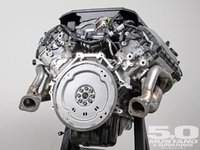
Ok without boring you guys here i just had a good read of the technical aspects in the design of the "very similar" 2011 Ford Mustang GT 5litre quad cam/4 valve Coyote engine.
Amazing the similarity of this 2011 engine in many aspects of the design to the M119 its not funny
http://www.mustangandfords.com/parts/m5lp-1003-2011-ford-mustang-gt-50-coyote-engine/viewall.html
http://www.mustangandfords.com/part...-mustang-gt-50-coyote-engine/photo-gallery/#1

What got my attention was the design of the inlet manifold design - read comments on page 53,54,55,56
it uses a single 80mm T/B which was hard to calibrate / They tested a twin bore 90mm which gained 3hp but it cost more so they stuck with the cheaper 80mm
That inlet manifold front entry will not work with the M119
However it has me convinced now it is really only the bottom plenum chamber on the M119 that really does need ditching and a complete new design fabricated up (ditching the EGR as well) and still with the same central intake location (but perhaps going from a 76.5mm opening to say 80mm maybe) but the chamber needs more depth and volume and a curved bottom bottom the same as the coyote design
Simple as that!!!

However for those wishing to retain the MAF sensor it would have to be re-located to keep the factory ECU happy
For those using an aftermarket ECU to run the engine it could easily be swapped out for a MAP sensor

and of course thermal coated to prevent heat soak
(even some piped/fanned cool air into the valley on a thermo switch as well for good measure to get the heat out)

The exhaust design has also got me intrigued - read the comments on this pages 30,49,57,58,59 (especially pages 58 & 59 on heat)
Cams - page 43 (specs)
Crank - page 23 with oil feeder holes leading edges layed open for better flow

One of the members on this forum was on the right track earlier with his custom modded bottom chamber - idea was right except that bottom floor needs to be rounded like the Coyote one -
Do we know who this was (400Eric maybe) that was working on this mod as i can't find any more info on his end result?

It would be a much simpler and cost effective mod to come up with a better designed lower chamber it appears on the surface
 

Attachments

  • m5lp-1003-74-o+50-coyote-engine+coyote.jpg
    m5lp-1003-74-o+50-coyote-engine+coyote.jpg
    97 KB · Views: 16
  • m5lp_1003_62_o+50_coyote_engine+multi_piece_composite_assembly.jpg
    m5lp_1003_62_o+50_coyote_engine+multi_piece_composite_assembly.jpg
    43.5 KB · Views: 16
  • m5lp_1003_63_o+50_coyote_engine+extensive_ribbing.jpg
    m5lp_1003_63_o+50_coyote_engine+extensive_ribbing.jpg
    48.5 KB · Views: 13
  • m5lp_1003_64_o+50_coyote_engine+whoosh_fingers.jpg
    m5lp_1003_64_o+50_coyote_engine+whoosh_fingers.jpg
    47.5 KB · Views: 11
  • m5lp_1003_65_o+50_coyote_engine+coyote_80mm_electronic_throttle.jpg
    m5lp_1003_65_o+50_coyote_engine+coyote_80mm_electronic_throttle.jpg
    23.5 KB · Views: 13
  • m5lp_1003_68_o+50_coyote_engine+coyote_short_tube_tri_y_headers.jpg
    m5lp_1003_68_o+50_coyote_engine+coyote_short_tube_tri_y_headers.jpg
    64.1 KB · Views: 16
  • m5lp_1003_70_o+50_coyote_engine+exhaust_manifolds.jpg
    m5lp_1003_70_o+50_coyote_engine+exhaust_manifolds.jpg
    70.5 KB · Views: 14
  • m5lp_1003_33_o+50_coyote_engine+display_engine.jpg
    m5lp_1003_33_o+50_coyote_engine+display_engine.jpg
    50.6 KB · Views: 16
  • mbsl500_imukotelo1.jpg
    mbsl500_imukotelo1.jpg
    55.2 KB · Views: 16
  • mbsl500_imukotelo2.jpg
    mbsl500_imukotelo2.jpg
    49.7 KB · Views: 13
Last edited:
Also of interest i believe this mod was done some time in the past with a 6.9litre converted to EFI and what appears individual T/B's -
I can't find any info on it though?
Looks pretty good :agree:
 

Attachments

  • engine73800.jpg
    engine73800.jpg
    59.2 KB · Views: 44
The 6.9 above was (is) owned by Barry Taylor of Barry Taylor Enterprises (d/b/a/ AMG West). He's the guy who has the huge stash of NOS AMG parts in the East Bay area of California. Cascade's buddy.

Barry has owned this car for many years. I believe it appeared at one of the M-100 meets about 10 years ago (I think either 2002 or 2003?) on the West Coast. There should be some information posted about it at the M-100 board at www.m-100.cc

IIRC it's mounted in an R107. I have seen extensive photos of this car but had moved on from the club (sold my 6.3 and 6.9) so didn't attend the meet where this car was at, after I had arranged and hosted the M-100 Meet in Portland, Oregon in 2001.
 
Best would be a dual runner intake like the M104 with a switchover valve and smooth runners. I hate plastic, but that intake is genius. The ceramic is nice but it just slows the heat transfer. We still have coolant running through our intakes right? There was a Japanese fellow on the old forum, CFRP roof, hood, great stuff. He put louvers in his hood and he said that helped loads with engine bay temps. Got to get the heat out.

That was what Yamaha did with the SHO 6 in the Taurus. We owned a 93 3.2 auto version and it was quite a little beastie.
 
That was a Sweet and greatly underappreciated engine! Pull the ford rev limiter, swiss cheese the sir box and Boom, you went from the as-ford-delivered 225 to the as - Yamaha - delivered 275....woooo!

Plus, that intake was beautiful:)

Jono
 
S65 uses traditional vacuum from the throttle bodies.
Intake runners are in the Airbox
Have to play around with that some day as I have a few S65s for spares...
Adapter plates are easy,only the coolant stuff on the m119 a bit tricky.

But a bit pointless to just do itbs,need a decent volume Airbox as well with runners.
Get more air in means get burnt mixture quicker out to be efficient.
So we are talking ported heads,cams and proper exhaust manifolds as well..

And suddenly even supercharging looks like a cheaper option compared to the costs of building a similar power n/a engine...

By supercharging I do not refer to the Albrex kit,but a proper built and designed one
,btw.
 
That was a Sweet and greatly underappreciated engine! Pull the ford rev limiter, swiss cheese the sir box and Boom, you went from the as-ford-delivered 225 to the as - Yamaha - delivered 275....woooo!

Plus, that intake was beautiful:)

Jono

Jono the Volvo V8 I speak of was designed by Yamaha while Volvo was under the control of Ford it's that same basic design with 2 extra cylinders. That's why I love that engine so much! Shame is they never put it in a proper platform to showcase it as it was only available in the S-80 and XC 90 SUV.
 
Can we get some more results on how this re-designed lower plenum air chamber turned out -
It appears it was sort of on the right track with little cost to create a larger volume -not sure where the MAF was going to be re-located?
I think it was a member of this forum
 

Attachments

  • mbsl500_imukotelo1.jpg
    mbsl500_imukotelo1.jpg
    55.2 KB · Views: 23
  • mbsl500_imukotelo2.jpg
    mbsl500_imukotelo2.jpg
    49.7 KB · Views: 19
Jono the Volvo V8 I speak of was designed by Yamaha while Volvo was under the control of Ford it's that same basic design with 2 extra cylinders. That's why I love that engine so much! Shame is they never put it in a proper platform to showcase it as it was only available in the S-80 and XC 90 SUV.
Ahhh...didn't know that....I'll have to check it out..:)
 
Can we get some more results on how this re-designed lower plenum air chamber turned out -
It appears it was sort of on the right track with little cost to create a larger volume -not sure where the MAF was going to be re-located?
I think it was a member of this forum
I suspect they were going to use the same location based on the Big hole in the middle...I suspect the OE boot fits over that...;)

Jono
 
Maybe I should state the obvious here as a engineer/tinker/fabricator.

THIS IS NOT hard. So let's throw some numbers to discussions. Rule of thumb for intake cross-section is 83% of the valve area. I asked earlier what the intake diameter was at the head and then in the plenum. Generally for a high-rise style you would want ~ 3.5% taper. So @ the head I'm getting ideally about 49mm (38mm intake valves) unless you have ultra rare 6.0 liter w 39mm valves and then you want 55 mm. But I'm not sure if I should be using maximum valve size or seat contact diameter.
So then you want P'n'P ITB? That's soo easy. You can utilize the original tb as a servo or if there is too much resistance with your linkage and bearings- use it to drive a linear servo.

Do you need the water cooling feature of the stock manifold? I think it's for emissions(constant temp), so I would get rid of that feature. Are there inexpensive ITB parts available? I'm thinking ala weber where you had valve/bearings/seals/linkage plates were pretty simple. But that save time and money to assemble purchased items.


Michael
 
Maybe I should state the obvious here as a engineer/tinker/fabricator.

THIS IS NOT hard. So let's throw some numbers to discussions. Rule of thumb for intake cross-section is 83% of the valve area. I asked earlier what the intake diameter was at the head and then in the plenum. Generally for a high-rise style you would want ~ 3.5% taper. So @ the head I'm getting ideally about 49mm (38mm intake valves) unless you have ultra rare 6.0 liter w 39mm valves and then you want 55 mm. But I'm not sure if I should be using maximum valve size or seat contact diameter.
So then you want P'n'P ITB? That's soo easy. You can utilize the original tb as a servo or if there is too much resistance with your linkage and bearings- use it to drive a linear servo.

Do you need the water cooling feature of the stock manifold? I think it's for emissions(constant temp), so I would get rid of that feature. Are there inexpensive ITB parts available? I'm thinking ala weber where you had valve/bearings/seals/linkage plates were pretty simple. But that save time and money to assemble purchased items.


Michael

I would be reluctant to remove the water cooling in the manifold. I would actually like to see it a little cooler. Increasing the air runner length a little would be good.
 
I would be reluctant to remove the water cooling in the manifold. I would actually like to see it a little cooler. Increasing the air runner length a little would be good.

On the M119, I don't think that the coolant is routed through the manifold to either heat or cool it. It was simply a convenient and elegant way to transfer the coolant without needing any extra or dedicated parts to be manufactured or assembled. The concept was already in existence from the previous 2 valve/single cam engine series, where an argument could possibly be made that it also served to heat the crankcase ventilation orifice in the idle air distribution block to prevent freezing...
 
Last edited:
No - the manifold intakes etc are not cooled by the coolant.
It moves water from one head to the other across the front and allows movement of a bit of coolant between passages around the top of the head -very shalllow into the base of the manifold face to the heads and that is it. No channels cooling any runners etc.
Best to thermal barrier coat the manifolds upper & lower and thermal barrier coat the top of the block in the valley.
Perhaps get some tubing with a small fan on thermo switch pumping fresh (filtered) outside air in there also to create cool constant airflow into the valley - especially on hot days in slow traffic

I have been looking hard at my spare 722.980 inlet manifold and measuring and scratching my head and thinking can something simple be trialled first
I read the other long running thread on porting the existing electronic T/B but can't see much gain in that when you have the base of the T/B & lower chamber base plate opening to contend with (understand about velocity/cone effect etc)
It appears to me doing some measuring - the chamber hole has room to be opened up to 80mm easily (maximum it can go to is 84mm without welding on more surrounding metal to take it out further but most likely not necessary)
An 80mm opening matches many nice cable operated throttle body on the market like these 2 for example
http://www.ebay.com/itm/New-BLACK-U...=AU_Car_Parts_Accessories&hash=item27e70b09b6
http://www.ebay.com.au/itm/17156794...l?_from=R40&_sacat=0&_nkw=171567941064&_rdc=1

However i feel at least a 25mm thick x 80mm diameter hole billet spacer is needed also to aid with straightening the airflow up and get some distance between the T/B plate and the floor of the plenum chamber. (increases distance from 70mm to 95mm)
Either that or cut off the plate and weld in a funnel shaped riser that narrows down at the top mount plate to 80mm with the bottom curving out wider to aid a smoother path airflow out to the runners as air enters the chamber

So there is aprox 185mm of length to play (maybe more) with to retain the 97 factory W140 air intake filter box on top (for factory look) down to the mount plate
Most T/B are aprox say 60mm height + the 25mm spacer plate = aprox 85mm
That leaves 100mm for a matched diameter MAF to fit in there
Does anyone know off hand a 90mm bore diameter MAF that would fit that height of aprox 100mm (less height is ok as well)

I rang speedmaster about the 4 x plate 1000cfm billet T/B they sell and it fits a 95mm plate hole - but i like the idea of the staged opening multi butterfly plates for retaining good airflow velocity at lower rev range and ease of throttle control and tuning. Makes sense however it would require a spacer plate that tapered down from 95mm to say between 80-84mm range bottom opening.
do-able yes and might aid velocity
That would mean a 95mm MAF of aprox 100mm height

I know this a just rough talk throwing idea's out there with a minimum of cost with this initial trial idea - but i know the 980 heads flow well (let down a bit by the soft cam profile but understand the interference on the pistons is "very tight" so trying to avoid mucking around with 4 x custom cams)
The M119-980 headers aren't that bad - they just need a decent twin exhaust system with appropriate flow cats (200-400 range) to ensure enough back pressure at lower rev range for street use

The key i see really lies in the custom Haltech ECU tune to unlock the M119
I know it is easy talk NOS (illegal over here on the street) or forced induction -but i have been down that path before with a nice Raptor centrifugal S/Charger http://www.raptorsc.com.au and all it got me was speeding fines as too tempting to bring on boost. So moving on in life now for a sunday driver street cruiser i am not interested in forced induction.

If you think there is no gain in mucking around with the existing intake - then we move on to a better custom system
 
Last edited:
Been doing some more tinkering in the shed on my spare 980 inlet manifold and need you advice on this one
Seeming this is going to be a custom tune with an aftermarket Haltech 2000 ECU and i am ditching the factory FBW T/B and MAF
I have the option of opening up that lower plenum centre opening to either 80mm / 85mm /90 mm - (90mm will require some welding/fabrication to create 90mm base but pretty straight forward + thermal heat barrier coating)

I have looked at 80mm cable operated T/B & 80mm MAF's off the shelf (Ford /GM / Nissan etc)
And also looked at that 1000cfm 4 x blade T/B requires a tapered mount plate to bring it down from 95mm to 90mm and a 90mm MAF (Ford Mustang aftermarket)

The above is a simple mod to the existing manifold and retains the factory airbox (will need the opening enlarged to 90mm if the 90mm MAF is chosen) so mucking around with different size cable operated T/B and MAF's either in 80mm or 90mm size id not expensive + i like the idea of using say a 20mm or 25mm mount plate to lift the T/B up a bit from the opening.

Pulling on your experience with these engines and their flow rates assuming a good matched exhaust / off the shelf CATS / and leaving the rest of the engine stock internal
What would be your suggestions on T/B - MAF dimensions 80mm or 90mm and what product would you go for if you were doing this mod
and also would you run MAP as well in conjunction

(note: I am still keen to explore the 8 x T/B custom mod with Jono down the track and we are in discussion on this off line -for an R&D experiment as a separate project)
 
Been doing some more tinkering in the shed on my spare 980 inlet manifold and need you advice on this one
Seeming this is going to be a custom tune with an aftermarket Haltech 2000 ECU and i am ditching the factory FBW T/B and MAF
I have the option of opening up that lower plenum centre opening to either 80mm / 85mm /90 mm - (90mm will require some welding/fabrication to create 90mm base but pretty straight forward + thermal heat barrier coating)

I have looked at 80mm cable operated T/B & 80mm MAF's off the shelf (Ford /GM / Nissan etc)
And also looked at that 1000cfm 4 x blade T/B requires a tapered mount plate to bring it down from 95mm to 90mm and a 90mm MAF (Ford Mustang aftermarket)

The above is a simple mod to the existing manifold and retains the factory airbox (will need the opening enlarged to 90mm if the 90mm MAF is chosen) so mucking around with different size cable operated T/B and MAF's either in 80mm or 90mm size id not expensive + i like the idea of using say a 20mm or 25mm mount plate to lift the T/B up a bit from the opening.

Pulling on your experience with these engines and their flow rates assuming a good matched exhaust / off the shelf CATS / and leaving the rest of the engine stock internal
What would be your suggestions on T/B - MAF dimensions 80mm or 90mm and what product would you go for if you were doing this mod
and also would you run MAP as well in conjunction

(note: I am still keen to explore the 8 x T/B custom mod with Jono down the track and we are in discussion on this off line -for an R&D experiment as a separate project)

You might want to check with Pro M Racing. They will custom calibrate the MAF for you. I had great success with their 90MM on my 408 stroker.
 
I have just given a heap of measurements on the existing manifold (including filling the plenum with water to measure its exact volume - 2.8litres) to Michael so he can run the flow simulations.
Long runners @ 390mm
Again what is the CFM of these engines are capable of in stock form?
I did some quick rough calculations assuming a 303ci engine with max revs at say 6500 and assuming 100% VE calculates around 570cfm (not sure how accurate that is to the M119 quad valve engine)
http://www.pcengines.com.au/calculators ... %20CFM.htm
 
Last edited:
Hoff,

So I'm looking around and other 5.0 liters. Coyote motor is generally given VE=100%, so I would guess that 90-100% is achievable. The Coyote heads flow 260 cfm intake/180 exhaust @ 0.4 inch lift. They run 50 degrees of variable timing instead of 25, but when cammed, you lock them down to 25 degrees. Looking at the Cams a medium cam is 12.5mm intake/ 11.5 mm exhaust. I think they run the same size intake/exhaust valves. So unfortunately, I think to make big power besides an intake- you need more cam. I'm going to model a single tube, and lower intake section- just to see. I don't think we will get quantitative data, but qualitative, unless time and ease of doing a transient analysis happens.

There is a company whom makes 4 valve heads for american engines. I think the 5-6 liter engines with mild cams flow 700 cfm. Aro makes custom 4 valve heads for example.


Michael
 
Last edited:
stcok_flow.jpg

Here is stock M119.960 cylinder head flow. It flows pretty well sorry this is finnish, "imu" means intake and "pako" exhaust.

Hoff,

So I'm looking around and other 5.0 liters. Coyote motor is generally given VE=100%, so I would guess that 90-100% is achievable. The Coyote heads flow 260 cfm intake/180 exhaust @ 0.4 inch lift. They run 50 degrees of variable timing instead of 25, but when cammed, you lock them down to 25 degrees. Looking at the Cams a medium cam is 12.5mm intake/ 11.5 mm exhaust. I think they run the same size intake/exhaust valves. So unfortunately, I think to make big power besides an intake- you need more cam. I'm going to model a single tube, and lower intake section- just to see. I don't think we will get quantitative data, but qualitative, unless time and ease of doing a transient analysis happens.

There is a company whom makes 4 valve heads for american engines. I think the 5-6 liter engines with mild cams flow 700 cfm. Aro makes custom 4 valve heads for example.


Michael
 
Not surprised...even the 117 heads flow Quite well. Mb did their homework with this stuff..;)
 
Not surprised...even the 117 heads flow Quite well. Mb did their homework with this stuff..;)

Nor am I as I keep saying the M-119 has potential but is restricted in our W-124's by camming, intake manifold and the exhaust + the primitive by today's standards engine management system. The heads should flow well enough to pull 500 HP out of a NA 5.0 easily with simple mods.
The issue is fitting anything in our engine bays in a real set of headers and free flowing intake. The headers are a big challenge simply because of the 2 exhaust ports per cylinder forces you to run individual tuned tubes to a Y for each cylinder then the tubes back to a collector.
 
Nor am I as I keep saying the M-119 has potential but is restricted in our W-124's by camming, intake manifold and the exhaust + the primitive by today's standards engine management system. The heads should flow well enough to pull 500 HP out of a NA 5.0 easily with simple mods.
The issue is fitting anything in our engine bays in a real set of headers and free flowing intake. The headers are a big challenge simply because of the 2 exhaust ports per cylinder forces you to run individual tuned tubes to a Y for each cylinder then the tubes back to a collector.

I am not sure if the exhaust is that bad. Invidual channells from valve keeps velocity high. And as stated here many times, any exhaust mod has not made significant difference. Bottleneck is intake side and biggest challenge there is very limited space, W124/R129there is not too much space above engine. Compression ratio is relatively low, increasing that gives better low end tq and increase effeciency. .960 engine pistons are _huge_ they are very heavy. Modern forged pistons and connecting rod makes moving masses much lighter, and efficiency goes again up. M119.97x pistons & rods are not that bad as in .960.
 
Nor am I as I keep saying the M-119 has potential but is restricted in our W-124's by camming, intake manifold and the exhaust + the primitive by today's standards engine management system. The heads should flow well enough to pull 500 HP out of a NA 5.0 easily with simple mods.
There is a difference between simple and cost-effective. Bolting in a set of M119 cams is, for some people, "simple". Problem is, even regrind cams from Dbilas/Hagmann will set you back ~$2k, if they are still available. You can buy a complete motor for less. Custom non-regrinds will probably be $3k-$4k, and who has done the R&D to supply a cam mfr with specs? If the cams have much more lift than stock, different springs are required, and then it goes outside the realm of "simple". Sure, the HEADS may flow enough to support 500hp from 5.0L (again, at the expense of bottom-end torque) but engineering the rest of the package is not easy, nor cheap. And, there is a huge difference in goals between aiming for 500hp on a race engine that is always over 4000rpm, and a street engine that almost never exceeds 4000rpm. Beating a dead horse, as Gerry has repeatedly stated, splurge on a NOS kit if you want big power.


I am not sure if the exhaust is that bad. Invidual channells from valve keeps velocity high. And as stated here many times, any exhaust mod has not made significant difference. Bottleneck is intake side and biggest challenge there is very limited space, W124/R129 there is not too much space above engine. ... .960 engine pistons are huge, they are very heavy. Modern forged pistons and connecting rod makes moving masses much lighter, and efficiency goes again up. M119.97x pistons & rods are not that bad as in .960.
You are correct. The exhaust has already been proven to not be restrictive at least to the 400-425hp range. The early .97x engines had lighter moving components [vs .960], the later .97x (as of USA 1993 model year) have even lighter components. The .98x went further and reduced the size of the intake valve.

:nos:
 
I agree...

Cost and engineering, fabrication resources for most are limited. I think if you invest in cams a marriage of a better intake design can work to get more top end, without a torque sacrifice.
It is either huge $$ or time. I will make one for the intellectual challenge and have a before and after dyno. I agree, you would be best to get valve/springs/keepers to compliment the cams. A very expensive as I'd buy ferra valves:). Probably get the combustion chambers and valves coated by swann.
Mb heads maybe very good, but analysis and porting have advanced in the past 20 years.
I think these new exhaust will net some power.

Rule of thumb for pluenm volume is it should equal the engine displacement. Upper tubes are long tube wo a taper. Obviously, they were maximising the reflection wave. 390 is too long.

M
 
Michael, I think you are correct. Camshafts are likely the key to unlocking M119 power, and AFAIK that was the only real bolt-on option offered on the German aftermarket (Hagmann/Dbilas). Intake mods might boost the gains further, but at what cost ($$)?

It appears from the flow charts that higher lift may not necessarily improve flow, so I'm hoping duration might be a better answer. Jono's measurements of the AMG E60 cams were at 10mm, so we know that near 400hp is possible with 10mm lift.

RENNtech had a machine shop port their 6L heads via CNC, would be nice to find that place and see if they still had the programs available... if the place is still in business.

:jelmerian2:
 
I have set of re-grinded cams, intake is 258/10.4mm, exhaust 252/9.4mm. In local engine machinery all 4 cams cost 400 eur.
 
I think you need more lift which means spring to match a new cam. I think 12.5/11.5 mm lift would be great. I don't want to mess with solid lifters.

M
 
I think you need more lift which means spring to match a new cam. I think 12.5/11.5 mm lift would be great. I don't want to mess with solid lifters.

M

Come on...we could do shim under bucket a-la the 16V's...think of all the Fun we'd have R&R'ing all 4 cams, setting lash..only to find you're still of 2 thou....Woooo!!!!

Sucks bad enough w/ shim over bucket..lemme tell ya!

@jackasic, you's gots my cams down there IIRC...;-)

If we can turn around in the next month or so we can profile my E60 cams, just need to insure them to the Moon when shipping them around...wonder if there are any left on the shelf in the fatherland..

jono
 
"Come on...we could do shim under bucket a-la the 16V's...think of all the Fun we'd have R&R'ing all 4 cams, setting lash..only to find you're still of 2 thou....Woooo!!!! "

Ever done a Jag? They were NOT fun. Many would leave the shim if it wasn't right.. I was a perfectionist and would pull the cams a second time. Yuck. When they talk about the Ti rods and solid lifter cam... all I think about is my days doing shims ala JAG/Alf/Fiat. VW were easy with them on top of the buckets. Maybe Fiat were the same.. Can't not imagine shimming with 4 cams with variable pulleys. Your going do the work every 30,000 miles for $500 right?

E60 cams had to still meet emission etc...

M
 
I think you need more lift which means spring to match a new cam. I think 12.5/11.5 mm lift would be great. I don't want to mess with solid lifters.
Disclaimer: I am not a cam profile engineer nor do I play one on TV.

That said... given the flow chart for the heads showing the flow basically peaks between 9-10mm, and the intake only gaining ~5% from 10 to 11mm, how much improvement do you think there would be with ~12mm lift? Personally, I would be willing to sacrifice a little idle smoothness in exchange for a no-hassle cam swap (i.e., stock springs).


Comment 1: With 12mm lift, the lobes may touch the side of the head by the valve cover gasket. Not good.

Comment 2: Remember that 1992 (USA) engines used cylindrical double springs on cams with more lift, and 93-up (USA) used conical single springs on cams with less lift.

Comment 3: At ~10mm lift, AMG used stock (conical) springs, but cut the spring pockets 0.5mm deeper.

Comment 4: I don't think anyone has reported the max lift possible with the cylindrical springs vs conical springs.

Comment 5: Please mention which scenario is being discussed for a given set of cam specs... the street engine, or the anything-goes race engine? Big difference.

Comment 6: I don't care if they do allow 600hp from a 5.0L, there is no way I'm messing with solid lifter cams on a street engine.

:grouphug:
 
I have set of re-grinded cams, intake is 258/10.4mm, exhaust 252/9.4mm. In local engine machinery all 4 cams cost 400 eur.

This is the max lift that M119.960 head can handle with hydraulic lifters. I have no plans to go solid lifters, altough it would be good idea to change lifters to latest M104 model, they are much lighter than the oldest M119 versions. Stock cylinderhead flows well but basic valve seat job and angle cut to intake valve probably give some extra cfm. guesstimate is up ~65..70hp/cylinder flow. I do not know what is the situation in US but at least here everyone who is making some kind of performance engine targets to use E85 ethanol fuel, it is cheap, it does knock and it sucks heat, it solves most problems related to engine tuning.
 
Dave,

I'm not a cam engineer. But I believe it is not total lift, but the area under the curve which relates better to total flow. It is an over simplification of simply 12mm or 10 or 9mm is better, similar or peak.

The only way to do this is step through the engine and evaluate components to find the area of limitations. Just saying it's under cammed, restricted intake, or needs porting arbitrary then leads to a waste of money because the limitation has not been fixed.
If it's head limited- got great resources for improvement. Talking with the pros, they are mild porting the new Porsche and Ferrari's to flow another 15%. They generally do one by hand, then capture the porting and do all future by CNC. Then you only have to pay a few hours to clean up the CNC work. But if these heads will magically flow what I want and we look at the head alone and with the intake. We will see what is next.
I was watching saving classic cars last night and they had a 32V 928 gt which put down 340 rwhp on the dyne on the tv show. So, I do think our cars made at the same time should be similar performance. Give up 10-20 hp for the timing chain and cam advance mechanism over timing belts.


Michael
 
Michael, yes, that is exactly what I was thinking. As I mentioned back in post 88, I believe RENNtech had a shop (probably in FL) that did their CNC porting on M119 heads. Would save a lot of time if that shop is still around and has the old CNC program available, otherwise someone will need to re-invent that wheel. On the bright side, there are a couple of 119.97x complete cylinder heads for sale on eBay for <$200 each that could be useful cores to experiment with, if anyone is serious about pursuing this.

What was the displacement on the 928GT that made 340rwhp? Do you have a link or any other info? I'm guessing it is the late 5.4L, 345hp version. I'd like to know how they bumped it to ~415hp without forced induction [or, increasing displacement beyond 5.4L]. Interesting design on that motor:


EDIT: I may have been wrong about CNC, not sure. I found an article stating RENNtech had CNC porting on their M120 heads, but I can't find any docs stating they also did CNC porting on the M119. I believe they did, just not sure if I can find anything to prove it. There was also mention of RENNtech doing Extrude Honing on the intakes only, not the heads. I looked into Extrude Hone a few years ago but it was quite expensive, and the benefit was questionable on a mostly-stock motor.
 
Back
Top