• Hi Guest !

    Welcome to the 500Eboard forum.

    Since its founding in late 2008, 500Eboard has become the leading resource on the Internet for all things related to the Mercedes-Benz 500E and E500. In recent years, we have also expanded to include the 400E and E420 models, which are directly related to the 500E/E500.

    We invite you to browse and take advantage of the information and resources here on the site. If you find helpful information, please register for full membership, and you'll find even more resources available. Feel free to ask questions, and make liberal use of the "Search" function to find answers.

    We hope you will become an active contributor to the community!

    Sincerely,
    500Eboard Management

500E Rear suspension plan?

Lavaone

E500E Enthusiast
Member
Hi, will be replacing shocks and accumulaters shortly. Does it make sense to order and replace the rear wheel carrier joint bushings at the same time i.e. to avoid replication of effort?

If so, is part # 204 352 00 27 the correct for my 1994 E500? I ask as forum searches seem to indicate it may have changed.

Lastly, is there anyone be willing to lend or sell me either the Mercedes or Baum R&R tool? I will gladly pay for the tool & shipping in advance and then return after using (hopefully for a substantial refund:-) if you want to lend. If willing to sell please let me know the price.

Assuming I might not get any takers to lend / sell me the tool, is 202 589 00 43 00 the right MB part number?

Thanks in advance!
 
If the rear wheel carrier joint hasn't been replaced recently, yes, might as well change those at the same time. The part number has changed many times but 204 352 00 27 is the latest / correct number. Assuming the Lemforder aftermarket is still made in Germany, it's less than 1/2 the price of OE.

202-589-00-43-00 is the correct tool, ~$220 from online dealers.

:banana1:
 
Ordered all from MB. At my current spend rate for rear suspension it makes little sense to me to try to save a few $$$ when source for bushings is unknown.
 
and I broke down and ordered the necessary second leg from the bloke on eBay.

“In for a penny, in for a pound.” Pardon my expensive pun.

Very concerned with unknown tariff, import duties and fees.
 
I know, 180 degrees from “that’s it, I’m out!”

All it took was another 200 mile all highway trip, crappy suspension and all. Comfort and power.

I’ll have the ride returned to normal once the other hydro-leg arrives and will be ecstatic. Again.
 
I’ve read a bunch of posts and how-to posts on R&R bushings, shocks and spheres and am ready to start on my 1994 E500. Does this high level plan make sense? Or, is there a better order that will save me some time? I’m hoping for sage advice re the bold italicized items. Thanks in advance!

P1: Remove tires and calipers. Bleed hydraulic system per Gerry V how-to.

P2: Have factory tool. R&R bushing. Start at #16 in bushing R&R how-to. Leave shock alone. Might help control re-alignment/movement?

P3: R&R shock and sphere together. Might ease coupling on sphere to shock connection if I fit loosely prior to insertion of both into trunk?

P4-5 Repeat P2&3 on other side.

P6: Add hydro fluid.

P7. Replace calipers and tires.

P8: Drive car to refill shocks and spheres and reset ride height
 
Last edited:
You don't need to remove the calipers, unless replacing. They can be unbolted and tied up to the frame bracket.

Since you are doing the rear wheel carrier support joint AND the rear shocks/hydrolegs, it's sort of a toss-up either way. I'd probably leave the shock connected and replace the support joint first, then re-attach LCA to support joint. Then separately replace the shock & spheres.

Don't forget to bleed the SLS system per the FSM procedure, using the same bleeder screw that you use to release pressure before disconnecting the shock or sphere.

:seesaw:
 
Just saw Ricardo’s post stating no need to remove brake caliper.

I’ll know soon enough if it’s applicable to my 94 E500.
 

Attachments

  • IMG_7383.jpeg
    IMG_7383.jpeg
    342 KB · Views: 9
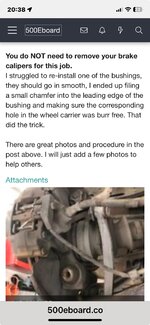
You need to UNBOLT the brake calipers, to remove the brake disc, so you can bend the dust shield away from the joint to allow the tool to fit in place.

But you do not need to disconnect the hose from the calipers (which would then require bleeding the brakes).

:jono:
 
I certainly don’t mean to question your advice but I thought I’d read on other posts that later model post 1993?) E500s have more room?

Again, I defer to your empirical knowledge. The next one of these replacements I do will be my first.😥
 

Attachments

  • IMG_7385.png
    IMG_7385.png
    244.4 KB · Views: 5
Another question: I’ll be doing this on jack stands with one hydraulic jack. Can’t lift the car and put the jackstand under the lifting pad at the same time. What’s the solution? Lift the car up by sliding the jack under the differential housing and slide jackstands under the lifting pads on the frame? Or jack each side up separately and put jackstands under the rear drivetrain or suspension but where?

As always, thanks!
 
Another question: I’ll be doing this on jack stands with one hydraulic jack. Can’t lift the car and put the jackstand under the lifting pad at the same time. What’s the solution? Lift the car up by sliding the jack under the differential housing and slide jackstands under the lifting pads on the frame? Or jack each side up separately and put jackstands under the rear drivetrain or suspension but where?

As always, thanks!
Use the lift jack on the diff, and then use the stands on the lift pads. Release the jack onto the stands, and reset the lifting jack onto the diff from the side so it’s not in your way, but still providing an extra security layer.

Oh and if you’ve never lifted this particular car before, remove the jack covers to inspect the jack pad points. Sometimes they’re rusted out, in which case I’d use another spot for the stands.
 
I certainly don’t mean to question your advice but I thought I’d read on other posts that later model post 1993?) E500s have more room?

Again, I defer to your empirical knowledge. The next one of these replacements I do will be my first.😥
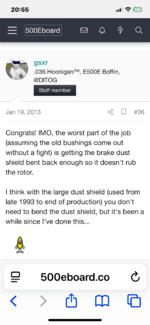
Good point! Try it with the rotor & dust shield in place and see if there's enough room. If not, then remove the rotor and bend the dust shield. Note that it is not easy to bend the dust shield back... if you do this, make SURE the rotor is not rubbing the dust shield before final assembly.

:banana2:
 
Use the lift jack on the diff, and then use the stands on the lift pads. Release the jack onto the stands, and reset the lifting jack onto the diff from the side so it’s not in your way, but still providing an extra security layer.

Oh and if you’ve never lifted this particular car before, remove the jack covers to inspect the jack pad points. Sometimes they’re rusted out, in which case I’d use another spot for the stands.
I’ve done it this way in the past so wanted insight from experts. But will definitely double check mount pad points. I double up on stands too. I had a mini-anxiety attack a few years back while changing my tranny oil and filter - I was on a rollaway when I realized there was a mere 1/2” between me and two tons of iron. I shot out from under the car like I was an ICBM coming out of the ground. A few deep breaths and two more jackstands and I went back under. Belt and suspenders.
 
I’ve done it this way in the past so wanted insight from experts. But will definitely double check mount pad points. I double up on stands too. I had a mini-anxiety attack a few years back while changing my tranny oil and filter - I was on a rollaway when I realized there was a mere 1/2” between me and two tons of iron. I shot out from under the car like I was an ICBM coming out of the ground. A few deep breaths and two more jackstands and I went back under. Belt and suspenders.
Yea my garage buddy forgot the handbrake when using ramps, fortunately he wasn’t under the car when it came rolling down, crashing into his workbench. Scary stuff!

Every year someone dies in Sweden being crushed by their car. One of the most unnecessary ways to go imo, totally avoidable!

You’re good to go though, hope all goes well with all the work you’re about to do! 🙌🏻
 
I was hanging with some old friends at the housing project I grew up and watched a guy get his head torqued when the metal milk crate ( remember those) he was using as a jack stand gave way. It happened just slow enough that his car just barely nipped him as he slithered out from under the frame rail. We watched as he ran around in circles like a chicken with his head cut off. Very lucky!
 
Change in plan. Doing shocks and spheres first. Tried loosening bearing bolt and couldn’t get it to budge. These are the moments you realize “I’m not getting old, I am old.” Have a pal who is a A&P trained mechanic but he runs a Bobcat and heavy equipment repair business. I’ll have him come by - he’s meaner than I am when it comes to this stuff and will go places I go won’t cause it’s my own car. 🫣

So, going with a conflation of Gerry’s 2 how-to’s on shocks and spheres R&R. Removing sphere and shock together did make getting banjo on much easier. Still struggling with hydro fittings at sphere so decided to attack with fresh attitude tomorrow.

One last thing: why do those copper rings roll away invisibly into the far recesses of the garage? I opened the package with all the shock attachment bushings, bolts, etc. and a copper ring sprang out of the package like Steve McQueen escaping Stalag 13. Only the washer has so far made good on its plan as it rolled under the car (of course) which is immobilized.
 
Instead of slowly lowering the car and having a helper guides the shock into the trunk, will it work to have a bottle jack under the shock mount and use it to lift the assembly?

A) I don’t have a helper (other than the Mrs. and I’d prefer not to involve her any more than necessary) and B) my jack can be a bit fickle on the bringing it down side of things.
 
You don't need to remove the calipers, unless replacing. They can be unbolted and tied up to the frame bracket.

Since you are doing the rear wheel carrier support joint AND the rear shocks/hydrolegs, it's sort of a toss-up either way. I'd probably leave the shock connected and replace the support joint first, then re-attach LCA to support joint. Then separately replace the shock & spheres.

Don't forget to bleed the SLS system per the FSM procedure, using the same bleeder screw that you use to release pressure before disconnecting the shock or sphere.

:seesaw:
I don’t have access to the FSM.
😱

Can you advise how to bleed at the level control valve?

Ad always, thanks in advance!
 
Instead of slowly lowering the car and having a helper guides the shock into the trunk, will it work to have a bottle jack under the shock mount and use it to lift the assembly?
Yes, you can use a jack under the LCA to raise/lower the shock as needed. Remember the shock is what limits the LCA extension under spring pressure. You must lift the LCA (compress the spring slightly), THEN loosen the top bolts, and finally lower the LCA slowly to let the shock come out of the chassis attachment point.


I don’t have access to the FSM. 😱
Click here for a link to the FSM index!


Can you advise how to bleed at the level control valve?
Here's a direct link to the procedure to both empty, and then fill (bleed) the SLS hydraulic system:


:jono:
 
Yes, you can use a jack under the LCA to raise/lower the shock as needed. Remember the shock is what limits the LCA extension under spring pressure. You must lift the LCA (compress the spring slightly), THEN loosen the top bolts, and finally lower the LCA slowly to let the shock come out of the chassis attachment point.


Click here for a link to the FSM index!


Here's a direct link to the procedure to both empty, and then fill (bleed) the SLS hydraulic system:


:jono:
This is great, thanks so much!

Just in time, FedEx delivered me the remaining parts I didn’t need but now need (copper washers and shock nuts which weren’t specifically mentioned on the how-to as being in the strut “accessories package” but which are included. Unfortunately one of the copper rings in the package was bent. Luckily I have four soon to be two extras.

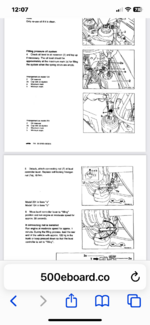
I’m confused of course by the diagram at the link:

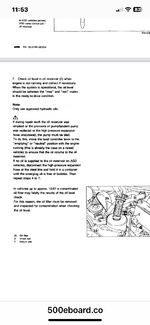
In the attached photo of the FSM, what is the expansion hose? Is it the shock to sphere hose? If so, I did disconnect, so I do need to do the bleed, right?

To bleed, I think I follow the instructions in the attached. So what position the fill lever must be in for “emptying or neutral position”? Only F and L are indicated in the FSM, not emptying or neutral.

Thanks again!

CharlieIMG_7393.png
 

Attachments

  • IMG_7394.png
    IMG_7394.png
    611.8 KB · Views: 4
In the attached photo of the FSM, what is the expansion hose? Is it the shock to sphere hose? If so, I did disconnect, so I do need to do the bleed, right?
"expansion hose" in that text is describing the high-pressure hose from the tandem pump to the metal pipe on the passenger side of the engine. Also note our cars do not have ASD.


To bleed, I think I follow the instructions in the attached. So what position the fill lever must be in for “emptying or neutral position”? Only F and L are indicated in the FSM, not emptying or neutral.
See FSM job 32-0501 linked below, SLS Functional Description, page #14:


:matrix:
 
All done, success! Ride returned back to luxurious normal.

Noted that passenger side ride height which was noticeably low previously is now even with driver side.

Thanks to all again. Newbie questions answers very timely, I really appreciate it!

A few notes to pass on for the next person: replacing the spheres and struts at the same time made getting the hydro fittings on the spheres in place much easier. I removed the entire line between sphere and shock on the driver side to access smaller line feeding sphere without any difficulty. This was an issue due to exhaust being close.

Also, using the bottle jack allowed me to push the shock up and in without lowering the car onto the tire and provided lots of work access. This eased access to the banjo footing on both passenger and driver sides. Otherwise you’re fighting the rigid hydraulic hose to start the banjo.
 
What to do with old struts?
First, slide up the accordion dust boot and see if the foam stop buffers are intact, degraded, or completely missing (disintegrated).

Then you can either save them in hopes that Martin will be able to rebuild them in the future, or sell to someone who wants cores to rebuild in the future.

BTW - were you able to replace the lower wheel carrier support joint without removing the brake disc, or bending the dust shield?

:banana1:
 
In #21 above I described how I basically decided to pu$$y out on those - for now.

I tossed and turned last night anxious about how to bleed the system. Your links were invaluable.

As it is I’m going to need a hot bath to ease my old aching bones after the past two days just doing the struts and spheres. My swollen fingertips will still be pulsing for a few days from trying to start the small fitting to the spheres.

I’m not shy, I’ll provide an update once I start that. I’m sure I’ll have questions though the how-to and other forum entries seem to have it well covered.

Thank you again!

Charlie
 
Back
Top