• Hi Guest !

    Welcome to the 500Eboard forum.

    Since its founding in late 2008, 500Eboard has become the leading resource on the Internet for all things related to the Mercedes-Benz 500E and E500. In recent years, we have also expanded to include the 400E and E420 models, which are directly related to the 500E/E500.

    We invite you to browse and take advantage of the information and resources here on the site. If you find helpful information, please register for full membership, and you'll find even more resources available. Feel free to ask questions, and make liberal use of the "Search" function to find answers.

    We hope you will become an active contributor to the community!

    Sincerely,
    500Eboard Management

Engine oil recommendations

Just so that all variants of the scenario are presented, there is this:


“U.S. Vehicles Model Year 1997 and Earlier Engine Oils.”
View attachment 120155

Also note that the viscosity chart below – published by MB in “Factory Approved Service Products August 2007” – supersedes ALL previously published viscosity charts; again, according to published documents available from Mercedes-Benz. Select the appropriate oil viscosity based on the lowest air temperature expected before your next oil change.

View attachment 120156

Reference: Mercedes-Benz Approved Engine Oils « AMG Market | AMG Mercedes-Benz Enthusiasts
Let me make a few points here:
  1. MB's "supercession" of all previous charts with current charts is just a formality, given that they basically have no choice. MB can't go back and mandate that motor oil manufacturers re-create the "old" 1980s and 1990s SF and SG-class motor oil spec in their mainstream, commercially available oils. If they did, auto parts stores would require half of the store's shelf space for stocking all of these old motor oil specs for older car owners. Nope ... ain't gonna happen.
  2. I can tell you VERY definitively, that if you use a "modern" SJ- or SL-class motor oil in an M117, an M103, an M110, or other earlier engine, you ARE GOING TO HAVE VALVETRAIN WEAR and PROBLEMS that will lead to EXPENSIVE DAMAGE TO THE ENGINE. You don't believe me? Just look at the cam lobe damage to my M117 here, because I used "modern" oils (and, FYI, changed them every 2,000 miles with filter). This problem with valvetrain wear is because the additive package of recent motor oils has EVOLVED and does not include the necessary levels of friction protection that earlier oils' SAE/API classifications had.
  3. Older MB engines were designed and manufactured with different internal tolerances than more recent engines. This is because of the advent of more refined and computer-controlled manufacturing and measuring processes, and much smaller internal tolerances in modern engines. Modern engines are designed for optimum efficiency and mileage through less friction -- thicker oils create more resistence and friction. Also, there are ancillary things like emissions systems in modern engines that require different additive packages than older engines' emission systems, necessitating "evolved" motor oils. Older MB engines were deisgned for higher viscosity oils.
  4. Remember that the viscosity measurements have never changed over the years. A 10W-40 motor oil from the 1980s is the same as a 10W-40 motor oil from 2020.
  5. Thus, it is a FALLACY that current motor oils (both viscosity and grades) are just automatically, 100% applicable and retrofittable/usable to any MB engine ever made. Absolutely not true.
  6. The M119 and M104 are more compatible with modern oils than older engines, because they don't have a valvetrain design that has the levels of friction as found in the M117 and earlier engines that used a cam-follower-type system. So while 0W and 5W oils of modern spec are certainly usable in them, I still would recommend motor oil with an additive package that is more like what was avaialble when these engines were being produced. RedLine oils are excellent for this.
 
Maybe check out the factory Mercedes-Benz oil? I buy it by the 55 gallon drum and it goes into every gasoline engine I service. Even the 600HP ones. I pay around $5.70 qt and I believe it's still made by Exxon Mobil. I like that it's lighter in color over Mobil 1 but some still prefer the 'more' name brand.

I have always been a big Amsoil fan though even from my motorcycle days. Quality stuff!
 
Last edited:
Sheeeeiiiddd... that's all I use... they don't necessarily hold up well... but I have only so much brainpower to devote to the effort... and at 5k changes, if I think about it at all I've thought about it too much... but keep in mind @kiev, "I'm not a role model."

maw
 
You never know how thinking about mundane, banal things might scale. In Newton's case thinking about falling apples lead to Newton's gravity laws! Archimedes was thinking about spilled water as he entered the bath. And so on. Thinking about motor oil might help us reach the next paradigm in understanding the human nature. :saucer:
 
Good article on TBN from Blackstone Labs, see thread below:

 
I have the intention to use Mercedes Benz Genuine 5W40 229.5 oil in my 500E from 1992 (Japan spec.) Is that a good choice ?
We have here in the Netherlands a Sea Climate with more hot summers then in the past.
Now I use Kroon Oil Emperol 10W40 Semi-Synthetic oil (229.1).
My 500E has no oil cooler.
 

Attachments

  • Mercedes_Benz_Origineel_5W40_229.5_5_Liter__15899_zoom.jpg
    Mercedes_Benz_Origineel_5W40_229.5_5_Liter__15899_zoom.jpg
    53.7 KB · Views: 9
I have the intention to use Mercedes Benz Genuine 5W40 229.5 oil in my 500E from 1992 (Japan spec.) Is that a good choice ?
We have here in the Netherlands a Sea Climate with more hot summers then in the past.
Now I use Kroon Oil Emperol 10W40 Semi-Synthetic oil (229.1).
My 500E has no oil cooler.
It will be fine. You'll probably want to change at 3-5kmi or so, unless you rack up a ton of miles.
 
It will be fine. You'll probably want to change at 3-5kmi or so, unless you rack up a ton of miles.
Exactly this.

Note that the paper filter element is the thing to consider here too. Eg many of my cars cover less than 1k miles per year. But I change the oil and filter again every 2 years maximum.

Why? Ever seen a paper oil filter break up or collapse in a Mercedes engine? I have and its scary stuff. Hence I would never go the full mileage interval if it spanned years to achieve and the 12 month spec is probably too close also unless you have money to burn 🔥

Example:

20181223_194604.jpg
 
Last edited:
Exactly this.

Note that the paper filter element is the thing to consider here too. Eg many of my cars cover less than 1k miles per year. But I change the oil and filter again every 2 years maximum.

Why? Ever seen a paper oil filter break up or collapse in a Mercedes engine? I have and its scary stuff. Hence I would never go the full mileage interval if it spanned years to achieve and the 12 month spec is probably too close also unless you have money to burn 🔥

Example:

View attachment 131398
Yikes. How long was that paper filter in there for and what brand was it?

I usually go 2 years between oil changes. The 500E gets up to 3 bar oil pressure, byt my sport beetle goes up to 5 bars. 😳
 
The 500E gets up to 3 bar oil pressure, byt my sport beetle goes up to 5 bars. 😳
Trivia: The Mercedes engines operate above 3 bar, but the gauge only goes to 3 bar.

FSM specs imply the oil pressure relief valve may open around 5.5 bar?
 
It will be fine. You'll probably want to change at 3-5kmi or so, unless you rack up a ton of miles.
When I do this, there are no risks for leaking seals, gaskets etc. after a certain time because of this transition ?
Semi synthetic to full synthetic transfer.
 
When I do this, there are no risks for leaking seals, gaskets etc. after a certain time because of this transition ?
Semi synthetic to full synthetic transfer.
There is always a possibility for leaks to appear when changing to a different oil formula. The different additive packages may affects seals differently, so there are no guarantees. It's highly unlikely there would be a sudden large leak though. Also, I believe the MB "full synthetic" is still a Group III oil, which may be slightly less prone to leakage. (??)

In general it's a good ideal to replace most of the M119 seals / gaskets / sealants after 30 years, if you haven't already done so. The only seal which is a real headache is the rear main, so cross your fingers on that one. It's not a common leak point, thankfully.

:seesaw:
 
Allright, the main reason for the switch to full synthetic is the coolant properties which are possibly better then the now used Kroon Oil 10W40 (although it runs good on that stuff) in relation to the ommited oil cooler. I hate leaks so I will think about it more longer.
 
Yikes. How long was that paper filter in there for and what brand was it?

I usually go 2 years between oil changes. The 500E gets up to 3 bar oil pressure, byt my sport beetle goes up to 5 bars. 😳
I believe it was a brand name filter like Hengst - more info in the link below


Seen this 3 times on MB engines it can happen but generally only if the oil filter has been there for several years and / or oil change has been neglected. On my fathers S500 at one point (MB Indie serviced religiously) that I changed the oil for him and the paper filter element was in bits. Indeed I had to pick pieces out of the oil filter housing intake tube which thankfully had plastic ribs that caught the debris but it was not good!

As I say max 2 years is my comfortable limit on a paper oil filter element in any engine I care about!
 
I have the intention to use Mercedes Benz Genuine 5W40 229.5 oil in my 500E from 1992 (Japan spec.) Is that a good choice ?
We have here in the Netherlands a Sea Climate with more hot summers then in the past.
Now I use Kroon Oil Emperol 10W40 Semi-Synthetic oil (229.1).
My 500E has no oil cooler.
I use the same factory 5W40 oil in all my MBs. I even use it in the old 16V VW.

Good choice. Can't go wrong with it, especially at about $5.00 USD a quart.
 
I've finally ran out of my large stash o Delo 15W40, years of trusted service, time to move on... I drive the car on weekends, about <=5K miles per year, and will be changing oil and filter annually. We live in VA, summers are 90F, winter, occasionally drops down to low 20's...

I was looking at Redline 5W50? So, considering that it "starts" as 5 and "performs" 50 at operating temps, would you use it my climate as year around oil? I like that is has added ZDDP...

Regards,
D
 
I prefer the two numbers to be as close as possible, and 5W-50 is at the opposite end of that extreme. Reason is, usually a lot of viscosity improvers are needed to get that wide of a spread. This is one of the reasons I stick with 10W-40.

Given your temp range of 90F summer to 20F winter, any synthetic of 10W-40 is more than adequate. Even 15W-40 synthetic is fine. No need to go thinner "W", or thicker on the hot side.

Side note: Different viscosities of Red Line have different additive packages. And, the additive levels change over the years as they monkey with the formula. Going back 8+ years, the RL 10W-40 had been around 1200 to 1400 ZDDP, with moly around 700-900. (!!) More recently, the 10W-40 has dropped to around 1000 to 1200 ZDDP, with moly around 600. I only had one UOA with Red Line 5W-40 but it was 1000-1100 ZDDP and 400 moly. I don't know what the 5W-50 has, I've never used it, but you could look for VOA/UOA results.

:v8:
 
I prefer the two numbers to be as close as possible, and 5W-50 is at the opposite end of that extreme. Reason is, usually a lot of viscosity improvers are needed to get that wide of a spread. This is one of the reasons I stick with 10W-40...
Oh, yeah, totally forgot about those improvers/modifiers, absolutely makes sense! Well, premium synthetics in 10w40 are plenty to chose from for sure... On the side note, the last oil change on it this passe Fri eve, and looking through the filler opening, engine components still look so clean and shiny!!! And still no oil consumption. :yahoo: And now, off for a morning drive!!!

Regards,
D

P.S. Saw a car in front of me yesterday, sticker on the back, "I hope something good happens to you today"... Put a smile on my face, so I hope something good happens to you all today!!!
 
Anyone ever ordered from these guys?


Lots of Red Line oils on sale, free shipping over $99


EDIT: Their MOTUL prices are great too!!!


for example, 5W40 X-CESS GEN 2 - 20L $130? That's almost walmart pricing of shelf stocked Mobile 1 wo the roll back...

 
Last edited:
A little pre-history: my engine has a hot tick. No tick when cold. When I replaced plastic oilers to metal ones it (or the liqui moly 5w40 229.5 that I put in at the same time) seemed to fix the issue for a while, but at some point in time, I've noticed it again.

I've tried Castrol Edge 10w40, Redline 5w50 and 5w30, a 5w50 229.3, and various 5w40 229.5 oils without any affect on the ticking. I figured I'll try Liqui Moly 10W40 MoS2 that MercedesSource guy recommends and it worked - no more ticking.

I put about 3-4 thousand miles on that 10w40 MoS2 and parked my car for about 4 months. After the hibernation, I drove the car for 3 weeks and parked it again for 2.5 months while I was away. Upon my return (2 weeks ago) I began daily-driving it again and noticed that ticking has returned. It could have been there after the 4 months hibernation, I just might not have noticed it. I'm guessing maybe that the MoS2 might have settled out.. I don't know..

In any event, 2 days ago I renewed the oil (exactly a 5k OCI) with the same 10W40 MoS2 and the ticking is gone again!! Previously, after returning from a drive, car idling in driveway, within a minute it would start ticking. Every time.

Magic 🪄? Yet it's what is
 
My 500E has always had 20-50 oil but I live in SoCal. I have 142K+ miles and no ticks. I have been using Royal Purple for last 3 - 5K changes.

It’s weird that it ticks when hot. To me that means oil is to thin when hot or maybe you just have one bad lifter. Another member on this forum just changed a bad lifter. If I spot the thread again I’ll flag it for you.
 
maybe you just have one bad lifter. Another member on this forum just changed a bad lifter. If I spot the thread again I’ll flag it for you.
Terry, thanks! I saw that thread and commented on it. It's likely a lifter/s in my case, but with LM 10w40 MoS2 the tick is completely gone

Ever try any 20/50's? Redline, Motul, Brad Penn... :p.
I haven't tried 15/20W-50 oils yet, but I did try Mobil's and RedLine's 5w50 variants. Around April of next year I'd like to try Liqui Moly's 20W50 mineral MoS2 variant. I like that it's only $28 per per 5L ($45 per oil change), yet should still be good for a 5k oci.

Viscosity index: 130
NOACK: 7%
Tbn: 10.5
Screenshot_20211015-121324.png


In contrast, RedLine 20w50 is $100 per oil change

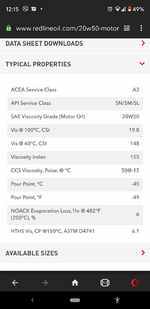
Viscosity index: 155
NOACK: 6%
Screenshot_20211015-121507.png
 
If you rack up enough miles, you can very likely push to a 10k OCI, although I'd recommend getting one or two UOA's with TBN analysis just to verify the interval is ok. I change our E420 at 10k which is every 18-24 months on average. (I also get UOA with TBN, every time.)

Note that although the second number is supposed to indicate the viscosity when hot, there is a range of viscosity for a given SAE rating. Not all xW-40 are the same, some push the limits of spec and may tend towards thinner or thicker. As noted earlier in this near-1000 post thread... I'm not a fan of thin oils (0W-x, 5W-x) unless the engine gets a lot of sub-freezing cold starts.

:duck:
 
For the M119, I would go with one of the following grades:
  1. 10W-40
  2. 15W-40
  3. 15W-50
  4. 20W-50
Nothing lighter, nothing heavier. You would want to go with #1 or #2 above if you live in a colder clime (midwest, northeast, Mid-Atlantic states). #3 or #4 if you are on the West Coast or live in the Southern US.

For the M117, generally I would recommend the same.

I do not believe that light 5W, and CERTAINLY NOT 0W, oils should really be used in the M119 or M117. The singular exception for a 5W oil only, would be if you live in a very cold environment, and are driving your car in winter, such as in Canada, Minnesota, Michigan, or upper New England. For typical Northeast, midwest, mid-Atlantic winter use, you can and should use a 10W-40 or 15W-40 oil.

Remember, these engines were designed for, and LOVE, heavier (10W-xx and above) oils. They are not like today's engines with tighter tolerances due to more precise design and manufacturing capabilities.
 
If you rack up enough miles, you can very likely push to a 10k OCI
I don't know. LM 10w40 MoS2 is a semi synthetic. LM 20w50 MoS2 that I'm thinking to try in late spring next year is mineral.
 
I don't know. LM 10w40 MoS2 is a semi synthetic. LM 20w50 MoS2 that I'm thinking to try in late spring next year is mineral.
Good synthetic can go 10k or beyond, assuming (1) oil analysis shows no issues and adequate TBN reserve, and (b) oil consumption does not suddenly increase near the end of the interval, which would indicate the oil is shearing down.

With mineral oil, I'd change at 3k, or 5k at the absolute max. You also lose all the benefits of synthetic (or semi-syn).

:wormhole:
 
With mineral oil, I'd change at 3k, or 5k at the absolute max. You also lose all the benefits of synthetic (or semi-syn).
Remind me what they are, besides longer oil life and easier pumpability in sub zero (C) temperatures?
 
Remind me what they are, besides longer oil life and easier pumpability in sub zero (C) temperatures?
  • Better low- and high-temperature viscosity performance at service temperature extremes.
  • Better viscosity index (VI).
  • Better chemical and shear stability.
  • Decreased evaporative loss.
  • Resistance to oxidation, thermal breakdown, and oil sludge problems.
  • Possibility to extended drain intervals, with the environmental benefit of less used oil waste generated.
  • Improved fuel economy in certain engine configurations.
  • Better lubrication during extreme cold weather starts.
  • Possibly a longer engine life.
  • Superior protection against "ash" and other deposit formation in engine hot spots (in particular in turbochargers and superchargers) for less oil burnoff and reduced chances of damaging oil passageway clogging.
  • Increased horsepower and torque due to less initial drag on engine.
  • Last benefit among the advantages of synthetic oil : Improved Fuel Economy (FE).

Remember this ad? It's from the 1980's back when M-1 was still a true synthetic, Group IV/V base stock:

 
IMOP, Synthetics are a “Slam Dunk”! It’s no contest against “Dino Oil”

Albeit, Not Mobil 1 for my car. MB 1 15-50 went thru like “Shit Thru a Tin Horn” No problem like that with Royal Purple 20-50 I’m happy to say:)
 
IMOP, Synthetics are a “Slam Dunk”! It’s no contest against “Dino
I'm under the impression that it's the MoS2 which totally eliminates hot tick in my situation. There are only 2 oils that have it premixed from the factory: liqui moly 10w40 (semi synthetic) and liqui moly 20w50 (mineral). This why I want to try their 20w50 variant from late spring, despite it being mineral.

I think modern mineral variants that are "recommended" for A3/B4 spec application, which LM 20w50 mineral is, should be completely fine for a 5k mi oci, which is about 2-2.5 months in my case
 
What's concensus on cars driven <1,000 miles per year? Oil type - change interval?
This is tough to answer. The oil mfr's, almost without exception, will state to change the oil at no longer than 12 months regardless of miles. I think that's insane, especially for a vehicle in storage. And, @Klink has mentioned in the past there might even be some negative effects to changing too frequently. I would probably change at 2-3kmi even if that means 3-5 years, assuming when the car is driven, it's driven 30+ minutes at high enough load to get the oil fully hot (this takes MUCH longer than the cooling coming up to temp). I'd still use synthetic and get UOA.


Is there a current list of Group IV oils somewhere out there by chance?
Not that I'm aware of. The problem is that the oil companies change their formulas constantly, usually to meet new API guidelines that continually reduce ZDDP levels. But some have also changed base stocks, like Mobil-1 did in the mid-2000's from Group IV/V to Group III... at first only on some viscosities, and later to almost all. AFAIK the only M-1 which is still Group IV/V is their "Extended Performance" line, which is not available in xW-40 or xW-50. Everything else is Group III.

You could post the same question on BITOG and see if there's a running list or not. Most companies don't want to admit their oil is a Group III. This is one reason I like Red Line, they are up front about their oils being Group IV/V unless stated otherwise (they have a few Group III oils at lower cost to meet specific mfr requirements).

:grouphug:
 
Since I change my oil on R129 x2 per year, and drive it about 5k miles per year (I know it's an overkill, but the car seem to like 50 weight in the summer, and I revert to 40 weight in the winter, with M1 at walyworld, comes up to about $100 per year... And that's about the price of 1 oil change with Redline or Amsoil such as this one https://www.amsoil.com/p/premium-protection-10w-40-synthetic-motor-oil-amo/?code=AMOTP-EA (with "membership" and assuming it is still group IV)

What I may have to do, since the winter oil change is coming soon, try one of those, and see how we do with 10w40 through Virginia's hot summer...
 
This is a good read to bust the myths and bulldust marketing on engine oils from and independant researcher


Interesting Amsoil Signature Series 100% synthetic ranked #2 out of 150 different brand oils tested
Top ranking by far was Quaker State Full Synthetic

It is a long read but well worth it and don't skim through it - you need to read it in full to get a good understanding in all applications and best take out is "don't" use Diesel oil in gas (petrol) engines
 
This is a good read to bust the myths and bulldust marketing on engine oils from and independant researcher


It is a long read but well worth it and don't skim through it - you need to read it in full to get a good understanding in all applications and best take out is "don't" use Diesel oil in gas (petrol) engines
I commented on this RAT article 7 years ago back in post #315 of this thread, with another update circa 2018... click here.

I don't agree that diesel oils should not be used in gas/petrol engines. Some diesel oils may not be suitable for gas/petrol usage, but a blanket statement condemning all diesel oils is a bit much.

:grouphug:
 
I’ve used diesel-rated Chevron DELO 400 15W-40 in my M104s for probably the last 12-14 years. Never had a single issue — and the DELO is explicitly also rated on the label/specs as being acceptable for gas engine usage.

The detergents in the DELO oil keep the inside of the M104 unbelieveably clean.
 
I’ve used diesel-rated Chevron DELO 400 15W-40 in my M104s for probably the last 12-14 years. Never had a single issue — and the DELO is explicitly also rated on the label/specs as being acceptable for gas engine usage.

The detergents in the DELO oil keep the inside of the M104 unbelieveably clean.
I started with Delo LE 400 a few years ago, then switched to Rotella T4...lately, I can't find Rotella T4 where I live ( North Florida) but walmart has Delo SDE 400. However, I wonder if it is better or worse than Delo LE.
If I can not find Rotella T4 in the near future ( a few weeks when my oil change is due), I might try Liqui Moly 20w50 ( with the MOS2) from FCPeuro.
my 1993 400E has now 288600 miles ( oil change due at 288800 )
 
I believe the DELO 400 SDE has replaced the LE (low emissions).

Rotella and DELO are both available in 5-gallon pails (best economy of scale) at any Tractor Supply store. You can also get 2.5-gallon jugs of DELO from Walmart, which is a nice size in one bottle that doesn't leave a lot left over from an oil change.


Back
Top