• Hi Guest !

    Welcome to the 500Eboard forum.

    Since its founding in late 2008, 500Eboard has become the leading resource on the Internet for all things related to the Mercedes-Benz 500E and E500. In recent years, we have also expanded to include the 400E and E420 models, which are directly related to the 500E/E500.

    We invite you to browse and take advantage of the information and resources here on the site. If you find helpful information, please register for full membership, and you'll find even more resources available. Feel free to ask questions, and make liberal use of the "Search" function to find answers.

    We hope you will become an active contributor to the community!

    Sincerely,
    500Eboard Management

Engine oil recommendations

@Jlaa, project farm is definitely better. It's not intellectually lazy. The effort and pedantism are very commendable, even if the tests themselves lack scientificness.
 
IMHO, this oil guy (though a serious dork) is infinitely more tolerable than Hoovy. Much like Uncle Kent, I’m happy to pay him with a YouBoob “watch”.

I can’t say that for Hoovy. I’ve never understood why a trust fund kid like Hoovy even needed a YouBoob channel to make more money. I guess it’s so he feels like he’s actually doing something productive with his life.
 
IMHO, this oil guy (though a serious dork) is infinitely more tolerable than Hoovy. Much like Uncle Kent, I’m happy to pay him with a YouBoob “watch”.

Project Farm Guy is the good kind of dork 🤓. We're all dorks.


I can’t say that for Hoovy. I’ve never understood why a trust fund kid like Hoovy even needed a YouBoob channel to make more money. I guess it’s so he feels like he’s actually doing something productive with his life.

I don't mind Hoovie doing his youtube channel but his "woe is me I wasted so much money" schtick is very stale. He either needs to (a) bring some rigor into his videos or (b) new content. I think the issue that we can all see with Hoovie is that he's phoning it in. That's being lazy. The Project Farm guy is far from lazy.
 
Viscosity 101 webinar from a tribology lab manager. Required watching for oil junkies. You can watch most of it at 1.5x+ speed.

The viscosity differences between engine oil and gear (differential) oils, around 18:00, is interesting. Analysis/testing is discussed toward the end (28:xx).

 
My M-B tech turned me on to Liqui Moly 5W-40 and it freaking amazed me! It’s been more than 5,000 miles and my M119 has used ZERO oil. NONE. The dip stick is still perfectly right on the fill line! I’m very impressed, not to mention excited to death that my 5.0L is still this strong with 132,000 miles.
 
Good M119's can easily go 5,000 miles consume a drop of oil, particularly if the oil used is top quality (usually full synthetic with Group IV/V base stocks).

One of my current M119's has gone 10kmi with Red Line 10W-40 and based only on the dipstick level indicated, it consumed less than 0.5 quart during 10kmi over ~2 years. It started out a bit above the halfway mark on the dipstick and 10k later it was a bit below the halfway mark. No oil was added. Engine now has 150kmi.

On the flip side, if the engine is using 1 qt or less over 5kmi, I wouldn't worry about it - that's not abnormal. It's time to worry if the engine is drinking a quart every 1kmi or worse.
 
For many years, my oil consumption with Motul 300V Power 5w-40 oil was a tad less than 1/2 quart every 5.5K miles. But about eight months ago, I switched to Motul 300V Competition 15w-50 oil and after 4K miles no oil has been consumed. However, the car is not being driven daily as before, so I need to wait and check at 6K miles. I always found that the oil pressure (although mine was well within the factory specs) was a tad low for my liking, especially when sitting in long traffic in the hot summer weather and when getting off the freeway in the hot weather. I started to notice that towards the ending of my track participation a few years ago. Long story short, the oil pressure is much better now, a 1/2 bar higher than before and in all weather conditions. The engine now has 168K miles on it and I’m sure the tolerances have increased a bit, so the 15w-50 oil will be used from now on.
 
For many years, my oil consumption with Motul 300V Power 5w-40 oil was a tad less than 1/2 quart every 5.5K miles. But about eight months ago, I switched to Motul 300V Competition 15w-50 oil and after 4K miles no oil has been consumed. However, the car is not being driven daily as before, so I need to wait and check at 6K miles. I always found that the oil pressure (although mine was well within the factory specs) was a tad low for my liking, especially when sitting in long traffic in the hot summer weather and when getting off the freeway in the hot weather. I started to notice that towards the ending of my track participation a few years ago. Long story short, the oil pressure is much better now, a 1/2 bar higher than before and in all weather conditions. The engine now has 168K miles on it and I’m sure the tolerances have increased a bit, so the 15w-50 oil will be used from now on.
Getting close to that high mileage award...nice!
 
I have said for many years Thant any oil that is 5W or below is too light. A much better choice is 10W, 15W or even 20W depending on the clime where you live. I use RedLine 15w-50 and have for years. It works well.
 
My current service tech and my tuner both told me that when the 036’s came to the California market, they were filled with 20w-50 oil from the factory, being dino oil back then. When I bought my 500E back in 2005, I found out that the original owner ran 20w-50 Castrol dyno oil from the time he purchased the car until I bought it.
 
Last edited:
Yep. Not surprised to hear that. Both the M119 and it's father M117 engines were designed for, and very much like, a heavier weight oil. I will always sing the praises of oils ranging from 10W-30 to 20W-50, depending on one's clime and use of the car (or not) during cold temperatures. I realize that "0W-5" oils are in vogue right now with the average Joe, but they are not appropriate for our cars.

I think you're going to be very very happy with the 15W-50 viscosity, particularly living in SoCal.
 
So... this weekend I went into the rabbit hole of choosing an oil and I feel I have lost a few years from my life.

I have an 560 SEC with the M117. Currently it is running Castrol GTX semisynthetic 15w40. When looking under the valve covers I saw that the cams are in "okish" condition ( not an expert thought ), and I also have a noisy lifter or two. I will probably change the lifters, but for now, considering the fact that I also have to change the oil I thought, what the hell, lets try something else maybe it can make things better.

The issue is, living in Europe the options are completely different from what I'm seeing being discussed in the forums. Can't find the majority of oils people usually suggest. I did find 2 that seem to be recommended for older cars:
- Liqui Moly mos2 10W-40 - can't find an official specification for ZDDP - I read in some places that it could be around 1300, but is unofficial
- Amsoil Premium Protection 10W-40 Synthetic Motor Oil with high zinc - officially it has 1265 phosphorus and 1378 zinc. Also twice as expensive as the liqui moly.

Does anyone have any experience with these oils?
 
Can you not source Penngrade-1 for your M117? That's the preferred oil for M117. It has ZDDP levels in the 1500-1700 range:


Amsoil Premium Protection 10W-40 "AMO" is good stuff. Same with the 20W-50 version "ARO". At $12 USD per quart, it's their top-shelf Group IV/V synthetic. As you mentioned, they appear to have ZDDP levels in the 1300 range, which is good, but I don't know if it's "enough" for the M117. @gerryvz and @jhodg5ck are the M117 experts.

Liqui-Moly priced at ~$6 USD/qt will be a Group III synthetic. Which is fine if you change it frequently. I doubt it has ZDDP levels above ~1300. You'll have to look for a UOA or VOA report to find out. The BITOG forum might have what you need:
 
Brad Penn is available all day on Amazon. That Castrol will eat your cams...which if the cams are looking tired I guarantee your rockers are Worse. If this cars a keeper I'd recommend going in and changing them sooner rather than later.

We run Brad Penn in everything that was designed mid 90's and earlier. Might be hard on cats but they're cheaper than engine hard bits!

Jono
 
Thank you for the suggestions!

Yes, I can order Brad Penn from Amazon US, but unfortunately it will cost me close to 250$, shipping is really expensive. I will look more into it, maybe use the Amsoil now and in the future I can find brad penn cheaper

Later edit: actually I'll bite the bullet and order some brad penn. 10w40 or 15w40? I don't drive the car in the winter often, and when I do it's usually not under 0C / 32F.
 
Last edited:
Yes, I can order Brad Penn from Amazon US, but unfortunately it will cost me close to 250$, shipping is really expensive.
Yes, it sounds indeed very expensive. I am assuming $250 is for a case of 12 quarts. IIRC you need about 8 quarts (1 quart = 0.95 liters), perhaps a bit less per oil and filter change. Anyway, what I am suggesting is that you hook up with two more guys who would like to have Brad Penn and order two cases, a total of 24 quarts. That would be $500 but your share would be 500/3=$167. 167 is much better than 250, just saying.
 
that means M119, right? you chose to run Brad Penn 20W50 in M119s over modern 5w40 oils? Just clarifying. Thanks

Yup, they all run BP 20/50. We've tracked on it for a weekend endurance run of about 14 hours. In the dead of summer we did opt for the Redline 20/50 but that was Properly Hot Georgia weekend.

Jono
 
Older engines were designed for higher viscosity oil and typically have larger bearing clearances.

Dave, a question: isn't it the HTHS that's important and not the viscosity per see? And that's why there are 0w30 oils now that have 229.5 certification because their HTHS is 3.5, which is what most if not all 5w40 229.5 oils have. What do you think?
 
Last edited:
HTHS is another good measure of oil quality / longevity. However, I think viscosity is more (most?) important when selecting an oil, as a particular engine was designed with bearing clearances that needed XX viscosity. Messing with viscosity can change oil flow and pressure. So, I prefer to stick with what MB recommended for the M119 when it was in production (xW-40 or xW-50, anywhere there aren't penguins).

I'm not convinced that thinner oils, despite having other good qualities (i.e., excellent HTHS), would work well in our "old" engines. Of anecdotal interest is that the last normally-aspirated V8 that AMG built, the M156/M159, specified a 5W-40 viscosity. No super thin stuff allowed at 7000-8000rpm with up to 600hp. The spec sheets explicitly state that 0W-40 is not approved for those engines. Things that make you go "hmmmm".

Disclaimer: I don't claim to be a tribologist or expert; I'm mostly regurgitating years of reading on this topic from various sources that appear to have a clue.

:v8:
 
We run 10/60 in the 156/159...per the reco of some folks who were there when they were developing the engine. Made the switch about a year ago with that info in hand..;)

....such an Awesome engine IMHO!


Jono
 
Now, I have five months of using 0W20 of my daily driver, about 5000 miles of mixed driving. Do I notice anything bad? None! Do I see drastic gas mileage improvement? No. However, I am suspecting that I might have a very slow gasoline leak somewhere. I smell a faint gas smell when I am in the trunk area, but I could not find definitive signs of leaks yet.

The engine oil is still in decent color, not too dark or dirty. I do use MOS2 which might mask something.

jftu105
 
I smell a faint gas smell when I am in the trunk area, but I could not find definitive signs of leaks yet.
If you continually have a gas smell, and cannot locate any sign of a leak, check if you can put in 16 gallons (into the 18.5 gal tank) when the reserve light comes on. If it's much less... say 14 gallons or less... you might have a partially collapsed tank with hairline cracks causing the fuel smell. If the tank capacity is normal, keep looking for the leak.

:detective:
 
Watched the webinar on the oil viscosity posted by Dave. It is informative. The quote at the end,

"Viscosity is the most important…."

was actually referring to when using the used engine oil to do diagnosis, viscosity changes are the most tell-tale parameter for any malfunctions of the engine. It is not saying that viscosity is the most important parameter that should never deviate from the factory recommendations.

jftu105
 
I have a 94 E320/M104 Wagon with 209K that's nearing completion of a topend rebuild like what Gerry did with his 95 year in 2013. I live in Southern CA. What I've been using the last 100K miles is Castro high mileage 20/50 including a bottle of Slick 50. It was changed every 2500 miles but more frequently every 2K betw 150K to 209K. Any recommendations for change after this rebuild and reason why? TIA. -Steve
 
Mike Akbar at Akbar Service in Upland always said: M104 and M103 engines will go 500,000+ miles if you 1. Change the oil every 2,500 miles and 2. Use Pennzoil 20W/50 ONLY. Every oil change.! That brand. That weight. Only. Every oil change.

When I asked him why, he said that these engines can’t handle synthetic oil and will eventually begin to spring leaks in odd places; the heavy oil leaves deposits inside the engine that bind to the sealed areas, like gaskets, I suppose, which kinda tightens up all the jointed areas and strengthens them over time. It’s part of the design.

Anyway, his point was that synthetic oil is actually designed to remove those micro-deposits placed there previously and slowly, that causes problems. Best thing these engines respond to is 20W/50 and always the same brand. In the 80s and 90s Pennzoil was used by all Mercedes-Benz dealers in N. America so the older cars are used to that brand’s formula and it’s a high quality product so he recommended I stay with the dealer brand of my car’s era. I took his advice when my car had 128K miles. The current owner has 311K on it and has maybe spent $3,000 on it since 2004. He did exactly what I told him when he bought it from me. I don’t think there’s any downside regardless...

Best of luck,

J
 
I have a 94 E320/M104 Wagon with 209K that's nearing completion of a topend rebuild like what Gerry did with his 95 year in 2013. I live in Southern CA. What I've been using the last 100K miles is Castro high mileage 20/50 including a bottle of Slick 50. It was changed every 2500 miles but more frequently every 2K betw 150K to 209K. Any recommendations for change after this rebuild and reason why? TIA. -Steve
I'd stop using the Slick 50. :run:

2000-2500 mile intervals are a bit overkill unless the engine is getting severe service. Assuming you live in a warm climate, 20W-50 viscosity is fine. With light duty you could bump the interval to 3-4k if desired, but it won't hurt to keep changing at 2500 miles.
 
Dave,
Cutting out Slick 50 is a cost savings of about $15 per change which is fine. I always thought it helped. is it snake oil?
Thank you.
-Steve
 
Thanks Dave & Jlaa, I'm always open for improvement options. Always something to learn from others. Nobody's put down Castrol 20/50 high mileage so must be ok for the warm sunny Southern Calif Climate. Also, read that Chevron Delo 400 being mention at different forums. I did try some straight 40wt but haven't used it long enough to notice any changes. Besides haven't been driving much either under 5K yr. Lots of LiquiMoly marketing from all directions as well. Thanks and Happy Thanksgiving to all.
 
It really doesn’t matter what oil you use on these engines, as long as it is a brand name, of the appropriate viscosity, and is changed appropriately.

For multiple M104s, I have run Chevron DELO 400 15W-40 for many many years. Changed at 3,000 mile intervals. It’s a Diesel engine oil, but is rated for gas engines. As a diesel oil, it has extra detergents that keep the engine’s interior clean. The 15W-40 viscosity is great for all climates.

The main points I would make are a couple-fold:

1) If your engine has been using dino-oil, DO NOT change to a full synthetic oil. Keep using dino oil. There's really no compelling reason to use synthetic oil on an M104.

2) The Pennzoil oils of today are NOWHERE NEAR the same as they were 20-30 years ago when these cars were new. Not only have chemical formulations and additive packages radically changed, but the SAE API ratings have dramatically evolved as well. Back when the M104 was new, I think the rating was something like SH or SJ. Now the current API spec is SP. These oil specs are very very different, so "being loyal" to Pennzoil is a fallacy. As said, any brand name oil is going to fine.

Unlike the M103 or M117, the M104 (and M119, and M120) doesn't have a higher-friction valvetrain geometry that requires oils with higher levels of ZDDP. This means that even current, modern oils work fine with the M104.

Bottom line: use appropriate viscosity (these engines were designed for and LOVE heavier oils, so a 20W-50 is exellent in your climate); and use a quality, brand name oil (Pennzoil, Quaker State, DELO 400, Rotella, and many others are just fine to use). And change your dino oil every 3,000 miles. Then you're good to go. Change your filter with every oil change. Use a quality filter on an MB -- factory MB, Hengst, Mann, or Mahle.

Don'ts: Don't bother with partial synthetic or full-synthetic oils. Just use dino oil. Don't go below a 10W-30 or 10W-40 oil (and this really only applies if you are in a colder climate). Don't use single-weight (SAE 30 or SAE 40) oils. 15W-40 or 20W-50 is perfect if you are in California or in the Southern US, year round. Don't go more than 5,000 miles, max, on a pure dino oil. 2,500-3,000 mile change interval is perfect for a pure dino. Don't EVER use any type of oil additive like Slick 50 or anything else. It's not needed, EVER. Just use good oil, change it regularly, and you're good to go. Don't use cheap, non-European oil filtes like Fram, EVER.
 
Gerry,
Great info. I hope Slick 50 wasn't damaging to the engine. Like I mentioned, I always added a bottle to each oil change with a new filter of course for the past 100K miles.
Thank you! Happy Thanksgiving!
 
I don't think it's going to hurt anything. It's just unnecessary. Today's engine oils have additive packages and chemistry that are pretty amazing. I think it's difficult to improve on things. If there was a big benefit to having Slick 50 or similar, they'd have added it into the oils long ago !!
 
  • Like
Reactions: SVH
Mike Akbar at Akbar Service in Upland always said: M104 and M103 engines will go 500,000+ miles if you 1. Change the oil every 2,500 miles and 2. Use Pennzoil 20W/50 ONLY. Every oil change.! That brand. That weight. Only. Every oil change.

When I asked him why, he said that these engines can’t handle synthetic oil and will eventually begin to spring leaks in odd places; the heavy oil leaves deposits inside the engine that bind to the sealed areas, like gaskets, I suppose, which kinda tightens up all the jointed areas and strengthens them over time. It’s part of the design.

Anyway, his point was that synthetic oil is actually designed to remove those micro-deposits placed there previously and slowly, that causes problems. Best thing these engines respond to is 20W/50 and always the same brand. In the 80s and 90s Pennzoil was used by all Mercedes-Benz dealers in N. America so the older cars are used to that brand’s formula and it’s a high quality product so he recommended I stay with the dealer brand of my car’s era. I took his advice when my car had 128K miles. The current owner has 311K on it and has maybe spent $3,000 on it since 2004. He did exactly what I told him when he bought it from me. I don’t think there’s any downside regardless...

Best of luck,

J
I have said similar things for many years. I inherently have nothing against synthetic oils (and actually use RedLine synthetic in my E500, and RedLine synthetic gear oils in my G-wagen front/rear axle and transfer case). But if you have a mid to higher-mileage engine, and you suddenly change from using dino oil, which the engine is used to, to synthetic oil, you ARE going to have leaks develop. That's just how it is.

I don't agree 100% with the implied assumption that the Pennzoil 20W-50 that you buy today is the same oil as MB dealers used back in the 1980s and 1990s. Oils have significantly evolved, and while the brand is the same, I would venture to say that just about everything else is significantly different between 1980s/1990s Pennzoil and 2020 Pennzoil.

Also, engines of the M103 and M104 generation typically used very very few "chemical" gasket sealants (i.e. RTV) and MUCH more paper and traditional gaskets. So Akbar is correct again that older dino oils are good, particularly when used over time, in these situations. Today's engines use much more chemical-based sealants in metal to metal joints, and as such these are more designed for use with modern lubricants and oils.

There are numerous videos I've seen on YouTube doing comparisons of older oils and current oils of the same brand, and in every case there are major differences in the oils' characteristics.

Not saying that Akbar is giving bad advice -- in fact I agree with pretty much everything (98%) he is saying. My one comment is as above, today's Pennzoil is very different than what MB dealers were using back in the day. That's not to say that it's not good oil, or shouldn't be used. If it works .... do it !! I don't think Akbar is steering you wrong in the least.
 
When I asked him why, he said that these engines can’t handle synthetic oil
The statement "these engines can't handle synthetic oil" is completely, entirely, false.

More accurately, an old engine with old seals MAY develop leaks if switched from dino to synthetic. This means the offending seals should be replaced, and with all new seals / sealant, it will not leak. I understand that many people don't want to deal with seal replacement, especially if it happens to be the rear main seal, which requires pulling the transmission. Not fun.

:grouphug:
 
The statement "these engines can't handle synthetic oil" is completely, entirely, false.

More accurately, an old engine with old seals MAY develop leaks if switched from dino to synthetic.
I agree. These engines certainly CAN handle synthetic oil. I think he was inferring what you just said -- that older engines with original seals are very likely going to leak after switching to synthetic oil. If new seals are installed, there is no reason why things would leak if synthetic oil is used from the get-go after seal replacement.
 
I've gone 5,500 miles in exactly 3 months. 90%+ of that is freeway at, mostly, illegal speeds (daily 120 is a thing for me 🙃). Due to Ohio's relative lack of diversity, the freeway never has enough traffic for the speed to drop below 60 mph. Outside of the freeway it's mostly interrupted 45 mph flow with sparse streetlights. So, after 3 months/5,500 miles my off-the-shelf 229.5 oil looks like it has just several undred miles on it. Never experienced this before. I wonder if I should try 10,000 mi 🤔👹. Though the incoming Mytivac top fluid extractor will no doubt create an itch in my ass

PXL_20201211_163134980~2.jpg
PXL_20201211_163141736~2.jpg
PXL_20201211_163250500~2.jpg
 
If you are driving 5kmi in 3 months (!!), you can very likely move to 10k intervals. However I would get one oil analysis at 10k including TBN, just to confirm. High mileage in short time spans is the ideal scenario for extended drain intervals.

BTW, the oil level should normally be in the middle between MIN and MAX, I assume your photo had allowed the oil to move on the dipstick?

:jono:
 
If you are driving 5kmi in 3 months (!!), you can very likely move to 10k intervals. However I would get one oil analysis at 10k including TBN, just to confirm. High mileage in short time spans is the ideal scenario for extended drain intervals.

BTW, the oil level should normally be in the middle between MIN and MAX, I assume your photo had allowed the oil to move on the dipstick?

I take my son to and from pre-school 5 days a week. 2 daily round trips total 112 miles. Plus some local driving. On occasion I take the other household vehicle to stretch its legs or if it snows.

The oil is smack in the middle of the dipstick. I did not wipe it for the photo secession :)
 
^^^
The Gospel according to @DITOG.

I’m a big fan of 20W-50, 15W-50, 15W-40 and 10W-40 in my cars. M117, M104, M119.

NO 5W- or 0W-anything in my Benz engines.
But if you or GSXR lived on the Canadian border? Would that change your thinking on 5W?
 
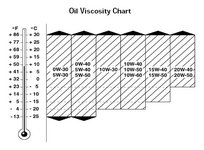
No. I would still go by MB factory recommendations for viscosity. Ill have to double check the chart, but I think that MB only recommended 5W oils for the very very very coldest temperatures.

They recommended 10W and 15W oils even for applications well below freezing, and even 20W-50 for applications DOWN TO freezing.
 
Thanks Vookster for saving me a trip downstairs to my office at 0240 hours.

As I have said, a 5W oil is only recommended for the very coldest applications, and there is NO 0W oil listed. How many people drive their E5E at a temp that is 0F or below? I would venture to say not many.

And thus, not really needed. Remember, these engines were designed for and LOVE thicker oils. Unlike today’s engines, which are designed for 0W and 5W oils.

A 10W-40 or higher viscosity oil is going to be fine for pretty much any situation that anyone on this forum will find themselves in.

I used 15W-50 full-synthetic RedLine oil in my E500 in the warmer year-round climate of Texas, and continue to use that same grade here in Maryland. I use 15W-40 in my M104 in Texas for many years, and continue to use it here in Maryland.

I have adjusted my M117 from 20W-50 in Texas to 15W-40 or 10W-40 here in Maryland. I am going into my fourth winter here. I have yet to see a temperature drop below 20F in the dead of winter. I think this is due to both geography (Mid-Atlantic state as compared to New England), living just 2-3 blocks from the water (Chesapeake Bay & the Severn River), and, of course, Global Warming.
 
Just so that all variants of the scenario are presented, there is this:


“U.S. Vehicles Model Year 1997 and Earlier Engine Oils.”
spec.jpg

Also note that the viscosity chart below – published by MB in “Factory Approved Service Products August 2007” – supersedes ALL previously published viscosity charts; again, according to published documents available from Mercedes-Benz. Select the appropriate oil viscosity based on the lowest air temperature expected before your next oil change.

chart.jpg

Reference: Mercedes-Benz Approved Engine Oils « AMG Market | AMG Mercedes-Benz Enthusiasts
 
Back
Top