

For some months now, I've noticed what I've come to believe is a "lazy" thermostat .. meaning that the car takes a while for the coolant temp needle to get to the 80C mark. In cold (40-60F ambient...remember, I live in Texas!) weather, it can take 6-7 miles, which is too long.
Seeing as in 11+ years of ownership, I've never replaced the thermostat, I felt it was time to do this.
My E500 is a fairly early 1994 model year production car, with production date of Oct. 18, 1993. The EPC indicates that the correct thermostat for the car is the part number 116 200 03 15, which is also shared with my 560SEC. I had a spare Behr thermostat with this part number in my parts stock.
Tools needed:
Parts needed:
The first thing to do with this job, is to clean the area thoroughly by giving it a nice shot of brake cleaner. Here's an overview of the area, as cleaned and just before the job is started.

After you've cleaned the area, you want to remove the plastic under-cladding panel. Remove the 6-8 eight-millimeter bolts that hold the panel to the bottom of the engine compartment. Set the cladding panel aside; you may want to clean it up later.
Then, you want to drain the coolant from the radiator. To do this, look up and behind the front bumper until you find the pet-cock. This should be a little knurled plastic wheel with a slot for a screwdriver in it. Using your stubby flat-blade screwdriver, and getting your drain pan ready, loosen the pet-cock a few turns, and the coolant will start to flow out the drain tube. Loosen it a bit more with your fingers, but don't remove it totally from the bottom of the radiator.
Here are a few photos of the pet-cock wheel, loosening it, and the coolant draining. You should expect around a gallon of coolant to drain into your pain. Be sure to check the condition of the coolant -- it should generally be a light golden color (sort of like pee) but should be clear and free of any cloudiness.


Let the coolant drain into the pan for a couple of minutes. Then, the next step is to remove the short hose that attaches to the thermostat housing. This is a straight ring clamp, so you can use your long, flat-blade screwdriver to loosen its clamp. Slide the loosened clamp down onto the hose body.


Side note: Look at the condition of the serpentine belt in the first photo directly above. You should ALWAYS examine your belt visually for cracks, and replace it if you see any cracks or fraying. Note that this serpentine belt had last been replaced in January, 2013, so it is exactly two years old. Texas heat is not very forgiving of rubber parts.
After loosening the clamp, CAREFULLY stick the end of your screwdriver, or a hooked tool, in between the end of the hose and the housing, to break the hose free from the housing. This will help you remove it from the housing in a minute.
If you are feeling REALLY ambitious, also loosen the bottom clamp that attaches the other end of the hose to the alternator support. This will make it MUCH easier to remove the thermostat housing from the side of the water pump. Otherwise, you can just bend the hose out of the way, but you should be VERY careful not to rip the hose, and if it looks old/beat up or otherwise not in good condition, REPLACE THE HOSE ASAP.
In my case, I didn't like the look of the hose - it was slightly bulged - so I opted to replace it. See below for the condition of my hose after I removed the top clamp.
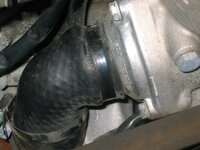


After working the hose free from the thermostat housing, you can begin to remove the thermostat housing itself. It is held to the side of the water pump by three 10mm bolts, with washers. Two of the three bolts are extremely easy to access; the third one, down and behind the hose, is much more difficult. This third bolt is best accessed with the hose out of the way, and using either a wobbly extension with your 10mm socket, or with a "deep" 10mm socket. It is very difficult to see this third bolt, so you have to do this partially by "feel." Take good care not to strip this third bolt head !!

Here are all three bolts, removed. You can see the wobbly and socket apparatus I used to access the third (difficult) bolt. The engine oil dipstick, which is partially in the path of accessing this third bolt, can also be loosened from the cylinder head (it's a single, small Allen bolt to do this) and that can make a bit more room for a "straight on" purchase on the head of this third thermostat housing bolt.


After the three bolts are removed, you can generally break the thermostat housing away from the water pump housing by wiggling it back and forth with your hand. First photo below shows it starting to come free; the second one shows it broken free and ready for removal from the vehicle.


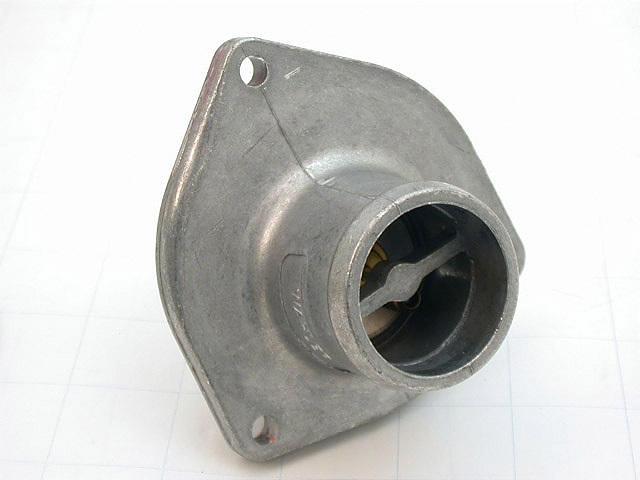
Here are a few views of the thermostat and housing, as removed from the water pump housing.

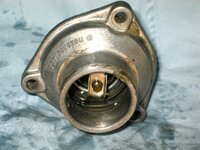


CONTINUED IN NEXT POST ...
Seeing as in 11+ years of ownership, I've never replaced the thermostat, I felt it was time to do this.
My E500 is a fairly early 1994 model year production car, with production date of Oct. 18, 1993. The EPC indicates that the correct thermostat for the car is the part number 116 200 03 15, which is also shared with my 560SEC. I had a spare Behr thermostat with this part number in my parts stock.
Tools needed:
- 8mm socket (1/4" drive)
- 10mm socket (1/4" drive), wobbly & short extension optional
- stubby flat-blade screwdriver
- long flat-blade screwdriver
- Brake cleaner
- Six-quart drain pan
- Shop towels and absorbent rags
- MB coolant (if needed)
Parts needed:
- Thermostat kit, MB part number 116 200 03 15 (most cars, all USA-spec 036's)
- 90° coolant hose 119-203-02-82 (optional, but prudent to replace)
The first thing to do with this job, is to clean the area thoroughly by giving it a nice shot of brake cleaner. Here's an overview of the area, as cleaned and just before the job is started.
After you've cleaned the area, you want to remove the plastic under-cladding panel. Remove the 6-8 eight-millimeter bolts that hold the panel to the bottom of the engine compartment. Set the cladding panel aside; you may want to clean it up later.
Then, you want to drain the coolant from the radiator. To do this, look up and behind the front bumper until you find the pet-cock. This should be a little knurled plastic wheel with a slot for a screwdriver in it. Using your stubby flat-blade screwdriver, and getting your drain pan ready, loosen the pet-cock a few turns, and the coolant will start to flow out the drain tube. Loosen it a bit more with your fingers, but don't remove it totally from the bottom of the radiator.
Here are a few photos of the pet-cock wheel, loosening it, and the coolant draining. You should expect around a gallon of coolant to drain into your pain. Be sure to check the condition of the coolant -- it should generally be a light golden color (sort of like pee) but should be clear and free of any cloudiness.
Let the coolant drain into the pan for a couple of minutes. Then, the next step is to remove the short hose that attaches to the thermostat housing. This is a straight ring clamp, so you can use your long, flat-blade screwdriver to loosen its clamp. Slide the loosened clamp down onto the hose body.
Side note: Look at the condition of the serpentine belt in the first photo directly above. You should ALWAYS examine your belt visually for cracks, and replace it if you see any cracks or fraying. Note that this serpentine belt had last been replaced in January, 2013, so it is exactly two years old. Texas heat is not very forgiving of rubber parts.
After loosening the clamp, CAREFULLY stick the end of your screwdriver, or a hooked tool, in between the end of the hose and the housing, to break the hose free from the housing. This will help you remove it from the housing in a minute.
If you are feeling REALLY ambitious, also loosen the bottom clamp that attaches the other end of the hose to the alternator support. This will make it MUCH easier to remove the thermostat housing from the side of the water pump. Otherwise, you can just bend the hose out of the way, but you should be VERY careful not to rip the hose, and if it looks old/beat up or otherwise not in good condition, REPLACE THE HOSE ASAP.
In my case, I didn't like the look of the hose - it was slightly bulged - so I opted to replace it. See below for the condition of my hose after I removed the top clamp.
After working the hose free from the thermostat housing, you can begin to remove the thermostat housing itself. It is held to the side of the water pump by three 10mm bolts, with washers. Two of the three bolts are extremely easy to access; the third one, down and behind the hose, is much more difficult. This third bolt is best accessed with the hose out of the way, and using either a wobbly extension with your 10mm socket, or with a "deep" 10mm socket. It is very difficult to see this third bolt, so you have to do this partially by "feel." Take good care not to strip this third bolt head !!
Here are all three bolts, removed. You can see the wobbly and socket apparatus I used to access the third (difficult) bolt. The engine oil dipstick, which is partially in the path of accessing this third bolt, can also be loosened from the cylinder head (it's a single, small Allen bolt to do this) and that can make a bit more room for a "straight on" purchase on the head of this third thermostat housing bolt.
After the three bolts are removed, you can generally break the thermostat housing away from the water pump housing by wiggling it back and forth with your hand. First photo below shows it starting to come free; the second one shows it broken free and ready for removal from the vehicle.
Here are a few views of the thermostat and housing, as removed from the water pump housing.
CONTINUED IN NEXT POST ...


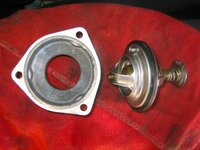


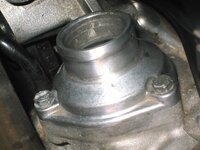


 Obviously this is an M104 not an M119, but the care taken should be the same (plus you have TWO plugs on an M119).


 Correct number is: 119-203-02-82


