• Hi Guest !

    Welcome to the 500Eboard forum.

    Since its founding in late 2008, 500Eboard has become the leading resource on the Internet for all things related to the Mercedes-Benz 500E and E500. In recent years, we have also expanded to include the 400E and E420 models, which are directly related to the 500E/E500.

    We invite you to browse and take advantage of the information and resources here on the site. If you find helpful information, please register for full membership, and you'll find even more resources available. Feel free to ask questions, and make liberal use of the "Search" function to find answers.

    We hope you will become an active contributor to the community!

    Sincerely,
    500Eboard Management

M119 and M113 - bit of comparison

Thought i would drop in and update you guys on Tim La Trobe in NZ with his M119-970 block that he has recently swapped in after cracking the last one during racing late last year in his W126 SEC
The last M119-970 block he had the liners bored out to 102mm (with his M117 crank & rods & Wiseco custom forged pistons and comp ratio was 9:9.1) to create a 6.3litre M119-970 engine

This recent installed M119-970 block has Darton liners inserted with wiseco 100mm forged pistons and the compression raised to 11:7.1
Dropped back to 100mm bores with thicker liners to ensure plenty of meat in the liners this time ( the last 102mm bored liners proved a bit too thin in the wall)
Again this fresh block is running an M117 crank and M117 rods (same as the last block) and there has been no issues with the crank and rods with constant track work shifting at 7,500rpm
This engine has custom built intake manifold (by Tim himself) with a front mount 102mm cable operated throttle body and it works well

His power result has gone up from the last engine with the initial tuning on one of those dyno's that bolt up direct to the rear hubs to eliminate tire slippage.
Tuner is estimating around 680-700hp at the engine with it limited to 7,500rpm
Remember this SEC is running a manual "dog gear" gearbox (so no Auto Trans calculations)
Tim is sure there is more power waiting to be found!! Especially in valve timing and exhaust as its still making solid power at 7,500rpm so he believes it could handle more revs.
But he is just happy to have this much power on tap and being able to drive it and will try for a test day in the next few weeks as have the first race round on the 3rd of Sept at Hampton downs in NZ

Do yourself a favour and listen to his dyno pulls with a decent sound system
https://www.facebook.com/tim.latrobe...type=3&theater
https://www.facebook.com/tim.latrobe...10408232513251
https://www.facebook.com/tim.latrobe...type=3&theater

These are "Very impressive" results for a naturally aspirated M119-970 engine showing its true potential for a 25yr old engine design. Its all about allowing the engine to breathe.
700hp at the engine would have to be the most ever seen out of one of these engines in N/A form

Be great to see the W126 SEC back out on the track fresh with a new engine - awesome sound
For those who missed out on that sound last year here is a reminder of what this mighty SEC sounded like in some dialing in practice laps last year (2015 with the previous M119-970 block)
Again -turn up your base & sound system and have a listen
https://www.facebook.com/tim.latrobe...type=2&theater


Last edited:
Awesome @!

Love the deep throaty roar! Someone send him a 500eboard link. We need him.
 
Last edited:
FYI i did a big write-up on Tim's SEC and his engine build on the BW forum some time ago with tons of pics
http://www.benzworld.org/forums/w126-s-se-sec-sel-sd/2407961-beast-has-arisen-her-3yr-sleep.html
If you would like/prefer a dedicated thread here on this forum of his handywork in the performance section just mention as Tim is always too busy to post on forums and only drops in updates on his own facebook page from time to time.
He has pushed the boundaries of these engines and really unlocked the M119's true potential "in modified form" to get them breathing properly and kept the engine naturally aspirated which has culminated in amazing results now.
 
Just wonder.. will M119 outlive M113 ?
I heard that M113 does burn more oil.than M119 ..but M119 hardly burn some oil...almost nothing... does that mean that he is gone have more lifespan...in miles...???
 
Just wonder.. will M119 outlive M113 ?
I heard that M113 does burn more oil.than M119 ..but M119 hardly burn some oil...almost nothing... does that mean that he is gone have more lifespan...in miles...???
There are so many variables that go into something like this, that it's really impossible to say in a general way. Maintenance, usage pattern of the engine, etc.

Both engines seem to be quite durable, and as time has gone by I think the M113 has increasingly impressed folks with its durability and ease of maintenance. Not to mention the various power levels and mods (superchargers, etc.) that are available for it.

Bottom line - I think both engines are great. The M119 was engineered in a different era, and with a different philosophy and goal, than the M113. I cannot say that it means that one is clearly better or worse than the other.

Cheers,
Gerry
 
I don't know about the M113 but a really good M119 will use almost zero oil over 5-7kmi oil change intervals, with Group IV/V synthetics. More typical is using a quart of oil in 3-5kmi. When M119 consumption gets down to a quart per 1500 miles or less, something is probably wrong... external leaks, valve stem seals, something along those lines.

What that means in total lifespan? No clue... the M113 could still live a long time while consuming more oil. Anyone know typical consumption rates on the M113, for standard & Kompressor versions?

:scratchchin:
 
In almost 70,000 miles of driving my E500, I've yet to see ANY measurable oil usage whatsoever, with either partial synthetic (Mobil 1) or Group IV/V synthetic (RedLine).

Leaking valve stem seals & valve guides don't seem to be an issue with the M119, unlike they start to be at around 125,000-150,000 miles with the M117. This is in large part because the valvetrain geometry is different with the M119, which doesn't place the side-load on the valve stems that wears the guides and seals that the M117's valvetrain geometry does. The M117 has an amazingly loose factory spec for oil consumption -- I was shocked when I first saw it. Since I had new valve guides pressed into the heads of my M117 about 6.5 years ago, it hasn't consumed a measurable amount of oil either.

Same valvetrain geometry issue exists with the inline-six M103 (valve stem/guide wear) vs. the M104 (little to no valve stem/guide wear).

Perhaps Klink can comment on what he has seen with the M113 with regard to oil consumption.

Cheers,
Gerry
 
Yeah I remember my W124 E420 1995..(sold in 2013) I was really impressed.... I'd never add a oil between... oil chainges
3.5k interval... Every time when I pull out the dipstick.. it been same amount of oil.... Now I am driving Toyota Avalon 2011... it's sucks.:doh:.. planning to sale in spring ... looking for E430 01-02 or S420 98-99..
 
... looking for E430 01-02 or S420 98-99..
Not to get too far off topic, but the W210 E430 and W140 S420 are VERY different vehicles. The engine difference is basically irrelevant between those choices. Make sure to test drive some of each before making a decision...

:seesaw:
 
Not to get too far off topic, but the W210 E430 and W140 S420 are VERY different vehicles. The engine difference is basically irrelevant between those choices. Make sure to test drive some of each before making a decision...
Thank you...
Yes I know they are Very different.. but basic maintance probably in M113 much easier i mean (oil changes) .... Hmm.. Oil chaineed interval.. I would never go above 5k miles..even with synthetic .. I don't trust to all that "Dealer Suggestions" I believe in conspiracy theory. They doesn't wanna see relible engines..no any more.. . .. It's called "Marketing" Just saying For me onlyM113 or M119 or M117.. Don't trust M273....or M278... I believe M113 was the last engine...
 
Yes I know they are Very different.. but basic maintance probably in M113 much easier i mean (oil changes) .... Hmm.. Oil chaineed interval.. I would never go above 5k miles..even with synthetic .. I don't trust to all that "Dealer Suggestions" I believe in conspiracy theory. They doesn't wanna see relible engines..no any more.. . .. It's called "Marketing" Just saying For me onlyM113 or M119 or M117.. Don't trust M273....or M278... I believe M113 was the last engine...
5k intervals are fine for normal service, as long as you are using an oil that meets MB's requirements. M119 and M113 have both proven to be very reliable, even more so than the M117 IMO. M273 has a good reputation so far, it was the M272 that was a nightmare. Don't know anything about the M278. All those are too new for my budget anyway.

If you buy an M119 make sure to pull both valve covers and oil pan to inspect chain rails, replace as needed, and clean the debris out of the sump.

:hornets:
 
I'm not Klink,

But the reduce valve guide wear is due to the OHC where the buck style lifter takes out side load where the rockerarm type has some side wear. 4V vs 2V designs, the valve is lighter,less mass=less wear.

For previous discussions on CVCC from honda- that's a lean-burn design and not a "3 valve" cost reduction. Small intake valve has a richer charge than the primary valve which is the leaner mixture.
 
Both M113 and M119 results shown in those threads were very good (pics attached below). 1 bar deviation from highest to lowest is within spec and nothing to be concerned about.

All of my M119's that I've tested have been within spec, and IIRC all may have been 1 bar max deviation, one engine was 0.5 bar max from highest to lowest cylinder.

:mushroom1:
 

Attachments

  • 1312346d1423189745t-photo-diy-engine-compression-testing-m113-18.jpg
    1312346d1423189745t-photo-diy-engine-compression-testing-m113-18.jpg
    31.2 KB · Views: 16
  • 242691d1244410098-photo-diy-m119-engine-compression-check-12.jpg
    242691d1244410098-photo-diy-m119-engine-compression-check-12.jpg
    59.7 KB · Views: 18
Guys check this ... compression test M113 and M119...
M113 with 100k....
http://www.benzworld.org/forums/g-c...n-testing-m113.html#/topics/2273146?_k=qtm4ut

This M119 but I don't know how many miles...
http://www.benzworld.org/forums/w14...pression-check.html#/topics/1449960?_k=8xu0mr

Does that mean that M119 has more durable piston rings..???.or its the maintance ... ???.
I am impressed.. M119 has less variation in cylinders compression...
Rule of thumb ... ALWAYS take anything posted on Banzworld with a grain of salt.....
 
Guys.. how would you compare M119 or M113 to GM LS series engines? Which on your opinion better in terms durability & reliability and longevity ..? it would be nice to hear, from Mercedes mechanics. I Mercedes freak .. i dont know much about GM engines . Is that push rod system In LS engines that great?
I also heard that LS engine use a M117 design !
 
I also have a 2006 ML500 and get 26mpg on a run, uk gallons so 4.54 litres. That's normally 4 up with the dog doing 80mph, it's a very efficient engine and I can do that time and time again. In general use I'm around 20mpg with short trips less than 10 miles and lots more accelerating and braking.

The M119 is a fantastic engine with lots of character and real low down guts. The M113 is a great engine but missing that last bit of zing and character. I'm very happy with both engines in their roles.

Dave!
 
Got the SL500 at 92k miles June 2015, currently 121k. 2 oil changes in between (93k, 103k) and haven't had to top off oil yet. I am pleasantly surprised by the M113. FSS finally showed 1200 miles till service. I scanned with C3 and WinHHT and found by driving highway it gives you mileage balance between changes.

Only downside is the cost to maintain as noted... 16 plugs, 16 ignition wires, 8 coils, 4 o2 sensors... so far replaced all buy 6 coils and upstream o2 sensors.

Just for kicks I read the last 5 oil changes as stored in computer and also referenced maintenance booklet for the rest (I'm 2nd owner), intervals are as follows:

10.1k 25.7k 39.6k 50k 63.2k 76.6k 93.3k 103.1k
 
I think Eric might be right on the bore spacing thing... This might explain the M117 inspired LSX builds on other forums. Just Google... M117 and/with LS1... I haven't confirmed it yet I need to measure or CMM the block at some point in the next year or two. Extrapolating from the the head gasket dimensions I get like 112 mm~ish bore spacing. I think it might be 111.8mm, because I'm making the assumption General Motors just copied Daimler's bore spacing logic.

There used to only be two Alusil liner/sizes.

Also the Nissan Titan Engine vs the original 45 engine from the early 1990s... The big difference is the current engines don't have the factory engineered bedplate.

Also when Renntech bored out a few M119s to 102mm part of the reason they probably failed is due to the fact they bored out/through the factory/oem installed Alusil liner.
 

Attachments

  • Screenshot_2019-04-22-19-03-31-183_com.google.android.apps.docs.jpg
    Screenshot_2019-04-22-19-03-31-183_com.google.android.apps.docs.jpg
    75.4 KB · Views: 19
  • IMG_20190422_190627.jpg
    IMG_20190422_190627.jpg
    223.9 KB · Views: 16
  • IMG_20190422_190442.jpg
    IMG_20190422_190442.jpg
    255.2 KB · Views: 20
  • IMG_20190422_193103.jpg
    IMG_20190422_193103.jpg
    130.6 KB · Views: 24
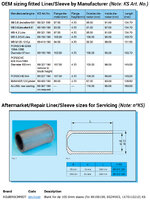
The chart above shows diameters for 5.0/5.6L engines with 96.5mm bore (note the ID shown is 95.5, allowing for etching).

That chart does not show data for 6.0L engines which have 100mm bore.

Also, AFAIK... the M119 blocks did not use liners from the factory. The liners are for repair work, not the initial builds.

:klink:
 
102mm leaves you with Next to Nothing for the gasket to seal against. That size bore seems to be more the hallmark of Brabus over RT in IME.

GM paid AMG to come out and do a big display/show them what they were up to in the 1980's...used the Nissan proving grounds out west.
AMG even did a design concept with wheels/body kit and interior on a period late 80's Caddi... I wonder where that thing ended up??

jono
 
102mm leaves you with Next to Nothing for the gasket to seal against. That size bore seems to be more the hallmark of Brabus over RT in IME.
I agree, the gasket seal is probably the biggest issue with 102mm bore. Hmmm.... machine it for O-ring seals instead? :jono:

Did anyone except RENNtech and Lorinser try a 102mm bore? The Brabus 6.4L (badged 6.5) used 101mm bore with custom 100mm stroker crank. I think Lorinser also did a 101mm bore with 6.1L displacement.

:scratchchin:
 
Also, AFAIK... the M119 blocks did not use liners from the factory. The liners are for repair work, not the initial builds.

This is just me extrapolating from my interpretation of the data/information.... All blocks are sleeved at the factory. I think conceptually this is what makes such motors "modular". You cast a frame/shell and drop in whatever sleeve suits the platform in which it is fitted.
 

Attachments

  • ALUSIL.jpg
    ALUSIL.jpg
    933.6 KB · Views: 13
Hey ! Long time no talk :)
Does this engines were designed for a different oil weight ? M119 has developed with 10w40 and M113 with 0w40 ? Do they interchangeable?
 
It's all dependent on the climate that you run the vehicle in. Certainly oils are interchangeable, but IMHO it is not advisable (though it is certainly POSSIBLE) to run 0-weight oil in an M119. 5- and 10-weight oils are better.

The M113, being more modern, I think is better able and spec'd to run 0-weight oils (as well as 5- and 10- and others).

The older motors are better with slightly thicker oils, in my opinion.
 
It's all dependent on the climate that you run the vehicle in. Certainly oils are interchangeable, but IMHO it is not advisable (though it is certainly POSSIBLE) to run 0-weight oil in an M119. 5- and 10-weight oils are better.

The M113, being more modern, I think is better able and spec'd to run 0-weight oils (as well as 5- and 10- and others).

The older motors are better with slightly thicker oils, in my opinion.

I agree. My own experience is that both the m113 + m119s run nicely on a high quality 5w40 Fully Synthetic Oil. I had lifter noise on a m113 that was cured by changing up from a 0w30 oil the car came with.

I run 0W40 Mobil One fully synthetic Turbo diesel oil in all modern Diesel Benzes. And Shell Helix Ultra fully synthetic 5w40 in m104, m113, m119 & m275 engines.
 
The M117 especially likes heavier oils. I've run 20W-50 Brad Penn for many years in my 560SEC, though I will be moving to 10W-40 Brad Penn in the colder climate of Maryland.

Generally with my M119 I run 10W-40 Redline or close to it. For my M104 (G-wagen), I run 15W-40 diesel-grade oil (Chevron Delo 400).
 
I once heard that M113 was designed were even 229.1 wasn't exist... but 229.1 has recommendation of 10W40 and Up..From that point I can make a conclusion that M119 "required" thicker oil... if M113 does too.
A am running in my M113 Castrol GTX HM 10W40!
Anybody tried use 0W40 in M119 ? How is it ?
 
I once heard that M113 was designed were even 229.1 wasn't exist... but 229.1 has recommendation of 10W40 and Up..From that point I can make a conclusion that M119 "required" thicker oil... if M113 does too.
A am running in my M113 Castrol GTX HM 10W40!
Anybody tried use 0W40 in M119 ? How is it ?

From MB Maintenance Manual: The left column refers to ambient air temperatures in your climate.
I use what MB recommends. For the climate I live in, which ranges from 40F-105F, I use 15W-50 (Mobil-1 from WallyWorld), year round.
Please Note - MB does not recommend using zero W anything on the M119.

1572666138703.png
 
@Jlaa is 100% correct. The fluids brochures that came in the E500E owners manual pack, which I’ve scanned and posted here on the forum, should be gospel when it comes to determining oil thickness.
 
The original article (web page) that kicked off this thread has been unavailable since around 2013, so I went into the Wayback Machine and downloaded it as a PDF, and attached it to the original post.

Enjoy !!
 
Here is video about M119..
The guy saying that pre 1993 was best 5.0 ..they were monstrous ..I believe it's 119.960
Just wonder why no cars popular with m119 tuning ..
So in general m119 producing more power then m113 engine ?
 
Just wonder why no cars popular with m119 tuning ..
So in general m119 producing more power than m113 engine ?
My personal view is the 4v per cylinder M119 was pretty much maxed out from the factory in the .036, given the computers that could run it.

I don't think Mercedes ever maxed out the 3v per cylinder twin spark M113 from the factory. In the R129 SL500 I think they bumped it to 320hp, which is basically the same as .036 power (sans WOT enrichment).

I haven't looked at what AMG and other tuners got out of these engines with the same displacement. But my guess (owning both for over a decade) is that they're basically the same, with perhaps the M113 burning cleaner (two spark plugs per cylinder) and more efficiently. You can probably get more power out of an M113 with different intake and tuning, but MB never did.

For instance, oetuning.com reports tuning both the M119 and M113 for the R129, the M119 to more hp (341hp v 329), but the M113 to more torque (369tq v 351tq). I'm pretty sure this is nothing more than advanced timing and I'm not at all sure it shows up on every dyno this way. But it makes sense the M119 would make more hp with the added airflow of 4v versus 3v, though it also makes sense that it's a "leaner" power that doesn't burn as much gas or make as much torque as 2 spark plugs per bank. I'm no engineer but there's a logic there that makes sense to my brain.

maw
 
Last edited:
Here is video about M119..
The guy saying that pre 1993 was best 5.0 ..they were monstrous ..I believe it's 119.960
Just wonder why no cars popular with m119 tuning ..
So in general m119 producing more power then m113 engine ?
The early M119 wasn't necessarily the "best", it was just different. And it had the worst injection system, regardless of Pierre's assertion it was the "most reliable", which is hilariously inaccurate, IMO.

The M119 is not popular for tuning because there is no low-hanging fruit. Both the LH-SFI and ME 1.0 injection systems cannot be easily tuned. The LH systems have fixed ignition timing maps, so there's no easy power gain with timing advance. And the ME 1.0 systems can't be tuned via aftermarket software like the later ME 2.0+ systems... no way to change timing or fuel on those either. There are a couple German tuners that offer camshaft regrinds for the M119, but I've never seen before/after dyno graphs, and information on these cams are sketchy at best.

More commentary on Pierre's video at the link below:

 
Further to @gsxr point above about the computers, both Audi (S4, RS4, R8, etc) and Ferrari (Maserati 4200GT) have gotten more out of 4.2L naturally aspirated V8’s in the mid ‘00s than Mercedes got out of either of these in the ‘90s. That’s all computing software not hardware.

maw
 
Last edited:
Muddying the waters is that horsepower per liter can vary with peak RPM. Ferrari generally gets power from smaller displacement by revving to the moon. MB designs for healthy low/midrange torque and sacrifices peak power. There's no easy way to just rev the M119 higher, the bore/stroke ratio isn't ideal for really high RPM, and then the intake manifold becomes a choke point. Y ou can switch the intake to ITB's (full aftermarket engine management) but then you lose the low-end torque.

Many, many variables in this equation...

200.gif
 
Cousin Pierre is a lover of KE-Jet systems for both M117 and M119. That's just how he thinks. It is what it is.

As a 20+ year owner of both systems, I love them both equally. Completely different in execution. Both have their strengths and weaknesses. I have not found the KE-Jet to be any less reliable than the LH, though. In fact the KE will always get you home, no matter what. You lose an EZL on the LH, and you're either on 4 cylinders or dead in the water. You can diagnose KE-Jet with a simple multimeter - no special diagnostic equipment needed.

Yes, today it's ancient, but LH is pretty much also now on the cusp of being "ancient." Especially when I compare it with the direct injection and diagnostics of my 2019 boat motors. Volvo Penta + GM Gen V block V-8s FTW !!!

:gm::jono:
1038_a2015_0030.png

I know some of the "master mechanic" members here hate KE-Jet (along with W123 chassis cars), but it really is not so bad, and was pretty excellent for its time.
 

Attachments

What I like about the LH/ME electronic injection is that even at very high mileage (200-300kmi and beyond, like Glen's car nearing 700kmi) they can still perform 100% as new. And they are low maintenance systems - you don't have to remove/clean/replace injectors. Yeah, not a bad idea to keep a spare EZL in the trunk if you're the paranoid type (I do this for long trips, it's cheap insurance).

CIS mechanical injection has some wear items that make it a challenge to keep running properly as miles add up and stuff wears. Not many people know the sorcery required to make them run well, and obtaining the parts / rebuilt components needed could be another challenge. CIS is not bad when new / perfect, but it ain't easy keeping it that way.

:grouphug:
 
CIS is designed as some system components wear, to self-adapt. This is what the EHA valve does on KE-Jet systems or the infamous "warm-up regulator" on the earlier K-jet Lambda systems.

To be honest, I've never had to do a single thing to my CIS in 21 years and more than 100K miles. Except I replaced the injectors one time, at 183K miles. Also an EHA valve a couple of times over the years, as they do leak (this is mainly from ethanol fuel, and wouldn't be nearly the issue with non-ethanol fuel). Otherwise, never replaced a single component. EHA replace is a 5-minute job, though the component is expensive ($250-350). But, it's a very occasional replacement.

Overall, sort of equivalent to the cap/rotor/insulator weakpoint with the M119. KE systems can easily go 250K without any mechanical issues. The system is designed to run fine, even if any single component fails (except a fuel pump relay, but you can jumper those two prong holes with a piece of wire to activate the fuel pumps). CIS will ALWAYS get you home.
 
CIS mechanical injection has some wear items that make it a challenge to keep running properly as miles add up and stuff wears. Not many people know the sorcery required to make them run well, and obtaining the parts / rebuilt components needed could be another challenge. CIS is not bad when new / perfect, but it ain't easy keeping it that way.
Absolutely. It’s a fairly complex system with more moving parts, no one can deny that. They can go a long time without issues but if one does come about, it can be a total nightmare to solve.. or so I’ve heard. They are often described as finicky. Availability of parts in the future is also not certain.
 

Who has watched this thread (Total: 5) View details

Back
Top