• Hi Guest !

    Welcome to the 500Eboard forum.

    Since its founding in late 2008, 500Eboard has become the leading resource on the Internet for all things related to the Mercedes-Benz 500E and E500. In recent years, we have also expanded to include the 400E and E420 models, which are directly related to the 500E/E500.

    We invite you to browse and take advantage of the information and resources here on the site. If you find helpful information, please register for full membership, and you'll find even more resources available. Feel free to ask questions, and make liberal use of the "Search" function to find answers.

    We hope you will become an active contributor to the community!

    Sincerely,
    500Eboard Management

Camshaft adjustments for performance improvement

Jim

E500E Guru
Member
On this link

http://www.928motorsports.com/parts/offset_camshaft_keyset.php

I read as follows...

"Advancing or retarding the camshafts in relation to the crankshaft is another performance tool you have to move your power and torque exactly where you want it.

Advancing a camshaft opens the intake earlier and closes the exhaust earlier. This will shift the power curve down, and produce more low range torque at the loss of a little top-end power.

Retarding the camshafts shifts the power band up, increasing mid-range and top-end torque, at the loss of the bottom-end."

I think the comments above are talking about single overhead camshaft design but the story would still apply e.g. more inlet camshaft advance will give less fresh charge loss.

So...

I have seen camshaft off-set keys ( say 3 deg. to 6 deg.) on other engines as a means of managing timing chain stretch.
Is it possible to fit the 32v M119 with camshaft offset (woodruff?) keys to allow the adjustments outlined on the 928 site.

Here is alink showing what the keys look like.

http://www.928motorsports.com/parts/offset_camshaft_keyset.php

If offset keys are not an option and since the M119 variable inlet valve timing has a range of 25 degrees and one tooth on the sprocket is 18 degrees...could the inlet camshaft be advanced by one tooth? I can see that the maximum advance would then be 18 + 25 = 33 degrees...

I suppose Vernier adjustable sprockets is another option.

Any advice would be appreciated.

Jim.
 
Changing cam timing is an old trick. Done it a bunch on 911's engines.

But, the M119 engine has variable intake timing to eliminate someo of the trade-off's with timing fixed timing design. I would think that modifying the advance/retard mechanism to get a another 4-5 degrees might be helpful- but I won't do offset keys. There is a tech paper you can purchase from the SAE library by mercedes on the effects of varying intake, exhaust timing. I think engineers felt like they capured ~90% of the benifit with intake timing varing. Note the new AMG 6.3 varies intake timing by 45 degrees(!!!!), instead of our M119's 20 degrees.

Hope I got my facts right..
 
You can adjust the cams to whatever you want if you remove the dowel pin and slot the cam sprocket mounting bolts. But checking / adjusting the timing via dial gauge is absolute torture on the intake cams, as you have to fully assemble the cam adjuster and re-install the exhaust sprockets, chain, and tensioner after each adjustment... then rotate the engine a bunch of times to measure, then tear it all apart again to adjust, and keep repeating until you get the desired numbers. The exhaust cams are easy to dial in since you can access the sprocket bolts with the chain installed.

The other problem is knowing what to adjust them to. So you move things a few degrees and dyno the engine, and the results aren't what you wanted... now tear it all apart and change it again, go back to the dyno, repeat... are you getting the idea how much R&D this is? You're probably better off buying performance cams from Hagmann or dBilas instead. Bolt those in and go.

BTW - one tooth on the cam sprockets = 20° CA (crank angle). There are 36 teeth on the cam sprocket, 10° cam angle per tooth, which is 20° crank angle per tooth (the cams turn once for every 2 turns of the crank).


:seesaw:
 
Thank-you for the correction on the angle for one tooth.

So are there any cam off set keys useable on the M119 even if it is only for chain stretch managment?

Jim
 
So are there any cam off set keys useable on the M119 even if it is only for chain stretch managment?
There are none from the factory, and I have never seen anything aftermarket either.

If the chain is stretched significantly, it should be replaced. There is no factory spec, but based on my personal observations, when you can measure 6° of stretch (or more!) at the right/passenger exhaust cam, the chain should be replaced. Up to 3-4° is probably normal, as all chains will stretch slightly after 10k-20k of break-in. With a brand new chain the measured stretch should be 0-1°.

:banana2:
 
Thank-you Dave...nice and clear now.

Any thoughts on keeping the inlet advanced? It would be easy to apply 12v to the solenoids with some control system or just a switch...or is that going to upset the CAN Box inhabitants?
 
If the intake cams are kept advanced via the solenoids, idle quality is poor (rough idle), and top-end power is reduced. The factory setup really is quite good.

If you are looking for more high-RPM power, I'd look into the Hagmann or dBilas cams (click here).

If you want more low-end torque, start saving up for a 6.0L conversion / upgrade... :D


:apl:
 
Dave is correct with regard to offset Woodruff keys for the M119. There are three or four offset value Woodruff keys available from MB for the M117 (and aftermarket keys are easily available/usable too), but nothing for the M119.

Cheers,
Gerry
 
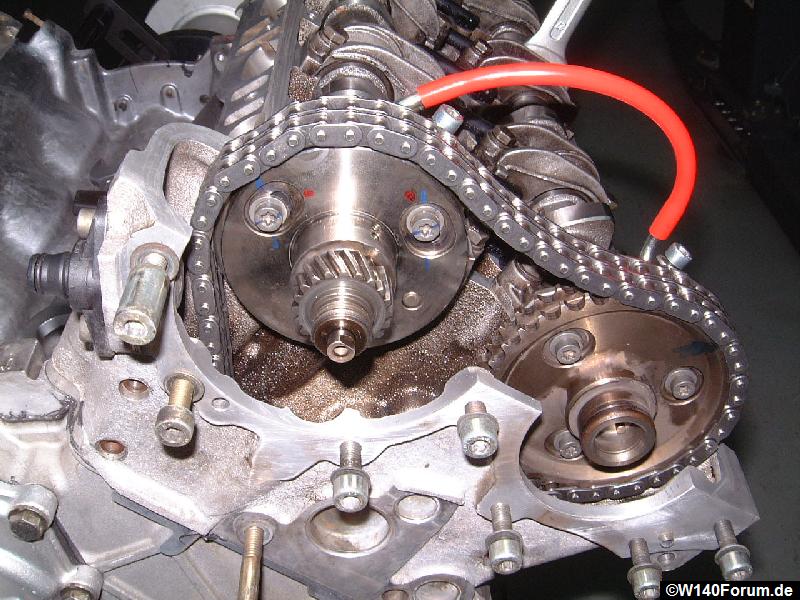
The attached picture I think comes from Bernard's 6.0 build. An image search found it for me courtsey of a member here (thank-you).

Looking at the inlet cam can I see that the sprocket holes are elongated thereby allowing some "degreeing" of the inlet valve timing. At least that is what I think I can see with my Xmas Cracker magnifying glass. Given the 20 degrees of advance already provided by the inlet cam solenoid device is seems odd to see the slotted holes.

It might make more sense on the exhaust where there is no adjustment other than moving the cam one tooth.

What do you think?
 

Attachments

  • Cam sprockets.jpg
    Cam sprockets.jpg
    102.2 KB · Views: 86
The attached picture I think comes from Bernard's 6.0 build. An image search found it for me courtsey of a member here (thank-you).

Looking at the inlet cam can I see that the sprocket holes are elongated thereby allowing some "degreeing" of the inlet valve timing. At least that is what I think I can see with my Xmas Cracker magnifying glass. Given the 20 degrees of advance already provided by the inlet cam solenoid device is seems odd to see the slotted holes.

It might make more sense on the exhaust where there is no adjustment other than moving the cam one tooth.

What do you think?
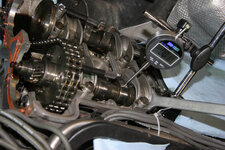
Bernard ordered custom camshafts for that particular engine build, and I believe that as with all RENNtech 6L camshafts, they require being set with a dial gauge, not with the pins as on the factory cams. The tool in the photo with the pins is simply holding the camshafts in place during assembly.

The slotted sprocket holes allow tweaking the cams as needed until the dial gauge shows the number specified by the manufacturer. AFAIK, Bernard never said where he got the specs for these cams, or who made them... only that they cost somewhere around $5000. (!!!)

Photo attached showing Bernard setting cams via dial gauge on that same engine build.

:spend:
 

Attachments

  • post-21-1190850937.jpg
    post-21-1190850937.jpg
    90.5 KB · Views: 64
I'm sure you could tweek a few hp by setting the cams exactly to spec with slotted pulleys or off-set key. But it's a bit of work and for how much gain?
If you were trying to win a race where engines are regulated to stock- it would give you an edge.


Michael
 
It might make more sense on the exhaust where there is no adjustment other than moving the cam one tooth.

Looking again at the picture I see there is a small amount of adjustment on Bernard's exhaust cam as well. That exhaust sprocket has more material in the center than the standard M119 sprocket. Would that come from an M104 engine? I have part number 111 052 00 01 as a possible replacement to allow holes to be slotted. I do not know if the face of the replacement sprocket will make perfect alignment for the teeth.
 
Looking again at the picture I see there is a small amount of adjustment on Bernard's exhaust cam as well. That exhaust sprocket has more material in the center than the standard M119 sprocket. Would that come from an M104 engine? I have part number 111 052 00 01 as a possible replacement to allow holes to be slotted. I do not know if the face of the replacement sprocket will make perfect alignment for the teeth.
I think they modify/machine the original M119 sprockets to elongate the holes. Not an off-the-shelf part.

:mushroom:
 
I have searched far and wide but cannot find a figure for the M119 Rocker Ratio...does any one know this please.
 
There is no rocker ratio. A rocker ratio is for cars with rocker arms. The M119 does not have rocker arms. The cams push directly on the lifters (followers / tappets).

:mushroom:
 
The OEM documentation gives a range of engine speeds where the inlet valve advance takes place; I think it says 1800 to 2000 rpm.

Since the actuation power for the camshaft rotation comes from the lubricating oil pressure; I think the 200 rpm range is quoted because at the lower engine speeds the oil pressure would be lower and hence possibly less hydraulic power available to move the camshaft.

Perhaps on an engine with "less oil pressure" the advance takes place at a slightly higher engine speed.

On my face lifted car it was very noticeable that the engine output improved at 1800 rpm with no throttle pedal movement. This with 3+ bar always indicated except in super hot traffic jams.

Jim
 
Jim

The M120 motors have an exhaust gear that gives you like 2.5 deg advance (If I remember right). You may see if that would work on the M119. Its the same gear used on the 3.6L M104 motors, or subs to now.

-Mike
 
I really think if someone wants to play with M119 timing- they need to go back to the bible where it was developed...

Mercedes engineers published SAE paper in 1988-1992 time frame with all the development detail and conclusions. If anyone has a large university library close whom can make a copy-I'd love to have a pdf(but not to the tune of $25/each).

I'm reading on newer cars, that is the real trick in getting more than 10-15 hp out of bigger cams, is you have to change the advance/retard points and the amount! To do that, you are talking about adjusting the cams in a few degree increments with the advance/retard disabled, dyno and repeat.

Is there a german linkedin or Mercedes retiree forum? Bosch? Maybe Christian could track down some of the guys whom did the development(aka names are on the papers). That would be a Star magazine worthy article. Getting to interview and discuss these engines with the guys whom did the development @ Mercedes.


Michael
 
Any information M119 stock camshafts? What are the differenceses between M119 variants? (M119.066, .071 , 074, 08x)? One cheap trick that has been used in other engines is to obtain extra intake cams and put them to exhaust side and re-grind only original intake cams. Is this possible in M119? I tried to do some search but I couldn't find any data on stock cam lift & timing.
 
Jouniu,

Please see this thread

http://www.500eboard.com/forums/sho...ng-Entry-into-Service-Guide&p=35040#post35040

post #3.

I must own up that the data presented does not take into account the different lift amounts that the various manufacturers use when specifying camshafts.
However assuming that Mercedes are consistent in their lift choice the data may partially answer your question.

There are 3 or perhaps 4 threads that deal with camshafts so search around, the OEM source material is linked a couple of times.

I have looked at the camshaft swop idea and I think it is possible but would need some electron beam welding due to the Differences in the two drive ends of the shafts.

Jim
 
The earlier M119.974 engines have a valve overlap of -43 deg based on measurements at 2mm valve lift. (later engines the figure is -44 deg.)

Does anyone know the amount of crank angle from the start of lift to 2mm lift. If both inlet and exhaust take, say 22 degrees, then on starting we have zero overlap, I do not think that is the case, especially as we have the exhaust air injection pump making sure that any un-burnt fuel (caused by some overlap) from the combustion chambers is burnt in the exhaust during start-up.
 
Hello guys,

one aspect with the cams of the M119 is the hydraulic tappets.
there is a great limitation in maximum contact pressure (camshaft acceleration) in order for the tappets to work.
just look at all the early problems with the m156 and valve gear (tappets wear out - major warranty claims)
mercedes fixed this for the SLS engine with upgraded tappets, but still there are issues.

with roller follower cams the whole lift curve can be made much more aggressive, and thus alot of performance improvement.

so why did BMW keep conventional direct tappets on the 8300 rpm S65??? cost reasons.
but note that these tappets have a curved top and an alignment tab in the tappet to prevent rotation.
the curved top allows for a larger contact surface with the cam when the lift is increased.


look at the audi s6+ that had 326 PS from 4,2 liters. Audi changed the tappets on the intake to mechanical ones to accomodate the more aggressive intake profile needed for the power.
the later S8 engine that produced 360 PS from 4,2 liters had a 5 valve head with a roller cam follower.

most volvo straight engines the last 20 years had mechanical tappets, there are no significant noise issues with this in my opinion.
(there are alot of 034 and 036´s with tin-can silencers that destroy far more of the sound picture that mechanical tappets would do)

so my first upgrade would be mechanical tappets for intake, double valve springs, titan retainers and upgraded cam.
but it´s not worth more than max 10 hp

I would really like to see a hard fact comparison of the cams.
Unfortunately I don´t have loose cams, but if someone could send me cams and share the postage cost I could offer
to get the cams to a doctor and have them measured (30-40 dollar per cam) and present the results here.
It would then be great to include 975, 980 and 985 cams in the same roll.
please send a PM if that is of interest to anyone.

cheers
Truls
 
Jim,

Look at this a little more. The MB M119 cam "straight up" installation for "normal load range" is in the retard position. If you want more top-end, you can retard the cams giving away mid-range torque for top end hp. When the cams are in the mid-range, the intake cam ADVANCES, so you will be farther apart than the factory in this mid-range mode. The retard mod versus valve head clearance is probably pretty generous for timing chain stretch- but I would carefully confirm it. It's pretty mindless for someone to mount a stock gear on a mandrel and elongate bolt holes on a mill. Setup is 90% the work, so I would get a few sets done if you are going to play and sell them to someone else.

Intake is a long tube design unlike your audi/bmw references. There is no free lunch and 95% of V8 use by ppl is below 4000 rpm. So giving up torque for a S-class is not a good match.

I did porsche work in the 90's and we would always put a degree wheel on every 911 the first time. But we'd try and move the timing point to match the driving style of the owner- move it advanced or retard. Naturally dependent on the displacement. Never advanced a cam on a 2.0 liter for instance. 2.7, 3, 3.2's. We played with them and the customers were very happy with the results.

I think that without more aggressive cams- you won't get much, but it will be noticeable and measurable. I think MB's-even AMG's they try and keep the civilness to the highest. No shacking or rough idle qualities- maintain reliability and emission qualities too=0)

Roller cams are well known for ages.. But you need to really understand better on flow vs lift. American iron needs aggressive profiles to get the same flow. ROT, 2 valve head will require twice the lift as a 4 valve for the *same flow*. I think the number I saw was Arao heads flowed 300+ cfm @ 0.320 lift, and 2.02/1.60 SBC heads with heavy porting required to break 300 cfm. Hondas/Fiats/Chevy/Ford/BMW/VW etc, looked at lots of them and the trend and numbers are there to support that ROT. It's approximate. So if you only need 10-11mm to get great flow- you the only gain will be reduced friction. We're not trying to lift the valve 16.5mm (aka 0.650 inch!!!) Remember too, the valve is lighter, so it is less likely to bounce/flow depending on angular velocity or acceleration.

If you want a higher redline- you can convert to flat tappets. The Bucket is 35mm and I believe either one of the other euro makes uses the same size. But you'll have to shim=) My old VW would run 10,000 rpm and the valves would float. BUT, I've never over-reved our engines as i's electronically limited to 6000 in neutral, I think the float point is speculative without data.

Dyno the car before and after.

Have you ever dialed in cams on a multi-valve engine? A M119 is not the easiest engine to dial-in.


Maybe you should just mill off the cam boxes completely and go with rotory valves like MB's ILMOR Indy engine and spin some crazy rpm!!!
 
:plusone:

Ditto what Michael said. FYI, some of the M119 performance chips increase short-term rev limit to 6600rpm and I believe Jono has explored that limit repeatedly with no ill effects. What we don't know is how far beyond 6600rpm the M119 will spin before there are issues with valve float, or the power curve falling off a cliff, or the LH fuel map is not available to support the beyond-design-spec RPM.

Manually adjusting M119 cams with a dial indicator is unbelievably slow, tedious work. I mean borderline torture, especially to adjust the intake cam, you have to remove the exhaust sprockets and disassemble the adjusters, put it all back together, measure again, if it's wrong take it apart all over, and repeat as necessary. BT, DT.
 

Attachments

  • cam_adjustment.jpg
    cam_adjustment.jpg
    211 KB · Views: 36
If you put a new chain and guides or measured 2 degrees or less- you could probably arbitrarily just set it to 6 and 8 degrees and try it.


"Manually adjusting M119 cams with a dial indicator is unbelievably slow, tedious work. I mean borderline torture, especially to adjust the intake cam, you have to remove the exhaust sprockets and disassemble the adjusters, put it all back together, measure again, if it's wrong take it apart all over, and repeat as necessary. BT, DT."

Nobody has ever described it other wise.

The only limit truely by LH-SFI is hexidecimal. Your are limited to 10,300 rpm.


M
 
adjusting valve lash on a DOHC is an All Day affair, if things go Well.. It's one thing on a SOHC engine w/ adjustable lifters...changing shims...UUUUGGGHHHH. it is not my most favourite job. Plus, Tim only had to swap out to solids in his track car when he was pushing under power @ 7500, down shifts to 8K. I don't plan on that.

With a stock 5.0 the 6600 is only handy for the over run coming into a corner should logistics make it preferable to shifting...Back to needing more cam to utilize the added RPM.

jono
 
So why did Bernhard do it?
I think Michael meant it was relatively easy to elongate the bolt holes to allow adjustment.

Berhard likely did it because the custom camshafts require adjustment, same as the 119.960 AMG cams (click here, see pages 16-17).

:mushroom:
 
Mindless as in not difficult or specialized accessories a machinist would have. Ppl are too often confused by "easy"= quick or low cost.

Honestly I think the whole discussion is just a desk exercise for most here... especially the 4.2 crowd.

Michael
 
I think Michael meant it was relatively easy to elongate the bolt holes to allow adjustment.

Berhard likely did it because the custom camshafts require adjustment, same as the 119.960 AMG cams (click here, see pages 16-17).

:mushroom:

That was nice document, Those cam gears need to be modified, already discussed that with friend who have milling machine, should be pretty trivial job. Intresting in that document was that they modify ignition timing -3 degress with that trim plug. Maybe the compression ratio is higher. Adjusting cam gears is painfull job as already said, done that several times to myt other car.

About hydraylic tappets, They survive 8000rpm+ and moderate cam profile, just need to use good oil. Also it is recommend to switch the latest M104 design tappets, they are much lighter than the old ones. (same issue also in other cars, early 90s hydraylic tappets are heavy compared to later ones.) I think there is not so many companies that produce hydraylic tappets, INA is one of them.
Japanese use solid tappet still in new cars, some supra guys use yaris tappets in theis 2jz engines.
 
The attached picture I think comes from Bernard's 6.0 build. An image search found it for me courtsey of a member here (thank-you).

Looking at the inlet cam can I see that the sprocket holes are elongated thereby allowing some "degreeing" of the inlet valve timing. At least that is what I think I can see with my Xmas Cracker magnifying glass. Given the 20 degrees of advance already provided by the inlet cam solenoid device is seems odd to see the slotted holes.

It might make more sense on the exhaust where there is no adjustment other than moving the cam one tooth.

What do you think?

proxy.php


Look again that intake cam. It looks like that positioning pin is still in place, it is then impossible to adjust cam. In that amg 500sl 6.0 introduction document says that those pins must be removed.
 
" Maybe the compression ratio is higher" Nope- they tried at R-T I believe, but no sucess. The 4.2 with a smaller bore runs 11:1, so I think you are running into detonation before the ignited mixture via the center. If you want to get crazy- you can get custom pistons to induce more charger tumble on the compression stroke. It would help power and pre-ignition.

"he attached picture I think comes from Bernard's 6.0 build. An image search found it for me courtsey of a member here (thank-you).

Looking at the inlet cam can I see that the sprocket holes are elongated thereby allowing some "degreeing" of the inlet valve timing. At least that is what I think I can see with my Xmas Cracker magnifying glass. Given the 20 degrees of advance already provided by the inlet cam solenoid device is seems odd to see the slotted holes.

It might make more sense on the exhaust where there is no adjustment other than moving the cam one tooth.

What do you think?"

Jim, Dialing in camshafts you are setting the camshafts to where the camgrinder/designer intended. The 25 degree intake VVT you don't want to mess with. What happens if you are 10 degrees retarded over design- then you are only getting 10 degrees of advance.
M
 
Look again that intake cam. It looks like that positioning pin is still in place, it is then impossible to adjust cam. In that amg 500sl 6.0 introduction document says that those pins must be removed.
Correct - the locating pins (tool) must be removed before adjustment. I think the photo was taken before adjustment was made??

Also note in this photo it appears there are markings for the T35 Torx bolts to be rotated 90°... don't do that. The 90° rotation is only for the T40 bolts used on later engines. I made the same mistake the first time too, there is unclear information in the FSM. The T35 bolt+washer is torqued to 18Nm with zero rotation afterwards. Someone else posted elsewhere on the forum that the later T40 bolts will not work on the .97x engines because they are longer and cause interference.

:klink:
 
Jim, Dialing in camshafts you are setting the camshafts to where the camgrinder/designer intended.
Yes - the adjustment procedure here is dialing in per specs of the camgrinder/designer.

I do not understand why cams were produced that require this procedure. Seems to me if they drilled the locating hole for the tool/pin in the proper location to begin with, adjustment would not be necessary. I wonder if this is a byproduct of regrinding, or if the blanks have the locating hole pre-drilled and it cannot be moved. I also think the late E60 cams (think 1994-up) use the tool, with no adjustment needed, as there is no mention of the procedure in the .97x AMG manuals.

:scratchchin:
 
Here is some pictures.

My friend modify original cam gears to adjustable. Also regrinded camshaft by Mauri Virtanen.
 

Attachments

  • intake.jpg
    intake.jpg
    34.3 KB · Views: 32
  • exh.jpg
    exh.jpg
    32.5 KB · Views: 37
  • cam.jpg
    cam.jpg
    30.5 KB · Views: 37
Any idea how much material was ground off of the base circle when re-profiling?
 
But we still need lashes below the hydraulic lifters, right? Thats whats holding me still back doing a regrind with Dbilas...

No need for lashes. These should be within adjustment range of hydraulic lifter, altough the advice is to buy new lifters, old ones probably do not last long. I guess this apply to Dbilas too.
 
No need for lashes. These should be within adjustment range of hydraulic lifter, altough the advice is to buy new lifters, old ones probably do not last long. I guess this apply to Dbilas too.
I heard otherwise. There is a guy here in this forums from a Scandinavian country aswell, that did a cam regrind and he also needed the lashes. I read it in other forums too with cam regrinds for the M119 engines.
 
I heard otherwise. There is a guy here in this forums from a Scandinavian country aswell, that did a cam regrind and he also needed the lashes. I read it in other forums too with cam regrinds for the M119 engines.


Correct, when a cam is reground, the material is removed from the base circle.

So an increase of 1mm lift or .040" causes a loss of valve spring pressure and the lifter is .040" off of the ideal preload.

Domestic push rod engines use either longer push rods or adjustable rockers.

A M117 can use thicker thrust washers available from 3.7mm to 6.15mm thickness

Also of note, the M119 lifter or as WIS calls it "hydraulic valve clearance compensating element"
only has 2mm of total stroke/movement.

So a 1mm reground cam would cause a 50% loss of "clearance take up"


.
 
Last edited:
Thanks about info. I quickly tested one cam with old lifters and there 0.05mm..0.10mm clearence with some valves. But using old random lifters does not tell much any way. As said regrind cams must be used only with new lifters, that is said also in dbilas web page.
 
No problem. I used to build engines for street racers (motorcycles like the GSXR 1100)
so I'm used to setting up DOHC heads, cam timing, shim under bucket valve adjustment,
piston to valve clearance, etc.

The Japanese bikes like my 1st 1979 Kawasaki KZ650 inline 4
had shim under bucket. I did my first valve adjustment on
that when I was just 17.
 
Yep "1mm reground cam would cause a 50% loss of "clearance take up""

Obviously you need to be pretty much centered in the range. On American Iron, typically if you ran them near fully pumped up, you could exceed the rev limit without issue. Typically, the lifer would not bleed off excess and hold the valve open as rpm was increased.
Done Jag 6 cylinder shimming, Fiat, VW, Alfa Romeo... Alfa's shim under the follower on the stem. Might be able to find an off the shelf shim. But then it depends if your engine serial number- there was a split where valve stems were reduced in diameter.
Hope my memory is good on the stuff above.

M


Michael
 

Who has viewed this thread (Total: 6) View details

Who has watched this thread (Total: 3) View details

Back
Top