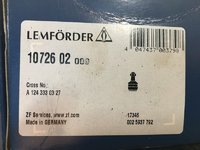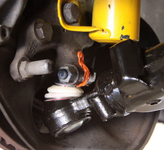

First and foremost, if your W124/R129 car is equipped with the LCA that uses replaceable lower ball joint, despite the few videos one may find online – not going to happen with out removing the caliper and and the rotor. Not unless one wants to butcher the dust shield.
The dust shield is shaped where it “hugs/cups” around the ball joint receiving end/knuckle, and the clearance between this part of the shield is only few millimeters. Not enough to “move” the shield out of the way and pull LCA down.
Once the caliper and the rotor removed, dust shield now has room to move outward, bending it slightly out of the way, and with that, the ball joint section of the LCA can easily be separated and clear the assembly.
Tools:
With the car secured, hand brake on and the wheels chucked, loosen the wheel bolts, jack the car, remove the wheel/tire, secure the car with jack stands for safety.
Over all there are only 4 bolts to be removed, but it will take a little time... Be prepared to move the steering wheel clock to clock for better access to those bolts.
Removed the 17mm steering stop bolt/pin (I don't know what else to call it), this would be much easier to access the 19mm nut of the ball joint

Onto the ball joint retaining bolt/nut combo, using 19mm socket
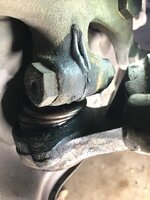
Loosened them up, did not remove the nut all the way, just taped it a little, to start the "extraction".
Using appropriate spring compressor, partially compressed the spring. This relieved the pressure from the LCA.
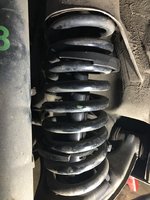
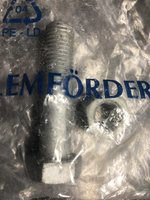
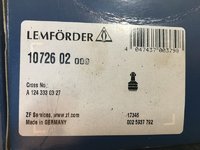
Placed the jack under the outer part of LCA, and jack up LCA just enough where one can see the shock assembly starting to move up, stoped right there. Now is the time to punch out the 19mm ball joint nut/bolt assembly. New bolts and nuts are included with Lefmorder kit.
Now it is time to remove the rotor and the caliper: 1 set screw and x2 caliper bolts (19mm) Hanged the caliper safely where no strain on the sensor or the brake line is introduced.
Bent the dust shield outward a little, and now it will clear the knuckle... Inserted the pry-bar in the suitable area and began the separation from the shaft. Once loose, started lowering the jack slowly, and separated completely.
Moved the strut hub assembly out of the way and secure it with the strap, needed this room maneuver around with the ball joint press tool
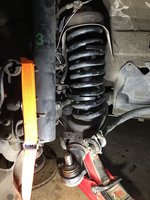
Tool kits are different, almost like a little puzzle. I borrowed this set from a friend, however, Autozone rents similar kit.
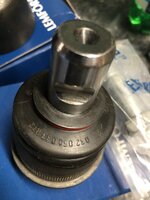
Before proceeded any further, please, note, there is a notch on the ball joint base:

Look at the car's old ball joint, note the position of the notch and make sure the new one goes in the same position/orientation of the notch.
[Admin edit: This assumes the "old" joint was original, and/or installed correctly. FSM job 33-0440 (link) has a diagram which shows the orientation of the notch, with the text "...the [notch] on the joint is aligned with the center of the control arm"
Found the appropriate size fitting, press the ball joint assembly out
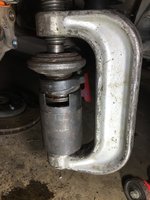
This old one came out in 3 pieces, definitely old and tired

Ensured that all the surfaces are clean prior to installation of the ball joint!
Placed the jack under the LCA and move LCA upwards, definitely need that clearance at the bottom to press the new ball joint in.
Positioned the new ball joint into receptacle, ensuring the proper orientation of the notch. This is the combination I found worked the best with this ball joint tool set:

Once firmly sited/pressed in, lowered the jack, released the strut/hub assembly and it is now the time to mate them together.
When the assembly is on the shaft of the ball joint, placed the jack back under the LCA:
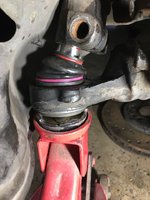
Jacked it up to the point where the shaft is all the way in and the shock assembly starting to move upwards... Ensured that the steering wheel is straight, looked into the hole where the 19mm, at this point it should be perfectly round. That opening should perfectly correspond with the notch on the shaft of the ball joint for that 19mm bolt to clear
I used the original bolt to test fit, just to make sure (that way there is no chance to damaging the treads of the new hardware):

With jack still under the LCA, remove the old "test" bolt, installed new bolt and nut supplied with the kit. Tightened down.
Bent the dust shield back to it's original orientation. Installed the rotor. Secured with set screw, I always like to apply a bit of anti-seize to that screw.
Installed the caliper back, securing it with 19mm bolts/hardware, torque to specs (115nm if I'm not mistaken), new hardware is recommended.
Re-installed the 17mm steering stop/bolt/pin.
Checked for completeness of all steps. Onto the other side you go... Hope this helps.
Regards,
D
P.S If any one can provide proper torque specs for the 19mm ball joint bolt/nut, that would be great!
If anyone have any additional tips/pointers/corrections, please, chime in!
The dust shield is shaped where it “hugs/cups” around the ball joint receiving end/knuckle, and the clearance between this part of the shield is only few millimeters. Not enough to “move” the shield out of the way and pull LCA down.
Once the caliper and the rotor removed, dust shield now has room to move outward, bending it slightly out of the way, and with that, the ball joint section of the LCA can easily be separated and clear the assembly.
Tools:
- 17mm wrench
- 19mm socket
- 19mm wrench
- Extensions
- Punch
- Spring compressor
- Jack
- Jack stands
- Wheel chucks
- Ball Joint Extraction/press tool set
- Ratcheting strap
- Hanger wire for the caliper
With the car secured, hand brake on and the wheels chucked, loosen the wheel bolts, jack the car, remove the wheel/tire, secure the car with jack stands for safety.
Over all there are only 4 bolts to be removed, but it will take a little time... Be prepared to move the steering wheel clock to clock for better access to those bolts.
Removed the 17mm steering stop bolt/pin (I don't know what else to call it), this would be much easier to access the 19mm nut of the ball joint
Onto the ball joint retaining bolt/nut combo, using 19mm socket
Loosened them up, did not remove the nut all the way, just taped it a little, to start the "extraction".
Using appropriate spring compressor, partially compressed the spring. This relieved the pressure from the LCA.
Placed the jack under the outer part of LCA, and jack up LCA just enough where one can see the shock assembly starting to move up, stoped right there. Now is the time to punch out the 19mm ball joint nut/bolt assembly. New bolts and nuts are included with Lefmorder kit.
Now it is time to remove the rotor and the caliper: 1 set screw and x2 caliper bolts (19mm) Hanged the caliper safely where no strain on the sensor or the brake line is introduced.
Bent the dust shield outward a little, and now it will clear the knuckle... Inserted the pry-bar in the suitable area and began the separation from the shaft. Once loose, started lowering the jack slowly, and separated completely.
Moved the strut hub assembly out of the way and secure it with the strap, needed this room maneuver around with the ball joint press tool
Tool kits are different, almost like a little puzzle. I borrowed this set from a friend, however, Autozone rents similar kit.
Before proceeded any further, please, note, there is a notch on the ball joint base:
Look at the car's old ball joint, note the position of the notch and make sure the new one goes in the same position/orientation of the notch.
[Admin edit: This assumes the "old" joint was original, and/or installed correctly. FSM job 33-0440 (link) has a diagram which shows the orientation of the notch, with the text "...the [notch] on the joint is aligned with the center of the control arm"
Found the appropriate size fitting, press the ball joint assembly out
This old one came out in 3 pieces, definitely old and tired
Ensured that all the surfaces are clean prior to installation of the ball joint!
Placed the jack under the LCA and move LCA upwards, definitely need that clearance at the bottom to press the new ball joint in.
Positioned the new ball joint into receptacle, ensuring the proper orientation of the notch. This is the combination I found worked the best with this ball joint tool set:
Once firmly sited/pressed in, lowered the jack, released the strut/hub assembly and it is now the time to mate them together.
When the assembly is on the shaft of the ball joint, placed the jack back under the LCA:
Jacked it up to the point where the shaft is all the way in and the shock assembly starting to move upwards... Ensured that the steering wheel is straight, looked into the hole where the 19mm, at this point it should be perfectly round. That opening should perfectly correspond with the notch on the shaft of the ball joint for that 19mm bolt to clear
I used the original bolt to test fit, just to make sure (that way there is no chance to damaging the treads of the new hardware):
With jack still under the LCA, remove the old "test" bolt, installed new bolt and nut supplied with the kit. Tightened down.
Bent the dust shield back to it's original orientation. Installed the rotor. Secured with set screw, I always like to apply a bit of anti-seize to that screw.
Installed the caliper back, securing it with 19mm bolts/hardware, torque to specs (115nm if I'm not mistaken), new hardware is recommended.
Re-installed the 17mm steering stop/bolt/pin.
Checked for completeness of all steps. Onto the other side you go... Hope this helps.
Regards,
D
P.S If any one can provide proper torque specs for the 19mm ball joint bolt/nut, that would be great!
If anyone have any additional tips/pointers/corrections, please, chime in!
Attachments
Last edited by a moderator: