• Hi Guest !

    Welcome to the 500Eboard forum.

    Since its founding in late 2008, 500Eboard has become the leading resource on the Internet for all things related to the Mercedes-Benz 500E and E500. In recent years, we have also expanded to include the 400E and E420 models, which are directly related to the 500E/E500.

    We invite you to browse and take advantage of the information and resources here on the site. If you find helpful information, please register for full membership, and you'll find even more resources available. Feel free to ask questions, and make liberal use of the "Search" function to find answers.

    We hope you will become an active contributor to the community!

    Sincerely,
    500Eboard Management

HOW-TO: Replacing M119 distributor caps & rotors

My caps came with three bolts and six washers.
Three thin and three thick washers.

Where do the thin ones belong?
 
I got the Bremi caps, and it came with (3) lock washers, and (3) flat washers. I placed the flat-washer on last so it rests on the cap (and doesn't dig into it like the lock washers would).

:-) neil
 
I got the Bremi caps, and it came with (3) lock washers, and (3) flat washers. I placed the flat-washer on last so it rests on the cap (and doesn't dig into it like the lock washers would).

:-) neil

Correct installation
 
Rotor bolt advise needed!

This is a fairly straight forward process as mentioned in several posts, but I did run into one problem that I found to be in common with the u-tube video on this topic by "2phast".

On both sides, one of the rotor bolts would not break loose with the 3mm allen, the hex hole was slightly too large for the 3 mm Allen wrench, and it just spun. 2phast had the same problem, and mentioned that since he didn't had a 3.5mm allen he broke his free with a bolt extractor.

The 4mm I have was way too big, and I tried a 1/8" which was "almost" the right size, a hair too large.

I didn't have a bolt extractor and was about to head to the store to find a 3.5mm allen, and went on line to see who might have one, and ran across a metric to inch table showing all the sizes and compatibilities.

It was instantly obvious that a 3.5mm wasn't the answer, as it's larger than a 1/8 allen, and the 1/8th allen was almost small enough to do the trick.

After debating what to do, I decided to make the 1/8" allen work, sanded a very small taper on all 6 sides, then started it into the bolt, and gently tapped it in the rest of the way with a very small hammer.

Had to do this twice, and held my breath as I increased pressure very slowly until both bolts broke free.

So going back to the brand new Bosch rotors, and putting the 3mm allen in these new bolts, I notice the same problem, very loose, and I tried 3 different 3mm keys.

WTF, does the stealership have a special sized key for this? Those bolts are NOT 3mm, and they are not 1/8, they are something in between.

I don't understand, the allen key for the dist cap fit it's bolts perfectly, does anyone else experience this problem with Bosch rotors as well? If so what do you do to keep these bolts from stripping?
 
Rotor bolt advise needed!

This is a fairly straight forward process as mentioned in several posts, but I did run into one problem that I found to be in common with the u-tube video on this topic by "2phast".

On both sides, one of the rotor bolts would not break loose with the 3mm allen, the hex hole was slightly too large for the 3 mm Allen wrench, and it just spun. 2phast had the same problem, and mentioned that since he didn't had a 3.5mm allen he broke his free with a bolt extractor.

The 4mm I have was way too big, and I tried a 1/8" which was "almost" the right size, a hair too large.

I didn't have a bolt extractor and was about to head to the store to find a 3.5mm allen, and went on line to see who might have one, and ran across a metric to inch table showing all the sizes and compatibilities.

It was instantly obvious that a 3.5mm wasn't the answer, as it's larger than a 1/8 allen, and the 1/8th allen was almost small enough to do the trick.

After debating what to do, I decided to make the 1/8" allen work, sanded a very small taper on all 6 sides, then started it into the bolt, and gently tapped it in the rest of the way with a very small hammer.

Had to do this twice, and held my breath as I increased pressure very slowly until both bolts broke free.

So going back to the brand new Bosch rotors, and putting the 3mm allen in these new bolts, I notice the same problem, very loose, and I tried 3 different 3mm keys.

WTF, does the stealership have a special sized key for this? Those bolts are NOT 3mm, and they are not 1/8, they are something in between.

I don't understand, the allen key for the dist cap fit it's bolts perfectly, does anyone else experience this problem with Bosch rotors as well? If so what do you do to keep these bolts from stripping?

Just a few days ago I installed new Bosch Caps & rotors (Made in Spain) – the 3.0mm Allen size was AOK. (Having said that the old Bremi ones were a sloppy fit – I just put it down to poor quality bolts. On one side they were in fact already rounded out by someone else– this caused me quite a headache)


I use Draper Expert allen wrenches- they are always a good fit & strong
 
if you have a dremel, make a cut on each side of the surface for a medium flat screw driver. Maybe do it ahead of time on the install.

Good Idea, I was thinking how easy it was to change these two items on older American design cars, a flat or phillips screwdriver to take the dist cap off, and the rotor was friction fit.

Sometimes I thing they should make engineers and designers work as mechanics for 5 years or so, before they are allowed to design anything...

Mercedes choices of fasteners is puzzling at times.

Also, the new Bosch rotors were made in Spain, and all 6 new bolts have oversized 3mm key holes. I was worried about stripping them when installing them.

I think a phillips head bolt would have been a better choice.

If I run across this again, I think I'll try to put a slot in the new bolts before install... Tanx
 
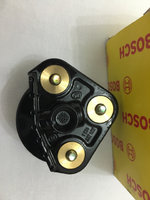
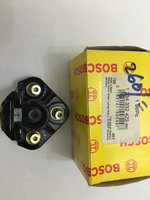
I also bought a few months ago the below Bosch caps&rotors for my '92 500E, but I haven't installed them yet.
So, you guys are saying that the 3mm key does not fit in well?
Image1468174538.754719.jpg Image1468174556.380909.jpg Image1468174567.437934.jpg Image1468174578.824005.jpg Image1468174589.509440.jpg
 
The 3mm key is correct. However - DO NOT use ball-end hex/Allen wrenches!! And don't over-tighten the bolts, either. See my note back in post #2 about using a dab of threadlock on 'em.

Don't forget to pull the rotor bracket while the rotor is off, to inspect the back side of the insulator bowl for any sign of liquid/fluid. If present, at least clean them dry with solvent; or better yet replace the entire insulator if installing new caps/rotors.

:shocking:
 
The 5mm fits the caps perfectly, there is no way you can strip them, something else would break first. The 3mm fit into the rotors are a different thing, and I tried 3 different 3mm allen keys, all with the same result. They fit in so loosely that the threat of stripping the 3mm bolts is instantly very apparent, and easy to do. Putting the new ones on is easy, you will just wonder if it's torqued enough, it's taking the old ones off, (if they are the same problem), may be your problem. I think the 3mm bolts (on the ones I have anyway), are out of spec, OHL. In my younger days I was a tool and die maker, so I understand machining and manufacturing tools, no way would the actual hex size on these bolts be acceptable in our old shop. I haven't measured the hex opening of these 3mm bolts, but I'd bet anything they are OHL. I think Dave's threadlock tip may give enough confidence not to overtighten. Still, if these bolts were proper fitment with a 3mm key, there wouldn't be any problem to speak about.
 
I began to remove the rotor bolts recently while changing caps and decided to wait and put off removing stripped fasteners due to the same loose fitment you encountered. I intend to use some yet to be thought of substance in the socket ( possibly metal shavings or lapping compound) before I go at it again when I will also have new insulators to install.

drew
 
I began to remove the rotor bolts recently while changing caps and decided to wait and put off removing stripped fasteners due to the same loose fitment you encountered. I intend to use some yet to be thought of substance in the socket ( possibly metal shavings or lapping compound) before I go at it again when I will also have new insulators to install.

drew

Is there room to tightly clamp a set of ViceGrips on the OD of the rotor bolts to crack them loose?
 
Is there room to tightly clamp a set of ViceGrips on the OD of the rotor bolts to crack them loose?

I tried that myself with a set of vice grips that JUST fit in there. See pic attached- it was the pointed grips I used. (Normal sized grips won't fit in there at all)

No go- no matter how tight I put the grips they just spun. I tightened them so much they eventually ripped the edge off the bolts rounding them off before they would break loose.

Certainly worth a try though. Mine were already rounded out by someone else and were tight as hell.

I am thinking next time around I will get a set of m3 (I think that's what they are anyway) hex headed bolts and swap them out for good. That way no Allen required to remove in the future, just a regular hex socket.

IMG_1388.JPG
 
I believe Arnt / 500AM used hex head or up sized socket heads. There is a thread here somewhere. I'm planning on using new factory bolts just snugged with a little blue thread sealer. Do the bolts thread into aluminum? If so, corrosion may be the issue causing this and anti-seize may be the solution. I suspect the heat contributes as well.

drew
 
Is there room to tightly clamp a set of ViceGrips on the OD of the rotor bolts to crack them loose?

Here is the "2phast" u-tube video, 15 minutes, around 11:18 he starts talking about his solution for the stripped 3mm hex bolt.

https://www.youtube.com/watch?v=R8TedfsImp8

I like the idea JC220 has, if possible remove the bolts on the new rotors and use good bolts that you can reliably remove instead. Ya know, next time I'm in a hardware store, I'm going to check out 3mm hex nuts, and see what's available, I bet I can find some that fit the hex key properly.

BTW, I also tried one variation of the micro-shim idea, wrapped aluminum foil around the 3mm key, almost worked on one bolt, not even close on the other. Seem to remember an old mech using lapping slurry or something similar in situations like this.
 
After reading this as a precaution before starting this job I ordered this
http://www.ebay.de/itm/1-St-Innense...949230?hash=item58d504466e:g:y5IAAOxyOlhS0myo

3.5 is way too big, you may as well cancel the order, see my post (#7 in this thread). Your better off sourceing a 1/8 inch key, which is almost the right size for these out of spec bolts.

3mm = .11811
1/8 = .125
3.5mm = .13779

Just a guess, but based upon what it took to force the 1/8 inch key into these bolts, the measurement inside these bolt heads is probably around .122. So where a 1/8 key is about 2 to 3/1000's too big, the 3.5mm key will be about 14-15/1000's too big, impossible to fit it into even these oversized 3mm bolts, (see attachment).

Here is the link to the full conversion list, it may be helpful for other applications as well...

http://www.vaughns-1-pagers.com/science/allen-wrench-conversion.htm

I am keeping my modified 1/8 key around for the next time, and if it doesn't work, (it should), I'll get my dremmel out and cut a slot for a straight head screwdriver.

But if at all possible, I'll not put the stock 3mm bolts back in the next time, I'm going to find a fastener that's appropriate to a $30 part.

I think sourcing better quality bolts and replacing the bad ones on the new rotors before you install them is the real answer, after you have gotten the old ones off.

Good Luck
 

Attachments

  • Metric vs SAE sizes partial.jpg
    Metric vs SAE sizes partial.jpg
    93.8 KB · Views: 24
I was heading to a local Auto Store today so I thought I’d bring the old rotor and bolts with me.

I got a packet of M5 Cap bolts that are perfect for this application. They have a 4mm allen slot vs the old 3mm one and it is a tight fit on a 4mm key. It will not round out like the OE bolts tend to. This pic compares the OE bolt head & the new one. (Note- this is the old battle scared Bremi Item I had to drill through and cut the bolts to release)

IMG_1390.JPG


So you guys can order whatever bolts you like ahead of the job here’s the details-

· M5 Thread
· 4mm Cap head (Vs old 3mm cap)
· 14mm Thread length. It does NOT matter at all if the new bolt is fully threaded vs the old part threaded one.
IMG_1392.JPG


Thread length can be + - 1-2mm. Or order longer ones and cut them down to match the original bolt length.

My new rotors are already installed. I have bagged & tagged the new bolts for safe keeping so next time I have the rotors off I will swap the bolts out for the better ones.
 
JC220,

Question on the metric cap screw sizes, I went on line to source the size you mentioned, and found many companies that make them in all sizes.

I did notice in the spec's when comparing sizes, that the common cap size that takes a 3mm allen key is actually a M4-.7 screw.

Then looking at the spec's for the M5 you mentioned, I see M5-.8

If I understand the sizing conventions correctly, then M5-.8 means = Metric, 5mm diameter, and .8mm thread pitch

So thinking about the correct tapped hole in the cam plate that the rotor screws into, are the 3 holes drilled and tapped for M5-.8, or M4-.7?

Have you tried to screw these new M5-.8 cap bolts into the cam plate that the rotors screw into yet?

Tanx..O
 

Attachments

  • Rotor screw compare.jpg
    Rotor screw compare.jpg
    222.2 KB · Views: 32
Question on the metric cap screw sizes, I went on line to source the size you mentioned, and found many companies that make them in all sizes. I did notice in the spec's when comparing sizes, that the common cap size that takes a 3mm allen key is actually a M4-.7 screw.

Then looking at the spec's for the M5 you mentioned, I see M5-.8 ...

Hi Oscar,


I had taken the old bolt to the store with me. They always screw a nut on first to match the thread size then select a bolt for me. It was a standard M5 thread. The little aluminium rotor bracket actually has M5 nuts pressed in from behind.


Metric bolts can come with different pitches. For a M5 bolt 0.8mm is the most common used – which is what these rotor bolts are.
(Different pitches may be available for rare applications)


On your chart it looks like MS250014A20000 is ideal since it’s M5 thread and 4mm allen key.
(Just check that the Length they mention of 14mm is the threaded part only and doesn’t include the cap too :doh:)


FYI GSXR flagged this thread today which I had never seen until now:
http://www.500eboard.com/forums/showthread.php?t=4559


They had the same idea! Post #14 is of particular interest.

(I’m not sure about the statement regarding filing the shank of the new bolts down to allow free play. IMO the bolts were milled like that so they would stay on the rotor in the box and to simplify install. Just like the Caps come with the bolts the same way. When tightened down this free play is non existent anyway)
 
Last edited:
Hi Oscar,


I had taken the old bolt to the store with me. They always screw a nut on first to match the thread size then select a bolt for me. It was a standard M5 thread. The little aluminium rotor bracket actually has M5 nuts pressed in from behind.

Thanks, that's great info and it sounds like your M5 bolt is the answer then.

I wonder what was Mercedes motivation to not use a standard manufactured M5 bolt, and go out of their way to make a special one with the smaller key size of 3mm?

I'd bet that economics are involved in this somehow, either saving them money, or making them money. I see these M5 SS bolts are available for cheap.

I think I'll pick the M5's up and change them out now, before the defective ones I just installed get too affected by prolonged exposure to engine heat.

Thanks again....O
 
Guys, I was wondering, does WIS give any information(hints) regarding the tightening torque screws (all of them - caps/rotors/insulator discs)?
 
yes it does..but i do not have WIS available
But hopefully someone will find it for you.:)
 
For those who stripped the 3mm allen rotor bolts like me... Here is an easy way to get them out:

Take a good quality T20 torx bit and hammer it in the 3mm allen stripped bolt of the rotor with a medium size hammer. There is not much room to do that but it is possible on every of the 3 bolts. Because there is not mutch room for the hammer, there is no risk of damaging the rotor bracket. The bolts are cheap iron and hammering the torx bit in will go easy. Loosen the rotor bolt with the ratchet type as on the picture, or an other small ratchet. I had to take out 1 bolt from each rotor that way.

IMG_0918.JPG
IMG_0927.JPG
IMG_0928.JPG
IMG_0930.JPG
IMG_0931.JPG
IMG_0932.JPG
 
FYI GSXR flagged this thread today which I had never seen until now:
http://www.500eboard.com/forums/showthread.php?t=4559

They had the same idea! Post #14 is of particular interest.

(I’m not sure about the statement regarding filing the shank of the new bolts down to allow free play. IMO the bolts were milled like that so they would stay on the rotor in the box and to simplify install. Just like the Caps come with the bolts the same way. When tightened down this free play is non existent anyway)
Joe,
My intention was to use a similar bolt type as shown in your post #21 in this thread. But the Norwegian vendors claims to only sell boxes with 2-400 bolts - unless you pay a cosmic price on a special order with a specific number. So to make it simple and get this trial done, I picked up regular M5 stainless steel bolts at a bike store and filed down the threads to make a slick shank to achieve the needed free play when the bolts are hooked on the rotor.

The bolts in your post #21 is a low head type, approx 1 mm, giving a shorter key grip. I specifically wanted the standard head height with a deeper key grip since my bolts are stainless steel which is a softer material. However, I've had these rotor bolts on both my cars for some years now, and the problem is solved completely. When the rotors are due for replacement, I move the bolts over to the new rotors.
 
Last edited:
I got the Bremi caps, and it came with (3) lock washers, and (3) flat washers. I placed the flat-washer on last so it rests on the cap (and doesn't dig into it like the lock washers would).

:) neil
I am sorry.. I know it's a very old post, but I am replacing the parts next week... Do you mean to say that you put the flat washer on the INSIDE of the caps, then the lock washers on the Outside??
Or you put both on the outside, with the lock washer closest to the head of the bolt???
Might seen like a stupid question, but I want to make sure, as I never put the flat washers inside the cap
Thank
 
I am sorry.. I know it's a very old post, but I am replacing the parts next week... Do you mean to say that you put the flat washer on the INSIDE of the caps, then the lock washers on the Outside??
Or you put both on the outside, with the lock washer closest to the head of the bolt???
Might seen like a stupid question, but I want to make sure, as I never put the flat washers inside the cap
What brand of caps did you buy? The bolts are normaly pre-installed with the washers / lock-washers in the correct locations. They always go on the outside of the cap by the bolt head, never between the cap and engine.

:mushroom:
 
What brand of caps did you buy? The bolts are normaly pre-installed with the washers / lock-washers in the correct locations. They always go on the outside of the cap by the bolt head, never between the cap and engine.

:mushroom:
That is what I have always done.. In the past 7 years... But I wanted to make sure I was doing it right.. Lol
 
Couple of additional items here for reference learned the very hard way today on my car. First for future reference some torque values and tips from other E500E members.

Screenshot 2024-03-10 at 8.55.50 PM.png


IMG_3256.jpeg

On the Bosch rotors I gently hammered in my 1/8 “ Allen tool making sure I had a tight fit before removing those small socket head cap screws. 1/8" is 3.175 and I think I filed down to 3.13 which makes it super tight fit and resulted in easy removal of my Bosch rotors.
 
Last edited:
Cam seal installation.

The cam seals are behind item number 5, the insulators. To remove the insulator you need to remove item number 4, which is held in by that 9Nm socket head cap screw (use M5 Allen tool).

diagram.png

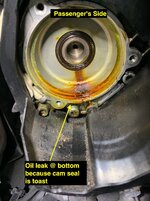
If you remove your rotors and insulators and see this then you need to replace your Cam seals as well.

IMG_3139.jpeg

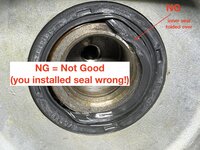
First the WRONG way to install a Cam Seal with a folded over inner part of the cam seal.

Don't be like Ricardo and fail to understand what the Mercedes installation tool is designed to do. It is designed to help install the inner part of the cam seal properly OVER the outer diameter of the cam shaft. Here is a bone headed install.

IMG_3301.jpeg


Here is the colored cross section from the Mercedes WIS that I now understand after having FAILURE teach me a lesson. (FYI oil up the camshaft prior to seal installation per WIS, use only motor oil).

In the image below you can see that the orange Mercedes tool (which is apparently NLA, and was ~$100) is used so that the inner part of the cam seal is gently stretched open, and then transferred onto the cam shaft first. Then you take the blue tool (something you make yourself) to drive the cam seal into the housing deeper about 2 to 3mm deeper from the face of the cam shaft.

Screenshot 2024-03-10 at 9.14.20 PM.png

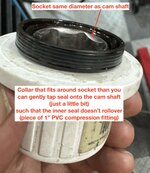
Today for the ORANGE tool in my shop @Jlaa and @Teddy_West helped me find a socket that is approximately the same size as the end of the cam shaft. We mounted the seal onto this socket and then found a piece of PVC compression fitting that went around this socket (after @Teddy_West filed the ID a bit larger for a light press fit around the socket) to help us initially press the seal onto the cam shaft. The ORANGE tool just helps you transfer the open inner part of the cam seal right onto the cam shaft. (I didn't use this tool the first time around and destroyed my Elring seals in the process... see the failure photos above).

IMG_3313.jpeg

At this point the cam shaft seal is in just enough to hold itself with the inner flange properly installed around the cam shaft. Now onto the BLUE tool from the cross section. We used a larger socket that matched the diameter of the seal but whose inner diameter fit around the cam shaft. Something like the image below. The screw is an M6 x 1.0 x 80mm long and with some washers was used to gently press in the Cam Shaft seal such that it is 2 to 3mm deep relative to the cam shaft face. This represents the BLUE tool in the Mercedes WIS cross section diagram. (FYI: I am sure you can get away with just tapping on the BLUE tool with a small hammer but this clever screw into the M6 x 1.0 cam shaft trick learned via other 500EBoard member posts makes this very smooth once you have the properly sized tools).

IMG_3302.jpeg
 
Last edited:
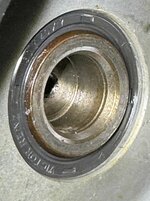
Finally this is what you want to see when you are done. A properly installed Cam Seal that is about 2 to 3mm deep.

IMG_3310.jpeg


I wasn't really happy with my tool setup because I didn't want to go to Home Depot or Ace and find the right set of copper pipe or PVC so we just made do with what we had in my garage after a few hours of failures and destroyed Elring seals. After the light bulbs went off in our heads, we got my backup set of Victor Reinz seals to work. As usually what should take 15 minutes consumed hours. I hope my description can help others in the future.
 
Last edited:
Thanks for this write-up on replacing the cam seals. It would actually make an excellent separate HOW-TO, as well as being in this thread as a highly recommended part of the cap/rotor/insulator replacement job.

The cam seal replacement job is actually quite simple if you remove the front cylinder head covers (here and here), but I understand that is often not something that folks want to do (i.e. requiring special MB orange koala-claw goo sealant, removal of cam covers, etc.), and it's easier to replace the seals in situ given all of the extra work. However, removing the cam covers does give the opportunity to inspect and replace (if needed) the plastic chain guides, cam oiler tubes (if you want to replace plastic with metal), and inspect the plastic chain rails...
 
The cam seal replacement job is actually quite simple if you remove the front cylinder head covers (here and here), but I understand that is often not something that folks want to do (i.e. requiring special MB orange koala-claw goo sealant, removal of cam covers, etc.), and it's easier to replace the seals in situ given all of the extra work. However, removing the cam covers does give the opportunity to inspect and replace (if needed) the plastic chain guides, cam oiler tubes (if you want to replace plastic with metal), and inspect the plastic chain rails...
+eleventbillion: ^^^

If the valve covers have never been removed (or, it's been many years), and the chain rails not inspected, and chain stretch not measured... it's best to bundle all this into one big job. Once the valve covers are off, it's incremental labor to remove the front head covers and then change the exhaust sprocket seal on the workbench. However if that work has been done recently-ish, I'd probably replace the seals in-situ.

In Ricardo's case, he already had an engine-out mechanical refresh not too long ago (Nov-2017, click here). Unfortunately these two seals were missed during that refresh.

:duck:
 
It is very likely that if these soft parts (cam seals, valve cover seals, upper chain rails, plastic chain guides) are 15+ years old, or you have no confirmation that they have been replaced in the past ~10 years, or you have more than 100K of mileage on the engine -- or any combination of the above -- then it actually makes MUCH MORE SENSE to remove the front cylinder head covers and replace all of these things. And replace plastic cam oiler tubes if you still have them installed. It's literally incremental labor to do that. Also a good time to consider replacing the timing chain tensioner as a proactive replacement (or at minimum, its gasket).

And of course, removing the driver's side cylinder head cover means removing the power steering reservoir, short hose, SLS pump, and so forth. Most all of which need replacing and cleaning up if your car hasn't had it done in the recent past.

It's easy to quickly get into the rabbit hole by doing this, because these disassembly jobs can lead to replacement of the rubber & Tecalan breather hoses, plastic vacuum lines, and so forth. But for long-term owners, this is all necessary stuff to be done. Trust me.

The good thing is that there are resources here that explain how to do ALL of this for the intermediate DIYer.
 
@RicardoD --- note here -- Camshaft oil seal leak | M119 Engine

I saw this post from @jaymanek regarding taking off the front covers when replacing the cam seals for optimum results. I am not sure if this explains at all why it was so difficult for us to install new cam seals (w/o taking off the front covers) but I thought Jay's learnings were interesting, especially as he has done this job multiple times.

Screenshot 2024-05-19 at 8.19.12 AM.png
 
We had difficulty installing the cam seals because we didn't have the right install tools. Nothing to do with the covers. Now we have the knowledge and the right tools / fixtures.
 
Back
Top