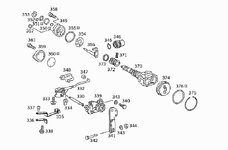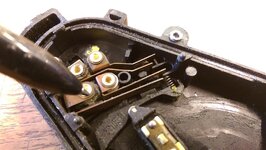

GSXR edit: The neutral safety switch (NSS) is also referred to as the starter lock-out/backup lamp switch, and is switch S16/3 in MB documentation.
(Note: S16/1 is the NSS used on other 124 chassis without LH-SFI, S16/1 does not have the additional 4 pins for gear position indicator function.)
All,
Today I had to replace the neutral safety switch (aka starter lockout switch) on my wife's 1995 E320 wagon, which uses the 722.3X transmission that is quite similar to that of our E500Es.
The symptoms for this were the inability of the car to start when the key was turned, although the following observations were made:
a) the key turned all the way to the right and would spring back to the running position, but nothing engaged mechanically
b) all dashboard lights were on and tested fine; the battery had full power; no CEL or other diagnostic lights stayed lit
c) the steering wheel lock was NOT engaged (this prevents the key from being turned all the way)
d) the shift lever did not want to shift out of park, even with the brake depressed
e) the lever could eventually be wrestled into R and then N, and the car would start in N as normal
f) the backup lights of the car lit up when the car was placed in R (engine not running)
g) the solenoid that released the gear lever could be heard to audibly "click" (this is normal) when the brake was depressed, but the lever would not move downward to R or N
Thus, I deduced that the neutral safety switch (NSS) was the culprit, primarily because the car would not start in the P (Park) position, and was exceedingly difficult to wrestle out of this position once it was placed in and the engine turned off.
There were a couple of other potential causes for this, which could be one of the two cables requiring adjustment that lead from either the ignition switch or the brake pedal to the shift lever (these are safety mechanisms that are found in all 1990 and later W124s, according to GXSR).
I wanted to get this condition fixed right away, so I called up my local dealer (Mercedes-Benz of Houston North) and inquired as to whether they had an appropriate NSS in stock. It turns out that they did, so I drove down there at the end of the day and purchased it. This unit, for the E500E, is part number 000-545-62-06. It is similar to the E320 unit below but not identical.
Replacing the unit required the use of a 10mm open-end wrench, a 1/4" ratchet and 10mm socket, and two large-sized flat-blade screwdrivers.
Procedure is as follows:
a) Put the car up on ramps or jack-stands. I prefer ramps myself as I believe they are sturdier than stands.
b) Make sure the car is in P (N is OK too, but P is preferred). Engage the rear emergency brake.
c) Get under the car and locate the NSS. It is on the left-side of the transmission, immediately above the transmission oilpan on the side of the transmission. You will see a large white ring surrounding an inch-plus diameter black plug.
d) Turn this white ring counter-clockwise with your finger to loosen it. This will allow the large black plug to be pulled/pried straight out and off of the NSS. Move this large black plug and wiring harness out of the way by bending it away and tucking it under a pipe, tube or other wire (make sure everything is cool, not hot).
e) Using the open-end wrench on the bolt-head, and the 10mm socket on the nut end, loosen and remove the nut/bolt holding the clamp onto the metal flange protruding from the NSS. This clamp looks like a miniature battery terminal clamp.
f) Insert the blade of one of the screwdrivers into the open space between the clamp halves, and prise them apart. This should move them enough that you can prise the entire clamp-head off of the metal flange with your other screwdriver. This can be done in two steps, or together depending on how dextrous you are and how much room you have to work in.
g) After prising the clamp off the metal flange, use your flashlight to inspect the rubber shift linkage bushing that is pressed into the linkage member just above the clamp. If it is bad, use your flat-blade screwdriver to remove the small metal clip and separate the piece of metal that the bushing is pressed into from the linkage itself. This is a separate operation to remove the bushing and press in a new one; I won't cover that here.
h) Use your 10mm socket and remove the 10mm bolts that hold the NSS to the transmission housing. One bolt is immediately to the right of the metal flange; the other is at the upper right (1 o'clock) position of the NSS, and is difficult to see except with a flashlight and looking directly up there to find it. You MUST remove the clamp/linkage from the metal flange BEFORE you remove this upper-right bolt.
i) Remove the NSS from the body of the transmission. It should slide out to the right (not much space, but it will slide out). Carefully note the position of the black arm with the pin in it on the left side of the surface of the NSS (it's to the left of the large plug with white retaining ring that you initially loosened.
j) Installation is the reverse of removal. The one key thing that you MUST do is to ensure that the black arm's little round pin is inserted into the hole in the clamp/linkage assembly when you re-attach it. Tighten the 10mm bolts hand-tight, but don't overdo it. Same for the 10mm clamp bolt. Make sure it's snug and give it an extra partial turn, but don't crank it down so that it cracks the NSS housing.
k) After re-assembling, get in the car and ensure that things shift smoothly and that the car starts in both P and N. If it does not, or the linkage feels a bit notchy, you will need to adjust the NSS a bit by loosening the 10mm bolts slightly and re-positioning it on the transmission housing. This is easy to do, but you have to dis- and then re-assemble everything to access that upper-right 10mm bolt. This adjustment is why the mounting holes on the NSS are slightly oval -- to allow for moderate adjustments if required.
Total time for this job is around 1 hour, as long as you have a lift or enough room to work under the car.
Hope this helps.
Cheers,
Gerry
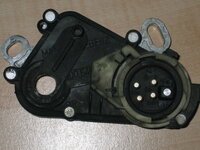
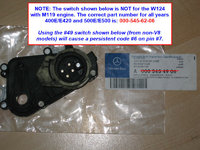
Note that the part number shown in the photos attached below is for the E320 W124, NOT the E500E.
(Note: S16/1 is the NSS used on other 124 chassis without LH-SFI, S16/1 does not have the additional 4 pins for gear position indicator function.)
All,
Today I had to replace the neutral safety switch (aka starter lockout switch) on my wife's 1995 E320 wagon, which uses the 722.3X transmission that is quite similar to that of our E500Es.
The symptoms for this were the inability of the car to start when the key was turned, although the following observations were made:
a) the key turned all the way to the right and would spring back to the running position, but nothing engaged mechanically
b) all dashboard lights were on and tested fine; the battery had full power; no CEL or other diagnostic lights stayed lit
c) the steering wheel lock was NOT engaged (this prevents the key from being turned all the way)
d) the shift lever did not want to shift out of park, even with the brake depressed
e) the lever could eventually be wrestled into R and then N, and the car would start in N as normal
f) the backup lights of the car lit up when the car was placed in R (engine not running)
g) the solenoid that released the gear lever could be heard to audibly "click" (this is normal) when the brake was depressed, but the lever would not move downward to R or N
Thus, I deduced that the neutral safety switch (NSS) was the culprit, primarily because the car would not start in the P (Park) position, and was exceedingly difficult to wrestle out of this position once it was placed in and the engine turned off.
There were a couple of other potential causes for this, which could be one of the two cables requiring adjustment that lead from either the ignition switch or the brake pedal to the shift lever (these are safety mechanisms that are found in all 1990 and later W124s, according to GXSR).
I wanted to get this condition fixed right away, so I called up my local dealer (Mercedes-Benz of Houston North) and inquired as to whether they had an appropriate NSS in stock. It turns out that they did, so I drove down there at the end of the day and purchased it. This unit, for the E500E, is part number 000-545-62-06. It is similar to the E320 unit below but not identical.
Replacing the unit required the use of a 10mm open-end wrench, a 1/4" ratchet and 10mm socket, and two large-sized flat-blade screwdrivers.
Procedure is as follows:
a) Put the car up on ramps or jack-stands. I prefer ramps myself as I believe they are sturdier than stands.
b) Make sure the car is in P (N is OK too, but P is preferred). Engage the rear emergency brake.
c) Get under the car and locate the NSS. It is on the left-side of the transmission, immediately above the transmission oilpan on the side of the transmission. You will see a large white ring surrounding an inch-plus diameter black plug.
d) Turn this white ring counter-clockwise with your finger to loosen it. This will allow the large black plug to be pulled/pried straight out and off of the NSS. Move this large black plug and wiring harness out of the way by bending it away and tucking it under a pipe, tube or other wire (make sure everything is cool, not hot).
e) Using the open-end wrench on the bolt-head, and the 10mm socket on the nut end, loosen and remove the nut/bolt holding the clamp onto the metal flange protruding from the NSS. This clamp looks like a miniature battery terminal clamp.
f) Insert the blade of one of the screwdrivers into the open space between the clamp halves, and prise them apart. This should move them enough that you can prise the entire clamp-head off of the metal flange with your other screwdriver. This can be done in two steps, or together depending on how dextrous you are and how much room you have to work in.
g) After prising the clamp off the metal flange, use your flashlight to inspect the rubber shift linkage bushing that is pressed into the linkage member just above the clamp. If it is bad, use your flat-blade screwdriver to remove the small metal clip and separate the piece of metal that the bushing is pressed into from the linkage itself. This is a separate operation to remove the bushing and press in a new one; I won't cover that here.
h) Use your 10mm socket and remove the 10mm bolts that hold the NSS to the transmission housing. One bolt is immediately to the right of the metal flange; the other is at the upper right (1 o'clock) position of the NSS, and is difficult to see except with a flashlight and looking directly up there to find it. You MUST remove the clamp/linkage from the metal flange BEFORE you remove this upper-right bolt.
i) Remove the NSS from the body of the transmission. It should slide out to the right (not much space, but it will slide out). Carefully note the position of the black arm with the pin in it on the left side of the surface of the NSS (it's to the left of the large plug with white retaining ring that you initially loosened.
j) Installation is the reverse of removal. The one key thing that you MUST do is to ensure that the black arm's little round pin is inserted into the hole in the clamp/linkage assembly when you re-attach it. Tighten the 10mm bolts hand-tight, but don't overdo it. Same for the 10mm clamp bolt. Make sure it's snug and give it an extra partial turn, but don't crank it down so that it cracks the NSS housing.
k) After re-assembling, get in the car and ensure that things shift smoothly and that the car starts in both P and N. If it does not, or the linkage feels a bit notchy, you will need to adjust the NSS a bit by loosening the 10mm bolts slightly and re-positioning it on the transmission housing. This is easy to do, but you have to dis- and then re-assemble everything to access that upper-right 10mm bolt. This adjustment is why the mounting holes on the NSS are slightly oval -- to allow for moderate adjustments if required.
Total time for this job is around 1 hour, as long as you have a lift or enough room to work under the car.
Hope this helps.
Cheers,
Gerry
Note that the part number shown in the photos attached below is for the E320 W124, NOT the E500E.
Attachments

Last edited by a moderator: