• Hi Guest !

    Welcome to the 500Eboard forum.

    Since its founding in late 2008, 500Eboard has become the leading resource on the Internet for all things related to the Mercedes-Benz 500E and E500. In recent years, we have also expanded to include the 400E and E420 models, which are directly related to the 500E/E500.

    We invite you to browse and take advantage of the information and resources here on the site. If you find helpful information, please register for full membership, and you'll find even more resources available. Feel free to ask questions, and make liberal use of the "Search" function to find answers.

    We hope you will become an active contributor to the community!

    Sincerely,
    500Eboard Management

The $400 400E

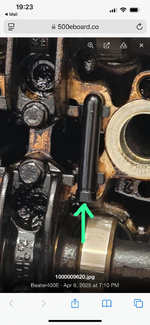
I think the prior owner was allergic to oil changes. Definitely needs some timing chain guides. The oiler tubes appear to all be intact. If I understand the common failure mode, the end cap would be missing if one had failed, right? All of these tubes have their end caps.

View attachment 211312
Correct, the end here will be missing and open:

1743963978143.png

It looks like the oil in that engine might take a while to drain!!

Best get it warmed up a bit.
 
I swapped out the oiler tubes. All the plastic ones were still intact. I also replaced the upper timing chain guides on the passenger side since they were broken and I was right there.

No difference. It's fairly quiet when it's cold, but as it warms up it gets pretty loud. I took it for a short drive. The car has plenty of power. It surges just a bit at idle, but I haven't touched the ignition yet, so I assume it needs everything. The wiring harness is also toast, so who knows what problems that could be introducing. The two mile loop I ran did nothing for the valve noise. I'd love to take it out and give it a full shakedown, but still no registration or insurance, so I have to stay close to home.

I got out the stethoscope and poked around. It sounds like it's centered around one of the intake valves on cylinder 7. My best guess at this point is a collapsed lifter. I did inspect the cams when I had it apart and didn't see any obvious issues there. No flat lobes or anything.

I have plenty of lifters sitting around, so I could easily swap some in. I'd rather keep the original lifter on the original cam lobe if possible though. Are these lifters serviceable? I seem to recall it was possible to disassemble and clean them up. I'll do some searching around on that.

Another option would be to go ahead and swap in the set of 92 intake cams I've been hanging onto. Those are good for an extra half millimeter or so of lift and I think just a bit more duration. I have the matching lifters for that cam, organized and labeled by location. I could swap that whole mess in. This engine needs chain guides anyway, so it's not much more work to just swap the intake cams while I'm at it.

Of course, I've been wanting to try swapping a set of intake cams in place of exhaust cams at some point too. This is probably my best opportunity for that, since this car is so much easier to work on than the 400E.

My only hesitation is that if I try to do all those things at once, it would be hard to troubleshoot if anything went wrong. I'd rather do it one step at a time, but that's a lot more work.

I'm not even supposed to be here working on this car today.
 
By the frequency of your tick, it sounds like you only have 1 collapsed lifter. During my research I did find details on cleaning them which I did try on mine but I couldn’t get it to fill with oil. There was no other obvious issue with it when I dismantled it so I chose to just replace it.

If you rotate the engine until the cam lobe is pointing upwards you can test each lifter until you find the one which can be compressed. Use a non metallic object to check each lifter.
 
By the frequency of your tick, it sounds like you only have 1 collapsed lifter.
That was my thought too. I only hear a single, regularly-spaced tick. The stethoscope says it's probably the rearmost intake valve on cylinder 7.
Realistically I'll probably put this car on the back burner for a bit while I take care of some other projects. My other SL needs some work, as does my Jeep. Once those are done I'll get this one on the lift and go through it.
 
Apropos of nothing, I was going through some of my parts hoard and ran across these ball socket joints I'd picked up a couple years ago. These are the ball socket used in some parts of the w124 climate control linkage, like the recirculation door. Mine was broken when I got the car, so I went on a quest for replacements. I don't know how I originally found them, but I wanted to document what they are for the good of mankind.

They are apparently manufactured by Springfix linkages, although I wasn't able to find it in their catalog.

Best source I think is actually Porsche. Porsche part number 99916802500 or N0157041.

1000009647.jpg
 
My fuel gauge started acting up yesterday. It'll act fine most of the time, but occasionally it'll kind of flutter. I'm guessing it's intermittently losing continuity from the sender. When it flutters, the needle basically drops down for a split second, and then returns to normal. Sometimes it only drops 1/4 tank or so, sometimes all the way to empty, and then it returns to the actual fuel level quickly.

I'm sure it's either the sender, the gauge, or the wiring. Wiring seems unlikely. So it's down to the sender or the gauge. Does anyone know of any specific tests to run, or whether one or the other is more likely to fail?
 
My 129 is like that too. It seems pretty accurate for the first half of the tank, but then it drops rapidly. When I'm down to maybe 1/4 tank it'll read near empty.
My 129 is the only car I have EVER run out of fuel in and it has happened to me TWICE.

I now brim fill it, reset the trip counter and drive 250 miles or so before filling it up again. It is the only thing on my car which isn't 100% reliable and I have no desire to tear apart the fuel system to get to the cause or to run out of fuel again,. these cars are heavy...
 
My fuel gauge started acting up yesterday. It'll act fine most of the time, but occasionally it'll kind of flutter. I'm guessing it's intermittently losing continuity from the sender. When it flutters, the needle basically drops down for a split second, and then returns to normal. Sometimes it only drops 1/4 tank or so, sometimes all the way to empty, and then it returns to the actual fuel level quickly.

I'm sure it's either the sender, the gauge, or the wiring. Wiring seems unlikely. So it's down to the sender or the gauge. Does anyone know of any specific tests to run, or whether one or the other is more likely to fail?
99% likely to be the sending unit. You can remove it (get fuel level below half tank, lower the better) and then disassemble / clean it. Practice on a junkyard sending unit first.

:klink:
 
The gas gauge has been working great ever since the fuel system cleaner. Consider that one resolved.

With most of my summer shenanigans out of the way, I think I'm about ready to dive in on some work on this car. I of course have my 95 SL500 parts car, which I'm hoping will provide its engine. I also have a 6 speed manual from a Chrysler Crossfire that I'll like to install.

The SL engine still has some valve train noise. It definitely needs timing chain guides. It could have some funky lifters. That's my best guess on the valve noise. I think last time I moved it the throttle was unresponsive or something too.
First order of business will be getting that car running perfectly. I'll give it a compression test and maybe a leakdown test to make sure that engine is worth swapping. If I can get it running great I will probably try a couple little modifications I have in mind.

I have some 92 intake cams that have extra lift. Nothing weird there. Should be a simple swap. The other mod is a bit more experimental. I want to try installing intake cams in place of exhaust cams. I won't go into all the details right now, but in theory it should result in more top end power. Hard to know just how much. I might consider running the parts car on the dyno before and after some of these changes, if the dyno shop will give me a decent price on it. No clue what they'd charge, but it would be interesting.

Once I'm happy with the engine it'll come out and go into the 400E.

I'm also beginning to work on some elements of the 6 speed swap. I will probably finish the engine swap first before the 6 speed swap. Limiting the number of variables to troubleshoot will probably be wise.

I've taken a bunch of measurements from the engines and the trans. I have the complete dual mass flywheel setup and clutch from the donor Crossfire. The plan at this point is to machine adapters to make that all bolt together. That's a little easier said than done, but I'm confident I can do it.

I figure I'll get the whole trans mocked up to an engine separate from the car. Once it's all set, I'll swap it in and deal with the shifter and driveshaft once it's in.
 
Sounds like a good plan! Give Motor Mayhem a call in Meridian to see what they're currently charging for 2-3 dyno pulls (roughly 1 hour of time). Hopefully it's not over $150-ish. Bring a USB flash drive so you can get the DynoJet .DRF files with the raw data to manipulate on your computer. More details here.

:v8:
 
I have some of the basics figured out for the flywheel adapter. It looks like it'll have to be a 2 piece adapter, which uses 8 flat head countersunk bolts to bolt to the crankshaft, then 8 more to bolt the two halves together, and then the 8 factory flywheel bolts. So 24 total bolts to bolt the M112 dual mass flywheel to the M119 crankshaft. Plus a bucket of thread locker. The necessary thickness of the flywheel adapter plate will affect the final thickness of the bellhousing adapter, so I'm working that out first.

I know that most people would just throw money at this and buy a custom solid flywheel with the right bolt pattern. I COULD do that, but then it snowballs with a new clutch, and maybe some upgrades and very quickly it makes more sense to just throw $2500 at Kangaroos Team for the full kit. Instead, I'm going to stick to the DIY method that costs almost nothing. It may end up being more trouble than it was worth, but I enjoy the challenge, and if I can make the dual mass flywheel work, I think that will be a more "Mercedes" driving experience.

Speaking of a challenge, I've already hit a minor snag. The bolts I'll need for the crankshaft are M12-1.5 flat head countersunk 35mm machine screws.

Turns out that's almost impossible to find. M12x1.75, or M12x1.25, or any head type other than the flat head are all reasonably doable. That exact combination is tough though. Looks like I'll have to pay almost $10 each for them through BelMetric. Yuck.
 
Wow. After measuring the total stack up of everything involved, my engine to trans adapter plate will have to be like 2.75 inches thick. Probably better to fabricate something for that rather than try to machine it from billet. The billet blank alone would be something stupid like $2000.

I suppose I could also consider making my own flywheel...
 
Last edited:
I've been following the $400 400E thread closely as I think your approach is admirable - "do" instead of "pay" and see what happens. I, for one, hope this all works out, as this hobby gets stupid expensive quick if paying other dudes, so your explorations are adding huge value to the community and I salute you for that!

Consider doing a 6 Liter DYI instead of the manual pairing with a 5 Liter swap. Might be bigger smiles for just as much money
 
Consider doing a 6 Liter DYI instead of the manual pairing with a 5 Liter swap. Might be bigger smiles for just as much money
Any 6 liter build is going to require custom pistons, no matter how you slice it. The 5.6 concept I've been considering might be a good low buck build. But that's going to take time and experimentation. The 5 liter swap is a known quantity, so that's a no-brainer for now, even if i replace it with a 5.6 later.

Nothing will top the stick shift for smiles though. I'm a die hard 3 pedal guy. I manually shift my 722.3 every single time in both of my cars. I need a stick shift. I have the swap 90% figured out, so that's definitely happening before a stroker build.
 
Sounds like a good plan! Give Motor Mayhem a call in Meridian to see what they're currently charging for 2-3 dyno pulls (roughly 1 hour of time). Hopefully it's not over $150-ish. Bring a USB flash drive so you can get the DynoJet .DRF files with the raw data to manipulate on your computer. More details here.
My brother did a dyno session at Motor Mayhem a few months ago. It was $260 for a few pulls. I'll probably talk to them about it, but since I'd need a baseline, and then a couple return trips to measure the changes, I probably won't do it. If it was a couple hundred dollars total, I might consider it, but if we're up in the $400-$500 range just to find out the gains from fiddling with the cams it's probably not worth it to me.
 
$260! Yikes. Definitely give them a call and explain you're just looking for baseline data, nothing else... same as the "other guy" who used to bring Mercedes to them on a regular basis years ago. Less than 1 hour of their time total.

:jono:
 
$260! Yikes. Definitely give them a call and explain you're just looking for baseline data, nothing else... same as the "other guy" who used to bring Mercedes to them on a regular basis years ago. Less than 1 hour of their time total.
I'm wondering if it would be reasonable to try to do multiple configurations in a single day. If I bring a buddy and tools, the cam swaps could be done in under an hour. In theory I could do a baseline set of pulls, swap the 92 intake cams, then do an updated set of pulls, then swap the exhaust cams and do a final series of pulls. It would probably take a couple hours, but I think it could be done in a single day if we're well prepared.

I don't imagine they'd want us just sitting on the dyno the whole time though. I don't know. Once I have it ready for the cam swaps I might call them.
 
I'd do a practice run at home against the clock, before attempting this at the dyno shop. If you can do it in a reasonable time, that would be great. If the shop isn't busy that day, they may not care if your car is strapped to the dyno all day while you are fiddling with cams.

You'd want to have the 92 intake cams already bolted to the adjusters, so you are doing a straight cam+adjuster swap. Same with the spare exhaust cams, have the sprockets already attached. You could leave off the fan clutch as well to save time. Another possible time saver would be fabricating a bracket to replace the smog pump for quicker / easier access to the chain tensioner.

:banana1:
 
I'd do a practice run at home against the clock, before attempting this at the dyno shop. If you can do it in a reasonable time, that would be great. If the shop isn't busy that day, they may not care if your car is strapped to the dyno all day while you are fiddling with cams.

You'd want to have the 92 intake cams already bolted to the adjusters, so you are doing a straight cam+adjuster swap. Same with the spare exhaust cams, have the sprockets already attached. You could leave off the fan clutch as well to save time. Another possible time saver would be fabricating a bracket to replace the smog pump for quicker / easier access to the chain tensioner.

:banana1:
Exactly. I figure I'd have my most skilled buddy with me, but we'd prep it ahead of time by swapping all the different configurations at home and getting good at it. That would allow us to be efficient with the swaps, but also to make sure the car at least runs decently before we try it on the dyno.

With the exhaust cam swap I'll be installing custom adjustable cam sprockets that will require timing adjustments. I'll definitely want to get those degreed in and locked down before we go to the dyno.

I could potentially try a few other configuration changes while we're there.

With/without the clutch fan. With/without the catalytic converters (Sawzall at the end of the day). 92 LH vs 93 LH. Upgraded EPROM vs stock. A lot of these would be a simple matter of a 5 minute change and another pull. If the car's already hot at that point, and all we're after is the change in power for each configuration change, we could potentially test a bunch.

This would be the 95 SL500 parts car on the dyno, so nothing sacred, and much easier to work on than the 400E. If the shop is willing to play ball and not charge an absolute fortune, it could be really fun. I'm not looking for their tuning expertise. Just looking for some before and after delta numbers that we can add to the collective knowledge base.
 
Last edited:
Ah, doing this on the R129 should definitely be easier - more room in the engine compartment! I was thinking it would be the 400E (very tight).

Forget the LH and EPROM testing. I've BTDT, there's no power to be found beyond the "WOT" module. Ditto for the fan clutch, the OE clutch disengaged above 3500rpm anyway. I've only done dragstrip testing sans cats but AFAICT the factory cats offer very little restriction. Single digit change, if any. The cam changes are definitely the big question mark. You'll be able to get a decent idea from street driving and testing with your performance meter.

There's still time to get some dragstrip data too... couple of grudge or test dates left on the calendar before the "Last Blast" on Oct-18.


:tree:
 
There's still time to get some dragstrip data too... couple of grudge or test dates left on the calendar before the "Last Blast" on Oct-18.
Believe me, no one wants this car on a drag strip. It's a pile.

Ah, doing this on the R129 should definitely be easier - more room in the engine compartment! I was thinking it would be the 400E (very tight).
Yeah, I want to do all my testing and tuning with the engine in the easy chassis, and then I'll swap whatever I like best into the 400E once I'm happy with it. I don't want to have to do all that work in the 400E chassis. For anyone who isn't familiar, the difference is massive. There is a ton of room in the R129 engine bay, and NONE in the W124.

Forget the LH and EPROM testing. I've BTDT, there's no power to be found beyond the "WOT" module. Ditto for the fan clutch, the OE clutch disengaged above 3500rpm anyway. I've only done dragstrip testing sans cats but AFAICT the factory cats offer very little restriction. Single digit change, if any. The cam changes are definitely the big question mark. You'll be able to get a decent idea from street driving and testing with your performance meter.
Yeah, I thought that might be the case on the LH and EPROM. If no one has actually tried the fan or the cats, it would be interesting to try it, even if all we do is prove that there really is no difference.

Another interesting thing would be to see the shape of the curve in each case. Maybe the cam changes end up tilting the curve to the point that it's a little more powerful up top, meaning a higher peak power number, but if it gives up a ton of low and midrange it loses so much total area under the curve that it's not worth it. Those are the kinds of things I want to see with the cam swap.

The other little odds and ends would just be interesting "while we're here" tests. If anyone has ideas for things to try I'd love to hear them. No guarantee that we'll do it, but it could be fun.
 
There won't be any measurable change with/without the fan clutch, assuming OE Sachs/Horton. Maybe with a Chinese clutch that's engaged all the time (might be a fun experiment, listening to it roar to 6300rpm). The cat/no-cat test would definitely be useful. I predict a 5-7hp change at most.

The shape of the curves would be something to look for on the cam swaps. This is where dyno data becomes much more useful than street testing.

:v8:
 
The first stages of this project are no fun. The upper engine harness on this car is original and quite crispy. I recently scored a bunch of parts off a 94 SL500 in the junk yard. One of the things I snagged was a brand new upper engine harness. Unfortunately, someone had gotten to the car before me and cut the harness to bits.

I grabbed all the bits I could find, and figured I can piece together a usable harness from this. I believe all the parts are here EXCEPT the MAF pigtail. I have a couple other crispy harnesses around, so I grabbed the MAF pigtail off one and went to work rewiring it. The connector is of course not really serviceable, but it can be cut in half with a razor knife if you're careful.

Once I had it split, I swapped the pins over to new wires and reassembled the connector and glued it back together. The glue is curing now. Next, I'll splice that pigtail back into the main branch of the harness, and then work to splice all the other severed pigtails back into the harness.

The coaxial cable for the cam sensor was severed, so it will need to be replaced entirely, but I should be able to use one from one of the other harnesses. I'll splice everything carefully and rebuild it with heat shrink and Tesa tape. When it's done it'll look brand new.

Both of my driver cars have good harnesses, so I won't really have a use for this one aside from this parts car/test mule. When I'm done with that car I could probably sell this harness, although I'm not sure how to feel about that. I'm confident it will last decades. When I want to I can do excellent work. Even so, it will be a repaired harness with several splices hidden inside. I don't know. Maybe I'll just keep it as a spare. Could be handy for the next project or parts rig.

Once the wiring is solid I'll need to address an off idle stumble, unless the harness solves that. Onward!
 
1000010828.jpg

My new license plates just arrived. For those not familiar, this style license plate was standard in Idaho from the 1970s through the early 1990s, after which they were retired. That means that when this car was new, it would have used this style plate.

Idaho just made this retro style available as a special order option. It felt like the right choice for this car.

Idaho also changed the law regarding front license plates. We can now run without a front license plate IF the car lacks a front license plate mount. So now I need to find a license plate delete filler.
 
My new license plates just arrived. For those not familiar, this style license plate was standard in Idaho from the 1970s through the early 1990s, after which they were retired. That means that when this car was new, it would have used this style plate.

Idaho just made this retro style available as a special order option. It felt like the right choice for this car.
VERY COOL! I would have gotten those on a car or two if I was still there. :deniro:


Idaho also changed the law regarding front license plates. We can now run without a front license plate IF the car lacks a front license plate mount. So now I need to find a license plate delete filler.
About freakin' time. Sheesh, once again, something fixed after I left. Wish they would just eliminate the front plate completely (in all 50 states). Cut the cost of plate manufacturing in half.

:spend:
 
View attachment 223736

My new license plates just arrived. For those not familiar, this style license plate was standard in Idaho from the 1970s through the early 1990s, after which they were retired. That means that when this car was new, it would have used this style plate.

Idaho just made this retro style available as a special order option. It felt like the right choice for this car.

Idaho also changed the law regarding front license plates. We can now run without a front license plate IF the car lacks a front license plate mount. So now I need to find a license plate delete filler.
Fantastic plate there! Might have to look up some of the old ones on ebay to put on the garage wall.
 
Finally got the wiring harness sorted. What a nightmare. To keep things tidy I wanted to do low profile soldered splices. The problem is that this was a cheap aftermarket harness, which used copper clad aluminum (CCA) wiring.

CCA wire is exactly what it sounds like. It's multi-stranded wire, made of aluminum, with each strand having an incredibly thin layer of copper on the outside. At first glance it looks like regular copper wire. It performs OK, and is a fair bit cheaper than pure copper wire. That is the reason CCA would be chosen over pure copper wire.

So what's the problem?

This harness had been cut and I needed to splice it back together by soldering. Soldering CCA wire sucks. The thin copper layer will corrode when exposed to the elements, which the cut ends were. I didn't want to cut the harness any shorter, so I had to kind of work with the length that I had.

You can clean up copper wires by dipping in vinegar and salt. Then neutralizing before soldering. That works well. If you do that with CCA you just strip the copper off completely, leaving bare aluminum. Aluminum forms oxide quickly in open air, and the oxides have a higher melting point than the clean aluminum underneath, meaning it's extremely difficult to get solder to bond to aluminum.

I fiddled with it for a couple hours before I landed on something that actually worked. I ended up dabbing each solder joints with tinning flux before heating with a soldering pen set to 850 degrees F. This would effectively tin the wires. Giving a base layer that the solder could bond to.

50-ish solder joints later, and plenty if heat shrink and Tesa tape, and the harness was finally complete. I probably had 10 hours in it.

I just swapped it in. The car runs, but the harness didn't fix any of the issues. I didnt expect it would, but I knew I had to eliminate this issue before I could troubleshoot anything else.

From here I can begin regular troubleshooting.

1000010831.jpg

1000010832.jpg
 
what mercedes model did this aluminum bracket came of?
It just came with the E55 sway bar. The weird thing is the EPC lists 2023260226, which is a stamped steel bracket, so I don't know the exact source if the aluminum one. BUT... I just discovered something. I'll post what I found in your main sway bar thread.
 
Got the off-idle stumble resolved. That was the mass air flow sensor. It now has good throttle response. Still has a ticking valve and a very slight bit of surging at idle.

I think I'll go through the ignition system and make sure it all looks OK, and then probably maybe do an engine flush. I know a lot of people arent fans of an engine flush, but this is an engine with 225k miles from a $500 car, which will be going into a $400 400E. The stakes are low.

I don't expect the flush to do MUCH, but I've seen the top end and I know it's a little crusty. I'd like to eliminate some of the carbon junk from the oil passages if I can. There's a chance it'll free up a stuck lifter and quiet the valve noise as well.

I'll probably replace the timing chain guides after that, and then see how it runs. If there's still valve noise, I'll move on to pulling the lifters and cleaning them.
 
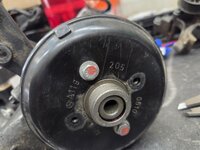
While I'm in here replacing stuff, I'm eyeballing this smog pump. I haven't searched yet, and I will, but does anyone know how best to deal with belt routing if the smog pump were removed?
 
While I'm in here replacing stuff, I'm eyeballing this smog pump. I haven't searched yet, and I will, but does anyone know how best to deal with belt routing if the smog pump were removed?
AFAIK, an idler pulley must be mounted in place of it. Depending on location & diameter, a different belt length may be required.

The smog pump itself acts like a big, bulky idler pulley when electrically disconnected.

:roadrunner:
 
AFAIK, an idler pulley must be mounted in place of it. Depending on location & diameter, a different belt length may be required.

The smog pump itself acts like a big, bulky idler pulley when electrically disconnected.
If I'm going to do some camshaft switcharoo shenanigans in the near future, deleting the smog pump would cut a huge amount of work out of each swap.

When I was at the junk yard today I noticed the 97 E420 I looked at had what I think was an electric smog pump, and then an idler pulley in that position. I'm sure the belt would be different, but I can figure that out.

Any idea if that idler is a simple bolt in to replace the smog pump, or if there are othee complications?
 
The M119.98x engines with the electric smog pump have a different bracket with an idler pulley. I forget if it's a simple bolt-in though. If there's a 97 E420 at the Jungle, I'd snag that piece to experiment with. Also grab the viscous fan bracket from that car, it allows more clearance for electric fan installations. If you don't plan to use it I'd love to buy that from you (and, I'd buy any others you can find - but the only donor is the 1997 E420).

:apl:
 
The M119.98x engines with the electric smog pump have a different bracket with an idler pulley. I forget if it's a simple bolt-in though. If there's a 97 E420 at the Jungle, I'd snag that piece to experiment with. Also grab the viscous fan bracket from that car, it allows more clearance for electric fan installations. If you don't plan to use it I'd love to buy that from you (and, I'd buy any others you can find - but the only donor is the 1997 E420).
I'll grab those and see what I can figure out.
 
So yes, the later M119 electric smog pump bracket will bolt right up. There's a bunch if superfluous junk hanging down that I'll probably cut off since all I need is the idler pulley. Looks like it'll work great though.

1000010844.jpg
 
That viscous fan bracket is interesting. It is the same as the bracket we're used to, except that the center of the pulley hub does not protrude as far forward. The pulley ends up in the same place, so it's directly interchangeable if you're going to electric fans. The threaded boss for the fan clutch does eat up some of the space saved, but it's still a big improvement.

As-is, without modifying anything, the W210 E420 bracket is 19mm shorter, including the threaded boss. That's enough to get any of the later OE Mercedes PWM fans in there. When I installed mine I used the stock bracket and did some fancy machine work to gain an extra 7mm of space, and that was enough. The 19mm is a mile by comparison.

If you needed more space, you could gain another 7mm by machining the threaded boss down even with the pulley bolts, and another 7mm by machining flush with the pulley and going to flat head countersink bolts. That fancy machine work is totally unnecessary though. This would work as a simple bolt in.

Part numbers are 1191554535 for the bracket. And 1192050510 for the pulley.

1000010846.jpg1000010848.jpg1000010849.jpg1000010847.jpg1000010851.jpg
 
Got the ignition system cleaned up. It was basically all factory original from 1995, aside from those spark plugs. I swapped everything with some good used stuff I had lying around. When the motor goes into the 400E I'll take the ignition parts off the 4.2 to use with this motor.

It still smokes just a bit at start up. I'm not too worried about it. It'll get a compression test at some point soon. As long as compression is good I'm happy. If I have to I can swap the valve stem seals. It doesn't sound like a fun job with 32 valves, but I'm sure I can do it.

Speaking of valves, my top end tick is still there. I hoped, but didn't expect that maybe a loose spark plug was responsible for the noise. No such luck. I'm going to pour a quart of Marvel Mystery Oil in the crankcase and let it idle for half an hour or so and see if anything changes.
 
The fuel gauge in this car doesn't work and I don't remember how much fuel I put in it, so I added another 5 gallons of premium and a bottle of Techron. I then added a quart of Marvel Mystery Oil to the crankcase and let the car idle for half an hour.

Now it runs worse. It started surging more and more, until it got to the point that it would almost stall, and then it would suddenly rev up. Eventually it did stall. It's cranky now. Sometimes it wants to run. Sometimes not. When I started it the last time I heard significant timing chain noise for a moment.

I think I'm just going to tear into it and do timing chain guides and clean up the lifters before I do anything else.
 
The surging / bad running miiiiight be due to a fuel issue. Strange though. Check pressure at the rail for grins if you start it again.

:run:
 
Back
Top