• Hi Guest !

    Welcome to the 500Eboard forum.

    Since its founding in late 2008, 500Eboard has become the leading resource on the Internet for all things related to the Mercedes-Benz 500E and E500. In recent years, we have also expanded to include the 400E and E420 models, which are directly related to the 500E/E500.

    We invite you to browse and take advantage of the information and resources here on the site. If you find helpful information, please register for full membership, and you'll find even more resources available. Feel free to ask questions, and make liberal use of the "Search" function to find answers.

    We hope you will become an active contributor to the community!

    Sincerely,
    500Eboard Management

The $400 400E

The surging / bad running miiiiight be due to a fuel issue. Strange though. Check pressure at the rail for grins if you start it again.

:run:
That was my first thought. When I brought the car home the pumps were bad so I threw in a used pump assembly I had laying around. That used pump assembly could be on its way out.

I think what I'll do is try to run it today and check the fuel pressure. Once it's warmed up a bit I can also do a compression test. I would like those data points before I tear into it to replace the timing chain guides.
 
I have the donor car sitting here idling right now. Holding steady at 51 psi fuel pressure. Interestingly, the fuel gauge just started working. I'm guessing the Techron I poured in yesterday is helping.

The stumbling and surging from yesterday has not returned. I'll just let it sit here and idle for an hour or two and see what it does. I work from home, so I can just leave the door to my shop open and listen to the car from my office.
 
And right on cue, it just did it. I happened to be standing here watching the fuel pressure gauge too. Fuel pressure went up near 60 psi as the car stumbled, and then the car recovered and revved up to almost 2000 RPMs for a moment before settling back to a normal idle.
 
I'm wondering if there's a vacuum leak. In particular, I'm wondering if the evap purge solenoid could be a factor. Just a wild guess. But if the evap solenoid opened suddenly with no resistance behind it, vacuum would drop, which would raise fuel pressure momentarily. Depending on the size of the leak, the RPMs could dip for a moment, but then due to the increased air flow the engine would rev up.

Just a theory, but I think I need to check for vacuum leaks before I go too much further. Still need to do that compression test too.
 
I think I might have been spot on with the evap solenoid. The canister side was unplugged. That would have meant any time the solenoid tried to purge it just opened a huge vacuum leak.

I checked the rest of the vacuum lines and replaced a couple rubber ends that were past it. The car is idling now. We'll see how it does this time. Both times it did its bog and surge thing it had been running roughly 30 minutes first. While it warms up I'm prepping for a compression test, and maybe a leakdown test.
 
The bog/surge thing did not return. I moved on to a conpression test.

1-155
2-155
3-155
4-155
5-155
6-155
7-175
8-155

So that's interesting. Cylinder 7 was reading 20 psi higher than all the others. No idea why.
 
I stuck a camera down cylinders 6 and 7 to compare.

Here's 6, with 155 psi.
1000010857.jpg

And here's 7, with 175.
1000010856.jpg

Both look a little oily. 7 looks worse maybe? My best guess is that there's enough oil in 7 to have contributed some additional ring seal and bumped up the compression on that cylinder.

Not sure exactly where the oil is coming from. Obviously either rings or valve guides. If it's rings, an Italian tune up should resolve it. If it's valve guides... I just have to replace the valve guide seals.

I am starting to wonder if I shouldn't use the 92 500SEL engine I have sitting here for my 400E instead. My hope had been to have the engine dressed and ready to go, and then just swap it over in a couple days. The R129 of course has the exact same configuration as the W124, so swapping it is just a bolt in.

At the end of the day, though, I'll want to try to get this motor as heathy as possible before I extract it anyway since one of them will end up in storage and I want to know its condition first.

I don't think there's really any more testing to do right now. Time to tear into it.

Timing chain guides are the top priority, but I'll probably yank all the lifters and give them a clean. I might even do valve guide seals while I'm in there. At least that way I know all that is good before I go any further. I expect I'll clean everything I touch along and replace a bunch of gaskets and seals. I'll probably delete the smog pump to make cam swaps easier. So much to do.
 
Plot twist. The timing chain guides are all good. I vaguely recall replacing one of the tower guides a few months back, but I thought there were broken guides elsewhere. I can see them all and they're all whole.

I have to pull the cams anyway to clean up the lifters, but it's looking good so far.
 
I chopped all the unnecessary junk off the smog pump bracket I'd liberated from that 97 E420. Got it mounted up. It definitely saves a ton of space. Everything lines up perfectly. I will need a shorter belt for sure.

1000010858.jpg
1000010859.jpg
1000010860.jpg

Next up... something stupid. 10 points to anyone who can tell me what's going on here.

1000010868.jpg
 
No guesses on my lathe nonsense I guess. Well here you go.

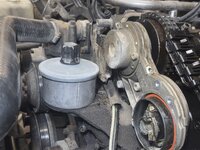
I made a stubby power steering reservoir. I intend to swap camshafts back and forth several times on this car while it serves as my test mule. For that reason, I'm removing as many impediments to that job as possible. All the plastic covers and guides came out. The smog pump is gone. With the stubby power steering reservoir I can remove the cam solenoid without having to deal with power steering at all. It's stupid, for sure, but this car will not be driven aside from a few test pulls. I thought about eliminating power steering entirely, but this was easier.

Look at that cute little thing.

1000010869.jpg
 
No guesses on my lathe nonsense I guess. Well here you go.

I made a stubby power steering reservoir. I intend to swap camshafts back and forth several times on this car while it serves as my test mule. For that reason, I'm removing as many impediments to that job as possible. All the plastic covers and guides came out. The smog pump is gone. With the stubby power steering reservoir I can remove the cam solenoid without having to deal with power steering at all. It's stupid, for sure, but this car will not be driven aside from a few test pulls. I thought about eliminating power steering entirely, but this was easier.

Look at that cute little thing.

View attachment 224159
If you could do similar with a M119.982 you could achieve god-like status, the power steering reservoir on that engine is a complete PITA to remove.
 
If you could do similar with a M119.982 you could achieve god-like status, the power steering reservoir on that engine is a complete PITA to remove.
Isn't that the plastic one? I thought it was already out of the way lf the solenoid since there's no distributor to worry about.
 
I left all my solenoid parts in a tray overnight with the intention of returning today to reassemble. Overnight, several of the magnets oozed oil.

1000010885.jpg

Oil is definitely permeating the magnets and contributing to leaks. I know I've seen discussion on the forum about that before. Here's confirmation. I think I'll sacrifice one to science and cut it open to have a look inside.
 
So yeah, the coils basically snap together. They're probably glued at the factory, but over time oil can get inside and work its way through.

1000010887.jpg

My guess is that a good cleanup and a slathering in some kind of sealant would probably make them serviceable for a long time. That's what I'm going to do. Best bet is probably just to get new ones if you need them though.
 
Last edited:
I think only a small amount of oil can be held inside the solenoid/coil housing. I found that letting them sit for a week or two with the connector pointing downward, onto a paper towel, generally lets some amount escape. That may be enough to keep the remaining oil inside after resealing/installing on the engine. With enough RTV gooped inside, hopefully no more oil will enter.

:brudda:
 
Let's talk timing chain stretch. I just checked mine. By the time I got the right side exhaust cams pinned I was at 28 degrees. I'm going to assume that's well within necessary replacement territory, yes?
 
Let's talk timing chain stretch. I just checked mine. By the time I got the right side exhaust cams pinned I was at 28 degrees. I'm going to assume that's well within necessary replacement territory, yes?
Assuming ALL rails are fully intact, that's a crazy amount of stretch. Or, close to 1 tooth off on the chain. The chains rarely stretch at all, usually the reason for measuring out of spec is worn guide rails.

If the rails are all good, I'd start by checking that measurement a couple more times to confirm, then see what happens if you re-time it with all 4 cams pinned.

If the chain really is stretched that bad, it's the worst I've ever heard of on an M119.

:klink:
 
Assuming ALL rails are fully intact, that's a crazy amount of stretch. Or, close to 1 tooth off on the chain. The chains rarely stretch at all, usually the reason for measuring out of spec is worn guide rails.

If the rails are all good, I'd start by checking that measurement a couple more times to confirm, then see what happens if you re-time it with all 4 cams pinned.

If the chain really is stretched that bad, it's the worst I've ever heard of on an M119.

:klink:
Yeah. I'm highly suspicious of a broken guide rail somewhere. Just got the cams out right this minute. Found the noisy lifter. Guide rail inspection next.
 
Something isn't adding up here. All the guides are intact, aside from the right intake guide, which is broken on the bottom. The middle sprocket pretty much takes the chain from there, so I see no reason for that kind of slop.

When I went to pin the cams, I set the crank to 45, then had to keep turning to 40 to get the left exhaust cam pin in. I then had to remove that pin and pull to 35 to get the left intake pin in. Then I pulled that pin and kept going to 30 to get the right intake in. Finally pulled that and turned to 28 to get the right exhaust pin in.

The fact that I had to pull progressively farther for each cam would suggest a stretched chain, but the increments make no sense. Assuming it was stretched equally throughout its length, the first cam should have been much further off, and each subsequent cam should have been much closer, given the shorter distance between each cam sprocket.

So yeah, I have no idea. I think for right now I'm just going to go through and clean up the lifters and replace the valve guide seals. Once that's done, I'll reassemble and see where we stand.
 
I ended up making some adapters that allowed me to bolt a valve spring compressor bridge down to the cylinder head. This setup works pretty well, but it's still a fiddly job. I tried the rope trick on the first cylinder just to try it out, but it's a lot of extra work compared to compressed air so I used air after that.

1000010890.jpg

I got through 3 cylinders yesterday. Disassembled and cleaned all the lifters, pulled the valve springs and replaced the valve stem seals. By the third cylinder I had my process down pretty well and I can do one valve and lifter in about 15 minutes. In theory that means I have 5 hours of work ahead to finish the valves and lifters.

I'm hoping to get through all the rest of them today. After that it'll be new timing chain guides and reassembly.
 
@Beater400E,
I used compressed air when I replaced the valve seals in my long gone 86-300E. It worked very well albeit a lot less complicated than the M119.
 
@Beater400E,
I used compressed air when I replaced the valve seals in my long gone 86-300E. It worked very well albeit a lot less complicated than the M119.
Yeah, I've used compressed air on other engines before, but in almost every case it's been 12 or 16 valves, and they were old school cam-in-block engines that didn't have the added complexity and space limitations of an overhead cam setup.

This 32 valve overhead cam setup is a ton of work. It'll be worth it in the end though, I'm sure. Just have to be patient. Oh, and don't drop any valve keepers into the depths of the engine. That would be bad.
 
Were any of the old stem seals visibly bad / failed / damaged? Also, what pliers are you using to R&R the seals?

I have an engine that is consuming a lot of oil, but I don't know if it's rings or valve seals. There's no visible blue smoke at any time. I thought valve seals tends to cause a bit of blue smoke at idle, or off-idle.

:scratchchin:
 
Were any of the old stem seals visibly bad / failed / damaged? Also, what pliers are you using to R&R the seals?

I have an engine that is consuming a lot of oil, but I don't know if it's rings or valve seals. There's no visible blue smoke at any time. I thought valve seals tends to cause a bit of blue smoke at idle, or off-idle.

:scratchchin:
They are petrified. They're permanently oversized and very stiff. I have not yet reached cylinder #7, which had higher compression, and I suspect may be the main cause of my cold start smoke. I'm guessing I may find a cracked or damaged seal in #7.

In my experience valve seals will cause smoke at cold start, and maybe in high vacuum situations like engine braking. I wouldn't typically expect to see much smoke at idle.

To R&R the seals I'm using this kit.

The spring compressor bridge kit is:

I actually use different pliers from both kits depending on the position of the valve I'm working on. Pliers are only for removal though. Installation uses a different tool in the kit and is very easy.

The bridge kit would be tricky to use without some kind of alternative mounting arrangement. I'm sure it can be done with some washers or something, but I just used some aluminum bar to align everything the way I wanted it.

71WUT78yCWL._AC_SL1500_.jpg 7190I5wOerL._AC_SL1500_.jpg
 
Last edited by a moderator:
Finally done with the valve stem seals and lifters. So much work. Didn't find a smoking gun on cylinder 7.

Next up is timing chain guides. After that I guess I reassemble and hope for the best on the timing chain itself.
 
Get a chain- mine was stretched after 81k miles and regular service. If you are going through this kind of effort you might as well throw a new chain at it. Love this project and am looking forward to what you discover with the various upgrades you have planned
 
Get a chain- mine was stretched after 81k miles and regular service. If you are going through this kind of effort you might as well throw a new chain at it. Love this project and am looking forward to what you discover with the various upgrades you have planned
Yeah, there's a good chance I'll end up doing that. I'm going to wait until I get the new guides in and see how it looks at that point.
 
Ok, question about the cam adjuster armature. I know there's an early version and a late version. I think I'm understanding that generally speaking, the LH M119s came with the early version, and the ME M119s came with the late version. I could be wrong about the cutoff, but that's not really important.

The factory repair info says that when performing repairs the early version should be replaced with the late version. I understand that to do so I would need to replace everything from the cam flange out. There is a 97 E420 at the junk yard that has all the needed bits.

My question is whether there's a reason to swap them. Why did the factory make the change and recommend the updated configuration be retrofitted? Is there a benefit to doing it?

On a side note, the adjusters are really annoying to reassemble. It can be done without the special tool, but it sucks.
 
AFAIK there's no advantage to the late style solenoid & armature, unless perhaps the late style were less prone to leaking? Don't think anyone has taken apart a new style solenoid yet to see if there's anything visibly different inside.

Manufacturer production of the solenoid likely changed to the new style, so the FSM said to replace with the late version because once supply ran out of the old, only the new could be obtained. As shown in FSM job 05-2175, the shape of both are different, and both need to match.

Yeah, possible but not fun without the special tool. Expensive, but worth it in reductions to swear jar deposits.

:nos:
 
Manufacturer production of the solenoid likely changed to the new style, so the FSM said to replace with the late version because once supply ran out of the old, only the new could be obtained.
I bet you're right. That makes sense. I won't worry about it then. I'll stick with the old style.
 
Finally made some more progress today. I got the three pinned upper timing chain guides replaced and started reinstalling the cams. Both left side cams are in and timed, and they are perfectly aligned at 45 degrees BTDC.

I'm guessing I must have done something dumb when checking the timing situation before I disassembled it. None of the guides were in terrible shape, so there's no reason for it to have been so wonky.

I have a busy few days coming up, so not sure if I'll have time to get the right side cams dialed in before next week. I'm optimistic that timing will be good though.

I'm planning on replacing the oil filter housing check valve and oil pressure sender, and also removing the air pump valve off the side of the block. I'll make a plate and gasket to close that off.

I'm wondering if there are any other changes I should consider as I'm getting this motor ready for the swap. I am considering an EGR delete. There is no emission testing in Idaho any more, so that won't be an issue. Any reason not to do that? Any other changes I should consider?

Before the engine goes in I will be replacing the oil pump pickup screen and oil level sender o rings. I will probably also install a new water pump and thermostat and maybe even new front and rear crankshaft seals. Obviously cam seals and valve cover gaskets will be all new.

I will probably pull the intake off just to clean it up and remove the dead mice. Seriously. There are dead mice. The intake will get new gaskets, and I'll replace the filters and o rings on the injectors. I have to swap my non-ASR ETA over, so it'll get a new gasket and MAF boot then. I also have all new OE breather hoses to go on it.

The goal is to make this motor as perfect as possible before it goes in. I have no reason to pull the heads or touch the bottom end, but everything else will be fresh.

What am I forgetting? Any additional maintenance items or upgrades I should consider?
 
@Beater400E,
Sounds like you have it covered. My only comment would be that deleting the EGR equipment would make the car more difficult to sell out of state somewhere in the future. If it’s your car for life who cares.:)
 
@Beater400E,
Sounds like you have it covered. My only comment would be that deleting the EGR equipment would make the car more difficult to sell out of state somewhere in the future. If it’s your car for life who cares.:)
I suppose that's possible, but this car will never be highly valuable anyway. Admittedly, I do question whether there's really any point in deleting the EGR. I do like the idea of simplifying things and eliminating potential issues. I don't think the EGR would make a difference in performance though, so I don't know if it's worth messing with. If anything, I could just pull and clean the valve, and then replace the vacuum lines and it should be trouble free for decades.
 
Well, my optimism was misplaced. I got the cams all back in and timed. Turned the motor over a couple times and checked it and... same numbers as before. The right exhaust cam can't be pinned until the crank hits 28 degrees BTDC.

Obviously I can manipulate the cams to get them all pinned at 45, but once everything is properly tensioned, the cams lag behind.

I don't know what else to check. It really seems like the chain is super stretched.
 
Well, my optimism was misplaced. I got the cams all back in and timed. Turned the motor over a couple times and checked it and... same numbers as before. The right exhaust cam can't be pinned until the crank hits 28 degrees BTDC.

Obviously I can manipulate the cams to get them all pinned at 45, but once everything is properly tensioned, the cams lag behind.

I don't know what else to check. It really seems like the chain is super stretched.
This could be the rare case where the chain really is stretched. Unfortunately, there's no way to know without rolling in a new one. Only other possible explanation would be a broken guide rail down inside the timing cover.

:runexe:
 
This could be the rare case where the chain really is stretched. Unfortunately, there's no way to know without rolling in a new one. Only other possible explanation would be a broken guide rail down inside the timing cover.
Yeah, I load a pretty good look down there when I had the cams and the other guide rails out. They looked fine. That, and if it was a bad lower rail I would expect to see the cams all pin together, just closer to TDC. In this case they are each progressively worse, which supports the stretched chain theory.

So yeah, it'll get a chain.

I know everyone says feeding a new chain in is a pain. It sounds like that's mostly just the case if the cams are installed though. I'm thinking I might just pull the cams back out and feed the chain through like that. All the valves will remain closed, so no concern with valves hitting pistons, and I don't have to worry about timing at all until the chain is done.

Looking at chain riveting tools online, I see lots of kits that specifically call out that they are compatible with several Mercedes engines, but none specify the M119. I assume that if they'll work with an M116 and an M103, they should work with an M119, right?


1760105146551.png
 
Correct - it's a pain to replace the chain with cams installed, trying to keep all cams in time while rotating the engine. The chain will occasionally jump a tooth. Fun stuff.

I forget the details on the chain tool. If it works for M116/M117, it should work for M119 also? Photos of the factory tools are here. Also see the FSM document at this link, although that's diesel-specific, the procedure is the same for gas engines. M119 doc is here. Note the diesel double-row links are larger diameter. Amazon kit has free returns so you can always send it back if it doesn't fit.

Also, the factory chain links have a pressed-on center plate, and pressed-on end plate... I think some aftermarket links are a slip fit? Some of the procedure steps are to press on these plates.
 
I have a couple timing chains on order. It'll probably be a week before they get here. Rummaging through my stuff I found a chain that I pulled out of one of my other motors that was nearly brand new. It had clearly been installed not long before that car got scrapped. I received the chain riveting kit this morning.

I think I may actually try swapping in this chain just to see where that puts me. If timing looks great I might just run it. If nothing else, it gives me a chance to practice breaking and riveting the chain before the new ones come in.
 
I pulled the cams and then extracted the chain. Pretty sure I can feed a new chain in by itself. It's pretty easy with the cams and spark plugs out.

I hung the "new" and old chains next to each other. Check it out.

1000010912.jpg

On the left is the lightly used (newish) chain. On the right is the old stretched chain that just came out of this engine. The old one is 10mm longer than the newish one. That's basically one link of the chain. That would equal 20 degrees of crankshaft rotation.

I measured 17 degrees of stretch at the right exhaust cam. Obviously there's more chain stretch that wasn't measured between the right exhaust cam and the crank, but that's a relatively short run. I would guess total stretch on this chain is in the low 20 degree range. 21-23 probably. That would suggest that this newer chain would probably put me at 42-44 degrees BTDC. A new chain would probably be marginally better.

I think I will still proceed with installing this chain and measuring the chain stretch. If I'm at 44 or 45 I'll probably leave it. 43 or worse I'll swap it again for a brand new one.
 
10mm difference total length shouldn't add up to 10mm (20°) at the cams, but I'm really curious what you find with the new-er chain rolled in!

:detective:
 
10mm difference total length shouldn't add up to 10mm (20°) at the cams, but I'm really curious what you find with the new-er chain rolled in!
Right. 10mm total length would be less. Maybe... 7mm at the right exhaust cam? Just a guess. That would be 14 degrees. I'm getting 17 total, so we're in the ballpark. I'll have an answer here in a bit. The "new" chain has been fed in and I'm working to rivet it now.
 
I think I know the answer at this point. I got the cams in, but apparently as I was getting the tensioner in place the crank must have been right on the edge of the teeth because it snapped one tooth over and then everything was 20 degrees off. I'll fix that tomorrow, but after rolling the motor over a couple times, all 4 cams can be pinned at 24 degrees. Once I fix the timing on the crank that should be 44 degrees.

Assuming that's what I get, I'll just run this chain.
 
Still haven't gotten back to fixing the timing, but hopefully I'll get that done today.

Something that I was curious about though... Is there any advantage to retaining the 8 rib serpentine belt setup? I assume that I'd have to keep the solid damper if I do that, which I believe makes removing the water pump far more difficult. The 95 6 rib belt drive uses the spoked damper, which is also a slip fit if I recall correctly. The 6 rib belt should theoretically have less friction, meaning marginally better fuel economy and power. I doubt the difference would even be measurable, but I can't think of any downside to running the 6 rib belt.

If I ever did something crazy like installing a supercharger, the 8 rib setup would probably be a big benefit, but short of that, I can't think of any reason to retain it.
 
No advantage to retaining the 8 rib serpentine belt.

Spoked damper is a slip fit.

The spring-loaded tensioner is a nice bonus in place of the rubber-bearing manual tensioner. AC bracket is different too.
 
No advantage to retaining the 8 rib serpentine belt.

Spoked damper is a slip fit.

The spring-loaded tensioner is a nice bonus in place of the rubber-bearing manual tensioner. AC bracket is different too.
Yeah, I'd run the spring loaded tensioner either way for sure. It was just a question of whether I should go to the effort of fitting all 8 rib pulleys to this 95 engine when it gets installed in the 400E or not. Sounds like there's no advantage to it, so I will definitely go with the 6 rib setup.
 
Back
Top