
After fighting vibration issues at highway speeds for many years on my first few W124's (300E/300D) back in the 1990's, I started insisting on Hunter Road Force balancing, which helped a lot. However, if a wheel is bent excessively, no amount of weight or fancy balancing will make the vibration go away. The Road Force machines have the ability to measure wheel runout, both lateral (side to side) and radial / vertical (up/down). When road force is excessive, the machine then measures runout. If it finds excess runout, the tire shop tells you to go get the wheel straightened, then come back with a straighter wheel and they'll try to balance again.
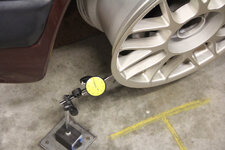
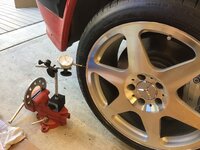
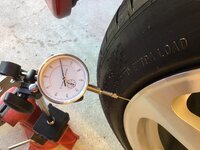
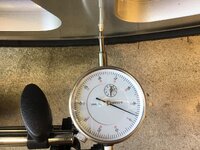
So, I started checking wheel runout myself, before taking wheels to get tires mounted. (I also never bring the car to the shop. NEVER EVER. Only bring loose wheels to a shop. Anyone who has watched a shop improperly jack up their vehicle, sometimes damaging parts beyond repair, knows what I'm on about.) But anyway, I measure runout with a dial gauge (see attached photos) and make sure they are straight, before ever going to the tire shop. That way, if the Road Force numbers are high and cannot be improved after rotating the wheel on the tire 90°/180°/270°, I know it's a bad tire and the tire shop knows as well.
Mercedes does not publish any specs for wheel runout on the 124, 129, or 140 chassis. They only publish a limit for wheel+tire combined, max 1.0mm radial (vertical) at center of tire, and max 1.5mm lateral at center of the sidewall. To me, this implies that even with a perfect tire, the wheel could not be more than 1.0-1.5mm out; and likely needs to be half that amount. The WIS documentation specifies a limit of 1.0mm for wheel+tire combined, both lateral and radial/vertical, for ALL chassis. This is a tighter tolerance than old spec allowed on the 124/129/140.
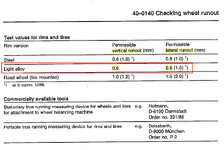
UPDATE: Mercedes did publish specs for the 126 chassis, as @liviu165 posted at this link (thank you!). The 126-chassis limits for alloy wheels are 0.60mm, lateral & radial/vertical, right in the ballpark I had been using for years (explained below). See 126 FSM job 40-0140 for details. Screen shots also attached below.
There are some generally accepted limits for wheel runout, from various wheel mfr's or wheel repair companies. The typical limit mentioned for alloy wheels is around 1/32" (0.030", or 0.80mm). I personally believe this is excessive and I like to see numbers better than 0.50mm radial/vertical & lateral. While I don't have hard data to support this theory, I also believe that it gets more difficult to obtain good Road Force numbers when the wheel runout exceeds the 0.50-0.80 range. At 1.0mm or more, that indicates a bend that should be corrected. I've measured quite a few of my own wheels with one measurement in the 1.0-1.5mm range, and had to get them straightened. Worst I've seen was 4-6mm on some bent AMG wheels - a bad eBay purchase years ago, and I didn't measure them until months later, too late to return for a refund. If you buy used wheels, measure them ASAP. (Anyone want some C219 staggered Styling 6 wheels that need repair?)
GSXR's opinion is that anything under 0.30mm is excellent. In some cases I've measured as low as 0.10-0.15mm! One particular set of BBS wheels was near flawless with 14 of 16 numbers at 0.25mm or less, and the worst two (of 16) were only at 0.35mm. I would expect new wheels should generally be 0.25mm or less in all directions. Rough guidelines:
The local wheel repair shop in Boise relies more on balance than measurements. One time I gave them a wheel to straighten, with ~1.00mm radial/vertical runout on the inside barrel, they gave it back still at ~0.80mm. They said it balanced fine, but I wasn't happy with 0.80mm. I had them try again and the second time they got it to ~0.50mm and said that was the best it was going to get. They charge ~$125 just for straightening, that does not include refinishing or any other work. (!!!) If your local shop charges less, consider yourself fortunate. If you have to pay to ship a wheel somewhere to be straightened, it may be $50 each way, depending on the distance.

So, I started checking wheel runout myself, before taking wheels to get tires mounted. (I also never bring the car to the shop. NEVER EVER. Only bring loose wheels to a shop. Anyone who has watched a shop improperly jack up their vehicle, sometimes damaging parts beyond repair, knows what I'm on about.) But anyway, I measure runout with a dial gauge (see attached photos) and make sure they are straight, before ever going to the tire shop. That way, if the Road Force numbers are high and cannot be improved after rotating the wheel on the tire 90°/180°/270°, I know it's a bad tire and the tire shop knows as well.
- Remove a front tire from your car. Ideally you also measure wheel bearing end play to verify it is not excessive, which would cause larger measurements than actual (bad data). Better yet, temporarily set bearing end play to ZERO, then when you are done adjust to spec of 0.01-0.02mm end play, per FSM job 33-0300.
- The car must be supported very well so it will not move (or, bounce on a 2-post lift) when you rotate the bare wheel.
- If the wheel mounting flange surface is not perfectly clean, it must be cleaned to ensure the wheel is flat against the brake rotor
- If the brake rotor surface is not perfectly clean, it also must be cleaned - same reason as above
- If the wheels are used (ever had a tire mounted), clean off old rubber from the bead seat area by scraping and/or using a wire brush. The surface where the dial gauge will ride against must be as clean as possible (bare paint or bare metal)
- Pry the brake pads away from the rotor, just enough so the rotor turns easily and spins with light finger pressure. There must be zero drag on the rotor
- With all mounting surfaces clean, install the wheel with at least 3 bolts. I use an impact wrench and tighten to an estimated 50 lb-ft or so. There's no easy way to torque to spec without a second person to step on the brake pedal. I don't think the torque is critical, but the bolts need to be more than hand-tight
- Verify that the wheel rotates very easily with 1 finger and does not drag on the brake pads. You are now ready to measure with the dial gauge
- Mount a dial gauge on a fixed surface. I have a magnetic mount and attach that to a heavy piece of iron. Adjust so it touches the bead seat area, radial/vertical or lateral, with at least 3mm of preload
- Turn the wheel by hand very slowly & gently so as not to skew the measurements; then rotate the wheel multiple times and look for average/min/max readings. Repeat until you are confident you have accurate data
- Sometimes there are visible high or low spots, sometimes not. This is when you find a fairly constant reading over 300°+ of rotation, but there is a large variation over a small section, maybe 30° of rotation (few inches along outer edge)
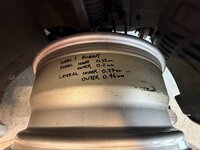
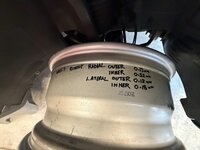
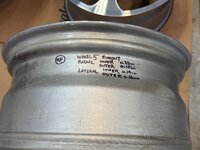
- I write the numbers on the wheel, along with the weight of the wheel, for future reference
- Now that you have the numbers, see below for decoding
Mercedes does not publish any specs for wheel runout on the 124, 129, or 140 chassis. They only publish a limit for wheel+tire combined, max 1.0mm radial (vertical) at center of tire, and max 1.5mm lateral at center of the sidewall. To me, this implies that even with a perfect tire, the wheel could not be more than 1.0-1.5mm out; and likely needs to be half that amount. The WIS documentation specifies a limit of 1.0mm for wheel+tire combined, both lateral and radial/vertical, for ALL chassis. This is a tighter tolerance than old spec allowed on the 124/129/140.
UPDATE: Mercedes did publish specs for the 126 chassis, as @liviu165 posted at this link (thank you!). The 126-chassis limits for alloy wheels are 0.60mm, lateral & radial/vertical, right in the ballpark I had been using for years (explained below). See 126 FSM job 40-0140 for details. Screen shots also attached below.
There are some generally accepted limits for wheel runout, from various wheel mfr's or wheel repair companies. The typical limit mentioned for alloy wheels is around 1/32" (0.030", or 0.80mm). I personally believe this is excessive and I like to see numbers better than 0.50mm radial/vertical & lateral. While I don't have hard data to support this theory, I also believe that it gets more difficult to obtain good Road Force numbers when the wheel runout exceeds the 0.50-0.80 range. At 1.0mm or more, that indicates a bend that should be corrected. I've measured quite a few of my own wheels with one measurement in the 1.0-1.5mm range, and had to get them straightened. Worst I've seen was 4-6mm on some bent AMG wheels - a bad eBay purchase years ago, and I didn't measure them until months later, too late to return for a refund. If you buy used wheels, measure them ASAP. (Anyone want some C219 staggered Styling 6 wheels that need repair?)
GSXR's opinion is that anything under 0.30mm is excellent. In some cases I've measured as low as 0.10-0.15mm! One particular set of BBS wheels was near flawless with 14 of 16 numbers at 0.25mm or less, and the worst two (of 16) were only at 0.35mm. I would expect new wheels should generally be 0.25mm or less in all directions. Rough guidelines:
- 0.05-0.30 mm = Excellent
- 0.35-0.50 mm = Very Good (no action required)
- 0.55-0.80 mm = Borderline (no action required, if Road Force balance is ok, and no vibration at highway speeds)
- 0.85-1.20 mm = Likely to vibrate, highly recommend straightening
- Over 1.25mm = Almost guaranteed to vibrate, definitely needs to be straightened
The local wheel repair shop in Boise relies more on balance than measurements. One time I gave them a wheel to straighten, with ~1.00mm radial/vertical runout on the inside barrel, they gave it back still at ~0.80mm. They said it balanced fine, but I wasn't happy with 0.80mm. I had them try again and the second time they got it to ~0.50mm and said that was the best it was going to get. They charge ~$125 just for straightening, that does not include refinishing or any other work. (!!!) If your local shop charges less, consider yourself fortunate. If you have to pay to ship a wheel somewhere to be straightened, it may be $50 each way, depending on the distance.