• Hi Guest !

    Welcome to the 500Eboard forum.

    Since its founding in late 2008, 500Eboard has become the leading resource on the Internet for all things related to the Mercedes-Benz 500E and E500. In recent years, we have also expanded to include the 400E and E420 models, which are directly related to the 500E/E500.

    We invite you to browse and take advantage of the information and resources here on the site. If you find helpful information, please register for full membership, and you'll find even more resources available. Feel free to ask questions, and make liberal use of the "Search" function to find answers.

    We hope you will become an active contributor to the community!

    Sincerely,
    500Eboard Management

The $400 400E

Got the engine timed. I've been doing this with the spark plugs out to make turning the engine over easier. With the plugs out I'm able to effortlessly pin all 4 cams at 46 degrees BTDC.

I find that a little strange. I'm guessing the lack of compression with the plugs out made the cams turn with less effort or something? 46 just seems odd since a new chain should be at 45. I'm going to install the plugs and try again.
 
Same thing. I'm going to assume that's normal. 46 is the earliest point at which the right exhaust cam could be pinned. I can also turn it to about 43 and it'll still go. Split the difference at 44.5 for the most accurate figure I guess.

So it's looking good.

I do have a small worry in the back of my mind though. When I riveted this chain in place, I might have clamped it down just a bit too hard. That link ended up less flexible than the rest of the chain. Like there was a little bit of binding in that link. It still comfortably flexes more than far enough to pass around any sprocket in the engine.

Should I be concerned about that? I expect that it'll probably "break in" right away and it won't be an issue, but I don't know. I do have two new timing chains on the way, and I could replace it, but I'd rather not if I don't have to. Has anyone experienced a tight link after riveting?
 
I've not experienced a "tight" master link after riveting, but I've only done timing chains maybe 3 times in my life. On the bright side, you can easily remove / replace the master link if you want to try again. Hopefully the cost isn't too high for the OE links (I haven't checked in a while). The OE type with press-fit center plate helps keep the link intact even if the outer plate were to somehow fall off.

:klink:
 
I've not experienced a "tight" master link after riveting, but I've only done timing chains maybe 3 times in my life. On the bright side, you can easily remove / replace the master link if you want to try again. Hopefully the cost isn't too high for the OE links (I haven't checked in a while). The OE type with press-fit center plate helps keep the link intact even if the outer plate were to somehow fall off.
What I should have done is measured the other links, and then crimped the master only until it was the same width. I overdid it a bit and the master link is about 0.020", or 0.5mm too narrow.

For the record, the OE master link is part number 0009971898 and is $5.69 at FCP Euro as of today. I ordered 3 of them.

A more difficult item to find is the timing chain tensioner gasket. I can't find one anywhere. I might see about making another small run of gaskets like I did with the power steering reservoir gaskets. Very few people ever wanted those, so I still have a ton, but at least I'll always have some for myself!

I'm also going to make up some gaskets for the front cylinder head covers, and the cam magnets. I know those should use anaerobic sealer, but I'm thinking a thin gasket might be a better option for the short term since I'm planning to swap cams a few times. With a thin gasket glued to the cam cover I can disassemble and reassemble without having to clean anything or reapply sealer. I will definitely remove those gaskets and apply sealer when I'm done with the cam swaps though.
 
I think the OE metal timing chain tensioner gasket can be re-used. Maybe add a bit of Hylomar to it. Since this is a test engine, I'd try that and see what happens.
 
I think the OE metal timing chain tensioner gasket can be re-used. Maybe add a bit of Hylomar to it. Since this is a test engine, I'd try that and see what happens.
I re-used the tensioner gasket on my engine after removal with no ill effects, no additional sealant etc. was applied either.
 
I think the OE metal timing chain tensioner gasket can be re-used. Maybe add a bit of Hylomar to it. Since this is a test engine, I'd try that and see what happens.
This engine doesn't have a metal gasket. It's a typical paper composite gasket, and it's seen better days.
 
I'm thinking of painting a set of valve covers for this engine. I know they are cast magnesium and can be a little tricky to paint properly and to ensure the paint will actually adhere long-term. Does anyone have any tips or suggestions to improve my odds of success?

What I'm thinking is I'll start with a set of later unpainted valve covers, clean them as well as I can machanically, sand and polish a bit to clean up any imperfections, and then bake them in the oven for several hours at about 300°F to drive out any oil or wax in the pores of the metal. Clean with acetone, then hit it with an etching primer and proceed to paint.
 
 
Yeah, I read that one. I don't plan to powdercoat them. Doesn't really fit with my DIY low budget style. I'm also usually not a fan of powder coating cast parts. In my experience it's common for corrosion to find an entry point, and then travel under the powder coat and cause it to peel badly.
 
I did find a metal shim for my timing chain tensioner. Surprisingly I only had one, despite having 7 M119 motors at my disposal. My 92 500SEL motor had a composite gasket. I could not find the shim/gasket from the 95 or 94 S500 engines I have that are disassembled. They might have been tossed. I didn't mess with the 400E motor or the Offroadster motor since those are runners. My 92 500SL CIS injection motor did have one though, so I swapped the used composite gasket onto that and installed the metal shim on this motor.

I've started cleaning up a set of valve covers. Got them pretty well degreased. Started playing around with smoothing and sanding and such. I decided that it's probably a better idea to get them as clean as possible before I go much further with the sanding though. What I dont want to do is force any oils into the metal by sanding over anything with residual grease.

While my wife is at work, I have commandeered the dishwasher. The valve covers are in there getting the best cleaning of their lives. I know it's generally not best practice to wash aluminum in a dishwasher because dishwasher detergent is highly alkaline and can damage aluminum. I believe this is one area where magnesium is a little more forgiving. At least I hope so.

Once they're done in the dishwasher they'll go in the oven for a few hours to try to drive out any contaminants in the metal. After that I may do another cycle in the dishwasher before I move on to sanding and final prep for paint.

I've ordered a can of zinc phosphate primer to hopefully help with adhesion to the magnesium. Supposedly zinc chromate is better, but is extremely hazardous, so I'll just use the zinc phosphate. My plan is to do some custom lettering on the valve covers. This is something I've done in the past on some of my other cars, and I think it looks great when it's done well.

The plan is to paint each valve cover silver, then apply vinyl decals across the lower side of each one that say Mercedes-Benz, as well as a three pointed star on the front of each. With the decals applied, I will then paint them both black, and then remove the vinyl. That will result in black valve covers with silver lettering and stars. I can then clear coat the whole thing, which helps smooth the boundary lines between the black and silver.

I know the lettering won't even be visible with the air cleaner in place, but I enjoy this kind of detail work sometimes. I'm contemplating prepping and painting all the engine plastics gloss black as well. I'm less committed to that at this point, but I have so many spares that I could easily paint a set and if I hate it just swap back to bare plastic.
 
After about 4 hours in the oven I pulled the valve covers out. The dishwasher did a great job of cleaning and the oven got them nice and hot. I honestly can't say whether the oven actually got them any cleaner. They didn't visibly change in the oven, other than slowly becoming darker. The cleaning processes got rid of grease and dirt, but they are a bit more oxidized than before.
Next I got to sanding. The surface has lots of imperfections from the casting process. I'm not necessarily trying to make them perfect, but the flat sections that are most visible I'd like to get as smooth as possible.

I'm also working on extracting the lower engine wire harness. It's completely obliterated and really needs to be rebuilt before this car runs again. The alternator exciter wire is broken and all the rest of the lower harness wires are just a mess of tangled copper. I didn't want to mess with it on this car, but it needs it just to be able to be trusted for testing.
 
Sounds like my timing chain master links are going to have to come from the fatherland. I think the timing chains I ordered are going to be here Monday, so I might just install one of those.
 
Since I'm waiting on parts I decided to throw the engine back together so I could drive the car out of the shop and work on something else over the weekend.

Got it all together and running, and woah buddy the lifters are loud. All of the lifters are clattering. It seems to be running well, but the lifters are angry. I don't know whether to just let it run for a while and hope they pump up, or what.
 
Were the lifters quiet prior to the work performed? Any chance you could have done something that might have blocked an oil passage?

If oil pressure is confirmed normal, I'd be tempted to let it get up to temp and see if they eventually quiet down. You're looking for oil temp to come up more than coolant temp, which will be hard if not driving it.

:hiding:
 
Were the lifters quiet prior to the work performed? Any chance you could have done something that might have blocked an oil passage?

If oil pressure is confirmed normal, I'd be tempted to let it get up to temp and see if they eventually quiet down. You're looking for oil temp to come up more than coolant temp, which will be hard if not driving it.
It had 4 lifters that were soft and noisy before. I pulled, disassembled, and cleaned them all. I doubt there's anything that would have blocked an oil passage. I can see there's plenty of oil flowing to the top end.

I know this happens a lot with Miatas. The Miata bucket lifter is a very similar design to the M119. In the case of the Miata they say the thing to do is get it up to temp, and then bring the RPMs up to 2000 or so for about 10 minutes.

Apparently the design makes it difficult to bleed all the air out of the lifters, and they need thinner oil and more oil pressure to work all the air out. That's my best guess right now.

I will be pulling the cams again in a few days anyway, so worst case I figure I can pull the lifters and vacuum bleed them then. To do that you just drop them into a jar of oil and then attach a vacuum pump to it. The vacuum will cause the air inside the lifter to expand and bubble out. When pressure is returned, oil will flow in to fill the low pressure inside the lifter. Science!

I'll try some RPMs first though.

I'd love to be able to drive the car, but the brake lights don't work, the corner markers are smashed, the tires are dry rotted and badly cracked, and it's not registered or insured. If I had a set of wheels and tires that I could bolt on I might be willing to do something about everything else to make it legal to drive, but I do not.
 
Sometimes I forget how relatively time-consuming these cars can be to work on. I'd pulled the parts car out this morning so I could help my dad replace the transmission and clutch in his Geo Metro. 3 hours later, that was done.

I have the parts car back in the shop. I let it sit here and warm up for half an hour or so, but the temp gauge never came up. I don't know whether it's a gauge issue or a sensor or wiring. The wiring harness is fresh, so I'm guessing it's the sensor.

The temp gauge sensor is the single pin sensor, right? I'll probably just go ahead and replace it. I want to be able to trust it when this motor gets installed in the 400E.

One other thing I can report us that the smoke I was seeing at cold start before is gone. It was definitely the valve stem seals.
 
Sure enough. 10 minutes at 2000-2500 RPMs did it. One by one they got quieter until the lifter noise was completely gone. It's sitting here quietly idling away right now. It still kind of stumbles at idle occasionally. Not sure what that's about. I'm not super worried about it, but it is a definitely not right.
 
1000010942.jpg

I started working on the whole intake as exhaust cam thing today. I slotted a set of exhaust cam sprockets ages ago. Today I started working to get a slotted sprocket mounted to an intake cam. The key, of course, is getting the intake cam timed exactly as the exhaust cam had been. To accomplish that, I need to be able to locate the original exhaust sprocket and exhaust camshaft orientation, and then put the intake cam and slotted exhaust sprocket in the same positions and then bolt them together.

I won't go into all the details, but I'm using a spare cylinder head and a number of custom machined fixtures to be able to lock everything in position. It's a lengthy process, but when I'm done I'll have a set of intake cams ready to install in place of the exhaust cams.
 
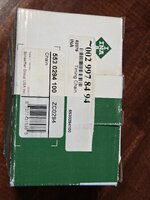
My new timing chains just arrived. I was surprised to see they are fully assembled. These are INA chains. They were dirt cheap, and look to be good quality. I'll need to break the chain and then reassemble with a new master link.

My master links from FCP are on the way. Hopefully I'll have those in a few days.

I'm starting to look ahead to the engine swap. I plan to have the engine out and on a stand long enough to clean and reseal everything. I'm going to have the accessory drive, as well as the intake and exhaust manifolds off. I'm wondering whether I should replace the head gaskets while I'm in that far. I've already done the valve stem seals, so I don't need to pull the heads for that. The engine has 225k miles on it. I have a set of OE gaskets, and I'll be right there, but is there any point if there isn't any sign of a head gasket issue?
 
Where did you buy the INA chains from? Is there a COO on the box/label? Most places want $200 for the chain. I think IWIS is the OEM, btw. Dealer/OE is $406 list, ~$300 discount.

If there are NO signs of head gasket issues... I'd leave it alone, especially for a test mule. However, if it's a long-term "keeper" engine... might not hurt to do the gaskets now with the engine out. I'd also consider taking the intake off so you can replace the 8 rubber donuts.
 
Where did you buy the INA chains from? Is there a COO on the box/label? Most places want $200 for the chain. I think IWIS is the OEM, btw. Dealer/OE is $406 list, ~$300 discount.
USPMotorsports.com. $26.37 each. Dirt. Cheap. COO is Germany.

1000010943.jpg

If there are NO signs of head gasket issues... I'd leave it alone, especially for a test mule. However, if it's a long-term "keeper" engine... might not hurt to do the gaskets now with the engine out. I'd also consider taking the intake off so you can replace the 8 rubber donuts.
This is the engine that is going in the 400E. It'll be a long-term engine. I might eventually put something else in this car, but I wouldn't get rid of this engine. I do plan to replace the intake donuts. I already have them on hand.
 
I have the intake cams mated to a set of exhaust sprockets at the correct timing. Basically ready to go back together. I'm just going to throw the 92 intake cams in on the intake side and I'm using a set of 95 intake cams as exhaust cams.

I talked to the dyno shop about running the car. He said it's $300 per session. I'm definitely not willing to do $300 for a baseline, and then $300 each for multiple tests later on. I asked him about swapping cams on the dyno. He was skeptical, but said we could potentially do that. I explained all the work I've done to prepare the car for quick cam swaps. He said we can do it as a single session, with maybe just a small additional expense for the added time.

I'll do a practice run or two over the weekend, hopefully once with a buddy so we can determine just how quickly we can get it done.

Once I have that, I'll get a game plan together and go talk to the shop about it and get a solid price quote.

My hope is to be able to run as many a/b tests as possible in a single session so we can get the most for the money. I know I mentioned these before, but the cam swap, mechanical fan delete, LH swap, and maybe catalytic converter delete are all options. I'll try to think of some other tests we could do. If anyone has any suggestions, let me know.

I'm also thinking again about what all I'm going to do with this engine once I yank it out to prepare to swap it into the 400E. I think I will do head gaskets. This is where I get in trouble though. "While I'm at it." I have numerous heads, valve springs, and lifters from several different years of engines. I for sure have 92, 94, and 95 heads, and all supporting parts available. I also have intake manifolds from the same. If the intake and heads are coming off, I might as well consider putting together the best possible combination when it goes back together.

I think I recall that some years had dual valve springs, which might be beneficial for higher lift and or higher RPM use. I believe some had lighter weight valve train components as well. I think I recall different valve stem diameters, which could impact flow and valve train inertia. Then there's the flow of the ports themselves. I know there are differences between intake manifolds, but I don't know what's best.

I'm also not opposed to doing some port work. I could certainly gasket match or port match the manifolds and heads. I could also potentially do some other port work if there's any value to it. The thing is, all of this work will cost me nothing but time, so I feel like it would be stupid not to put together the best combination possible. I'll do plenty of research on my own, but if anyone knows which components are the best to use, I'd appreciate the insight.
 
Sounds great! FYI - as I've BTDT - the power starts to drop off a bit when the engine heat soaks. For peak power numbers you want the 1st pull at ~60C. If doing back to back pulls, by the 3rd the temp will be near 100C and you will see the power start to drop. It may only be 5-7hp but when you are looking for small gains, this kinda makes it impossible without allowing time for the engine to fully cool back to the temp of the previous run. Which burns more time.

That said - I'd only do A/B testing that you expect will be at LEAST 10hp difference, otherwise you may just be seeing variations based on heat soak levels. I've already done LH swap testing and have posted dyno charts, so I wouldn't waste time/$$$ repeating the same thing. The cam swap is the elephant in the room that AFAIK, nobody has done before. Second test might be the catalyst bypass. As explained previously, the mechanical fan bypass would be low on the list, but could be done "hot".

1992 USA model year engines had dual valve springs. 1993-up has slightly less lift and single beehive valve springs. I think the 93 engines may have thinner valve stems, but I'm not sure - check the FSM, Group 05. Intake manifolds should be the same on all 5.0 engines (the 4.2 has different upper manifold). 93-up uses the lightweight lifters. FSM warns to NOT use the 1992 heavy lifters with 93-up single springs. You can use lightweight lifters with double springs.

With the intake off, eyeball how bad the port match is from the factory. I've always wondered if this was good, bad, or indifferent. I think there could be 5-15hp (wild guess) found in porting all 16 intake ports, but we don't know how much work is needed vs just a general cleanup. There are precious few photos of AMG or RENNtech porting jobs to use as comparison.
 
You can use lightweight lifters with double springs.
Do you think the single springs or dual springs would be the better choice here? I mean, as long as the valves don't destabilize at high RPMs it shouldn't really matter, so I'm leaning towards the single spring set up.

I am planning to swap a manual transmission into this car, and with your EPROM, I'll have a higher rev limit, so I want to be sure the valves remain stable all the way to 7000 or whatever it is.

As far as temps, I figured I try to get a pull at 100° C for every configuration. I'm not actually concerned with the peak number. I'm more concerned with the change from one setup to the next. My hope is that I can actually keep it hot between configuration changes, as crazy as that sounds. I'm hoping that will reduce the variables.
 
Ok, I think i figured out the valve stem thing. Early 119.960 engines had 8mm valve stems. All 119.97x had 7mm valve stems. The outside diameter of the valve guide did change when the dual valve springs were phased out. That necessitates a different valve stem seals, but only for the outside diameter of the seal. The stem diameter is the same.

So the head castings don't really matter. I could run either valve spring setup, but the spring retainer needs to match the spring style. The later lifters are lighter and preferred over the early ones. The only real question at this point is which valve spring style to run. I'm definitely leaning towards the later single coil style, mainly because it's already in there. I'll do a bit more research to see what I can figure out on that.
 
Do you think the single springs or dual springs would be the better choice here?
I'm really not sure. There seemed to be some concern about coil bind with larger lift values (10-11mm) but that should only be an issue with aftermarket cams (Dbilas or Hagmann regrinds). I think even the higher-lift 92 cams should be fine with the single springs. If you have a way to test both spring types to see at what point it binds, that might help.


I mean, as long as the valves don't destabilize at high RPMs it shouldn't really matter, so I'm leaning towards the single spring set up.
That's my thought too. And we aren't spinning high enough to be concerned about that, in theory anyway.


I am planning to swap a manual transmission into this car, and with your EPROM, I'll have a higher rev limit, so I want to be sure the valves remain stable all the way to 7000 or whatever it is.
It should pull to 6600-6650 with the modified EPROM, at which point there is a "soft" rev limit. Basically feels like the engine stops pulling. It's not a hard cutoff like the stock limit at 6300-6350 which feels really harsh. On the dyno you keep it at WOT until the revs stop increasing. Ignore what the tach says, they are often optimistic, might indicate like 6800 or something.


As far as temps, I figured I try to get a pull at 100° C for every configuration. I'm not actually concerned with the peak number. I'm more concerned with the change from one setup to the next. My hope is that I can actually keep it hot between configuration changes, as crazy as that sounds. I'm hoping that will reduce the variables.
This makes sense - but do what you can to try and cool the engine down closer to 80C before firing it up for the next pull. Use the big fans at the dyno shop, and run the heater on MAX, assuming your coolant recirc pump works - this circulates hot coolant through the heater core and speeds up the cooldown time. If you can keep your runs between 85-95C that would be ideal. I think the ECU's start to cut power sliiightly at 100C and above, you don't want to go there, it could mess up your results.

200.gif
 
If you have a way to test both spring types to see at what point it binds, that might help.
I don't have any of the dual springs out of a head at the moment, but I should be able to measure the installed height of a single spring, and then compress one to the point of bind and measure its height. If the difference is bigger than the cam lift, we're good there.

The only way the dual valve springs could be better than the single springs would be if the single springs have trouble controlling the valves at 6600 RPMs. I seriously doubt that will be the case. The dyno should show it if it is a problem. Valve control issues should show up as a sudden drop of power at high RPMs. Granted, other things can cause that too, but if we don't see that on the dyno graph, then we can assume the springs are adequate. The single springs also have the benefit of being lighter, especially with the corresponding smaller spring retainers.

This makes sense - but do what you can to try and cool the engine down closer to 80C before firing it up for the next pull. Use the big fans at the dyno shop, and run the heater on MAX, assuming your coolant recirc pump works - this circulates hot coolant through the heater core and speeds up the cooldown time. If you can keep your runs between 85-95C that would be ideal. I think the ECU's start to cut power sliiightly at 100C and above, you don't want to go there, it could mess up your results.
Good call. It shouldn't be too tough to keep it around 90.
 
I've got multiple dyno graphs pulling to 6600rpm on stock 5.0L (mostly 93-up engines) and there's no power loss. They pull strong all the way to 6600. I too was thinking the lighter springs might help power just a tick, although probably not enough to measure on a dyno. I assume you've seen the FSM doc on the 93-up changes, click here. Note the 93-up pistons were also lightened, and thinner rings were used.

:nos:
 
I've got multiple dyno graphs pulling to 6600rpm on stock 5.0L (mostly 93-up engines) and there's no power loss. They pull strong all the way to 6600. I too was thinking the lighter springs might help power just a tick, although probably not enough to measure on a dyno. I assume you've seen the FSM doc on the 93-up changes, click here. Note the 93-up pistons were also lightened, and thinner rings were used.
Yes, I've read that FSM info several times this week as I've been working on this. I knew about the rings, as well as the narrower crankshaft bearings, but I did not realize the pistons were also lighter.

I agree that each of these little things are probably imperceptable through the noise of a dyno, but adding them all together has to amount to something. Even if it's 1 horsepower and a tenth of a mpg, I'll take it.

I'm a data engineer by day, and system optimization is one of the key things I do every day. I can't help but pay attention to the details and look at how best to tune things for peak performance.
 
Not a ton of opportunity on the intake port matching. Both the head and the manifold are close to the shape and size of the gasket. There's a little room though, so gasket matching should provide some benefit. The fact that it is already close makes it a no brainer.

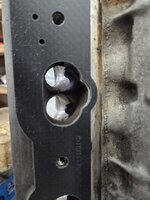
A spare 95 head:
1000010947.jpg


A 94 intake manifold:
1000010948.jpg
 
The plan had been to get the engine back together with all the new cams this weekend, but I got distracted. I spotted another cheap parts car I decided I needed.

1000010952.jpg

It was 350 miles away, but it was only $200. It's a 2006 C230. Why would I want a C230? Because stick shift.

1000010953.jpg

I already have one 6 speed that I plan to swap into the 400E. If that works out well I'll probably manual swap my SL too. I'll part out the rest of this car and scrap it soon.

If anyone needs W203 parts let me know.

My trailer took some damage on the way back when I hit a rock in the road, so I lost of bunch of time today fixing it.

1000010951.jpg

I did eventually get back to work getting the engine back together with the new cams. I ran out of time before it was done, but it should be ready to run tomorrow.
 
Oops. I made a mistake. I got the engine back together today and tried to start it. No luck. Does not want to run. It took me a bit to realize my mistake.

When I modified the intake cams to use as exhaust cams I completely forgot that I also needed to reclock the distributor rotor bracket as well. So my ignition timing is not even close.

I've been thinking about how I indexed and drilled the cams as well. I'm confident it would work, but I thought of a way to do it more accurately. I probably have them accurate within 1 or 2 degrees, but I think I can get it to a fraction of a degree. I may grab another set of cams out of my stock and try an alternate method.

A big part of my motivation for these projects is learning new skills and strategies for solving complex problems. I think I can do better, but I have to try it to actually learn it. This time I'll make sure the ignition timing gets adjusted as well.
 
After some experimentation and careful measuring, I decided the best way to get everything aligned was to index off the cam lobes and then start from scratch.

First, I had to eliminate all the holes in the cam flange so I would be able to drill new holes. One of the biggest challenges was the fact that there are 7 holes in each flange, 5 of which need to be relocated in order to get everything aligned correctly.

In some cases the new holes I needed to drill would have intersected existing holes, so step one was plugging the original holes. To do that I threaded M7 bolts into the 3 original bolt holes, then I drilled and tapped the other 4 holes to the nearest common size bolt and threaded bolts in each of those. I secured all 7 bolts with red Loctite, and then took the cams to the lathe and machined the flanges smooth.


Side note. These engines use M7 x 1.0 fasteners in a few places. M7 is an odd size. They're not commonly stocked by most hardware suppliers and tend to be far more expensive than similar M6 or M8 fasteners. I ended up using some extra factory cam cap bolts to fill the sprocket bolt holes. When it came time to tap the sprocket bolt holes, I combed through my inventory of hundreds of thread taps and came up with only one M7 tap. Fortunately it was in good shape, but I'll order a couple more. I also ordered up a box of M7 bolts to add to my inventory in case something like this comes up in the future.

In this first picture you can see where I'd experimented with one bolt in one hole. I was happy with that result, and decided to proceed with the other 6.

1000010969.jpg

Once the thread locker was cured, I cut the bolts off with an angle grinder, and then chucked the cams in the lathe to turn everything smooth.

1000010970.jpg

It might not look smooth and flat in the picture above, but it is. The threads of the bolts will have a valley where the minor diameter meets the flange face. The apparent "step" in the face is around 0.002" deep where I faced the flange smooth. Not enough to cause any issues.


With that done I installed an original exhaust cam into a cylinder head that was bolted down to my milling machine table. I installed a lightweight spring and a lifter in one bore, with an extended dial indicator measuring the lift on the #1 cam lobe. I secured a degree wheel to the end of the cam, and then used the dial indicator and degree wheel to find the exact position of maximum lift, and then I clamped the cam in that position.

I then used a pin that was the exact diameter of the aligning pin hole mounted in a right angle head on my mill to adjust the position of my mill table to align perfectly with the cam alignment pin hole.

With that in position, I locked the mill down and swapped the original exhaust cam out for the new, modified intake cam that will replace it. I used the degree wheel and the dial indicator to again find the position of maximum lift, and clamped the cam down. Now, since the milling head was already in the exact correct position for the alignment pin hole, I just drilled the hole.

I then proceeded to do the same thing for each subsequent feature on the flange. I had knocked the small dowel pin out of the cams at the start, and I simply reinstalled the dowel in the new location and secured it with green sleeve retaining compound. The whole process took a few hours, but when it was done I had an intake cam that had all the correct holes necessary to bolt a standard exhaust timing sprocket on with no modifications. Because the distributor rotor indexes off the exhaust sprocket, the ignition timing is now also going to be correct.

1000010971.jpg

I have one cam finished, and the other just needs the new holes drilled. I will hopefully have that done today. I expect to have the cams in the motor tomorrow and with any luck the engine will run.
 
I had never heard of M7 threads until I took my M119 apart and needed some items.

I use a supplier for work that claims to sell over 500,000 different components and they don't offer M7 fixings of any description!!
 
I had never heard of M7 threads until I took my M119 apart and needed some items.

I use a supplier for work that claims to sell over 500,000 different components and they don't offer M7 fixings of any description!!
Yeah, they're out there, but they're uncommon for sure. Mercedes likes to use odd fasteners. The flex plate bolts on the M119 are another kind of odd one. M12x1.5. Most M12 bolts have a 1.75mm thread pitch. I bought a bag of 10 bolts for the flywheel adapter I'm making for my manual trans swap, and it cost me $80.

All part of the fun with these cars I guess.
 
Yeah, they're out there, but they're uncommon for sure. Mercedes likes to use odd fasteners. The flex plate bolts on the M119 are another kind of odd one. M12x1.5. Most M12 bolts have a 1.75mm thread pitch. I bought a bag of 10 bolts for the flywheel adapter I'm making for my manual trans swap, and it cost me $80.

All part of the fun with these cars I guess.
Worth knowing, thanks!!
 
Hmmm. I was doing some reading and just stumbled across the fact that the 97 E420 used a transmission with a detachable bellhousing. I wonder how useful that would be for my planned 6 speed manual swap. Maybe I should go harvest one from the junk yard.
It's true, I happen to have one of those bell housings. Been hanging onto it for years with the intention of doing a manual swap someday. Every year it gets more possible to do somewhat affordably with online CNC services becoming more common. Or there's always the Kangaroos Team option too.
 
Any USA model year 1996-1999 M119 will have the 722.6 behind it, although there aren't a lot of those in the junkyard either.
 
Any USA model year 1996-1999 M119 will have the 722.6 behind it, although there aren't a lot of those in the junkyard either.
Yeah, I figured that would be the case. True that there aren't a ton around. The only one I have access to right now is this W210 E420. I did go fetch it.

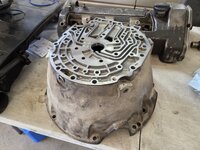
Now that I have it in my possession, I don't know if I'd really call this a "bellhousing" exactly. It's really more of the front half of the transmission case. The reason I say that is that the pump and front clutch assembly are all attached to it. They can be removed, but the base of this case half is really an internal structural part of the transmission.

I don't know that this is really any more useful as the foundation of a manual transmission swap than a 722.3 trans case. Either way I think they'd have to be cut and then have a flange welded to it to mount up the manual trans.

No regrets though. It still could be very helpful for mock up and for finding the center when building the adapter.

1000010979.jpg
 
Last edited:
I'm back working on my cam swap. I wanted to get some measurements so I could quantify exactly how much change the cams are giving me. Interestingly, it seems the 119.960 cams and the 1992 119.970/972/974 may effectively be the same.

The lift and duration on the intake cams are the same. The intake cams in the 960 are 5 degrees advanced compared to the 1992 cams, but otherwise they appear to be the same.

I don't have the 92 exhaust cams handy. They're currently still inside the 92 119.970 engine. I do know the 960 exhaust cams have the same timing and duration as the 1992 exhaust cams.

Swapping the 92 intake cams into the 95 engine gives me 1 degree more duration and half a millimeter of lift over the stock 95 intake cams. Timing is 2.5 degrees advanced with the 92 intake cams compared to the 95 cams.

Swapping 95 intake cams in place of the 95 exhaust cams will give me 10 degrees more duration on the exhaust and half a millimeter of additional lift. I'm setting the timing to be the same as stock, so no change there.

I'd like to get some measurements from some other cams to fill in some unknowns. Total lift numbers on my 92 119.975 4.2 engine, and then lift on my 92 119.970 engine will cover most of the bases. I still won't have numbers on 93-up 4.2 engines, but who cares about that?

It is interesting that the 960 cams appear to be essentially the same as the 92 5.0 LH cams. In theory I could install those as exhaust cams and go from half a millimeter of lift gained to a full millimeter of lift gained.
 
Great work! I have the lift data for all most of the M119 cams, if you need any of that info.

I don't have any duration or timing info, beyond what's printed in the FSM though.
 
Great work! I have the lift data for all the M119 cams, if you need any of that info.

I don't have any duration or timing info, beyond what's printed in the FSM though.
Yes please! Some additional lift data would help fill in some gaps in my knowledge.

I'm already considering taking a pair of 119.960 intake cams and installing them in the exhaust side. The duration would be about the same as the 93-95 cams I have in there now, but with another half millimeter of lift.
 
Back
Top