• Hi Guest !

    Welcome to the 500Eboard forum.

    Since its founding in late 2008, 500Eboard has become the leading resource on the Internet for all things related to the Mercedes-Benz 500E and E500. In recent years, we have also expanded to include the 400E and E420 models, which are directly related to the 500E/E500.

    We invite you to browse and take advantage of the information and resources here on the site. If you find helpful information, please register for full membership, and you'll find even more resources available. Feel free to ask questions, and make liberal use of the "Search" function to find answers.

    We hope you will become an active contributor to the community!

    Sincerely,
    500Eboard Management

Transmission overload protection switch ?

Mercedes only

E500E Enthusiast
Member
What is the main function of overload switch ?

I removed the switch and i have no different in the gear ( every thing normal :D ) ?
 
Re: overload switch ?

What is the main function of overload switch ?

I removed the switch and i have no different in the gear ( every thing normal :D ) ?

That's not surprising, as that switch actually has no function the vast majority of the time. The switch function becomes significant during full throttle up shifts and down shifts into second gear.

To limit the load applied to the number one transmission band and provide smoothness, the ignition control unit applies a deep but brief timing retard during extremely high load 1-2 up shifts and 3-2 downshifts. This results in an engine torque reduction that results in a faster and smoother shift into second gear, along with less thermal and mechanical load on the number one brake band. This timing retard is applied just as the ignition control unit "senses" the RPM change as the shift commences. The timing retard is removed the instant that pressure is built up inside that switch.

Note that during these two shifts, the number one brake band is restraining the movement of the number one clutch drum. The switch responds to pressure build up in the spring-loaded retaining member of the transmission band. That build up of pressure occurs just as the rotation of the number one clutch drum ceases. In that manner, the switch signals to the ignition control unit that the shift into second gear has fully completed, and in response to that signal, the ignition control unit releases the timing retard.

Contrary to some peoples imaginings, eliminating the switch from the circuit does not result in a performance gain during those shifts. Note that the switch does not produce the timing retard, it only limits the period of the timing retard. The ignition controller ALWAYS provides the timing retard during those shift points if they occur at an extremely high load (essentially, full throttle). Without the change in state of the switch being available as a signal, the ignition control unit simply applies an extremely long period of timing retard lasting well past any possible time required for the mechanical shift event to take place. Note also that jumping the switch to "lie" to the control unit produces the same effect. The logic of the control unit recognizes implausible states and reacts accordingly, again with a long duration timing retard...
:klink:
 
Re: overload switch ?

If I told you I had harsh downshifting into 2nd, but 2-3 seems fine.

M

The most common cause of harsh 1-2 upshifts is excessive clearance on brake band number one. The next most common cause, though exceedingly rare is a broken band two timing accumulator spring in the valve body, and or previous tampering with the valve body...
 
Re: overload switch ?

If the switch is disconnected or not working properly, the full-throttle shifts are affected (delay / hang). There is no change at part throttle, but the WOT shifts will not be correct until you fix it. The switch is cheap and easy to replace, if it's defective, just change it.

Anyone who doesn't believe me - go unplug the switch and then do a bunch of WOT runs, pay attention to how the upshift occurs. Now reconnect the switch and repeat. Trust me, the switch MUST be functioning for optimal performance.

:mushroom1:


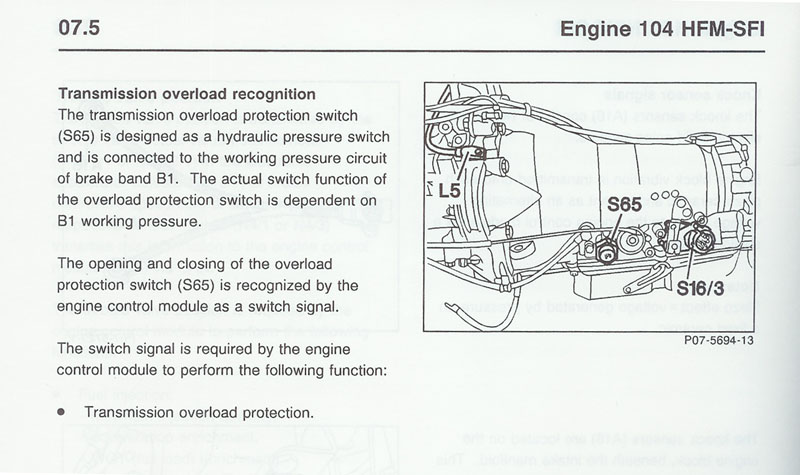
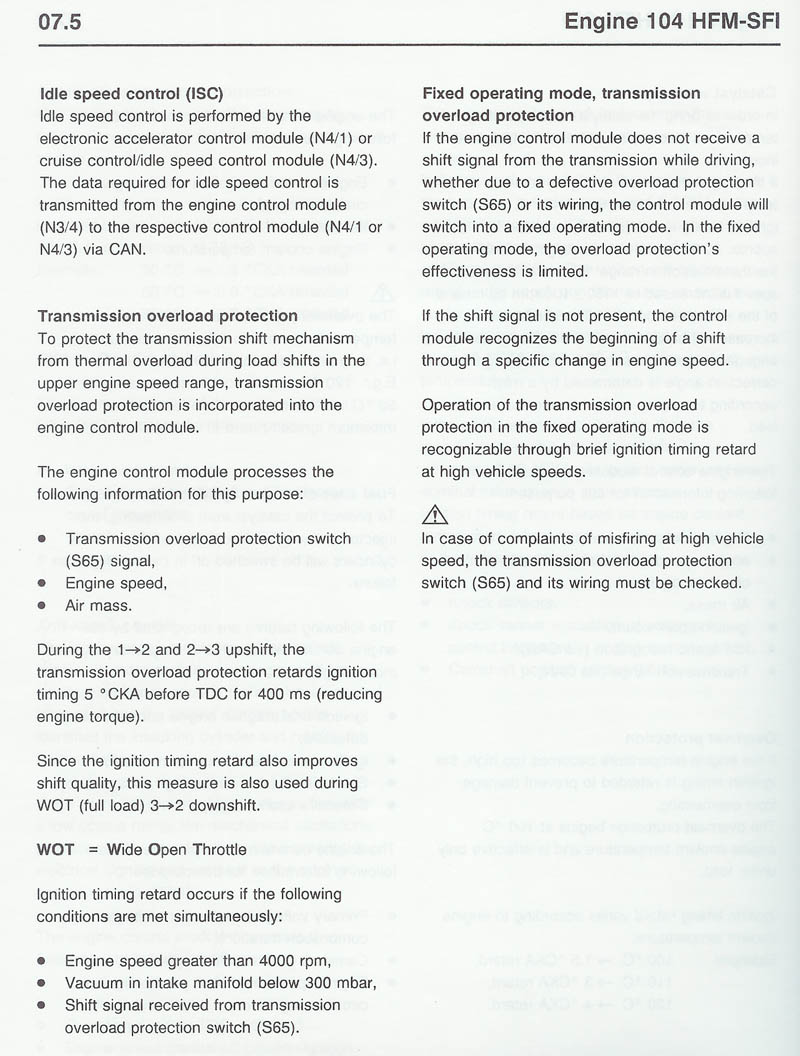
M104 FSM shown below, M119 is essentially the same:
proxy.php


proxy.php
 
Re: overload switch ?

If the switch is disconnected or not working properly, the full-throttle shifts are affected (delay / hang). There is no change at part throttle, but the WOT shifts will not be correct until you fix it. The switch is cheap and easy to replace, if it's defective, just change it.

Anyone who doesn't believe me - go unplug the switch and then do a bunch of WOT runs, pay attention to how the upshift occurs. Now reconnect the switch and repeat. Trust me, the switch MUST be functioning for optimal performance.

:mushroom1:


M104 FSM shown below, M119 is essentially the same:
proxy.php


proxy.php

Thanks Dave. Since you are usually the one that gets the heat on issues like this, I wanted to point out another "literature error". :hornets:

Interestingly enough, that particular functional description always angered me because it is incorrect. That switch is not connected to the working pressure side of the hydraulic circuit, nor even to the operating pressure side of the circuit for the B1 piston. It is hydraulically connected to the reaction valve circuit. The reaction valve is inside that spring-loaded stationary retainer for the B1 band. The nipple of that valve actually enters the reaction valve portion of the band retainer. The interesting thing about this set up is that just as the rotating drum that the band is grabbing becomes stationary, the large torque reversal produced jams the reaction valve closed, which results in the immediate buildup of pressure inside of it, forming an elegant hydraulic "signal" that the shift process has completed. That sudden pressure spike is what closes the switch. Other valves in the valve body are also diplaced by that pressure, and they then apply the full available working pressure to the band piston. This is how the valve body modulates the smoothness of the downshift process. I just threw that in there to point out yet another example of how so often there is a lot more going on than the often wildly oversimplified functional descriptions lead one to believe...
:klink:
 
Last edited:
Can somebody explain to me what is the part that is located underneath the overload protection switch? In the picture the number is 232. Is connected to the wire. In my 500E noticed that part but not in others 500E
proxy.php
 
Can somebody explain to me what is the part that is located underneath the overload protection switch? In the picture the number is 232. Is connected to the wire. In my 500E noticed that part but not in others 500E
proxy.php

Yes, but I'll have to do it later...
 
Re: overload switch ?

Thanks.
I wonder what will happen when disconnected and why it is in my 500e?
 
Can somebody explain to me what is the part that is located underneath the overload protection switch? In the picture the number is 232. Is connected to the wire. In my 500E noticed that part but not in others 500E
Your 500E transmission should look like the photo below. There should not be anything on your transmission that isn't on everyone else's 500E transmission.

EDIT: Very early build, Euro-spec 036 transmissions will have item #232. But no USA-spec car should have this.

transmission5.jpg
 
Last edited by a moderator:
My 034 is the same as the image above

I've seen that set up on early R129 500SL though
 
I've seen that set up on early R129 500SL though
Interesting. The 129.066 has a different transmission, so it could have different external components. I've never heard of any 124.036 (or .034) having the item specified in post #7...

:detective:
 
Can somebody explain to me what is the part that is located underneath the overload protection switch? In the picture the number is 232. Is connected to the wire. In my 500E noticed that part but not in others 500E
proxy.php

Kamylek, That is indeed the bracket and related piping for a cold upshift delay solenoid for rapid catalyst heating as Clark stated up above.

It has created a minor mystery here because no USA version 124.036 vehicle uses that particular arrangement. The EPC does show it as relevant for 722.365 transmissions in catalyst equipped vehicles in the ECE up to transmission end number 3559497.

If you wouldn't mind, please supply the chassis and transmission end numbers of your vehicle. If you don't want to post them, send a PM if you like that better. I'd like to look these items up with specific reference numbers. We yanks may be getting some additional education here...

Thanks!
 
Last edited:
I am currently away from home so when I get back I will give you the vin number.
May have a wiring diagram of the module to which it is connected?
 
I think since he's in Poland, his car is a very early build Euro-spec, which will have the item in question.

USA-spec cars will not have this.
 
Can somebody explain to me what is the part that is located underneath the overload protection switch? In the picture the number is 232. Is connected to the wire. In my 500E noticed that part but not in others 500E
1.gif
I have the same part in my car
 
I'm experiencing hanging/stumbling at WOT upshifts. This thread seems to indicate my overload protection switch may be bad ('95 E420).

Does anyone know the part number for that switch?
 
Additional forum resources on the topic, if needed:


Additional / supplemental HOW-TO:

 
Re: overload switch ?


That's not surprising, as that switch actually has no function the vast majority of the time. The switch function becomes significant during full throttle up shifts and down shifts into second gear.

To limit the load applied to the number one transmission band and provide smoothness, the ignition control unit applies a deep but brief timing retard during extremely high load 1-2 up shifts and 3-2 downshifts. This results in an engine torque reduction that results in a faster and smoother shift into second gear, along with less thermal and mechanical load on the number one brake band. This timing retard is applied just as the ignition control unit "senses" the RPM change as the shift commences. The timing retard is removed the instant that pressure is built up inside that switch.

Note that during these two shifts, the number one brake band is restraining the movement of the number one clutch drum. The switch responds to pressure build up in the spring-loaded retaining member of the transmission band. That build up of pressure occurs just as the rotation of the number one clutch drum ceases. In that manner, the switch signals to the ignition control unit that the shift into second gear has fully completed, and in response to that signal, the ignition control unit releases the timing retard.

Contrary to some peoples imaginings, eliminating the switch from the circuit does not result in a performance gain during those shifts. Note that the switch does not produce the timing retard, it only limits the period of the timing retard. The ignition controller ALWAYS provides the timing retard during those shift points if they occur at an extremely high load (essentially, full throttle). Without the change in state of the switch being available as a signal, the ignition control unit simply applies an extremely long period of timing retard lasting well past any possible time required for the mechanical shift event to take place. Note also that jumping the switch to "lie" to the control unit produces the same effect. The logic of the control unit recognizes implausible states and reacts accordingly, again with a long duration timing retard...
:klink:
@Klink Do you know how the EZL knows if the the shift is 1-2 or 3-2 as opposed to 3-4 or 4-3? The EZL sees the RPM change, and pulls timing until it sees second gear fully engage. Presumably it should not be doing the same when shifting into 3rd since there is no overload switch for 3rd gear, so I'm wondering how the EZL knows the shift is into 2nd, and whether it will also pull timing in 3rd. My 400E is misbehaving on 4-3 shifts and throwing an overload switch code. I've replaced the switch and verified it is indeed working in 2nd as it should. Just trying to understand the function of the overload switch a little better so I can try to solve this.
 
I thought about this before, and I may even have worked it out once and have simply forgotten, But here's what I do know along with the additional caveats I will mention as I go.

I don't know exactly how it "knows" but I know that it does. If I had more time I would research it further right now, but that's not possible for the time being.

I believe, though I'm not absolutely certain of the following:

In addition to the pressure activated switch in the number one transmission band thrust body/reaction valve which provides real time confirmation of the applied and unapplied states of the number one brake band, the EZL receives information over the chassis CAN network regarding the vehicle speed and the shift lever position. And it obviously knows the real time engine RPM because it is the control unit that calculates and broadcasts engine speed to other "interested" control units on the chassis CAN and the instrumentation. I do know that with the information it receives, it CALCULATES the actual gear that the transmission is in at any given instant. As you have already worked out, it does not receive literal and/or perfect Information regarding the actual physical status of the applied shift elements. Regarding your situation, the EZL is not likely to be having a negative influence on shifts not involving the application or release of the number one transmission band IF there are no hydraulic or mechanical faults with the B1 related components. I may return to this later, because I have some thoughts behind the "IF"

For what it's worth, the V12 cars using the 722.3 transmission do employ similar ignition retard smoothness/protection strategies on other shifts, and there is at least one additional pressure activated switch like that on B1 that supply the additional information required to facilitate the function. I don't remember right now which hydraulic pressures the additional switch or switches monitor, but I think it's the applied position of band number two via the B2 thrust body/reaction valve exactly as it's done on B1.
 
Back
Top