Ok - I finally have some time to catch this thread up a little bit.
Firstly however, I'd like to note my sincere thanks to
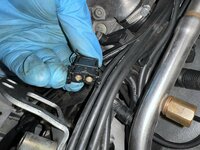
@northNH who came through with a set of caps and coil wires he had on the shelf. Many many thanks to you sir. You're a true reflection of everything that is great about this forum.
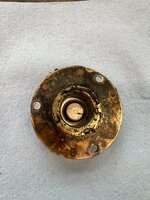
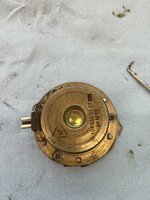
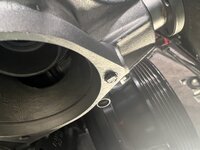
As I alluded to in my previous grouchy post, I'm currently in the middle of a job thats grown in scope pretty dramatically from where I started. Üters been down since the beginning of the year with additional mis-fire issues. As you've seen above, there is a good chance a lot of that was related to the degrading coil wire I found, but prior to its identification, I decided that it was a good time to finally repair my leaking coil magnets, which i also previously posted about. The leak hunting continued, and I pulled the smog pump and its bracket off, noting some wet-ness around some of the bolt holes in the timing case.

With the pump off, I finally was able to see what a mess the passenger side of the block actually was:


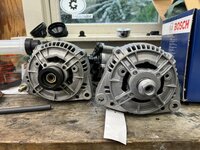
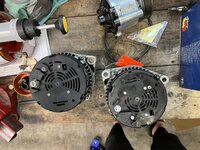
Note- at this point I had also removed the alternator, because, meh, why not?
While tediously cleaning the block, I remembered that a couple of years ago I had purchased a rebuilt MB water pump which I had never gotten around to installing. With the car somewhat apart, and craving more maneuvering room up front anyway, I went and drained the cooling system, and pulled the radiator out. Viscous fan, its bracket, and the vibration damper and pulley also came out.


The red paint mark on the damper (also a corresponding mark on the pulley) makes me think someones been in here before. The front part of the block wasn't as bad as the passenger side, but was still pretty oily.

Unclear on where all of it was originating, I booked an electronic consultation appointment with
@gsxr , and came away determined to dig even deeper and replace the crank seal.
But first, I positioned a large rubbermaid container under the front of the engine and got out the SGE and a garden hose. (Water pump was also removed by this point:

Much better:

Ordered myself up a crank lock from samstag, and the crank seal installation tool right from MB.

Also needed to get a torque wrench that could get up to 400nM. Treated myself with a Wera brand wrench, which while pricey, is a nice 'machine'

The whole crank seal process was a breeze. Marked the Belleville washers prior to disassembly so I didn't have to worry about remembering their direction.
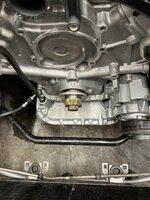
Put the crank lock tool in, and the bolt came out pretty easily with my 3/4in breaker bar and a cheater pipe.

Photo to document the depth the hub is pressed on to the crank

Used a 2 jaw puller to extract:

Top tip- get an old suspension nut you were going to toss anyway, and thread it onto your puller 'backward'. Gives the puller a nice flat spot to 'push' against:

Hub came off easy peasy.

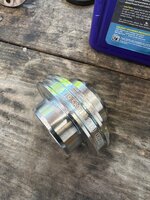
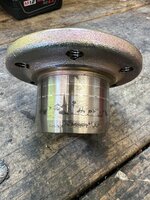
Cleaned up a little. You can see where the old seal rode:
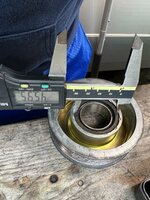
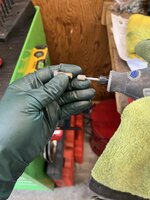
Measuring the depth of the seal before removal:

The seal appears to be in the original 'factory' position. Interestingly enough however, once I removed it it had a '120' PN, which per ISPPI seems to be a superceeded P/N.
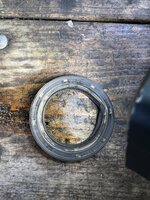
I am unclear if this is the original crank seal or not. That said, it was installed at the original factory depth (-ish). You can clearly see the wear spots on the crank hub, so I was keen to not install the new seal in the same spot.
@gsxr has a great writeup on his technique where he leaves the seal proud of the timing covers a bit in order to maximize the distance between the old wear groove and the new wear groove. In the end I simply utilized the '3mm' depth side of the installation tool. I'll leave the
@gsxr method available for the next time I need to replace the seal


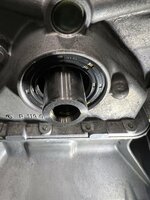
The tool makes it all quick work. Well worth it.
Check out these neat markings on the bellville washers:

Thought that was fun.
I used the toaster oven to heat up the crank hub to 50deg C. It slid onto the crank with little drama. A bit nerve wracking to make sure it had caught the woodruff key before cranking it down, but I compared the depth it was seated onto the crank prior to removal with where i was able to get it on all warmed up in order to confirm I has done it correctly.

I oiled up the bolt and washers and re-installed in their paint stripe order and torqued to 400nM. Was really quite easy!

Nice little torque stripe to finish it off.

Kinda neat to see how the washers rotate under torque.
I've got a ton more to cover, but I'm about typed out at the moment. More to come!