• Hi Guest !

    Welcome to the 500Eboard forum.

    Since its founding in late 2008, 500Eboard has become the leading resource on the Internet for all things related to the Mercedes-Benz 500E and E500. In recent years, we have also expanded to include the 400E and E420 models, which are directly related to the 500E/E500.

    We invite you to browse and take advantage of the information and resources here on the site. If you find helpful information, please register for full membership, and you'll find even more resources available. Feel free to ask questions, and make liberal use of the "Search" function to find answers.

    We hope you will become an active contributor to the community!

    Sincerely,
    500Eboard Management

OWNER a777fan (E420)

a777fan,

There is no way the guys here will let you quit, so don't even think about quitting at this point.
Not necessarily in this order, but make sure the following is working properly.

1. Crank position sensor. While it has been said that M119 crank position
sensor don't fail that frequently, there is still that chance. My C36
had the so start condition after hot and it ended up being the crank
position sensor. Granted, this may be an apple to orange comparison, but
it's worth looking into.

2. Fuel pressure. Check fuel pressure thoroughly as a fuel pressure regulator sometimes causes a crank no cause condition.

3. Revisit ignition parts. After installing a brand new set of Bosch caps,
my car ran worse than with the previously deteriorated caps. Ebay
seller took back the new defective caps and refunded my money. I found a
pair of good condition caps and rotors and my car runs fairly well. For
what it's worth, I like to have matching caps and rotors (same manf.).
Revisit the rest of the ignition parts, coils, etc. solid connections at plugs, caps and coils.
BTW, my bet is that your insulators are ok, but check for cracks etc. A car can run ok with cracks, believe it or not, but does not run well with wet insulators.

4. Throttle linkages. I haven't had a backfire issues with incorrect adjustments, but I guess anything is possible.

5. ETA. I would suspect a defective ETA with a backfire before I would blame incorrect adjustments.

6. EZL. Usually a bad EZL causes no start all the time or one dead bank
all the time. A bad vaccum line at the EZL causes a stumble not a
backfire.
 
Last edited:
Another ignition item to check, but most likely unrelated to your issue, double check to make sure that your plug wires are connected to the respective cylinder and cap (firing order).
 
A bad fuel pump relay can be intermittent and cause the same symptoms. Having a little gas or a can of starting fluid when a no start occurs is a quick way to differentiate between a fuel or electric problem.

drew
 
a777fan,

There is no way the guys here will let you quit, so don't even think about quitting at this point.
Not necessarily in this order, but make sure the following is working properly.

1. Crank position sensor. While it has been said that M119 crank position
sensor don't fail that frequently, there is still that chance. My C36
had the so start condition after hot and it ended up being the crank
position sensor. Granted, this may be an apple to orange comparison, but
it's worth looking into.

2. Fuel pressure. Check fuel pressure thoroughly as a fuel pressure regulator sometimes causes a crank no cause condition.

3. Revisit ignition parts. After installing a brand new set of Bosch caps,
my car ran worse than with the previously deteriorated caps. Ebay
seller took back the new defective caps and refunded my money. I found a
pair of good condition caps and rotors and my car runs fairly well. For
what it's worth, I like to have matching caps and rotors (same manf.).
Revisit the rest of the ignition parts, coils, etc. solid connections at plugs, caps and coils.
BTW, my bet is that your insulators are ok, but check for cracks etc. A car can run ok with cracks, believe it or not, but does not run well with wet insulators.

4. Throttle linkages. I haven't had a backfire issues with incorrect adjustments, but I guess anything is possible.

5. ETA. I would suspect a defective ETA with a backfire before I would blame incorrect adjustments.

6. EZL. Usually a bad EZL causes no start all the time or one dead bank
all the time. A bad vaccum line at the EZL causes a stumble not a
backfire.

Steve, thanks much for the rundown!

I have a fuel pressure gauge on the way so I’ll be able to check that out. I’ll be curious to hear if anyone else is running rotors that look like mine. Its a long shot, but since the new part is different, I’d like to confirm.

The ETA seems to behave normally otherwise, calibrates itself with the click clicks at startup etc. not sure why that would prevent starting when hot.

The backfires really make me think the fueling is fine, and the spark is the problem. No clue why it would work until shutdown, and then not work again.

*shrug*


Sent from my iPhone using Tapatalk
 
A bad fuel pump relay can be intermittent and cause the same symptoms. Having a little gas or a can of starting fluid when a no start occurs is a quick way to differentiate between a fuel or electric problem.

drew

Thanks drew! I’ll have that pressure gauge on the way, which should hopefully help me eliminate some possibilities.

Pretty sure I have a spare relay in my parts stash. :)


Sent from my iPhone using Tapatalk
 
I have the same rotors on both 400E and E500. Never had issues.
Very curious on what the cause of the no start will be. Sorry that i can not be of any help. Take your time
 
Imagine being 17, going to senior prom with the hottest date for Miles around. You did all the planning, rehearsing you cool over and over for weeks. Finally the day arrives, you get stuck in traffic - it starts to rain and when you finally arrive at the door, you forgot your pants.

Ok open your eyes and insert new insulators where you see the word pants.
 
The bad news is that it still doesn’t want to start when its hot. Its very very odd. It doesn’t stall. I got it up to 80 deg today where it stabilized (thanks to the new thermostat :)). Its only after I shut the car off that it doesn’t want to start again!

While it was running, I did a little poking around on the various vacuum lines. When i was fiddling with the one at the EZL, I could get the engine to stumble a little bit, which I thought was odd. It also seemed to stumble a little bit on its own here and there while it was just idling. Once it was off and wouldn’t restart, i pulled the EZL vacuum line off and tried to re-start. No change. I also cleaned up the positive battery cable and terminal, just in case the LH wasn’t getting the juice it needed once it was warm. No change.
For grins you can squirt a little starting fluid into the intake before trying to re-start, and see if it fires briefly or not. If so, it's a fuel issue. If not, that at least confirms ignition (or other electrical gremlin).


I have a blink code reader on its way, so I’ll be slightly empowered in a few days. Any other obvious tips to try in the meantime?
It isn't likely to be EZL related, as EZL's tend to fail permanently, not just act up when warm. I guess you could try shutting off at 40C and see if it restarts, if so try again at 50C etc, to see if the issue begins around a particular temperature. :?:


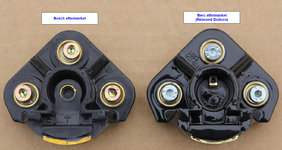
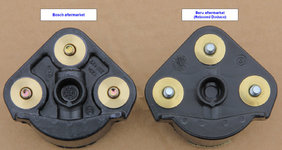
Here are the new rotors, which differ in the coil contact from the old ones...Are these correct?
Yep, they are fine. The new ones appear to be OE/OEM Doducu, which IMO are the best available. The other type is Bosch. There is a third version which is different from the first two, made by Bremi, which MB never used as a parts supplier on the 124/119.
 

Attachments

  • rotors_both1.jpg
    rotors_both1.jpg
    155 KB · Views: 20
  • rotors_both2.jpg
    rotors_both2.jpg
    125.5 KB · Views: 19
Correct me if i am wrong, but you can drive your car without pants on and a car will run without insulators, but it is not recommended to run in the rain pantless, your insulators will definitely get wet and you might get arrested.
Imagine being 17, going to senior prom with the hottest date for Miles around. You did all the planning, rehearsing you cool over and over for weeks. Finally the day arrives, you get stuck in traffic - it starts to rain and when you finally arrive at the door, you forgot your pants.

Ok open your eyes and insert new insulators where you see the word pants.
 
ewwww not the visual I wanted LOL!


But all that work and original insulator caps.....


haha. yes. not a great visual.

On the insulator caps, I guess my take was that I knew that the original caps were working as advertised prior to the clean up. I was already changing out a LOT of things while I was in there, and was keen to keep as much of it 'old parts' as possible, in order to reduce the total number of possible error contributors if something DIDN'T work right after I put all of it back together! And here we are.

Side Note; I just read through FSM 15-0020: Electronic Ignition system with variable Ignition characteristics and anti-knock control (EZL). WHAT A GREAT READ! I think most if not all my 'curious' questions regarding the EZL system were answered in there, including the fact that the B connector has no pin in spot 7!

It got me thinking about the various contributing data streams to the EZL though, does a faulty CTS result in a no start on this car? I know it can in VW/Audi land. Also... is there more than one CTS? Or does the dash show you the same signal that the LH and EZL consume?
 
A faulty crank sensor (CKP, in MB lexicon) will definitely produce a no-start. However, I think it will also cause the engine to stall / die as it heats up. At least that's what others have reported in the past with flaky CKP sensors.

Both LH and EZL share the same signal, btw... data transmitted via CAN.

:rugby:
 
A faulty crank sensor (CKP, in MB lexicon) will definitely produce a no-start. However, I think it will also cause the engine to stall / die as it heats up. At least that's what others have reported in the past with flaky CKP sensors.

Both LH and EZL share the same signal, btw... data transmitted via CAN.

:rugby:

Thx Dave!

Sorry, I meant the Coolant Temp Sensor (CTS).
 
Thx Dave! Sorry, I meant the Coolant Temp Sensor (CTS).
:jelmerian: Ah yes... there are 3 separate CTS's:

1) 4-pin, for the LH and EZL (each module uses 2 pins, and compares readings for plausibility)
2) 2-pin, for the HVAC pushbutton unit (this also triggers the auxiliary fans on high at 107°C)
3) 1-pin, for the dash gauge / instrument cluster only

All three are located at the front of the intake manifold.

:roadrunner:
 
A faulty crank sensor (CKP, in MB lexicon) will definitely produce a no-start. However, I think it will also cause the engine to stall / die as it heats up. At least that's what others have reported in the past with flaky CKP sensors.

Both LH and EZL share the same signal, btw... data transmitted via CAN.
The flaky CKP sensor in my C36 caused a no start when hot and it stalled on me once at a stop light, but it never died/stalled when I was at a good speed.
 
Last edited:
:jelmerian: Ah yes... there are 3 separate CTS's:

1) 4-pin, for the LH and EZL (each module uses 2 pins, and compares readings for plausibility)
2) 2-pin, for the HVAC pushbutton unit (this also triggers the auxiliary fans on high at 107°C)
3) 1-pin, for the dash gauge / instrument cluster only

All three are located at the front of the intake manifold.

Holy crap. Talk about over engineered! Sounds like the likelihood of a temp sensor failure causing anything bad is pretty low. Cross compared? Sheesh, thats impressive.


Sent from my iPhone using Tapatalk
 
Holy crap. Talk about over engineered! Sounds like the likelihood of a temp sensor failure causing anything bad is pretty low. Cross compared? Sheesh, thats impressive.

Yes, cross compared. One sensor connects straight to the ignition module, the other sensor connects to LH. Each module then places the temperature sensor data that it's reading on the databus so that the other control unit can see it as well. Also, if there is an implausibility to due to too much difference, not only are fault codes set for the implausibility, but each control unit will run off of the “safest” value as far as maintenance of engine function, preventing damage, and emission optimization goes. So, the fuel injection may use the higher sensor value to avoid cold over fueling, while the ignition system will use the value that suggests more conservative knock control, etc.
The LH M104, 119, 120 are by far the most “over engineered“ engine management systems that I have ever seen.
Later MB engine management systems are light years simpler, even though they may also do a number of fairly incredible things. One great example is the ignition system and knock management of the M112-113 series. Absolutely incredible, particularly in their day...
:klink:
 
Last edited:
Yes, cross compared. One sensor connect straight to the ignition module, the other sensor connects to LH. Each module than places the temperature sensor data that is reading on the databus so that the other control unit can see it as well. Also, if there is an implausibility to due to too much difference, not only are fault codes set for the implausibility, but each control unit will run off of the “safest” value as far is maintaining engine function, preventing damage, and emission optimization goes. So, the fuel injection may use the higher sensor value to avoid over fueling, while the ignition system will use the value that results in less knocking possibility, etc.
The LH M104, 119, 120 are by far the most “over engineered“ engine management systems that I have ever seen.
Later MB engine management systems are light years simpler, even though they may also do a number of fairly incredible things. One great example is the ignition system and knock management of the M112-113 series. Absolutely incredible, particularly in their day...
:klink:

I’m even more excited to get my blink code reader now. j/k

It really does seem like the weak point of this system is either the EZL itself or the ETA.

Since i had the ETA rebuilt, its starting to raise my eyebrows a bit


Sent from my iPhone using Tapatalk
 
OK. So I am not really sure what to make of today's results.

Setting the stage, I picked up where I left off on Monday night. If you remember, I had disconnected the throttle linkage from the ETA, and was in the middle of lengthening the link to ensure a proper idle speed.

The fuel pressure test kit showed up yesterday, so I first took a look at the cold (non-running) fuel pressure. Hooked the gauge up, turned the key to 'Run' and checked out the gauge. It popped right up to 3.2 bar. Turned key to 'OFF' I then let it sit for a half hour, and the pressure was still above 2.5 bar. A-OK!

Cranked the car over and started it. Looked at the gauge. A little over 3.2 bar. Pulled the vac hose off the FPR and the pressure jumped to 3.8bar. Great, right?

Here is a little vid:


I let the car continue to idle, and got it up to 80 or so degrees. Shut it down.

Let it sit a minute. Went to crank it over to see what the Fuel pressure was going to do... and the damn thing started! Not only did it start, but it started like 3 more times in a row!

Another little vid:

At this point I started pondering. This was the first time I had let the ETA adapt with the throttle linkage disconnected. Does anyone know what happens if the ETA adapts with the plate pulled off the idle stop by an incorrectly aligned linkage? This is really the only thing I can think of that might have been different than when I had the linkage all hooked up.

Excited that it wanted to now behave, I spent the rest of the afternoon trying (and then finally being successful) in extracting the long throttle linkage out from underneath the intake plenum. A screwdriver with tape, two wire hangars, and lots of cursing was the potion.

I was able to snap the throttle linkage back on, (through some sort of miracle I believe), and I confirmed I could now hear the idle switch in the ETA clicking when the linkage was released. I really wanted to go for a drive at this point. Got in, turned the key, (didn't think about letting the ETA adapt) and tried to fire it. NO DICE! Same old crank crank crank , backfire, crank crank crank etc. Thought perhaps the ETA needed to adapt again, ran through that procedure. Still a no-go. Went inside for some dinner and TV.

On my way to bed, I decided to try it again. Went out, and it fired right up. It lit it off 2 more times. Went for a drive around the block. No real issues. Although it does seem to stutter at times here and there. I keep thinking I have a vac leak somewhere.... :scratchchin:

Ideas? thoughts?
 
Last edited by a moderator:
77,

I have had a problem where my car will not start sometimes when hot.Same symptoms (crank, crank and crank and backfire but not start) Cool down it starts and is OK. Someone in the past (Guido aka Italian Benz on 500Ecstasy > MB Tech long gone from E500E scene) mentioned and fiddled with the cold start valve/sensor on my car. This part is right behind the throttle body. Klink or Dave should know what part I’m talking about.
I believe it monitors fuel pressure at start up. Anyway it might tie in with your throttle linkage that has been re-installed and may be out of spec.

In my humble opinion, you have taken apart and reassembled the whole top of the engine (and by the way, done a beautiful job!) If it started and ran before you began this project. To me at least I would be looking for something in the re- assembly process that is out of spec. You have disturbed an a lot of parts and pieces. It’s quite possible it’s some stupid little piece of crap mistake causing this current problem.

Don’t over diagnosis this issue. Look for an error in your work.

Anyway, Good or Bad that’s all I got!
 
That is all REALLY weird. The ETA has effectively no control over fuel mixture or ignition, so it's nearly impossible for the ETA to be related to a backfire, or extended cranking. There isn't a cold start valve on these cars, I think that is a CIS-E only item (Jono or Klink would know for sure). Definitely nothing on the LH system that monitors fuel pressure though. Terry is right, it's likely related to SOMETHING you may have done, but the symptoms are bizarre. The ETA adapting to the E-GAS module should be a 1-time thing, btw.

The interesting part is when you were driving, there was an occasional stutter. Maybe see if you can drive it more, and get it to act up? At this point, codes would be very helpful! Because if there are zero codes, it's looking pretty likely the root cause is somehow ignition related. (Still wouldn't hurt to squirt a small amount of starting fluid in when it won't fire, and see if that makes it fire or not... but if there was no fuel, it wouldn't backfire.)

:scratchchin:
 
a77fan,

Do you have another set of caps and rotors you could try?
Have you opened up the caps and looked to see anything suspicious?

On the occasions when you try to re-start the car and it doesn't start, does it seem like car will not have a chance in hell to start, meaning no firing of cylinders and no pops or backfiring.
If it sounds like there is not way it will start, you might want to get a CKP sensor and give that a try.
But, as GSXR states, codes would be helpful.
 
77,

I have had a problem where my car will not start sometimes when hot.Same symptoms (crank, crank and crank and backfire but not start) Cool down it starts and is OK. Someone in the past (Guido aka Italian Benz on 500Ecstasy > MB Tech long gone from E500E scene) mentioned and fiddled with the cold start valve/sensor on my car. This part is right behind the throttle body. Klink or Dave should know what part I’m talking about.
I believe it monitors fuel pressure at start up. Anyway it might tie in with your throttle linkage that has been re-installed and may be out of spec.

In my humble opinion, you have taken apart and reassembled the whole top of the engine (and by the way, done a beautiful job!) If it started and ran before you began this project. To me at least I would be looking for something in the re- assembly process that is out of spec. You have disturbed an a lot of parts and pieces. It’s quite possible it’s some stupid little piece of crap mistake causing this current problem.

Don’t over diagnosis this issue. Look for an error in your work.

Anyway, Good or Bad that’s all I got!

Thanks Terry!

I totally agree. I am 99.999999999999% sure it is something I have done during the re-assembly phase. Now its just pinpointing what exactly it is. Just need to work my way backward, slowly!
 
That is all REALLY weird. The ETA has effectively no control over fuel mixture or ignition, so it's nearly impossible for the ETA to be related to a backfire, or extended cranking. There isn't a cold start valve on these cars, I think that is a CIS-E only item (Jono or Klink would know for sure). Definitely nothing on the LH system that monitors fuel pressure though. Terry is right, it's likely related to SOMETHING you may have done, but the symptoms are bizarre. The ETA adapting to the E-GAS module should be a 1-time thing, btw.

The interesting part is when you were driving, there was an occasional stutter. Maybe see if you can drive it more, and get it to act up? At this point, codes would be very helpful! Because if there are zero codes, it's looking pretty likely the root cause is somehow ignition related. (Still wouldn't hurt to squirt a small amount of starting fluid in when it won't fire, and see if that makes it fire or not... but if there was no fuel, it wouldn't backfire.)

:scratchchin:


Interesting, so the ETA doesn't adapt to the LH, it adapts to the E-GAS/TTL-R? I'll have to go get some starting fluid to test that out, but your backfire comment is right on the money I think. It wouldn't backfire if it didn't have fuel. So I think it's got to be something shutting down the spark.

Side rant: My code blinker showed up yesterday, but some jerk seems to have stolen it right out of my mailbox! Still fuming on that one. :pissed:
 
a77fan,

Do you have another set of caps and rotors you could try?
Have you opened up the caps and looked to see anything suspicious?

On the occasions when you try to re-start the car and it doesn't start, does it seem like car will not have a chance in hell to start, meaning no firing of cylinders and no pops or backfiring.
If it sounds like there is not way it will start, you might want to get a CKP sensor and give that a try.
But, as GSXR states, codes would be helpful.


I have one old rotor that I can re-install. The other old one has a stripped captive allen bolt. I don't have any other caps, but they were operating well prior to this issue popping up. I did pull the caps on Monday night to make sure nothing was amiss in there, and that's when I snapped the photos of the rotor I added to post I made on Monday asking if they were correct. Everything looked A-OK on both sides.
 
Did you test the fuel pressure when it DIDN'T start? My earlier post was to show that fuel pumps sometimes intermittently act up on their way to permanent failure. I think your pressure test rules out the fuel pressure regulator. That is, when the pump works the FPR holds pressure. But I wonder what reading you’re getting when it doesn’t start. If you still have pressure then, as opposed to just residual fuel in the line, then like GSXR I would suspect ignition.

maw
 
Interesting, so the ETA doesn't adapt to the LH, it adapts to the E-GAS/TTL-R?
Correct. The ETA is controlled by E-GAS on ASR cars, and T/LLR on non-ASR cars. Totally separate from the LH module, which only controls fuel injection... and EZL only controls ignition. The next generation of Bosch engine management (ME 1.0) wrapped all three of these into a single computer, used on the 1996-1999 M119.98x engines.


I have one old rotor that I can re-install. The other old one has a stripped captive allen bolt. I don't have any other caps, but they were operating well prior to this issue popping up. I did pull the caps on Monday night to make sure nothing was amiss in there, and that's when I snapped the photos of the rotor I added to post I made on Monday asking if they were correct. Everything looked A-OK on both sides.
Your new OE rotors (and new insulators) are most likely fine... and while your old caps aren't automatically suspect because they are old, I do wonder if something fishy is going on there. Did you post any photos of the inside of your old caps? I scrolled through most of the thread and didn't see any, but I might have missed 'em...

:wormhole:
 
CIS-based systems DO have a separate cold-start valve (injector) on the front/top of the engine. LH systems DO NOT have a cold-start valve.

It sounds to me as if you have a vacuum leak. I had same with my M117, and it ended up being one of the donut rings between the top and bottom half of the intake manifold. I had not quite installed it right, and it was bent and had a slight leak. You can check it toward the end of my M117 top-end rebuild thread. It's an identical donut part between the M117 and M119, and the design of the manifold (in terms of how they fit together - not the airflow design itself) is nearly identical as well. A vacuum leak between the halves will cause a higher idle and other running issues.

See the post here: https://www.500eboard.com/forums/showthread.php?t=564&p=2537&viewfull=1#post2537

And this post with photos: https://www.500eboard.com/forums/showthread.php?t=564&p=2555&viewfull=1#post2555

The manifold o-ring bend (which allowed the leak) was on the INSIDE of the manifold halves when put together, so I didn't see it when I reassembled things despite a pretty thorough visual check at that time.

A smoke test should divulge pretty quickly as to whether there any vacuum issues.

Cheers,
Gerry
 
Did you test the fuel pressure when it DIDN'T start? My earlier post was to show that fuel pumps sometimes intermittently act up on their way to permanent failure. I think your pressure test rules out the fuel pressure regulator. That is, when the pump works the FPR holds pressure. But I wonder what reading you’re getting when it doesn’t start. If you still have pressure then, as opposed to just residual fuel in the line, then like GSXR I would suspect ignition.

maw

Indeed maw... I am kicking myself for not doing this simple check when it failed to start. You are absolutely correct that fuel cannot be ruled out until I show adequate pressure on a no-start condition.

If past performance is any indication, I'll have ample opportunity to test this out this afternoon after work! :D
 
Your new OE rotors (and new insulators) are most likely fine... and while your old caps aren't automatically suspect because they are old, I do wonder if something fishy is going on there. Did you post any photos of the inside of your old caps? I scrolled through most of the thread and didn't see any, but I might have missed 'em...

I'll snap some tonight and post em up!
 
CIS-based systems DO have a separate cold-start valve (injector) on the front/top of the engine. LH systems DO NOT have a cold-start valve.

It sounds to me as if you have a vacuum leak. I had same with my M117, and it ended up being one of the donut rings between the top and bottom half of the intake manifold. I had not quite installed it right, and it was bent and had a slight leak. You can check it toward the end of my M117 top-end rebuild thread. It's an identical donut part between the M117 and M119, and the design of the manifold (in terms of how they fit together - not the airflow design itself) is nearly identical as well. A vacuum leak between the halves will cause a higher idle and other running issues.

See the post here: https://www.500eboard.com/forums/showthread.php?t=564&p=2537&viewfull=1#post2537

And this post with photos: https://www.500eboard.com/forums/showthread.php?t=564&p=2555&viewfull=1#post2555

The manifold o-ring bend (which allowed the leak) was on the INSIDE of the manifold halves when put together, so I didn't see it when I reassembled things despite a pretty thorough visual check at that time.

A smoke test should divulge pretty quickly as to whether there any vacuum issues.

Cheers,
Gerry

Thx Gerry! I have been wondering the same thing about the donuts. I'll have to gin up a smoke machine to confirm a yes or no on the vacuum leaks.
 
That is all REALLY weird. The ETA has effectively no control over fuel mixture or ignition, so it's nearly impossible for the ETA to be related to a backfire, or extended cranking. There isn't a cold start valve on these cars, I think that is a CIS-E only item (Jono or Klink would know for sure). Definitely nothing on the LH system that monitors fuel pressure though. Terry is right, it's likely related to SOMETHING you may have done, but the symptoms are bizarre. The ETA adapting to the E-GAS module should be a 1-time thing, btw.

The interesting part is when you were driving, there was an occasional stutter. Maybe see if you can drive it more, and get it to act up? At this point, codes would be very helpful! Because if there are zero codes, it's looking pretty likely the root cause is somehow ignition related. (Still wouldn't hurt to squirt a small amount of starting fluid in when it won't fire, and see if that makes it fire or not... but if there was no fuel, it wouldn't backfire.)

:scratchchin:

Dave/77

My car has been in the garage over a year. I take it out a couple of times a month and let it run in the driveway.

About two months ago I started and let it run until up to temperature and shut it down. A few minutes later it wouldn’t start crank and backfire. I left it for an hour or so and it started right up and went back in the garage.?

It has something to do with the warm up. It has happened on quite a few occasions. When it re-starts everything is good to go and I can drive it anywhere. 77 appears to be having the same or a similar issue. Something in the warm up cycle is not operating properly. Like maybe the butterfly is not closing on the TB. Kinda like a carburetor choke if it’s not in the right position you will never start the motor!
 
Dave/77, My car has been in the garage over a year. I take it out a couple of times a month and let it run in the driveway.
Terry, I don't want to derail this thread, but in general it's not a good idea to let the car run in the driveway. The coolant gets up to temp, but nothing else ever does. It's better to leave the car parked for 6-12 months with a battery maintainer connected, and only fire it up when you are able to drive it 20+ minutes at near freeway speeds. This gets everthing up to temperature.


About two months ago I started and let it run until up to temperature and shut it down. A few minutes later it wouldn’t start crank and backfire. I left it for an hour or so and it started right up and went back in the garage.? It has something to do with the warm up. It has happened on quite a few occasions.
THIS sounds a lot like the "fluid on back of the insulators" syndrome. Have you replaced the insulators? If so, pull one or both and see if the back side is bone dry or not. I don't think this is what Jon is dealing with on his car, since everything is spic-n-span clean, and he has new edit: used, clean, dry insulators.

:scratchchin: :detective:
 
I don't think this is what Jon is dealing with on his car, since everything is spic-n-span clean, and he has new insulators.

:scratchchin: :detective:


Just one correction here Dave, I am using the original insulators. They were installed clean and dry less than 5-6 start cycles ago, however.
 
I was storing my car and running it in the driveway as you described above and had the exact same symptom's. Replaced the insulators and problem solved. Agree with GSXR these engines like to run hard, hot and often or not at all.
 
Just one correction here Dave, I am using the original insulators. They were installed clean and dry less than 5-6 start cycles ago, however.
:jelmerian:

You did state that, more than once. I blame senility and Louie's pants post. :p

Clean & dry should be fine, although now I'm curious what the back side of the insulators look like, in case you didn't take a photo? Did they look like new, or did they have chicken pox / measles appearance?
 
:jelmerian:

You did state that, more than once. I blame senility and Louie's pants post. :p

Clean & dry should be fine, although now I'm curious what the back side of the insulators look like, in case you didn't take a photo? Did they look like new, or did they have chicken pox / measles appearance?


I'll take em out this afternoon and snap some detailed photos.
 
I don’t think that GSXR should get a Jelmerian Award for that oversight.

Keep us posted, Triple Trouble.

Cheers from the Thames & Westminster Bridge, London,
Gerry

proxy.php
 
Terry, I don't want to derail this thread, but in general it's not a good idea to let the car run in the driveway. The coolant gets up to temp, but nothing else ever does. It's better to leave the car parked for 6-12 months with a battery maintainer connected, and only fire it up when you are able to drive it 20+ minutes at near freeway speeds. This gets everthing up to temperature.

THIS sounds a lot like the "fluid on back of the insulators" syndrome. Have you replaced the insulators? If so, pull one or both and see if the back side is bone dry or not. I don't think this is what Jon is dealing with on his car, since everything is spic-n-span clean, and he has new edit: used, clean, dry insulators.

I’ll make a note. I only run engine about 15 minuets. Not overheating anything. Long time since dist caps have been off. I’ll be checking everything out real soon and be on the road this summer.
 
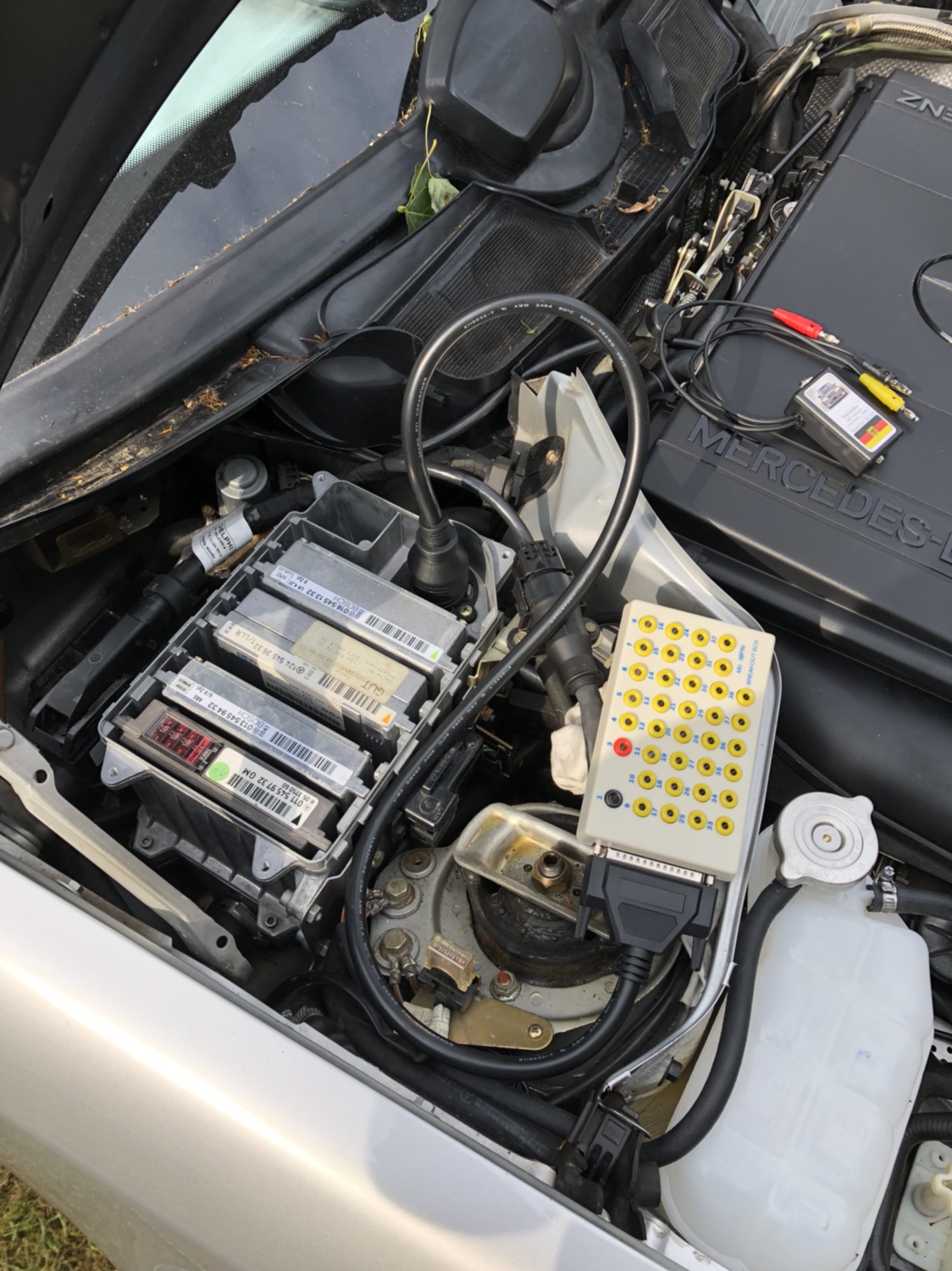
I'm very happy to report that Uter and I had a very productive evening together. First, I read off the codes! Here is what was there. Who knows how long they've been sitting in there

proxy.php


[TABLE="class: grid, width: 500, align: left"] [TR] [TD]Pin
[/TD] [TD]Pin Description
[/TD] [TD]Code
[/TD] [TD]Description
[/TD] [/TR] [TR] [TD]4
[/TD] [TD]LH Module
[/TD] [TD]4
[/TD] [TD]Voltage at hot wire MAF sensor (B2/2) insufficient or too high, or open circuit in ground wire at hot wire MAF sensor

[/TD] [/TR] [TR] [TD]6
[/TD] [TD]ABS
[/TD] [TD]25
[/TD] [TD]Left front axle vehicle speed sensor (L6/1), implausible signal
[/TD] [/TR] [TR] [TD]6
[/TD] [TD]ABS
[/TD] [TD]26
[/TD] [TD]Right front axle vehicle speed sensor (L6/2), implausible signal
[/TD] [/TR] [TR] [TD]7
[/TD] [TD]Idle Speed Control
[/TD] [TD]5
[/TD] [TD]Stop Lamp Switch (S9/1)
[/TD] [/TR] [TR] [TD]7
[/TD] [TD]Idle Speed Control
[/TD] [TD]6
[/TD] [TD]Not valid for USA Vehicles (?)
[/TD] [/TR] [TR] [TD]7
[/TD] [TD]Idle Speed Control
[/TD] [TD]11
[/TD] [TD]Fuel Safety shut-off signal to LH-SFI control module (N3/1) Closed throttle recognition signal to LH-SFI control module (N3/1)
[/TD] [/TR] [TR] [TD]8
[/TD] [TD]Base Module
[/TD] [TD]12
[/TD] [TD]Base Module (N16/1) voltage supply output fuse F1, open circuit
[/TD] [/TR] [TR] [TD]17
[/TD] [TD]EZL
[/TD] [TD]17
[/TD] [TD]CKP Sensor (L5) defective
[/TD] [/TR] [TR] [TD]17
[/TD] [TD]EZL
[/TD] [TD]18
[/TD] [TD]Magnets for CKP Sensor (L5) not recognized
[/TD] [/TR] [/TABLE] .


I got excited about the EZL ones, but then realized I had 'Klinked' my first startup by unplugging the CKP from the EZL to build oil pressure first. This is likely where these codes originated, since according to the documentation they are stored immediately. Since I don't know how old any of these are, I have no clue how pertinent they may be. I am curious what Pin 7, Code 11 is trying to tell me. What is the Fuel Safety shutoff for??

I cleared all the codes and then fired it up. It started just fine. I then used my mittivac to check the Air Intake plenum vacuum. It was pulling about -18 in Hg at idle. Does anyone know what the spec is for this? I figured comparing this number would be one way of looking for a vac leak.

I did notice something I found really interesting. I have been playing around with the air box off quite a bit. I had no idea how sensitive the engine was to disturbances in the air mass right above the MAF intake. You don't need to put your hand over the intake to get the engine to stumble. Waving your hand above the intake does it too!

I let it warm up while I looked up the codes I had just collected. It seemed to idle just fine. Warms up great too with the new Thermostat. Typically sits just a tick above 80 C. [emoji3]

proxy.php


After figuring out what the codes were. I shut it down, and checked the codes again. Nothing had popped up. I re-installed the cooling shroud, air intake ducts etc. In prep for a drive.

I hit the road! Drove great. No issues to report. Came back to the house, fiddled a bit with the Bowden adjustment and hit the road again. Again, no issues to report!

Seems to drive fine. Anyone ever heard about 'breaking in' new rotors? Cause thats about the only thing thats changed on the car since Sunday...:scratchchin:
 
What grade motor oil do you run? And was the Oil pressure sender ever replaced? The Oil pressure looks quite low to me just also verify that it gets at least 3 bar by 1500rpm that is a minimum spec even if it reads quite low at idle. It looks about 0.35 - 0.4 Bar at idle I would think that is maybe a tad low
 

Who has viewed this thread (Total: 6) View details

Who has watched this thread (Total: 5) View details

Back
Top